
Sunday, October 25 — Religious but Not Righteous
Micah had everything that looked like faith: a shrine, sacred clothing, household gods, even his own priest. What he didn't have was a God he was willing to obey.
Judges 17:1-6 — KJV
1 And there was a man of mount Ephraim, whose name was Micah. 2 And he said unto his mother, The eleven hundred shekels of silver that were taken from thee, about which thou cursedst, and spakest of also in mine ears, behold, the silver is with me; I took it. And his mother said, Blessed be thou of the LORD, my son. 3 And when he had restored the eleven hundred shekels of silver to his mother, his mother said, I had wholly dedicated the silver unto the LORD from my hand for my son, to make a graven image and a molten image: now therefore I will restore it unto thee. 4 Yet he restored the money unto his mother; and his mother took two hundred shekels of silver, and gave them to the founder, who made thereof a graven image and a molten image: and they were in the house of Micah. 5 And the man Micah had an house of gods, and made an ephod, and teraphim, and consecrated one of his sons, who became his priest. 6 In those days there was no king in Israel, but every man did that which was right in his own eyes.
Judges 17:1-6 — WEB
1 There was a man of the hill country of Ephraim, whose name was Micah. 2 He said to his mother, “The eleven hundred pieces of silver that were taken from you, about which you uttered a curse, and also spoke it in my ears—behold, the silver is with me. I took it.” His mother said, “May Yahweh bless my son!” 3 He restored the eleven hundred pieces of silver to his mother, then his mother said, “I most certainly dedicate the silver to Yahweh from my hand for my son, to make a carved image and a molten image. Now therefore I will restore it to you.” 4 When he restored the money to his mother, his mother took two hundred pieces of silver, and gave them to a silversmith, who made a carved image and a molten image out of it. It was in the house of Micah. 5 The man Micah had a house of gods, and he made an ephod, and teraphim, and consecrated one of his sons, who became his priest. 6 In those days there was no king in Israel. Everyone did that which was right in his own eyes.
Explanation
The last chapters of Judges don't follow a judge or a deliverer at all. They zoom in on ordinary households to show what Israel had become. Early in the book we were told that a generation grew up that didn't know the LORD or the works He had done. By chapter 17, the forgetting is complete. God hadn't forgotten His works. His people had.
Micah's story is almost darkly funny. He steals eleven hundred pieces of silver from his own mother. She doesn't know who did it, so she curses the thief out loud. Micah, now afraid of the curse, confesses and gives it back. His mother immediately switches from cursing to blessing: "May the LORD bless my son!" Then she announces she's dedicating the silver "to the LORD" by having an idol made. And of the eleven hundred pieces she dedicated, she gives two hundred to the silversmith. Even the dedication is partial.
Every piece of this is wrong, and every piece is dressed in religious language. The LORD's name is used to bless a thief and to fund a carved image, the very thing Exodus 20 forbade on Monday. Micah sets up a "house of gods," makes an ephod, a priestly garment, gathers household idols, and ordains his own son as priest, though God had appointed priests from Aaron's family alone. It's a do-it-yourself religion: God's vocabulary, Micah's rules.
Then comes the verse that explains the whole book: "In those days there was no king in Israel. Everyone did that which was right in his own eyes." The problem wasn't just missing leadership. It was a missing moral compass. When nobody looks to God as King, everybody becomes their own.
That's the trap of being religious but not righteous. It's easy to keep the outward things, the church clothes, the Bible app, the right words at the right time, while quietly deciding for ourselves what God would approve of. Micah's household would have told you they loved the LORD. They just wanted Him on their terms.
Look back over the week. Monday: no other gods. Tuesday: one God, one Lord, and knowledge that must serve love. Wednesday: Jesus refusing every shortcut and worshiping God alone. Thursday: the idol with nothing inside. Friday: the God who does not forget us and calls us home. Saturday: no one can serve two masters. Today, Micah shows us what life looks like when all of that is forgotten.
But the title of today's lesson is still good news. God's works are not forgotten by God. The same God who brought Israel out of Egypt, who blotted out sin like a cloud, who promised to rebuild the ruins, is still calling. We don't have to build our own shrine. We can come back to the real King.
Thought for the Day
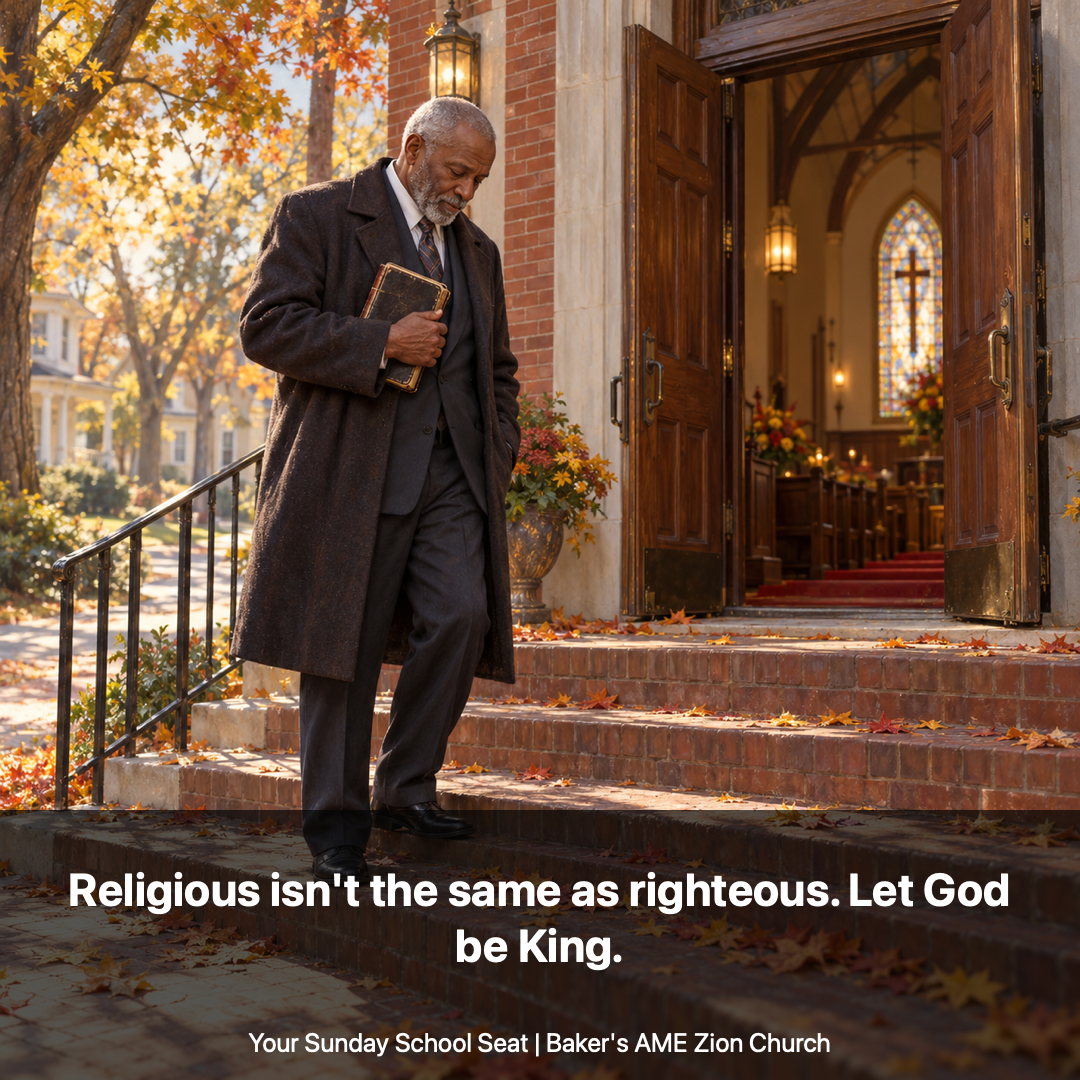
Religious isn't the same as righteous. Let God be King.
Reflection Question
Where have you been doing "what is right in your own eyes" while still using God's name over it?
Prayer
Lord, we confess that it's easy to keep the look of faith while making our own rules. Search our homes and our hearts for anything we've set up in Your place. Be our King again, not just in name but in obedience. Thank You that You have not forgotten Your works, and You have not forgotten us.
Today is Sunday school. We saved you a seat.