

A daily walk through Scripture, preparing our hearts for Sunday.
Tuesday, October 20 — Right Isn't the Same as Loving
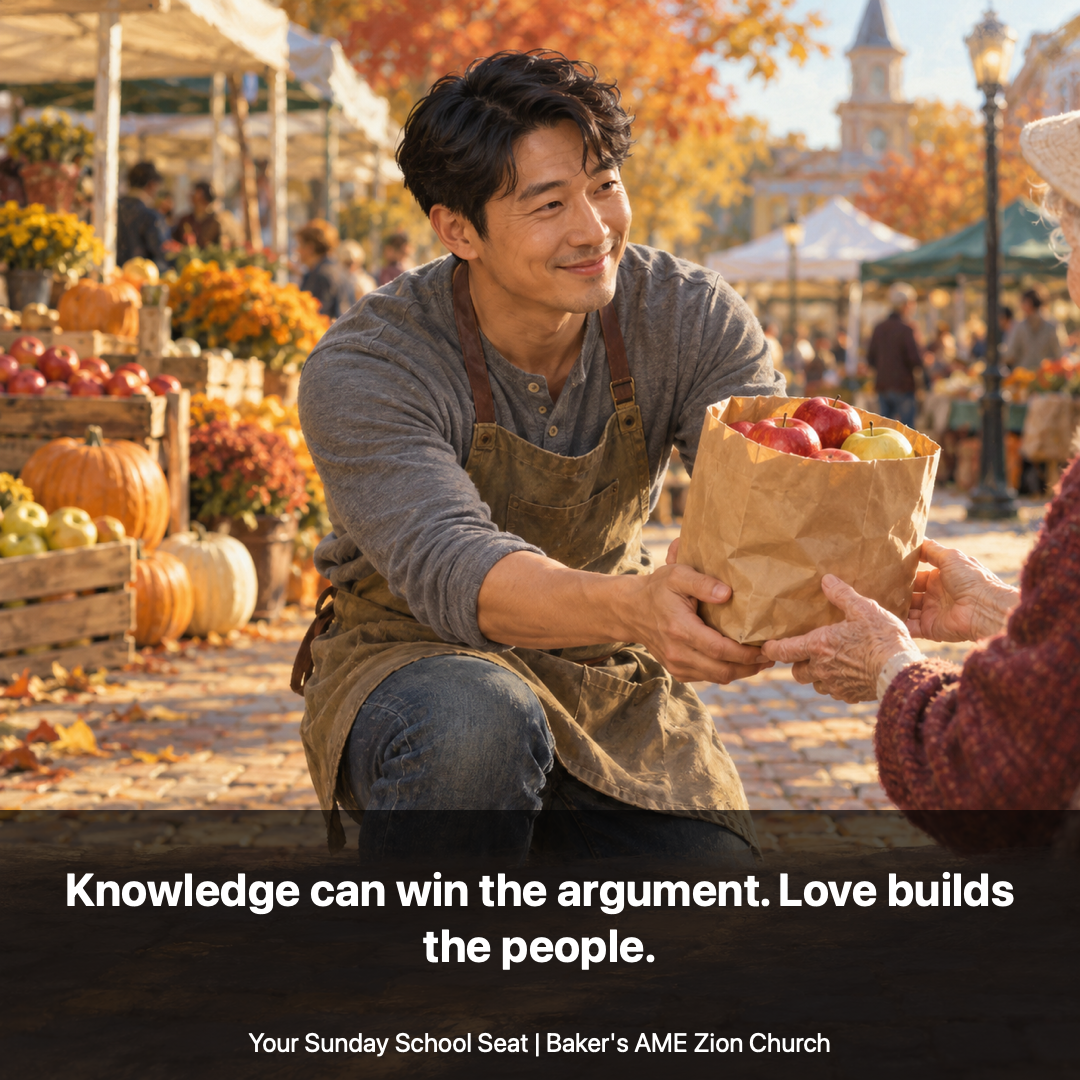
We all know someone who wins every argument and somehow loses every room. Sometimes, if we're honest, that someone is us.
1 Corinthians 8:1-6 — KJV
1 Now as touching things offered unto idols, we know that we all have knowledge. Knowledge puffeth up, but charity edifieth. 2 And if any man think that he knoweth any thing, he knoweth nothing yet as he ought to know. 3 But if any man love God, the same is known of him. 4 As concerning therefore the eating of those things that are offered in sacrifice unto idols, we know that an idol is nothing in the world, and that there is none other God but one. 5 For though there be that are called gods, whether in heaven or in earth, (as there be gods many, and lords many,) 6 But to us there is but one God, the Father, of whom are all things, and we in him; and one Lord Jesus Christ, by whom are all things, and we by him.
1 Corinthians 8:1-6 — WEB
1 Now concerning things sacrificed to idols: We know that we all have knowledge. Knowledge puffs up, but love builds up. 2 But if anyone thinks that he knows anything, he doesn’t yet know as he ought to know. 3 But if anyone loves God, the same is known by him. 4 Therefore concerning the eating of things sacrificed to idols, we know that no idol is anything in the world, and that there is no other God but one. 5 For though there are things that are called “gods”, whether in the heavens or on earth; as there are many “gods” and many “lords”; 6 yet to us there is one God, the Father, of whom are all things, and we for him; and one Lord, Jesus Christ, through whom are all things, and we live through him.
Explanation
Corinth was a busy port city crowded with temples. Much of the meat sold in the public market had first been offered to one god or another, and many social gatherings, from business dinners to family celebrations, happened in or near those temples. The young church wrote to Paul with a practical question: can a Christian eat that meat?
Some believers in Corinth had a ready answer. "We know idols aren't real, so the meat is just meat." Paul actually agrees with their theology. An idol is nothing. There is only one God. But before he says any of that, he puts a warning sign at the door: "Knowledge puffs up, but love builds up." Being correct is not the same as being mature. You can be right about God and still be wrong in how you treat God's people.
Verse 3 turns the whole conversation around. The person who loves God is "known by Him." Faith is not mainly about what we know; it is about being known. That is humbling for people who like to have the answers, and it is a relief for people who feel like they never do.
Then in verse 6 Paul gives the church something like an early creed. It echoes the old prayer every Jewish child learned, "Hear, O Israel, the LORD our God is one LORD," and it places Jesus right inside it. One God, the Father, from whom all things come and for whom we live. One Lord, Jesus Christ, through whom all things exist and through whom we live. Everything comes from God, and everything is for God. There is nowhere left for a rival to stand.
Yesterday we heard "no other gods." Today we learn that the "many gods and many lords" competing for attention are real pressures but not real gods. They have pull, but no power to save. That's the same tension we'll see Sunday in Judges, where people kept God's name on their lips while building shrines in their homes. Religious language is easy. A life fully given to one Lord is something else.
Think about the places where knowledge puffs up in our lives: the group text where you're quick to correct, the Bible study where you need to have the last word, the family dinner where you're technically right and everyone leaves hurt. Paul isn't asking us to stop thinking. He's asking us to let love decide what we do with what we know. A church full of people who know everything and build up no one has missed the point.
One God means every part of life belongs to Him, including how we win and lose arguments.
Thought for the Day
Knowledge can win the argument. Love builds the people.
Reflection Question
Where in your life right now are you more focused on being right than on building someone up?
Prayer
Father, You are the one God from whom all things come, and Jesus is the one Lord through whom we live. Forgive us when our knowledge makes us proud instead of kind. Teach us to use what we know to build up the people around us. Thank You that, before we knew You, You knew us.
This week we walk toward Sunday's lesson: God's Works Are Not Forgotten.
Monday, October 19 — Whatever Gets Your First Yes
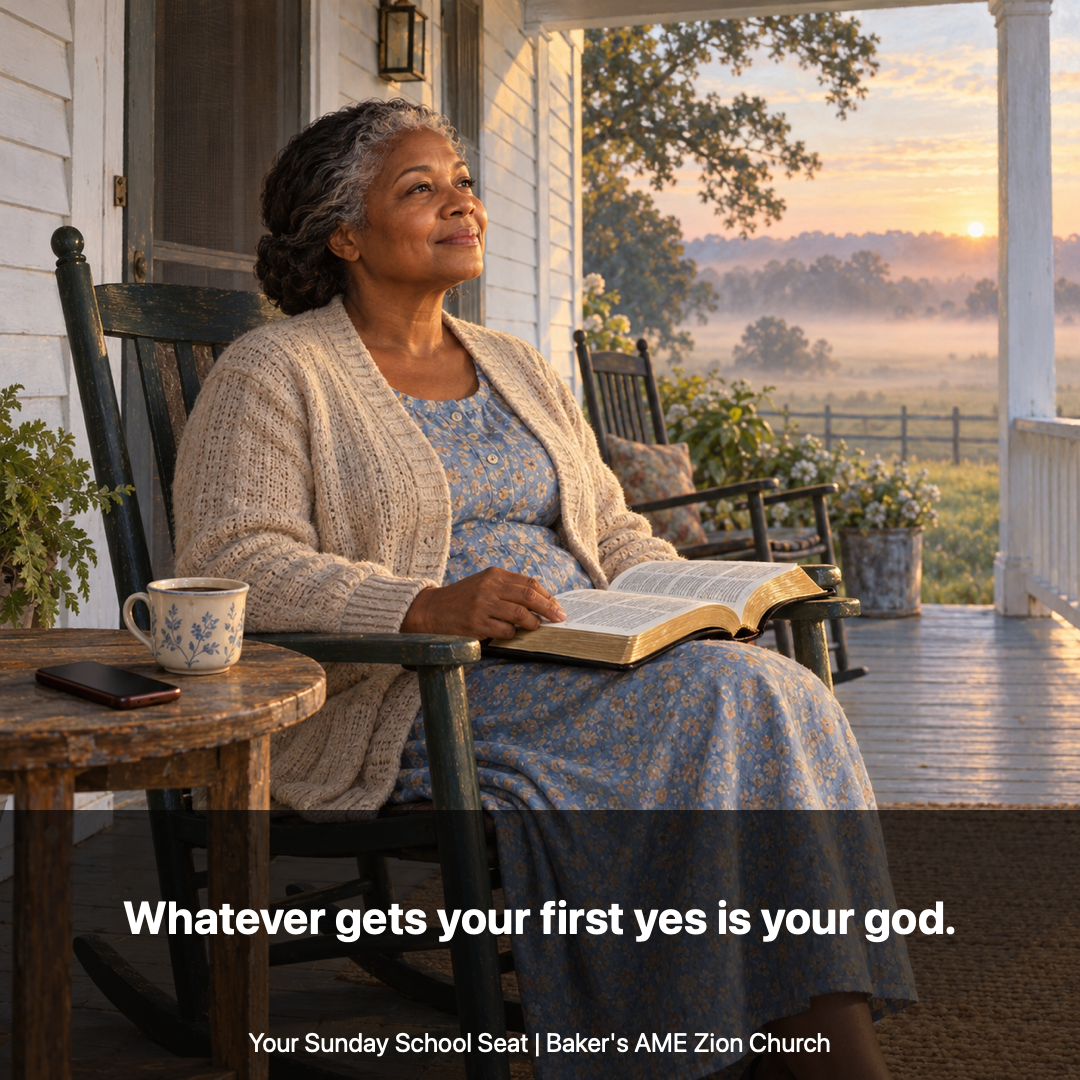
Before your feet hit the floor this morning, something reached for your attention first. Maybe it was the phone on the nightstand, a worry about money, or a to-do list already running in your head.
Exodus 20:1-7 — KJV
1 And God spake all these words, saying, 2 I am the LORD thy God, which have brought thee out of the land of Egypt, out of the house of bondage. 3 Thou shalt have no other gods before me. 4 Thou shalt not make unto thee any graven image, or any likeness of any thing that is in heaven above, or that is in the earth beneath, or that is in the water under the earth: 5 Thou shalt not bow down thyself to them, nor serve them: for I the LORD thy God am a jealous God, visiting the iniquity of the fathers upon the children unto the third and fourth generation of them that hate me; 6 And shewing mercy unto thousands of them that love me, and keep my commandments. 7 Thou shalt not take the name of the LORD thy God in vain; for the LORD will not hold him guiltless that taketh his name in vain.
Exodus 20:1-7 — WEB
1 God spoke all these words, saying, 2 “I am Yahweh your God, who brought you out of the land of Egypt, out of the house of bondage. 3 “You shall have no other gods before me. 4 “You shall not make for yourselves an idol, nor any image of anything that is in the heavens above, or that is in the earth beneath, or that is in the water under the earth: 5 you shall not bow yourself down to them, nor serve them, for I, Yahweh your God, am a jealous God, visiting the iniquity of the fathers on the children, on the third and on the fourth generation of those who hate me, 6 and showing loving kindness to thousands of those who love me and keep my commandments. 7 “You shall not misuse the name of Yahweh your God, for Yahweh will not hold him guiltless who misuses his name.
Explanation
Israel is camped at the foot of Mount Sinai, only weeks removed from the brick kilns of Egypt. They still have the calluses. Before God gives a single command, He tells them who He is and what He has already done: "I brought you out of the house of bondage." That order matters. The Ten Commandments are not a test you pass to get free. They are the house rules for people who have already been set free. Grace comes first; instruction follows.
The first command is simple and total: no other gods before me. "Before me" means in my presence, alongside me, in front of me. God is not asking to be ranked first on a list of priorities. He is saying there is no list. Then comes the ban on carved images, because people have always wanted a god they can see, carry, and manage. A god you make is a god you control. The living God refuses to be shrunk down to a size that fits on a shelf.
"Jealous" can sound petty to modern ears, but think of it the way a faithful spouse would. A husband who doesn't care whether his wife is seeing someone else doesn't love her more; he loves her less. God's jealousy is covenant love that will not share. And notice the math in verses 5 and 6. Patterns of rebellion ripple for three or four generations, and any of us who grew up around a family's unspoken habits know that's true. But mercy runs to thousands. Grace outlasts the damage.
Verse 7 is about more than cussing. To take God's name "in vain" is to carry it emptily, to stamp God's name on something God never blessed. That will matter by Sunday, when we meet a mother who "dedicated" silver to the LORD and then had an idol made out of it. This whole week walks toward that lesson: God's Works Are Not Forgotten, a story of people who were very religious but not righteous. It starts here, with the question underneath every other question: who actually gets first place?
So here is the honest test. What gets your first yes? What do you check before you pray? What do you fear losing most? What do you spend money on without thinking, and what do you skip without guilt? An idol in 2026 rarely looks like a golden calf. It looks like a paycheck, a reputation, a relationship, a screen. None of those things are evil. They just make terrible gods.
Thought for the Day
Whatever gets your first yes is your god.
Reflection Question
What is the first thing that claims your attention each morning, and what would change if God got that first moment instead?
Prayer
Lord, You brought us out before You ever asked anything of us. Forgive us for the quiet ways we've let other things take Your place. Show us what we've been bowing to without noticing. Today, we give You our first yes.
This week we walk toward Sunday's lesson: God's Works Are Not Forgotten.
October 19-25, 2026 - God’s Works Are Not Forgotten
This week we walk through seven readings that ask one honest question: who really sits on the throne of our lives? From the first commandment at Sinai, to Jesus refusing every shortcut in the wilderness, to Isaiah's carpenter bowing to a block of wood, to God's tender promise that His people are not forgotten, we see how easy it is to keep God's name while serving something else. It all builds to Sunday's lesson, "God's Works Are Not Forgotten: Religious but Not Righteous," the story of Micah's homemade shrine in a time when everyone did what was right in their own eyes. Watch, walk through the week with us, and join us for Sunday school.
Monday — No Other Gods but the Lord (Exodus 20:1-7)
Tuesday — One God and One Lord (1 Corinthians 8:1-6)
Wednesday — Worship God Alone (Matthew 4:1-11)
Thursday — There's Nothing There! (Isaiah 44:9-20)
Friday — Return to the Lord (Isaiah 44:21-28)
Saturday — No One Can Serve Two Masters (Luke 16:13-17)
Sunday — The People Cast Off Restraint (Judges 17:1-6)
Your Sunday School Seat | Baker's AME Zion Church — We Saved You a Seat
#YourSundaySchoolSeat #AMEZion #DailyDevotional #Faith #BlackChurch #Judges
Sunday, October 18 — A Hero Who's Not a Hero
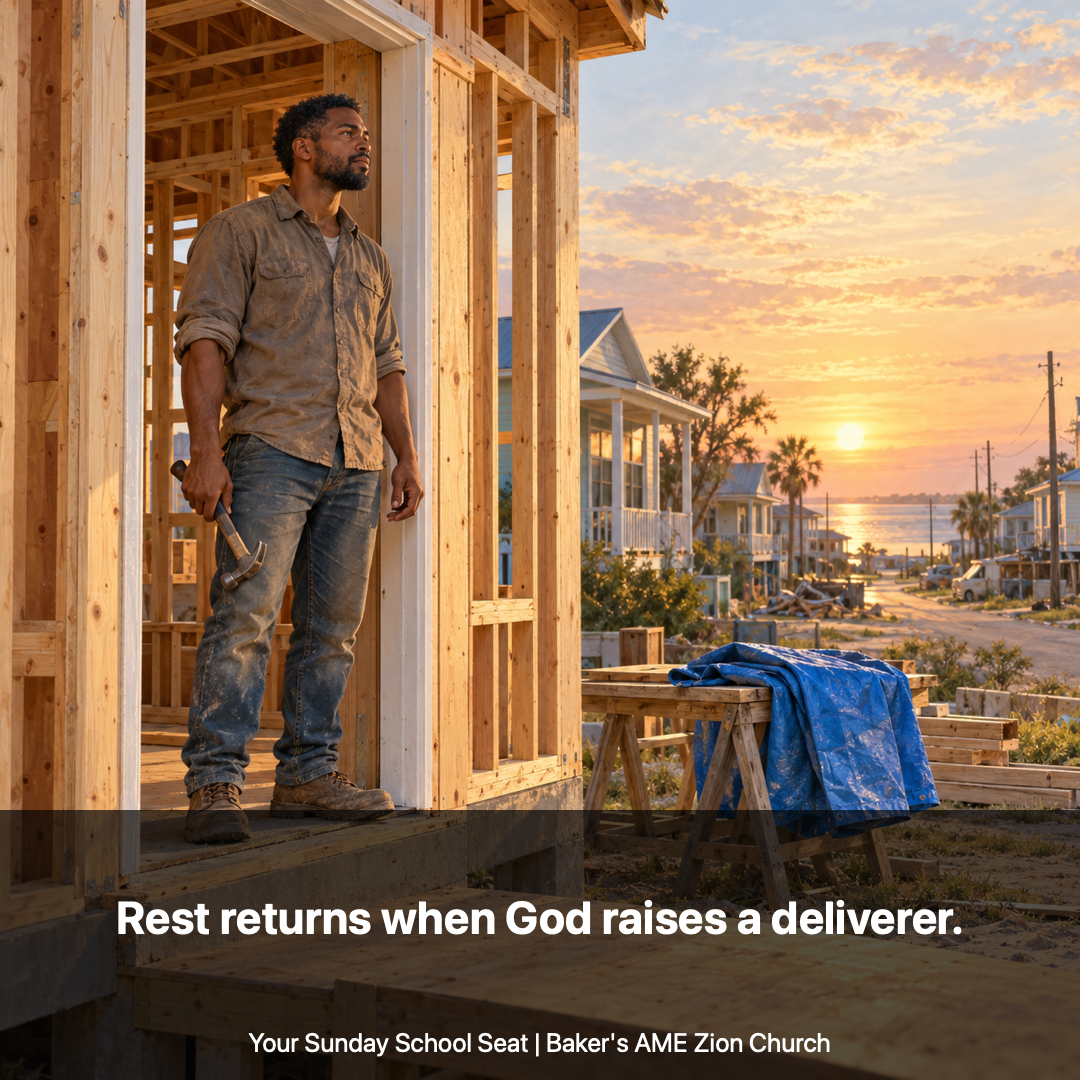
Eighteen years is a long time to wait for a rescue. And the one who finally shows up is not who anyone expected.
Judges 3:15-23, 30 — KJV
15 But when the children of Israel cried unto the LORD, the LORD raised them up a deliverer, Ehud the son of Gera, a Benjamite, a man lefthanded: and by him the children of Israel sent a present unto Eglon the king of Moab. 16 But Ehud made him a dagger which had two edges, of a cubit length; and he did gird it under his raiment upon his right thigh. 17 And he brought the present unto Eglon king of Moab: and Eglon was a very fat man. 18 And when he had made an end to offer the present, he sent away the people that bare the present. 19 But he himself turned again from the quarries that were by Gilgal, and said, I have a secret errand unto thee, O king: who said, Keep silence. And all that stood by him went out from him. 20 And Ehud came unto him; and he was sitting in a summer parlour, which he had for himself alone. And Ehud said, I have a message from God unto thee. And he arose out of his seat. 21 And Ehud put forth his left hand, and took the dagger from his right thigh, and thrust it into his belly: 22 And the haft also went in after the blade; and the fat closed upon the blade, so that he could not draw the dagger out of his belly; and the dirt came out. 23 Then Ehud went forth through the porch, and shut the doors of the parlour upon him, and locked them. 30 So Moab was subdued that day under the hand of Israel. And the land had rest fourscore years.
Judges 3:15-23, 30 — WEB
15 But when the children of Israel cried to Yahweh, Yahweh raised up a savior for them: Ehud the son of Gera, the Benjamite, a left-handed man. The children of Israel sent tribute by him to Eglon the king of Moab. 16 Ehud made himself a sword which had two edges, a cubit in length; and he wore it under his clothing on his right thigh. 17 He offered the tribute to Eglon king of Moab. Now Eglon was a very fat man. 18 When Ehud had finished offering the tribute, he sent away the people who carried the tribute. 19 But he himself turned back from the stone idols that were by Gilgal, and said, “I have a secret message for you, O king.” The king said, “Keep silence!” All who stood by him left him. 20 Ehud came to him; and he was sitting by himself alone in the cool upper room. Ehud said, “I have a message from God to you.” He arose out of his seat. 21 Ehud put out his left hand, and took the sword from his right thigh, and thrust it into his body. 22 The handle also went in after the blade; and the fat closed on the blade, for he didn't draw the sword out of his body; and it came out behind. 23 Then Ehud went out onto the porch, and shut the doors of the upper room on him, and locked them. 30 So Moab was subdued that day under the hand of Israel. Then the land had rest eighty years.
Explanation
When Israel finally cries out in verse 15, God raises up a deliverer: Ehud, son of Gera, a left-handed Benjamite. The name of his tribe means "son of the right hand," so the writer is winking at us with a left-handed son of the right hand. The story is told in earthy, almost darkly comic detail, and ancient listeners likely enjoyed watching a bloated tyrant get brought down. Ehud is chosen to carry Israel's tribute to Eglon, the payment the people had been forced to make. He hides a short double-edged blade on his right thigh, where a guard checking a right-handed man wouldn't think to look. He asks for a private audience, says he has "a message from God," and kills the king in his private room. Then he locks the doors behind him and slips away. The verses we skip afterward tell of Israel rallying and defeating Moab, and verse 30 gives us the result: "the land had rest fourscore years."
The unit topic is "A Hero Who's Not a Hero," and the text invites that tension. Notice what the narrator does and doesn't say. The LORD "raised them up a deliverer," so the rescue is God's doing. But unlike Othniel in verse 10, nothing here says the Spirit of the LORD came upon Ehud, and nowhere does the narrator applaud his methods. He deceives, he uses "a message from God" as a cover, and he kills a man in a private meeting. The writer reports what happened without holding it up as a pattern to copy. God works through flawed instruments. That does not mean everything the instrument does becomes a blueprint.
This is where the whole week lands. Philippians gave us courage, Matthew gave us light, the psalmist gave us longing, Hebrews gave us rest and the promise that God remembers our work, and Judges 3 gave us the story of a people who let their light go dim. Now the cry goes up, God answers, and the land has rest. The Hebrews writer would remind us that this rest is a signpost. The deeper deliverer is Jesus, a hero who actually is one, the great high priest who sympathizes with us and invites us to the throne of grace.
So what do we take from a hero who isn't a hero? First, hope. You don't need a perfect leader, or to be one, for God to move. God has worked through unlikely people throughout history, in ways nobody scripted. Second, humility. When God uses you, it isn't proof that you were right about everything. And third, discernment. We thank God for the rescue, but we follow Jesus' way, not Ehud's dagger. Rest returns when God raises a deliverer, and the best Deliverer is already here.
Thought for the Day
Rest returns when God raises a deliverer.
Reflection Question
Where do you need God to work through an unlikely person, and might that person be you?
Prayer
God of deliverance, thank You for hearing the cries of Your people, then and now. Thank You for working through imperfect people, including us. Keep us humble when You use us, and keep our eyes on Jesus, the true Deliverer. Restore rest to our homes, our neighborhoods, and our hearts. We trust You to finish what You start.
Today is Sunday school. We saved you a seat.
Saturday, October 17 — The Test of Comfort

Most of us expect the test to come in a crisis. This one starts at a comfortable kitchen table.
Judges 3:1-7, 12-14 — KJV
1 Now these are the nations which the LORD left, to prove Israel by them, even as many as had not known all the wars of Canaan; 2 Only that the generations of the children of Israel might know, to teach them war, at the least such as before knew nothing thereof; 3 Namely, five lords of the Philistines, and all the Canaanites, and the Sidonians, and the Hivites that dwelt in mount Lebanon, from mount Baal-hermon unto the entering in of Hamath. 4 And they were to prove Israel by them, to know whether they would hearken unto the commandments of the LORD, which he commanded their fathers by the hand of Moses. 5 And the children of Israel dwelt among the Canaanites, Hittites, and Amorites, and Perizzites, and Hivites, and Jebusites: 6 And they took their daughters to be their wives, and gave their daughters to their sons, and served their gods. 7 And the children of Israel did evil in the sight of the LORD, and forgat the LORD their God, and served Baalim and the groves. 12 And the children of Israel did evil again in the sight of the LORD: and the LORD strengthened Eglon the king of Moab against Israel, because they had done evil in the sight of the LORD. 13 And he gathered unto him the children of Ammon and Amalek, and went and smote Israel, and possessed the city of palm trees. 14 So the children of Israel served Eglon the king of Moab eighteen years.
Judges 3:1-7, 12-14 — WEB
1 Now these are the nations which Yahweh left, to test Israel by them, even as many as had not known all the wars of Canaan; 2 only that the generations of the children of Israel might know, to teach them war, at least such as before knew nothing of it: 3 namely, the five lords of the Philistines, all the Canaanites, the Sidonians, and the Hivites who lived on Mount Lebanon, from Mount Baal Hermon to the entrance of Hamath. 4 They were left to test Israel by them, to know whether they would listen to the commandments of Yahweh, which he commanded their fathers by Moses. 5 The children of Israel lived among the Canaanites, the Hittites, the Amorites, the Perizzites, the Hivites, and the Jebusites. 6 They took their daughters to be their wives, and gave their own daughters to their sons, and served their gods. 7 The children of Israel did that which was evil in Yahweh's sight, and forgot Yahweh their God, and served the Baals and the Asheroth. 12 The children of Israel again did that which was evil in Yahweh's sight: and Yahweh strengthened Eglon the king of Moab against Israel, because they had done that which was evil in Yahweh's sight. 13 He gathered the children of Ammon and Amalek to himself; and he went and struck Israel, and they possessed the city of the palm trees. 14 The children of Israel served Eglon the king of Moab eighteen years.
Explanation
The book of Judges covers the rough stretch between Joshua's death and the first kings, and it runs on a cycle you can almost set your watch by: Israel does evil, a foreign power oppresses them, they cry out, God raises up a deliverer, the land has rest, and then they forget again. Our unit title names the problem plainly: lacking leadership and a moral compass. Chapter 3 opens with an explanation. God left certain nations in the land "to prove Israel," to see whether the people would listen to the commands He gave through Moses. Our reading skips verses 8 through 11, where the first judge, Othniel, brings forty years of rest, and jumps to the next round: a king named Eglon, strengthened by the LORD, takes the city of palm trees and rules Israel for eighteen years.
Look at how the failure actually happens. The test wasn't an invasion. It was living next door to people who worshiped differently. And the problem was never that Israel had neighbors. Verse 6 puts its finger on worship: "and served their gods." They weren't conquered. They were absorbed, one casual step at a time. They dwelt among them, they joined their families, they adopted their gods. And verse 7 has the saddest line: they "forgat the LORD their God." The text doesn't say they hated Him. They forgot. Then verse 12 says that when they did evil again, the LORD strengthened Eglon. Their own choices had consequences, and God let those consequences become the alarm clock.
Tomorrow's reading picks up when the people finally cry out. This one is the "why." It shows how rest was lost in the first place, so that Sunday's restoration means something. Remember Tuesday's salt that lost its flavor? Here is what that looks like across a whole generation.
It's worth asking where drift is happening in our own lives. It rarely announces itself. A skipped prayer becomes a skipped Sunday, which becomes a quiet shrug. And notice that comfort is a test too. Abundance tests us as surely as hardship does. Instead of asking who your Eglon is, try asking what has been ruling you for a while: a habit, a debt, a resentment, a screen. Then cry out sooner than eighteen years.
Thought for the Day
Comfort tests us too. Stay awake, stay faithful.
Reflection Question
What small thing in your life has been slowly drifting, and what would it take to bring it back?
Prayer
Lord, we confess that we forget You most easily when life is comfortable. Wake us up before the drift becomes bondage. Show us what has been quietly ruling our hearts, and give us the humility to cry out early. Remind us that Your commands were always meant to protect us. Bring us home to You.
This week we walk toward Sunday's lesson: God Works Through Ehud.
Friday, October 16 — God Keeps Good Records
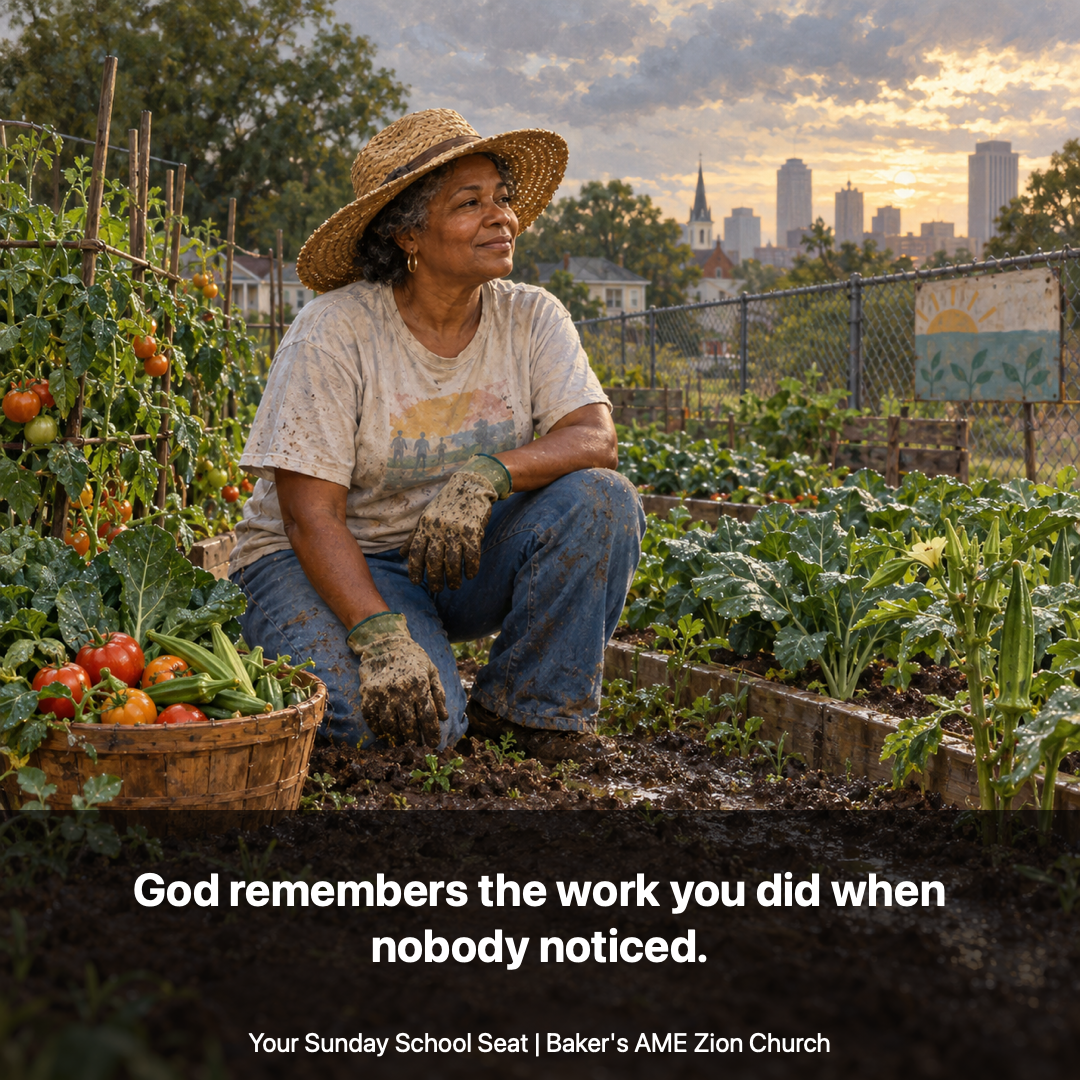
Somewhere right now, someone is doing good work that no one will ever thank them for. This passage is for them.
Hebrews 6:1-12 — KJV
1 Therefore leaving the principles of the doctrine of Christ, let us go on unto perfection; not laying again the foundation of repentance from dead works, and of faith toward God, 2 Of the doctrine of baptisms, and of laying on of hands, and of resurrection of the dead, and of eternal judgment. 3 And this will we do, if God permit. 4 For it is impossible for those who were once enlightened, and have tasted of the heavenly gift, and were made partakers of the Holy Ghost, 5 And have tasted the good word of God, and the powers of the world to come, 6 If they shall fall away, to renew them again unto repentance; seeing they crucify to themselves the Son of God afresh, and put him to an open shame. 7 For the earth which drinketh in the rain that cometh oft upon it, and bringeth forth herbs meet for them by whom it is dressed, receiveth blessing from God: 8 But that which beareth thorns and briers is rejected, and is nigh unto cursing; whose end is to be burned. 9 But, beloved, we are persuaded better things of you, and things that accompany salvation, though we thus speak. 10 For God is not unrighteous to forget your work and labour of love, which ye have shewed toward his name, in that ye have ministered to the saints, and do minister. 11 And we desire that every one of you do shew the same diligence to the full assurance of hope unto the end: 12 That ye be not slothful, but followers of them who through faith and patience inherit the promises.
Hebrews 6:1-12 — WEB
1 Therefore leaving the elementary teaching about the Christ, let us press on to perfection—not laying again a foundation of repentance from dead works, and of faith toward God, 2 of the teaching of baptisms, and of laying on of hands, and of resurrection of the dead, and of eternal judgment. 3 This will we do, if God permits. 4 For concerning those who were once enlightened and tasted of the heavenly gift, and were made partakers of the Holy Spirit, 5 and tasted the good word of God, and the powers of the age to come, 6 and then fell away, it is impossible to renew them again to repentance; seeing they crucify the Son of God for themselves again, and put him to open shame. 7 For the land which has drunk the rain that comes often on it, and produces a crop suitable for them for whose sake it is also tilled, receives blessing from God; 8 but if it bears thorns and thistles, it is rejected and near to being cursed, whose end is to be burned. 9 But, beloved, we are persuaded of better things for you, and things that accompany salvation, even though we speak like this. 10 For God is not unrighteous, so as to forget your work and the labor of love which you showed toward his name, in that you served the saints, and still do serve them. 11 We desire that each one of you may show the same diligence to the fullness of hope even to the end, 12 that you won't be sluggish, but imitators of those who through faith and patience inherited the promises.
Explanation
This is one of the harder passages in the New Testament, and it is worth admitting that up front. The writer of Hebrews pushes his readers past the basics toward maturity, then gives a sober warning about falling away, followed by a farm picture: land that drinks the rain and produces a crop is blessed, while land that produces only thorns is in trouble. Believers across the centuries have studied verses 4 through 6 carefully and have not agreed on every detail, so it is a good one to talk through with your pastor or your Bible study. But watch the hinge in verse 9: "But, beloved, we are persuaded better things of you." The writer is a pastor, not a prosecutor. He has just spoken sternly because he is sure of something better.
And here is what he is sure of: "God is not unrighteous to forget your work and labour of love, which ye have shewed toward his name, in that ye have ministered to the saints, and do minister." Look at what is remembered. Not sermons or titles. Work and labor of love, ordinary service to other believers, and the present tense matters: "and do minister." The people he is writing to were worn down, and he tells them God keeps good books. Then he gives two instructions. Show the same diligence all the way to the end, and don't become sluggish, but imitate those who inherit the promises "through faith and patience." Patience, not speed.
Sunday's lesson begins with a people who cried out to God for years under a heavy king. Waiting, in the Bible, is rarely passive. "God will not overlook your work" is the other side of "God hears the cry." Both say the same thing: God is paying attention. And notice the picture of land drinking rain. The word "land" is right there in Sunday's title, "Restoring Rest to the Land." Land that receives the rain bears fruit, and God notices what is growing.
Think about the person who has cooked for every repast for twenty years. The one who drives elders to their appointments. The parent who keeps showing up. The coworker who did the right thing when no one was looking and got no credit. You may never receive a thank-you, and this verse is the thank-you. It is also a nudge: weariness can make us sluggish, and the instruction is to keep going to the end of the row. Where has tiredness started to talk you out of something good?
Thought for the Day
God remembers the work you did when nobody noticed.
Reflection Question
What faithful work have you done that nobody seems to notice, and can you trust that God does?
Prayer
Faithful God, thank You that You do not forget a single act of love done in Your name. We bring You the work that has gone unseen and the tiredness that comes with it. Keep us from becoming sluggish, and give us patience for the long road. Let us follow those who inherit the promises through faith, one faithful day at a time.
This week we walk toward Sunday's lesson: God Works Through Ehud.
Thursday, October 15 — The Hard Work of Resting
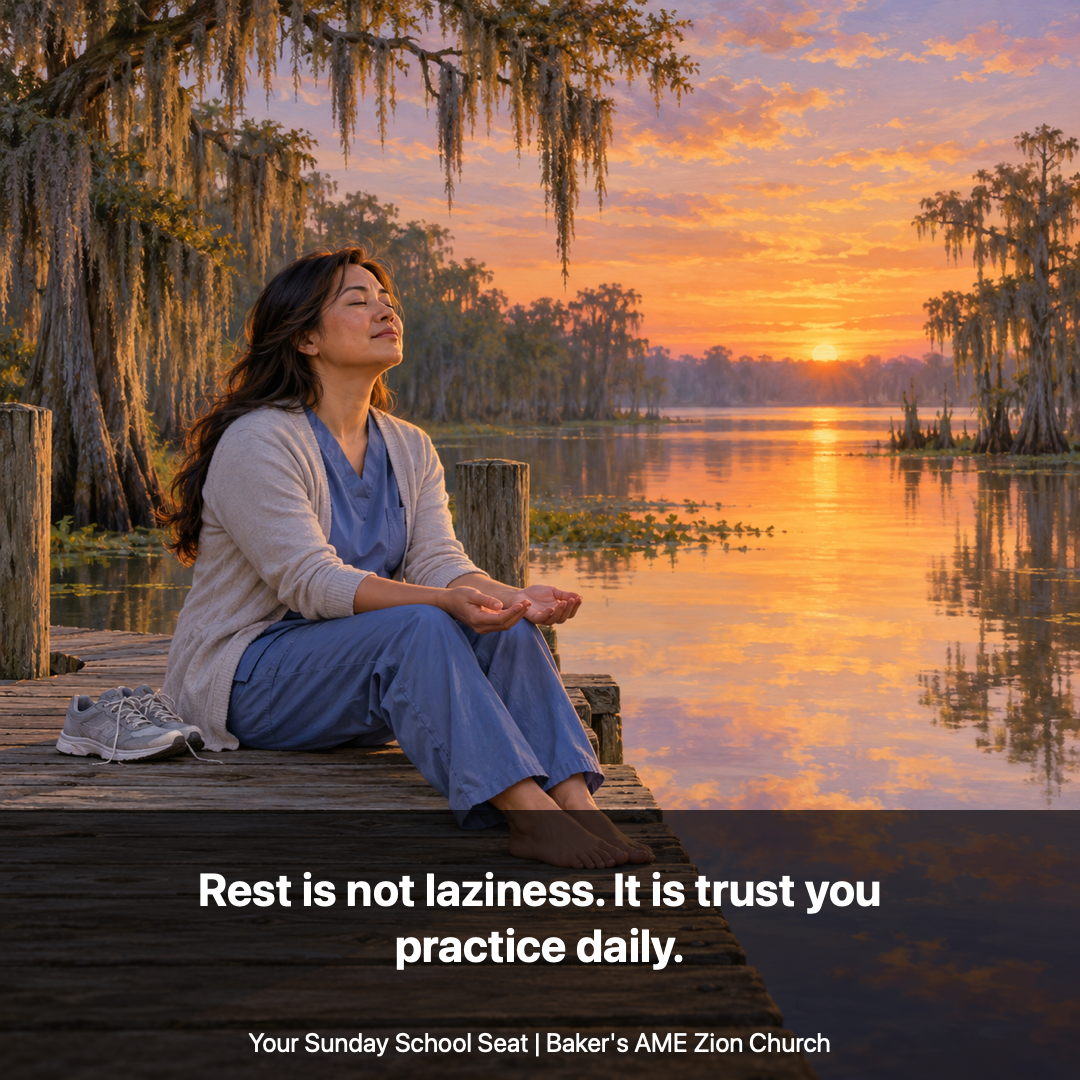
It sounds like a contradiction: work hard to rest. Anyone who has tried to truly stop for a day knows it isn't.
Hebrews 4:11-16 — KJV
11 Let us labour therefore to enter into that rest, lest any man fall after the same example of unbelief. 12 For the word of God is quick, and powerful, and sharper than any twoedged sword, piercing even to the dividing asunder of soul and spirit, and of the joints and marrow, and is a discerner of the thoughts and intents of the heart. 13 Neither is there any creature that is not manifest in his sight: but all things are naked and opened unto the eyes of him with whom we have to do. 14 Seeing then that we have a great high priest, that is passed into the heavens, Jesus the Son of God, let us hold fast our profession. 15 For we have not an high priest which cannot be touched with the feeling of our infirmities; but was in all points tempted like as we are, yet without sin. 16 Let us therefore come boldly unto the throne of grace, that we may obtain mercy, and find grace to help in time of need.
Hebrews 4:11-16 — WEB
11 Let us therefore give diligence to enter into that rest, lest anyone fall after the same example of disobedience. 12 For the word of God is living and active, and sharper than any two-edged sword, piercing even to the dividing of soul and spirit, of both joints and marrow, and is able to discern the thoughts and intentions of the heart. 13 There is no creature that is hidden from his sight, but all things are naked and laid open before the eyes of him to whom we must give an account. 14 Having then a great high priest, who has passed through the heavens, Jesus, the Son of God, let us hold tightly to our confession. 15 For we don't have a high priest who can't be touched with the feeling of our infirmities, but one who has been in all points tempted like we are, yet without sin. 16 Let us therefore draw near with boldness to the throne of grace, that we may receive mercy, and may find grace for help in time of need.
Explanation
Hebrews was written to tired believers who were tempted to drift back to what felt safer. In chapters 3 and 4 the writer reaches back to Psalm 95 and the wilderness generation, the people God brought out of Egypt who never entered His rest because they would not trust Him. The writer then makes a bold point: even when Joshua brought Israel into the land, a deeper rest still remained for the people of God. Our reading opens with the instruction that follows: "Let us labour therefore to enter into that rest." Labor to rest. The paradox is the point.
The effort being asked for here is the effort of trust. It is the work of dropping the pretense that we are running the universe. Then verses 12 and 13 hit hard. The word of God is like a surgeon's blade, able to separate what we say from what we really mean, and no creature is hidden from God's sight. That could be terrifying, but verse 14 turns the whole thing around. We have a great high priest, Jesus, who has passed through the heavens, and verse 15 says He is not distant from our weakness. He was "in all points tempted like as we are, yet without sin." The same One who sees everything about us also understands everything about us. So we are invited to "come boldly unto the throne of grace" to receive mercy and find grace "in time of need."
Connect this to Sunday. The lesson ends with a sentence in Judges 3:30: "the land had rest fourscore years." The writer of Hebrews would say that kind of rest, peace from enemies, is real and good, but it is also a signpost pointing toward a deeper rest in God Himself. Restoring rest to the land is a gift. Resting in the God who gives it is the destination.
Our culture treats rest as a reward for finishing everything. Scripture treats it as an act of faith. Sleep is a quiet confession that God doesn't need us awake to hold the world together. And scrolling through your phone at midnight isn't rest; it is numbness. This week, try an actual pause. An hour with no screen. A real Sabbath moment. And bring your unfiltered prayer to the throne of grace as you are, not after you've cleaned yourself up. The verse says "in time of need," not "after you've gotten it together."
Thought for the Day
Rest is not laziness. It is trust you practice daily.
Reflection Question
What would it look like this week to stop and trust God with something you've been carrying alone?
Prayer
Jesus, our great high priest, thank You that You understand our weakness. We are tired, and we have confused being busy with being faithful. Teach us to stop, to trust, and to come to Your throne without pretending. Give us mercy for what we have done and grace for what is ahead. Let us rest in You.
This week we walk toward Sunday's lesson: God Works Through Ehud.
Wednesday, October 14 — Better to Be a Doorkeeper
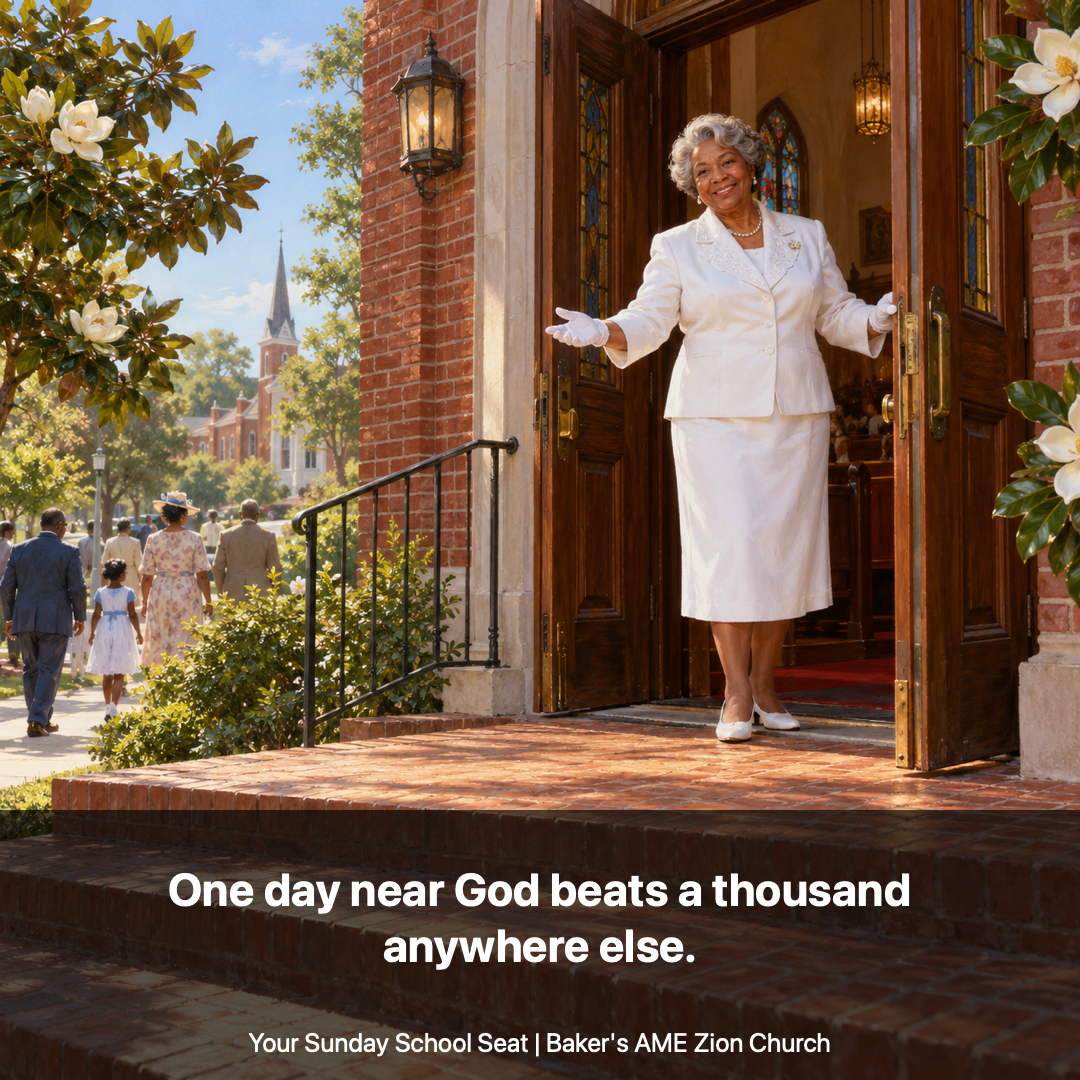
Everybody has a place they would rather be. This psalmist has a place he can't stop thinking about, and it isn't a beach.
Psalm 84 — KJV
1 How amiable are thy tabernacles, O LORD of hosts! 2 My soul longeth, yea, even fainteth for the courts of the LORD: my heart and my flesh crieth out for the living God. 3 Yea, the sparrow hath found an house, and the swallow a nest for herself, where she may lay her young, even thine altars, O LORD of hosts, my King, and my God. 4 Blessed are they that dwell in thy house: they will be still praising thee. Selah. 5 Blessed is the man whose strength is in thee; in whose heart are the ways of them. 6 Who passing through the valley of Baca make it a well; the rain also filleth the pools. 7 They go from strength to strength, every one of them in Zion appeareth before God. 8 O LORD God of hosts, hear my prayer: give ear, O God of Jacob. Selah. 9 Behold, O God our shield, and look upon the face of thine anointed. 10 For a day in thy courts is better than a thousand. I had rather be a doorkeeper in the house of my God, than to dwell in the tents of wickedness. 11 For the LORD God is a sun and shield: the LORD will give grace and glory: no good thing will he withhold from them that walk uprightly. 12 O LORD of hosts, blessed is the man that trusteth in thee.
Psalm 84 — WEB
1 How lovely are your dwellings, Yahweh of Armies! 2 My soul longs, and even faints for the courts of Yahweh. My heart and my flesh cry out for the living God. 3 Yes, the sparrow has found a home, and the swallow a nest for herself, where she may have her young, near your altars, Yahweh of Armies, my King, and my God. 4 Blessed are those who dwell in your house. They are always praising you. Selah. 5 Blessed are those whose strength is in you; who have set their hearts on a pilgrimage. 6 Passing through the valley of Weeping, they make it a place of springs. Yes, the autumn rain covers it with blessings. 7 They go from strength to strength. Everyone of them appears before God in Zion. 8 Yahweh, God of Armies, hear my prayer. Listen, God of Jacob. Selah. 9 Behold, God our shield, look at the face of your anointed. 10 For a day in your courts is better than a thousand. I would rather be a doorkeeper in the house of my God, than to dwell in the tents of wickedness. 11 For Yahweh God is a sun and a shield. Yahweh will give grace and glory. He withholds no good thing from those who walk blamelessly. 12 Yahweh of Armies, blessed is the man who trusts in you.
Explanation
Psalm 84 is attributed to the sons of Korah, a family of Levites who served in the temple, and some of them, according to Chronicles, were gatekeepers. That makes the psalm's most famous line feel personal. This is a pilgrim song, sung by someone on the road to Jerusalem, far from the sanctuary and homesick for it. The journey is part of the poem. There is a "valley of Baca" along the way, a name that sounds like weeping, a dry and hard stretch of road. And there are the sparrow and the swallow, tiny birds who have found a nest right by God's altar. Even they have a place to belong.
The psalm begins with longing: "My soul longeth, yea, even fainteth." It is okay to be homesick for God. Verses 5 through 7 describe the people who make the trip, those whose strength is in God and who have set their hearts on the pilgrimage. When they pass through the valley of tears, they turn it into a place of springs. They go "from strength to strength," not because they never get tired but because they are refilled along the road. Then comes the line everyone remembers: a day in your courts is better than a thousand elsewhere, and "I had rather be a doorkeeper in the house of my God" than live comfortably in the tents of wickedness. The humblest job in God's house beats the best seat anywhere else. Greatness here is measured by nearness, not position.
The week is circling around rest, and this psalm shows that rest is not simply the absence of work. It is being at home with God. The doorkeeper has a kind of rest even while standing on his feet. And the "tents of wickedness" at the end names where Israel kept wandering in the book of Judges, away from the house where they could have been at home.
If Sunday morning has started to feel like one more obligation, this psalm asks a different question: what are you actually longing for? And for those who serve quietly, the usher, the person who sets out the chairs, the one who stays to turn off the lights, this is your psalm. Humble work near God is not small. If you are in a valley right now, grief or exhaustion or waiting, notice what the pilgrims do. They dig wells for the people who come after them.
Thought for the Day
One day near God beats a thousand anywhere else.
Reflection Question
What are you longing for most these days, and is it drawing you toward God or away from Him?
Prayer
Lord of hosts, we are tired of running to places that never feel like home. Draw us back to Your house and Your presence, and make us glad to serve in even the smallest ways. Where we are walking through dry valleys, bring springs. Let our lives become wells for someone else coming behind us.
This week we walk toward Sunday's lesson: God Works Through Ehud.
Tuesday, October 13 — Let It Shine Anyway

Nobody ever walked into a dark room and complained that someone turned on a lamp. Jesus says that's all He's asking of us.
Matthew 5:11-16 — KJV
11 Blessed are ye, when men shall revile you, and persecute you, and shall say all manner of evil against you falsely, for my sake. 12 Rejoice, and be exceeding glad: for great is your reward in heaven: for so persecuted they the prophets which were before you. 13 Ye are the salt of the earth: but if the salt have lost his savour, wherewith shall it be salted? it is thenceforth good for nothing, but to be cast out, and to be trodden under foot of men. 14 Ye are the light of the world. A city that is set on an hill cannot be hid. 15 Neither do men light a candle, and put it under a bushel, but on a candlestick; and it giveth light unto all that are in the house. 16 Let your light so shine before men, that they may see your good works, and glorify your Father which is in heaven.
Matthew 5:11-16 — WEB
11 Blessed are you when people reproach you, persecute you, and say all kinds of evil against you falsely, for my sake. 12 Rejoice, and be exceedingly glad, for great is your reward in heaven. For that is how they persecuted the prophets who were before you. 13 You are the salt of the earth, but if the salt has lost its flavor, with what will it be salted? It is then good for nothing, but to be cast out and trodden under the feet of men. 14 You are the light of the world. A city located on a hill can't be hidden. 15 Neither do you light a lamp, and put it under a measuring basket, but on a stand; and it shines to all who are in the house. 16 Even so, let your light shine before men; that they may see your good works, and glorify your Father who is in heaven.
Explanation
These verses sit at the close of the Beatitudes, early in the Sermon on the Mount. Jesus has just blessed the poor in spirit, the grieving, the gentle, and the persecuted, and now He turns and speaks straight to the people in front of him: "Blessed are ye when men shall revile you." The "you" is plural. He is talking to a whole community on a hillside in Galilee, mostly ordinary people with little power, living under occupation. Then He hands them two pictures from daily life. Salt, which seasoned and preserved food. And a small clay lamp, which in a one-room house could light the whole place.
Notice the grammar. Jesus doesn't say "try to become" salt or "work toward being" light. He says "ye are." Identity comes first. The only question is whether you will cover it up. A city on a hill can't be hidden, and a lamp under a basket defeats its own purpose. Then the goal: "that they may see your good works, and glorify your Father." The point is not for people to admire you. It is for them to catch a glimpse of God through what you do. And Jesus is honest that this can cost something. The prophets before you were treated the same way. Joy in verse 12 is not pretending pain is pleasant. It is knowing you are in good company.
This is a warning that sets up the weekend. In Judges 3, which we read Saturday and Sunday, Israel lived alongside its neighbors and slowly started serving their gods. Salt that lost its flavor. Light under a basket. When a people stop looking different in the ways that matter, a land can slide into the kind of confusion that lets a king like Eglon rule for eighteen years. Sunday's lesson shows what a dimmed light costs. Today's passage is the invitation to keep it lit.
Shining is rarely loud. It is the coworker who doesn't join the gossip. The neighbor who shows up with a plate after a funeral. The parent who apologizes to a child. In a world full of hot takes, quiet and consistent goodness is surprisingly bright. Don't hide your faith to keep the peace, and don't wave it around to win arguments. Just keep the lamp on its stand where the whole house can see.
Thought for the Day
Light doesn't announce itself. It simply shows people the way.
Reflection Question
Where have you quietly dimmed your light this month to fit in or keep the peace?
Prayer
God, thank You for calling us light before we ever felt bright. Forgive us for the times we put the lamp under a basket because it was easier. Give us small, steady ways to show Your goodness at work, at home, and in our neighborhoods. Let the people around us see something true, and let the credit go to You.
This week we walk toward Sunday's lesson: God Works Through Ehud.
Monday, October 12 — Live Fully, Die Unafraid
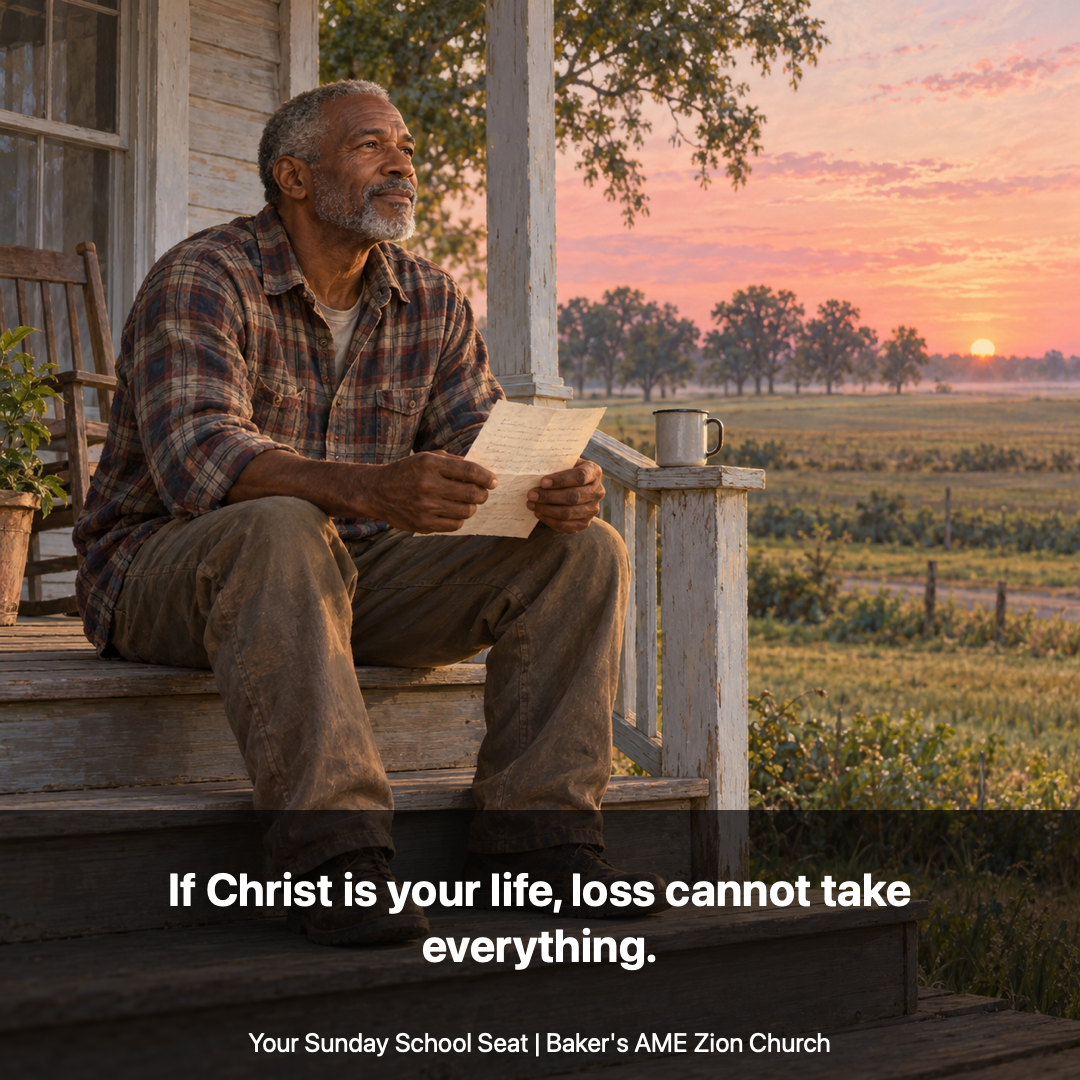
Most of us plan for the day we retire. Paul is writing from a guarded room, planning for the possibility that he won't.
Philippians 1:21-30 — KJV
21 For to me to live is Christ, and to die is gain. 22 But if I live in the flesh, this is the fruit of my labour: yet what I shall choose I wot not. 23 For I am in a strait betwixt two, having a desire to depart, and to be with Christ; which is far better: 24 Nevertheless to abide in the flesh is more needful for you. 25 And having this confidence, I know that I shall abide and continue with you all for your furtherance and joy of faith; 26 That your rejoicing may be more abundant in Jesus Christ for me by my coming to you again. 27 Only let your conversation be as it becometh the gospel of Christ: that whether I come and see you, or else be absent, I may hear of your affairs, that ye stand fast in one spirit, with one mind striving together for the faith of the gospel; 28 And in nothing terrified by your adversaries: which is to them an evident token of perdition, but to you of salvation, and that of God. 29 For unto you it is given in the behalf of Christ, not only to believe on him, but also to suffer for his sake; 30 Having the same conflict which ye saw in me, and now hear to be in me.
Philippians 1:21-30 — WEB
21 For to me to live is Christ, and to die is gain. 22 But if I live on in the flesh, this will bring fruit from my work; yet I don't know what I will choose. 23 But I am in a dilemma between the two, having the desire to depart and be with Christ, which is far better. 24 Yet, to remain in the flesh is more needful for your sake. 25 Having this confidence, I know that I will remain, yes, and remain with you all, for your progress and joy in the faith, 26 that your rejoicing may abound in Christ Jesus in me through my presence with you again. 27 Only let your way of life be worthy of the Good News of Christ, that, whether I come and see you or am absent, I may hear of your state, that you stand firm in one spirit, with one soul striving for the faith of the Good News; 28 and in nothing frightened by the adversaries, which is for them a proof of destruction, but to you of salvation, and that from God. 29 Because it has been granted to you on behalf of Christ, not only to believe in him, but also to suffer on his behalf, 30 having the same conflict which you saw in me, and now hear is in me.
Explanation
Philippians is a thank-you note written from confinement. Paul is under guard, most likely in Rome, waiting on a verdict that could go either way, and he is writing to a church in Philippi, a city proud of its Roman citizenship, that has been supporting him. The letter is known for joy, which is what makes this passage so striking. Paul is doing the thing most of us avoid at all costs: he looks at his own death and calls both options good.
"For to me to live is Christ, and to die is gain" is not a bumper sticker. It is a statement about what Paul's whole life is organized around. If Christ is the center, then dying moves him closer to the center, and living means more fruitful work among people he loves. He is "in a strait betwixt two," pressed from both sides, and then he settles it by thinking of others: staying "is more needful for you." That is not bravado. It is the calm of someone whose identity cannot be repossessed. Then he turns to the Philippians: whatever happens to me, let your way of life be worthy of the gospel, stand firm together in one spirit, and don't be frightened by those who oppose you. He even says that suffering for Christ has been "granted" to them, part of the same calling and the same struggle he is in.
Here is the thread to Sunday. This week's lesson is about a people who lost their moral compass, ended up under a foreign king, and then needed courage when God raised up a deliverer. Philippians shows what that kind of courage is made of. It is not a clenched jaw. It is a settled answer to the question "what do I most belong to?" Israel under Eglon had forgotten the answer. Paul, under guard, has not. And the rest God promises later this week begins in the same place: you can only rest once you have decided who is in charge.
Most of our fears are smaller versions of Paul's. The layoff rumor. The phone call about a child. The appointment we keep rescheduling. The conversation we dread. We tell ourselves the stakes are everything, and sometimes they are. Paul doesn't deny the stakes. He changes the question: if the worst happened, what would still be mine? And notice the phrase "striving together." Courage is easier in a row of folding chairs than alone at three in the morning. Who is standing next to you this week?
Thought for the Day
If Christ is your life, loss cannot take everything.
Reflection Question
What are you most afraid of losing right now, and what would still be yours if you lost it?
Prayer
Lord, we confess that we hold some things too tightly and fear some things too much. Teach us to say with Paul that Christ is our life and that nothing can finally take us from You. Give us courage for what is in front of us, and put steady people beside us so we do not face it alone. Make our ordinary days worthy of the good news we say we believe.
This week we walk toward Sunday's lesson: God Works Through Ehud.
October 12 - 18: God Works Through Ehud
This week we walk with Israel through a long season of drift, oppression, and a cry for help, and with the New Testament writers who show us how to stand firm, shine, and rest in the meantime. Across seven readings, from Paul's courage in chains to the psalmist's longing for God's house, from the promise that God remembers our work to the story of a deliverer named Ehud, we see that God hears His people and works even through imperfect instruments. It all builds to Sunday's lesson, "God Works Through Ehud: A Hero Who's Not a Hero." Watch, walk through the week with us, and join us for Sunday school.
Monday — Courage to Live or Die (Philippians 1:21-30)
Tuesday — Let Your Light Shine (Matthew 5:11-16)
Wednesday — A Humble Servant of God (Psalm 84)
Thursday — Let Us Strive for God's Rest (Hebrews 4:11-16)
Friday — God Will Not Overlook Your Work (Hebrews 6:1-12)
Saturday — God Tests God's People (Judges 3:1-7, 12-14)
Sunday — Restoring Rest to the Land (Judges 3:15-23, 30)
Your Sunday School Seat | Baker's AME Zion Church — We Saved You a Seat
#YourSundaySchoolSeat #AMEZion #DailyDevotional #Faith #BlackChurch #Judges3
Sunday, October 11 — God Stays Faithful Anyway
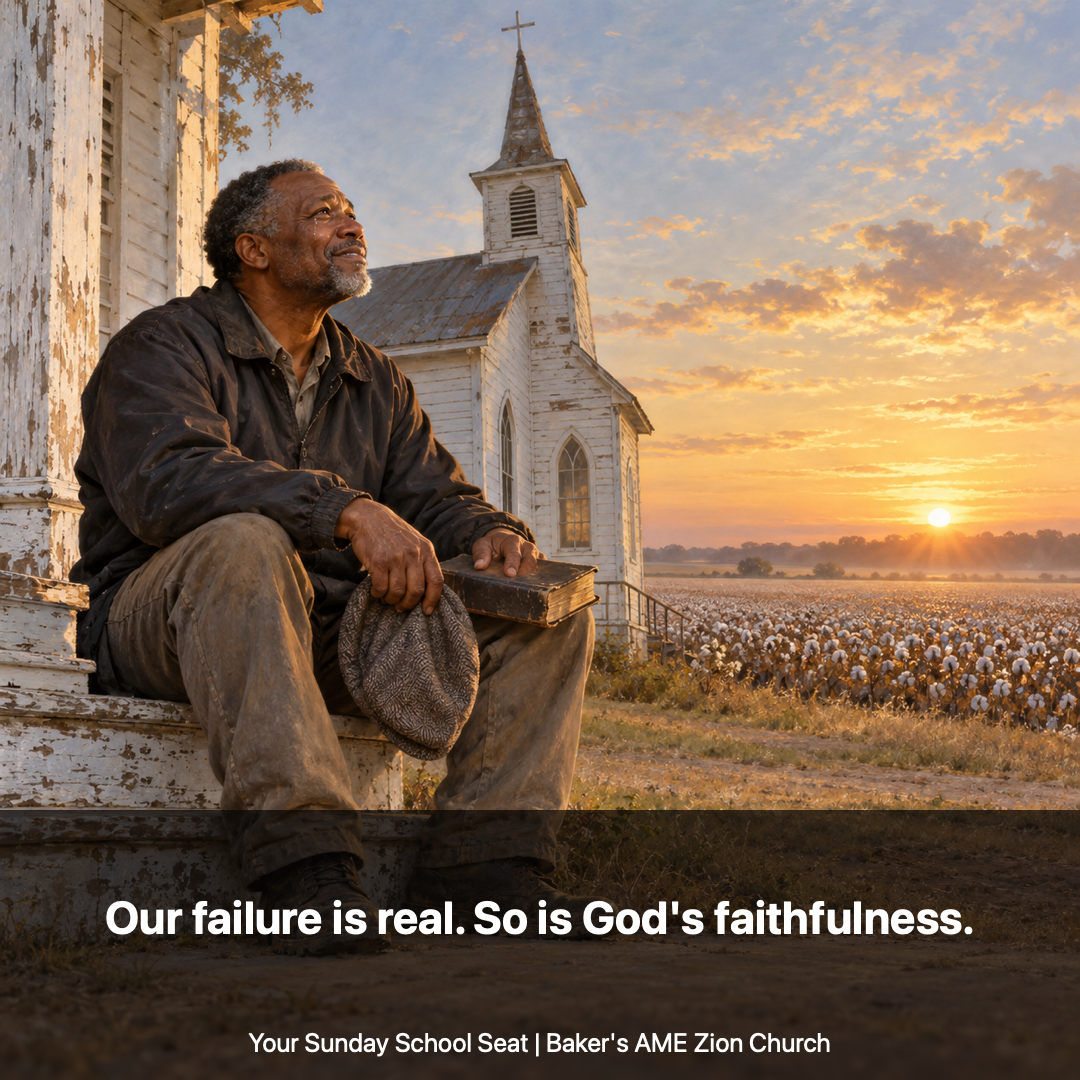
There is a particular ache in watching something your elders built get neglected by people who were never told why it mattered.
Judges 2:1-15 — KJV
1 And an angel of the LORD came up from Gilgal to Bochim, and said, I made you to go up out of Egypt, and have brought you unto the land which I sware unto your fathers; and I said, I will never break my covenant with you. 2 And ye shall make no league with the inhabitants of this land; ye shall throw down their altars: but ye have not obeyed my voice: why have ye done this? 3 Wherefore I also said, I will not drive them out from before you; but they shall be as thorns in your sides, and their gods shall be a snare unto you. 4 And it came to pass, when the angel of the LORD spake these words unto all the children of Israel, that the people lifted up their voice, and wept. 5 And they called the name of that place Bochim: and they sacrificed there unto the LORD. 6 And when Joshua had let the people go, the children of Israel went every man unto his inheritance to possess the land. 7 And the people served the LORD all the days of Joshua, and all the days of the elders that outlived Joshua, who had seen all the great works of the LORD, that he did for Israel. 8 And Joshua the son of Nun, the servant of the LORD, died, being an hundred and ten years old. 9 And they buried him in the border of his inheritance in Timnathheres, in the mount of Ephraim, on the north side of the hill Gaash. 10 And also all that generation were gathered unto their fathers: and there arose another generation after them, which knew not the LORD, nor yet the works which he had done for Israel. 11 And the children of Israel did evil in the sight of the LORD, and served Baalim: 12 And they forsook the LORD God of their fathers, which brought them out of the land of Egypt, and followed other gods, of the gods of the people that were round about them, and bowed themselves unto them, and provoked the LORD to anger. 13 And they forsook the LORD, and served Baal and Ashtaroth. 14 And the anger of the LORD was hot against Israel, and he delivered them into the hands of spoilers that spoiled them, and he sold them into the hands of their enemies round about, so that they could not any longer stand before their enemies. 15 Whithersoever they went out, the hand of the LORD was against them for evil, as the LORD had said, and as the LORD had sworn unto them: and they were greatly distressed.
Judges 2:1-15 — WEB
1 Yahweh’s angel came up from Gilgal to Bochim. He said, “I brought you out of Egypt, and have brought you to the land which I swore to give your fathers. I said, ‘I will never break my covenant with you. 2 You shall make no covenant with the inhabitants of this land. You shall break down their altars.’ But you have not listened to my voice. Why have you done this? 3 Therefore I also said, ‘I will not drive them out from before you; but they shall be in your sides, and their gods will be a snare to you.’ ” 4 When Yahweh’s angel spoke these words to all the children of Israel, the people lifted up their voice and wept. 5 They called the name of that place Bochim, and they sacrificed there to Yahweh. 6 Now when Joshua had sent the people away, the children of Israel each went to his inheritance to possess the land. 7 The people served Yahweh all the days of Joshua, and all the days of the elders who outlived Joshua, who had seen all the great work of Yahweh that he had worked for Israel. 8 Joshua the son of Nun, the servant of Yahweh, died, being one hundred ten years old. 9 They buried him in the border of his inheritance in Timnath Heres, in the hill country of Ephraim, on the north of the mountain of Gaash. 10 After all that generation were gathered to their fathers, another generation arose after them who didn’t know Yahweh, nor the work which he had done for Israel. 11 The children of Israel did that which was evil in Yahweh’s sight, and served the Baals. 12 They abandoned Yahweh, the God of their fathers, who brought them out of the land of Egypt, and followed other gods, of the gods of the peoples who were around them, and bowed themselves down to them; and they provoked Yahweh to anger. 13 They abandoned Yahweh, and served Baal and the Ashtaroth. 14 Yahweh’s anger burned against Israel, and he delivered them into the hands of raiders who plundered them. He sold them into the hands of their enemies all around, so that they could no longer stand before their enemies. 15 Wherever they went out, Yahweh’s hand was against them for evil, as Yahweh had spoken, and as Yahweh had sworn to them; and they were very distressed.
Explanation
The book of Judges opens after Joshua's death, and the picture is not pretty. Israel has not finished the work of driving out the peoples of the land. In chapter 2 an angel of the Lord comes up from Gilgal to a place called Bochim and confronts them. The message begins with what God has done: I brought you out of Egypt, I brought you to the land I swore to your fathers, and I said, "I will never break my covenant with you." Then comes the charge. I told you to make no league with the people of this land and to tear down their altars, but you did not listen. "Why have ye done this?" God says He will not drive those nations out, and their gods will be a snare. The people lift up their voices and weep, and they name the place Bochim, "weepers."
Then the narrator steps back and tells us how we got here. Joshua dismissed the people, each to their inheritance. They served the Lord all the days of Joshua and of the elders who outlived him, those who had seen God's great works with their own eyes. Joshua died at 110. And then verse 10, one of the saddest sentences in the Bible: another generation arose "which knew not the LORD, nor yet the works which he had done for Israel." Just like that. They did evil, served the Baals, abandoned the God of their fathers, and followed the gods of the people around them. The Lord's anger burned, and wherever they went the hand of the Lord was against them, and they were greatly distressed.
This is the lesson our unit has been building toward: "Lacking Leadership and a Moral Compass," and a topic that does not flinch, "Choosing Badly." The passage is honest. Evil has consequences, memory matters, and a faith that is not told will not be passed on. And yet the lesson title is "God Works Despite Evil," and you can see why. Verse 1 still stands in the middle of the wreckage: "I will never break my covenant with you." The Lord's faithfulness is not canceled by Israel's failure. Keep reading past today's verses and this same chapter says He raised up judges to deliver them. But the lesson starts here, with a God who stays faithful when His people do not.
Two things to carry out today. If you are a parent, a grandparent, a teacher, or a leader, remember that the faith is one generation away from being forgotten. Tell the stories. Say out loud what God has done for your family, your church, and your people. And if you are the one who has chosen badly, hear that Bochim is a place of weeping and also a place of worship; they sacrificed there to the Lord. Consequences are real. So is the covenant. Come back. The seat is still yours.
Thought for the Day
Our failure is real. So is God's faithfulness.
Reflection Question
What story of God's faithfulness do you need to tell the next generation, and who needs to hear it first?
Prayer
Faithful God, You keep Your promises even when we do not keep ours. Forgive us for the times we forgot You and the works You have done. Give us leaders with a moral compass and families who tell Your story. Bring us back, and keep us near. In Jesus' name, Amen.
Today is Sunday school. We saved you a seat.
Saturday, October 10 — Get Dressed in Love

Nobody leaves the house in the morning without checking what they are wearing. It might be worth asking what we are wearing on the inside.
Colossians 3:12-17 — KJV
12 Put on therefore, as the elect of God, holy and beloved, bowels of mercies, kindness, humbleness of mind, meekness, longsuffering; 13 Forbearing one another, and forgiving one another, if any man have a quarrel against any: even as Christ forgave you, so also do ye. 14 And above all these things put on charity, which is the bond of perfectness. 15 And let the peace of God rule in your hearts, to the which also ye are called in one body; and be ye thankful. 16 Let the word of Christ dwell in you richly in all wisdom; teaching and admonishing one another in psalms and hymns and spiritual songs, singing with grace in your hearts to the Lord. 17 And whatsoever ye do in word or deed, do all in the name of the Lord Jesus, giving thanks to God and the Father by him.
Colossians 3:12-17 — WEB
12 Put on therefore, as God’s chosen ones, holy and beloved, a heart of compassion, kindness, lowliness, humility, and perseverance; 13 bearing with one another, and forgiving each other, if any man has a complaint against any; even as Christ forgave you, so you also do. 14 Above all these things, walk in love, which is the bond of perfection. 15 And let the peace of God rule in your hearts, to which also you were called in one body, and be thankful. 16 Let the word of Christ dwell in you richly; in all wisdom teaching and admonishing one another with psalms, hymns, and spiritual songs, singing with grace in your heart to the Lord. 17 Whatever you do, in word or in deed, do all in the name of the Lord Jesus, giving thanks to God the Father, through him.
Explanation
Yesterday Paul told the Colossians to take off the old self. Today he tells them what to put on. Notice who he says they are before he tells them what to wear: "the elect of God, holy and beloved." Identity comes first, clothing second. Believers do not dress in compassion to become God's people; they dress in compassion because they already are. Paul is not handing out a checklist for earning approval. He is describing how people who have been loved look from the outside.
The wardrobe is plain and demanding: deep compassion, kindness, humility, gentleness, and patience. Then two actions that cost something: bearing with one another and forgiving whoever has a complaint against you, "even as Christ forgave you." Over it all goes love, which Paul calls "the bond of perfectness," the belt that holds the whole outfit together. Then Paul turns to the shared life of the church: let the peace of Christ rule in your hearts, be thankful, let the word of Christ dwell in you richly, teach and admonish one another with psalms, hymns, and spiritual songs. Whatever you do, in word or deed, do it in the name of the Lord Jesus, giving thanks to God. Anyone who has grown up singing in a sanctuary knows how true this is: the songs carry the Word into the body.
This is a moral compass written in one paragraph. Our unit, "Lacking Leadership and a Moral Compass," looks at what happens when a community loses its direction, and Sunday's lesson in Judges 2 points to the moment it was lost: a generation arose "which knew not the Lord, nor yet the works which he had done." Colossians 3:16 is the remedy. Let the word of Christ dwell richly; teach it, sing it, pass it on. And it ties to "God Works Despite Evil": the Lord does not wait for a perfect people. He clothes the ones He has chosen with what they could not produce on their own.
Pick one piece from Paul's closet and put it on this week. Maybe it is forgiving someone who never apologized, so that you can quit carrying it. Maybe it is thankfulness, thanking God out loud at the end of a day that did not go as planned. Maybe it is the quiet work of teaching a child or a grandchild a verse or a hymn, so the next generation does know the Lord and the works He has done. None of these will trend. All of them hold. When love is the belt, everything else stays in place.
Thought for the Day
Put on love first. Everything else fits better.
Reflection Question
Which piece of Paul's wardrobe, compassion, kindness, patience, forgiveness, or thankfulness, do you most need to put on today?
Prayer
Lord, thank You for calling us chosen, holy, and loved. Dress us today in compassion and kindness, patience and humility. Help us forgive as You have forgiven us. Let Your Word live richly in our homes, and let love hold everything together. In Jesus' name, Amen.
This week we walk toward Sunday's lesson: God Works Despite Evil.
Friday, October 9 — Take Off the Old Self
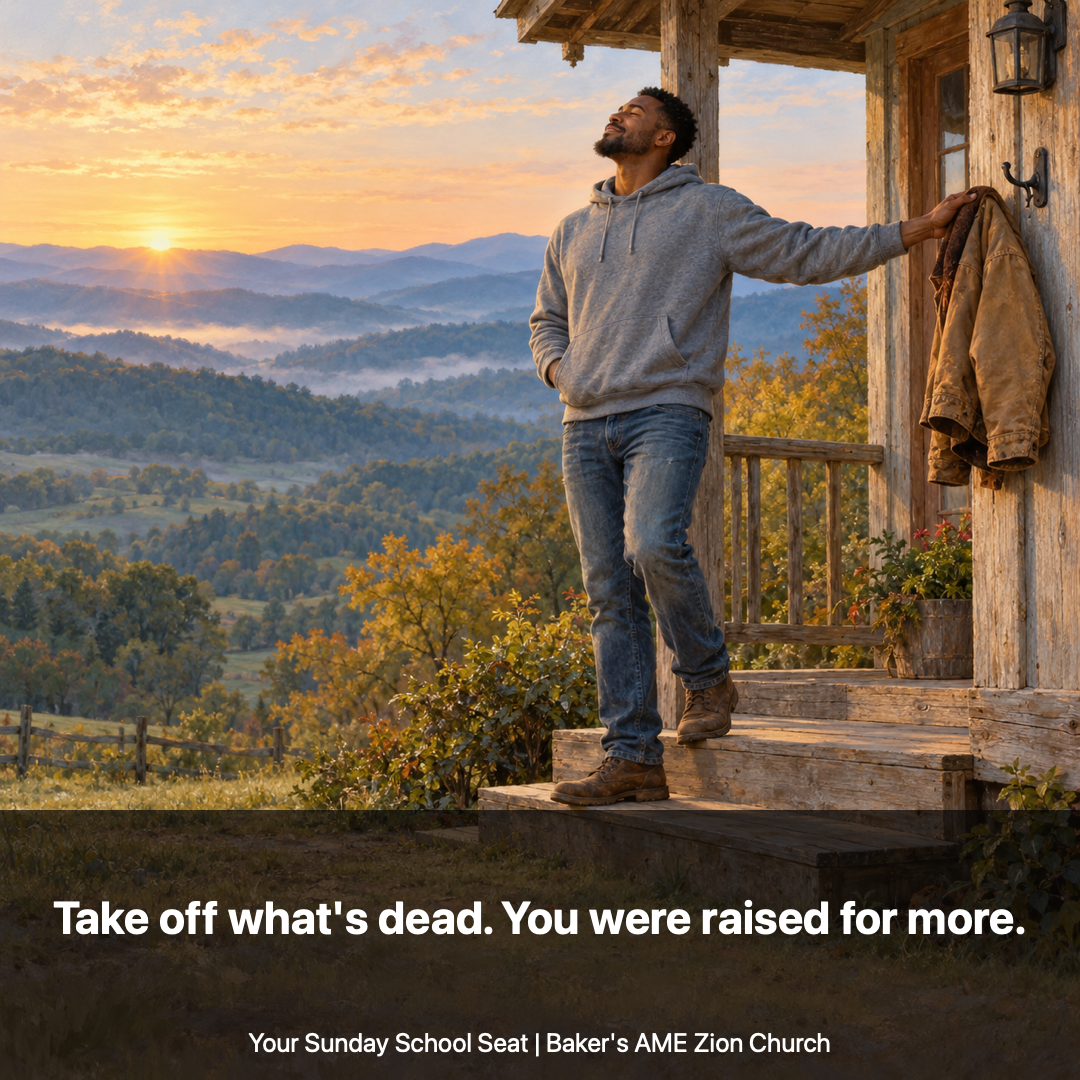
Every spring cleaning there is a moment when you pull out a piece of clothing, hold it up, and realize you have been keeping it for a version of yourself that does not exist anymore.
Colossians 3:1-11 — KJV
1 If ye then be risen with Christ, seek those things which are above, where Christ sitteth on the right hand of God. 2 Set your affection on things above, not on things on the earth. 3 For ye are dead, and your life is hid with Christ in God. 4 When Christ, who is our life, shall appear, then shall ye also appear with him in glory. 5 Mortify therefore your members which are upon the earth; fornication, uncleanness, inordinate affection, evil concupiscence, and covetousness, which is idolatry: 6 For which things’ sake the wrath of God cometh on the children of disobedience: 7 In the which ye also walked some time, when ye lived in them. 8 But now ye also put off all these; anger, wrath, malice, blasphemy, filthy communication out of your mouth. 9 Lie not one to another, seeing that ye have put off the old man with his deeds; 10 And have put on the new man, which is renewed in knowledge after the image of him that created him: 11 Where there is neither Greek nor Jew, circumcision nor uncircumcision, Barbarian, Scythian, bond nor free: but Christ is all, and in all.
Colossians 3:1-11 — WEB
1 If then you were raised together with Christ, seek the things that are above, where Christ is, seated on the right hand of God. 2 Set your mind on the things that are above, not on the things that are on the earth. 3 For you died, and your life is hidden with Christ in God. 4 When Christ, our life, is revealed, then you will also be revealed with him in glory. 5 Put to death therefore your members which are on the earth: sexual immorality, uncleanness, depraved passion, evil desire, and covetousness, which is idolatry. 6 For these things’ sake the wrath of God comes on the children of disobedience. 7 You also once walked in those, when you lived in them; 8 but now you also put them all away: anger, wrath, malice, slander, and shameful speaking out of your mouth. 9 Don’t lie to one another, seeing that you have put off the old man with his doings, 10 and have put on the new man, who is being renewed in knowledge after the image of his Creator, 11 where there can’t be Greek and Jew, circumcision and uncircumcision, barbarian, Scythian, bondservant, or free person; but Christ is all, and in all.
Explanation
Paul wrote to the church in Colossae, a small town in what is now Turkey, where believers were being pulled by a mix of philosophies, rituals, and rules that suggested Christ was not enough on His own. Chapter 3 turns from what the Colossians believe to how they live. And notice where Paul starts: "If ye then be risen with Christ." He begins with resurrection. The way we live is not an attempt to earn a new life; it is what a new life looks like.
Paul gives two directions. First, look up: seek the things above and set your mind there, not on earthly things. That is not an escape from real life; it is about where you aim your attention. Second, put to death what belongs to the old way: sexual immorality, impurity, evil desire, and covetousness, which Paul calls idolatry. Then the everyday sins that wreck relationships: anger, rage, malice, slander, filthy talk, lying to one another. He uses the picture of clothing: put off the old self with its practices and put on the new self, "renewed in knowledge after the image of him that created him." The last verse is a surprise. In this new humanity there is no Greek or Jew, slave or free; Christ is all and in all. Old ranking systems come off with the old clothes.
Sunday's lesson shows Israel choosing badly in Judges 2, giving in to the pull of the gods around them. Paul has a name for that pull: covetousness, which is idolatry. Israel's idols were called Baal and Ashtaroth; ours go by other names. And Paul gives the cure that Judges is missing: a mind set on things above, and a new identity that was handed to us, not built by us. Even this connects to the lesson title. God works despite evil, and part of His work is not only to forgive us but to make us new.
Be specific this week. What is the old coat you keep putting back on? It might be a quick temper, a habit of gossip, a little lie that smooths things over at work, or the late-night scrolling that feeds envy. "Put off" is an action. Think of hanging a jacket on a hook. You decide, you do it, and you are not carrying it around anymore. But you do not do it by gritted teeth alone. You do it because you have been raised. And when you walk into your workplace, your family, or your church, remember the last verse: no one is the "real" insider, and no one is beneath you. Christ is all and in all.
Thought for the Day
Take off what's dead. You were raised for more.
Reflection Question
What is one "old coat" you keep putting back on, and what would it look like to hang it up this week?
Prayer
Lord, thank You for raising us up with Christ. Turn our eyes toward You today, and give us the courage to take off what is dead. Show us the habits and words that no longer fit who we are in You. Teach us to see every person as someone Christ is in. In Jesus' name, Amen.
This week we walk toward Sunday's lesson: God Works Despite Evil.
Thursday, October 8 — Beware of Borrowed Worship
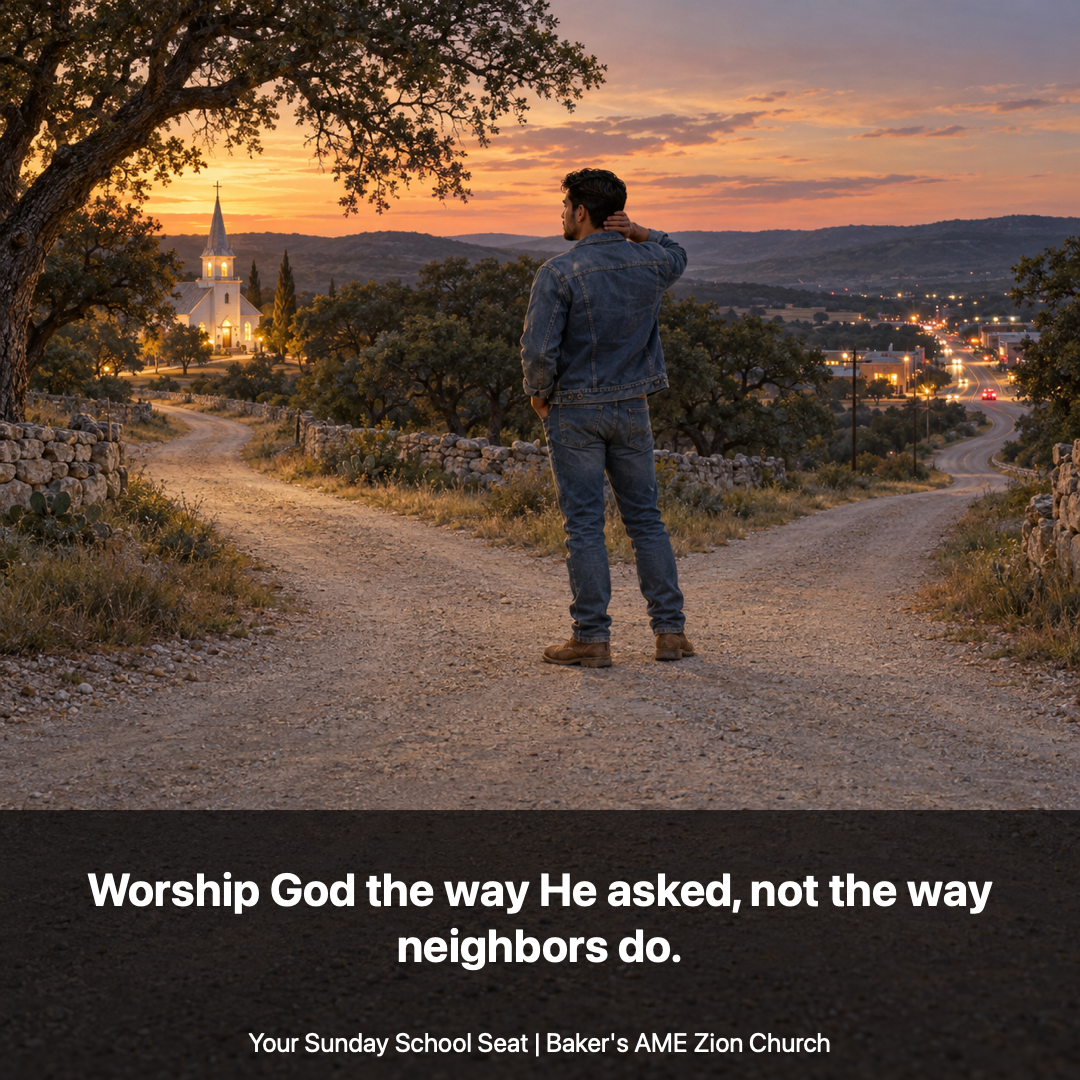
Peer pressure doesn't end at the school bus stop. It just gets quieter, and it comes with a smile and a "everybody's doing it."
Deuteronomy 12:20-32 — KJV
20 When the LORD thy God shall enlarge thy border, as he hath promised thee, and thou shalt say, I will eat flesh, because thy soul longeth to eat flesh; thou mayest eat flesh, whatsoever thy soul lusteth after. 21 If the place which the LORD thy God hath chosen to put his name there be too far from thee, then thou shalt kill of thy herd and of thy flock, which the LORD hath given thee, as I have commanded thee, and thou shalt eat in thy gates whatsoever thy soul lusteth after. 22 Even as the roebuck and the hart is eaten, so thou shalt eat them: the unclean and the clean shall eat of them alike. 23 Only be sure that thou eat not the blood: for the blood is the life; and thou mayest not eat the life with the flesh. 24 Thou shalt not eat it; thou shalt pour it upon the earth as water. 25 Thou shalt not eat it; that it may go well with thee, and with thy children after thee, when thou shalt do that which is right in the sight of the LORD. 26 Only thy holy things which thou hast, and thy vows, thou shalt take, and go unto the place which the LORD shall choose: 27 And thou shalt offer thy burnt offerings, the flesh and the blood, upon the altar of the LORD thy God: and the blood of thy sacrifices shall be poured out upon the altar of the LORD thy God, and thou shalt eat the flesh. 28 Observe and hear all these words which I command thee, that it may go well with thee, and with thy children after thee for ever, when thou doest that which is good and right in the sight of the LORD thy God. 29 When the LORD thy God shall cut off the nations from before thee, whither thou goest to possess them, and thou succeedest them, and dwellest in their land; 30 Take heed to thyself that thou be not snared by following them, after that they be destroyed from before thee; and that thou enquire not after their gods, saying, How did these nations serve their gods? even so will I do likewise. 31 Thou shalt not do so unto the LORD thy God: for every abomination to the LORD, which he hateth, have they done unto their gods; for even their sons and their daughters they have burnt in the fire to their gods. 32 What thing soever I command you, observe to do it: thou shalt not add thereto, nor diminish from it.
Deuteronomy 12:20-32 — WEB
20 When Yahweh your God enlarges your border, as he has promised you, and you say, “I want to eat meat,” because your soul desires to eat meat, you may eat meat, after all the desire of your soul. 21 If the place which Yahweh your God shall choose to put his name is too far from you, then you shall kill of your herd and of your flock, which Yahweh has given you, as I have commanded you; and you may eat within your gates, after all the desire of your soul. 22 Even as the gazelle and as the deer is eaten, so you shall eat of it. The unclean and the clean may eat of it alike. 23 Only be sure that you don’t eat the blood; for the blood is the life. You shall not eat the life with the meat. 24 You shall not eat it. You shall pour it out on the earth like water. 25 You shall not eat it, that it may go well with you and with your children after you, when you do that which is right in Yahweh’s eyes. 26 Only your holy things which you have, and your vows, you shall take and go to the place which Yahweh shall choose. 27 You shall offer your burnt offerings, the meat and the blood, on Yahweh your God’s altar. The blood of your sacrifices shall be poured out on Yahweh your God’s altar, and you shall eat the meat. 28 Observe and hear all these words which I command you, that it may go well with you and with your children after you forever, when you do that which is good and right in Yahweh your God’s eyes. 29 When Yahweh your God cuts off the nations from before you where you go in to dispossess them, and you dispossess them and dwell in their land, 30 be careful that you are not ensnared to follow them after they are destroyed from before you, and that you not inquire after their gods, saying, “How do these nations serve their gods? I will do likewise.” 31 You shall not do so to Yahweh your God; for every abomination to Yahweh, which he hates, they have done to their gods; for they even burn their sons and their daughters in the fire to their gods. 32 Whatever thing I command you, that you shall observe to do. You shall not add to it, nor take away from it.
Explanation
Moses is still preaching in Deuteronomy 12, and now he is looking ahead. One day Israel's borders will stretch far enough that the chosen place of worship is a long walk from home. So Moses makes a practical provision: you may eat meat at home, within your gates, and not every meal has to be a trip to the sanctuary. But there is a line. The blood is not to be eaten, because the blood is the life, and life belongs to God. Holy things and vows still go to the place the Lord chooses. Even ordinary eating is placed under the question of what God has said.
Then the tone shifts. Moses pictures a day when God has cleared the nations from the land and Israel is living in their houses and farming their fields. "Take heed to thyself that thou be not snared by following them." Look closely at the danger he names. It is not atheism. It is curiosity that sounds harmless: "How did these nations serve their gods? even so will I do likewise." Borrowing. Mixing a little of what worked for the neighbors with the worship of the Lord. Moses answers with a flat no, and he gives a reason: those practices included things God hates, done in the name of religion. Not everything with a religious label is worship of the God of Israel. The chapter ends with a rule for the whole book: do what I have commanded; do not add to it, and do not take away from it.
Now jump to Sunday. Judges 2 says that after Joshua's generation passed, the people "forsook the Lord, and served Baal and Ashtaroth," the very gods of the people around them. That is exactly the road Moses warned about. Our unit is called "Lacking Leadership and a Moral Compass," and the lesson topic is "Choosing Badly." Deuteronomy 12 shows us that the compass was handed to them well before the choosing began. The failure was not a lack of information. It was the pull of what everyone else was doing.
Where do we "inquire after their gods" today? Seldom with statues. More often it is a success formula that treats rest as weakness, a lifestyle that says status is the measure of a person, or a kind of spirituality that is all mood and no obedience. Some of what the world offers is good, and not everything outside the church is a trap. The test Moses gives is whether it competes with what God has said or answers to it. So here is a question worth carrying into the week: the next time you feel pulled by a trend, a shortcut, or a "that's just how people do it," stop and ask, "What has God actually said?" Then let that settle it.
Thought for the Day
Worship God the way He asked, not the way neighbors do.
Reflection Question
What trend or "everybody does it" habit has been shaping you more than God's Word has?
Prayer
Father, there are so many voices telling us how to live and what to chase. Keep us from being snared by what looks harmless. Give us the humility to ask what You have said before we ask what everyone else is doing. Make us faithful where it is easier to blend in. In Jesus' name, Amen.
This week we walk toward Sunday's lesson: God Works Despite Evil.
Wednesday, October 7 — Worship God on God's Terms
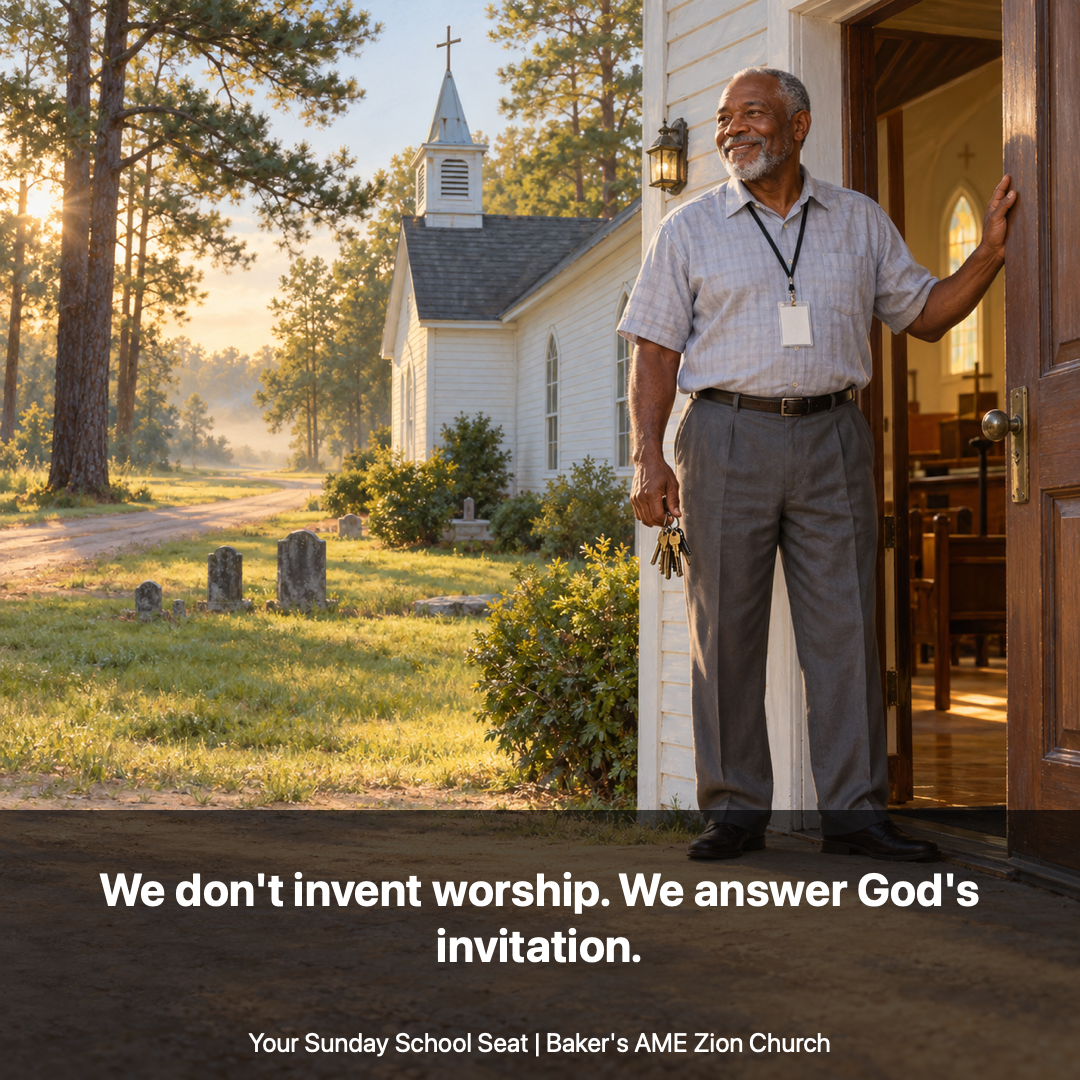
Everybody has a spot where they feel closest to God, a pew, a porch swing, a corner of the kitchen. But what happens when the way we like to worship and the way God asks to be worshiped are not the same thing?
Deuteronomy 12:1-14 — KJV
1 These are the statutes and judgments, which ye shall observe to do in the land, which the LORD God of thy fathers giveth thee to possess it, all the days that ye live upon the earth. 2 Ye shall utterly destroy all the places, wherein the nations which ye shall possess served their gods, upon the high mountains, and upon the hills, and under every green tree: 3 And ye shall overthrow their altars, and break their pillars, and burn their groves with fire; and ye shall hew down the graven images of their gods, and destroy the names of them out of that place. 4 Ye shall not do so unto the LORD your God. 5 But unto the place which the LORD your God shall choose out of all your tribes to put his name there, even unto his habitation shall ye seek, and thither thou shalt come: 6 And thither ye shall bring your burnt offerings, and your sacrifices, and your tithes, and heave offerings of your hand, and your vows, and your freewill offerings, and the firstlings of your herds and of your flocks: 7 And there ye shall eat before the LORD your God, and ye shall rejoice in all that ye put your hand unto, ye and your households, wherein the LORD thy God hath blessed thee. 8 Ye shall not do after all the things that we do here this day, every man whatsoever is right in his own eyes. 9 For ye are not as yet come to the rest and to the inheritance, which the LORD your God giveth you. 10 But when ye go over Jordan, and dwell in the land which the LORD your God giveth you to inherit, and when he giveth you rest from all your enemies round about, so that ye dwell in safety; 11 Then there shall be a place which the LORD your God shall choose to cause his name to dwell there; thither shall ye bring all that I command you; your burnt offerings, and your sacrifices, your tithes, and the heave offering of your hand, and all your choice vows which ye vow unto the LORD: 12 And ye shall rejoice before the LORD your God, ye, and your sons, and your daughters, and your menservants, and your maidservants, and the Levite that is within your gates; forasmuch as he hath no part nor inheritance with you. 13 Take heed to thyself that thou offer not thy burnt offerings in every place that thou seest: 14 But in the place which the LORD shall choose in one of thy tribes, there thou shalt offer thy burnt offerings, and there thou shalt do all that I command thee.
Deuteronomy 12:1-14 — WEB
1 These are the statutes and the ordinances which you shall observe to do in the land which Yahweh, the God of your fathers, has given you to possess all the days that you live on the earth. 2 You shall surely destroy all the places in which the nations that you shall dispossess served their gods: on the high mountains, and on the hills, and under every green tree. 3 You shall break down their altars, dash their pillars in pieces, and burn their Asherah poles with fire. You shall cut down the engraved images of their gods. You shall destroy their name out of that place. 4 You shall not do so to Yahweh your God. 5 But to the place which Yahweh your God shall choose out of all your tribes, to put his name there, you shall seek his habitation, and you shall come there. 6 You shall bring your burnt offerings, your sacrifices, your tithes, the wave offering of your hand, your vows, your free will offerings, and the firstborn of your herd and of your flock there. 7 There you shall eat before Yahweh your God, and you shall rejoice in all that you put your hand to, you and your households, in which Yahweh your God has blessed you. 8 You shall not do all the things that we do here today, every man whatever is right in his own eyes; 9 for you haven’t yet come to the rest and to the inheritance which Yahweh your God gives you. 10 But when you go over the Jordan and dwell in the land which Yahweh your God causes you to inherit, and he gives you rest from all your enemies around you, so that you dwell in safety, 11 then it shall happen that to the place which Yahweh your God shall choose, to cause his name to dwell there, there you shall bring all that I command you: your burnt offerings, your sacrifices, your tithes, the wave offering of your hand, and all your choice vows which you vow to Yahweh. 12 You shall rejoice before Yahweh your God—you, and your sons, your daughters, your male servants, your female servants, and the Levite who is within your gates, because he has no portion nor inheritance with you. 13 Be careful that you don’t offer your burnt offerings in every place that you see; 14 but in the place which Yahweh chooses in one of your tribes, there you shall offer your burnt offerings, and there you shall do all that I command you.
Explanation
Deuteronomy is Moses' last long sermon, preached on the plains of Moab with the promised land in sight. Israel is about to cross the Jordan into a country full of other people's religion. Chapter 12 opens the large section of specific instructions, and the very first thing Moses addresses is worship. That is not an accident. If a people is wrong about how to approach God, everything else tends to go wrong with it. The nations in Canaan worshiped wherever it felt spiritual: on the hilltops, under green trees, at altars that sprang up anywhere.
Moses tells Israel to tear those places down and not to worship the Lord the way the nations worship their gods. Instead they are to look for the place the Lord will choose to put His name, and to come there with their offerings. The point is bigger than geography. It is about who sets the terms. God is not a power we summon in whatever way suits us. He reveals Himself and invites us in. And look at what God's design for worship looks like: bringing what you have, eating together before the Lord, and rejoicing in all you have put your hand to, "ye and your households." Worship the way God designs it is full of tables, families, and gladness. Then verse 8 warns against the opposite approach, everyone doing whatever is right in his own eyes.
Keep that phrase in mind, because it echoes straight through the book of Judges, which is where Sunday's lesson lives. Judges 2 tells us Israel "forsook the Lord" and served the Baals. It did not start with a dramatic announcement. It started when worship became shaped by whatever felt right instead of what God had said. The slide toward evil in Judges begins at the altar, and Deuteronomy 12 is Moses' attempt to stop it before it starts.
We no longer have one chosen location; Jesus told the woman at the well that true worshipers will worship in spirit and in truth. But the principle holds. Worship is God's invitation, not our invention. This is not an argument about hymns versus guitars or short services versus long ones. It is a question about whether we come to meet God or to meet ourselves. Do our habits of worship, gathering with God's people, hearing the Word, praying, sharing the table, come from what God has shown us, or from what is convenient and comfortable? And do we leave rejoicing? Moses expected that we would.
Thought for the Day
We don't invent worship. We answer God's invitation.
Reflection Question
Is your worship shaped more by what God has asked of us or by what feels comfortable, and what is one small step toward the first?
Prayer
Lord, You are worthy of our worship, and You have shown us how to come to You. Forgive us when we make worship about ourselves. Draw us to Your house, Your Word, and Your people with glad hearts. Let our families leave rejoicing in You. In Jesus' name, Amen.
This week we walk toward Sunday's lesson: God Works Despite Evil.
Tuesday, October 6 — Where Sin Grew, Grace Grew More
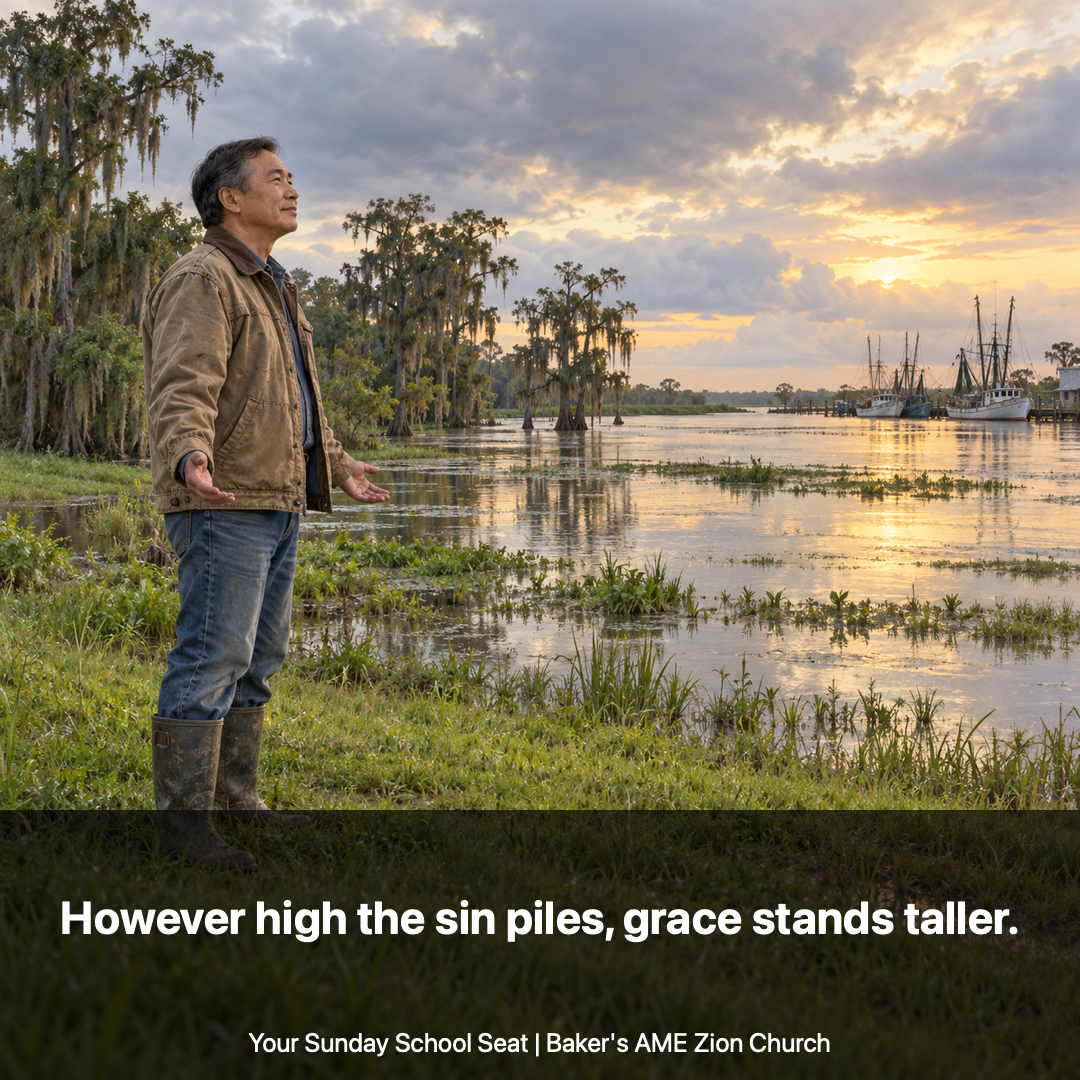
One bad decision at the top can ripple through a whole department, a whole household, a whole town. Paul says that is an old story, and then he tells a better one.
Romans 5:11-21 — KJV
11 And not only so, but we also joy in God through our Lord Jesus Christ, by whom we have now received the atonement. 12 Wherefore, as by one man sin entered into the world, and death by sin; and so death passed upon all men, for that all have sinned: 13 (For until the law sin was in the world: but sin is not imputed when there is no law. 14 Nevertheless death reigned from Adam to Moses, even over them that had not sinned after the similitude of Adam’s transgression, who is the figure of him that was to come. 15 But not as the offence, so also is the free gift. For if through the offence of one many be dead, much more the grace of God, and the gift by grace, which is by one man, Jesus Christ, hath abounded unto many. 16 And not as it was by one that sinned, so is the gift: for the judgment was by one to condemnation, but the free gift is of many offences unto justification. 17 For if by one man’s offence death reigned by one; much more they which receive abundance of grace and of the gift of righteousness shall reign in life by one, Jesus Christ.) 18 Therefore as by the offence of one judgment came upon all men to condemnation; even so by the righteousness of one the free gift came upon all men unto justification of life. 19 For as by one man’s disobedience many were made sinners, so by the obedience of one shall many be made righteous. 20 Moreover the law entered, that the offence might abound. But where sin abounded, grace did much more abound: 21 That as sin hath reigned unto death, even so might grace reign through righteousness unto eternal life by Jesus Christ our Lord.
Romans 5:11-21 — WEB
11 Not only so, but we also rejoice in God through our Lord Jesus Christ, through whom we have now received the reconciliation. 12 Therefore as sin entered into the world through one man, and death through sin; so death passed to all men, because all sinned. 13 For until the law, sin was in the world; but sin is not charged when there is no law. 14 Nevertheless death reigned from Adam until Moses, even over those whose sins weren’t like Adam’s disobedience, who is a foreshadowing of him who was to come. 15 But the free gift isn’t like the trespass. For if by the trespass of the one the many died, much more did the grace of God, and the gift by the grace of the one man, Jesus Christ, abound to the many. 16 The gift is not as through one who sinned; for the judgment came by one to condemnation, but the free gift came of many trespasses to justification. 17 For if by the trespass of the one, death reigned through the one; so much more will those who receive the abundance of grace and of the gift of righteousness reign in life through the one, Jesus Christ. 18 So then as through one trespass, all men were condemned; even so through one act of righteousness, all men were justified to life. 19 For as through the one man’s disobedience many were made sinners, even so through the obedience of the one, many will be made righteous. 20 The law came in that the trespass might abound; but where sin abounded, grace abounded more exceedingly; 21 that as sin reigned in death, even so grace might reign through righteousness to eternal life through Jesus Christ our Lord.
Explanation
In the ancient world, one person often stood for a whole people. A king's choice became the nation's fate; a head of household set the direction for everyone under his roof. Paul uses that way of thinking to tell the oldest story in the Bible in a new way. Through one man, Adam, sin entered the world and death spread to everyone. Paul says sin and death have been reigning, ruling like a harsh king over human life. He repeats that word "reign" on purpose, because he wants us to feel the weight of living under something that will not let go.
Then comes the turn, and Paul keeps using the same small phrase: "much more." The free gift is not like the offense. If the trespass of one brought death to many, then the grace of God, through one man Jesus Christ, abounds to many much more. The law came in so the offense would be seen for how deep it runs. But where sin abounded, grace did much more abound. That is not permission to be careless; Paul shuts that door in the very next chapter. It is a yardstick. Whatever the biggest mess in the room is, grace is bigger. At the end, grace reigns, taking the throne that sin and death had been sitting on.
Sunday's lesson in Judges 2 is a chapter where the offense abounds. A whole generation grows up not knowing the Lord, the people serve other gods, and trouble snowballs. If we read it alone, it is hard to see anything but a downward slide. Paul gives us the other half of the picture. When evil runs wild, God does not retreat. He out-gives it. That is what the lesson title means by "God Works Despite Evil," not around it, not after it is over, but right in the middle of it.
Think about the patterns that run through families: the temper, the silence, the addiction, the money fights, the promises that never got kept. People shrug and say, "That's just how we are." The Adam story says those patterns are real. The Christ story says they are not final. You may be the first person in your family line who chooses differently, and you will not be doing it alone. The same goes for what we see in the news or on our own street. When the problem looks too large for anyone to fix, "much more" is the Christian vocabulary of hope. Grace has the final word, and it is bigger than the thing you are afraid of.
Thought for the Day
However high the sin piles, grace stands taller.
Reflection Question
What pattern in your family or your own life feels unbreakable, and what would it look like to trust that grace is "much more"?
Prayer
God of grace, we see how deep sin runs in our world and in our own hearts. Thank You that Your grace runs deeper still. Break the patterns we thought we were stuck with. Let grace reign in our homes and in our habits today. In Jesus' name, Amen.
This week we walk toward Sunday's lesson: God Works Despite Evil.
Monday, October 5 — Loved Before We Got It Right

Most of us can name the day we felt we had finally earned someone's respect. Far fewer of us can name a day we felt fully loved when we hadn't earned a thing.
Romans 5:1-10 — KJV
1 Therefore being justified by faith, we have peace with God through our Lord Jesus Christ: 2 By whom also we have access by faith into this grace wherein we stand, and rejoice in hope of the glory of God. 3 And not only so, but we glory in tribulations also: knowing that tribulation worketh patience; 4 And patience, experience; and experience, hope: 5 And hope maketh not ashamed; because the love of God is shed abroad in our hearts by the Holy Ghost which is given unto us. 6 For when we were yet without strength, in due time Christ died for the ungodly. 7 For scarcely for a righteous man will one die: yet peradventure for a good man some would even dare to die. 8 But God commendeth his love toward us, in that, while we were yet sinners, Christ died for us. 9 Much more then, being now justified by his blood, we shall be saved from wrath through him. 10 For if, when we were enemies, we were reconciled to God by the death of his Son, much more, being reconciled, we shall be saved by his life.
Romans 5:1-10 — WEB
1 Being therefore justified by faith, we have peace with God through our Lord Jesus Christ; 2 through whom we also have our access by faith into this grace in which we stand. We rejoice in hope of the glory of God. 3 Not only this, but we also rejoice in our sufferings, knowing that suffering produces perseverance; 4 and perseverance, proven character; and proven character, hope: 5 and hope doesn’t disappoint us, because God’s love has been poured into our hearts through the Holy Spirit who was given to us. 6 For while we were yet weak, at the right time Christ died for the ungodly. 7 For one will hardly die for a righteous man. Yet perhaps for a righteous person someone would even dare to die. 8 But God commends his own love toward us, in that while we were yet sinners, Christ died for us. 9 Much more then, being now justified by his blood, we will be saved from God’s wrath through him. 10 For if while we were enemies, we were reconciled to God through the death of his Son, much more, being reconciled, we will be saved by his life.
Explanation
Paul wrote Romans to a church in the capital of the empire, a city that ran on rank, reputation, and who owed whom. The believers there were a mix of Jews and Gentiles who were still sorting out how they fit together. In the first four chapters Paul argues that everyone stands in the same place before God and that God sets people right through faith, not performance. Chapter 5 opens with a big "therefore": here is what that gets us. Peace with God. Access into grace. A hope that does not leave us embarrassed.
Notice that Paul says we already have this peace. It is not a prize at the end of a good record. He even finds a use for hard times: trouble teaches patience, patience builds character, and character grows hope, because God's love has been poured into our hearts. Then he gets to the center of it. When we were weak, when we were ungodly, when we were sinners, even enemies, Christ died for us. Paul admits that people will hardly die for a righteous person, and maybe for a really good one someone might dare it. God proved His love in the opposite direction: at our worst, not our best.
That is the doorway into Sunday's lesson. Our unit is called "Lacking Leadership and a Moral Compass," and Sunday's reading in Judges 2 shows a people choosing badly, generation after generation. The title of the lesson, "God Works Despite Evil," only makes sense if God's love does not wait on our getting it right. Romans 5 is the New Testament version of that same truth. If Christ died for us while we were still sinners, then our worst chapters are not the end of the story, and they are not what decides how God feels about us.
Plenty of us carry a quiet ledger. A parent who needed us to be perfect. A boss who remembers every miss. Our own voice, replaying the thing we said or the thing we did not do. We pray as if we are on probation. Paul says we are not. This week, when you fail in the ordinary ways, the short temper in the kitchen, the missed deadline, the text you wish you could unsend, try starting with "I am still loved" instead of starting with hiding. Grace does not make us careless. It makes us honest, because there is nothing left to hide behind.
Thought for the Day
God loved us before we ever got it right.
Reflection Question
Where are you still acting like you are on probation with God, and what would change if you believed you are already loved?
Prayer
Lord, thank You for loving us when we had nothing to offer. We confess how often we try to earn what You have already given. Settle our hearts in Your peace today. Help us live like people who are loved, not people who are afraid. In Jesus' name, Amen.
This week we walk toward Sunday's lesson: God Works Despite Evil.
October 5 - 11: GOd Works Despite Evil
This week we look at a people who made the wrong choices, and a God who did not let go. Across seven readings, from Paul's good news that Christ died for us while we were still sinners, to Moses' warning against borrowed worship, to the call to take off the old self and put on love, we see how God's grace meets us in our failure. It all builds to Sunday's lesson, "God Works Despite Evil," where a generation forgets the Lord and the Lord stays faithful anyway. Watch, walk through the week with us, and join us for Sunday school.
Monday — Loved Before We Got It Right (Romans 5:1-10)
Tuesday — Where Sin Grew, Grace Grew More (Romans 5:11-21)
Wednesday — Worship God on God's Terms (Deuteronomy 12:1-14)
Thursday — Beware of Borrowed Worship (Deuteronomy 12:20-32)
Friday — Take Off the Old Self (Colossians 3:1-11)
Saturday — Get Dressed in Love (Colossians 3:12-17)
Sunday — God Stays Faithful Anyway (Judges 2:1-15)
Your Sunday School Seat | Baker's AME Zion Church — We Saved You a Seat
#YourSundaySchoolSeat #AMEZion #DailyDevotional #Faith #BlackChurch #GodIsFaithful
Saturday, October 3 — Eyes Ever Toward the Lord
Some prayers are polished. Others come out at two in the morning in a hospital parking lot. Psalm 25 has both in it.
Psalm 25:12-22 — KJV
12 What man is he that feareth the LORD? him shall he teach in the way that he shall choose. 13 His soul shall dwell at ease; and his seed shall inherit the earth. 14 The secret of the LORD is with them that fear him; and he will shew them his covenant. 15 Mine eyes are ever toward the LORD; for he shall pluck my feet out of the net. 16 Turn thee unto me, and have mercy upon me; for I am desolate and afflicted. 17 The troubles of my heart are enlarged: O bring thou me out of my distresses. 18 Look upon mine affliction and my pain; and forgive all my sins. 19 Consider mine enemies; for they are many; and they hate me with cruel hatred. 20 O keep my soul, and deliver me: let me not be ashamed; for I put my trust in thee. 21 Let integrity and uprightness preserve me; for I wait on thee. 22 Redeem Israel, O God, out of all his troubles.
Psalm 25:12-22 — WEB
12 What man is he who fears Yahweh? He shall instruct him in the way that he shall choose. 13 His soul will dwell at ease. His offspring will inherit the land. 14 The friendship of Yahweh is with those who fear him. He will show them his covenant. 15 My eyes are ever on Yahweh, for he will pluck my feet out of the net. 16 Turn to me, and have mercy on me, for I am desolate and afflicted. 17 The troubles of my heart are enlarged. Oh bring me out of my distresses. 18 Consider my affliction and my travail. Forgive all my sins. 19 Consider my enemies, for they are many. They hate me with cruel hatred. 20 Oh keep my soul, and deliver me. Let me not be disappointed, for I take refuge in you. 21 Let integrity and uprightness preserve me, for I wait for you. 22 Redeem Israel, God, out of all his troubles.
Explanation
Psalm 25 is a psalm of David, and in Hebrew it is an acrostic — each verse begins with the next letter of the alphabet, an A-to-Z of trust. That means it was carefully crafted. And yet the feelings inside it are raw: loneliness, affliction, enemies, sin. Craft and honesty sit side by side. Then the last verse, which falls outside the alphabet pattern, widens the prayer from one person to a whole people: "Redeem Israel, O God, out of all his troubles."
The first few verses of today's reading describe the person who "feareth the LORD" — not cowering terror, but deep reverence that takes God seriously. God teaches that person "in the way that he shall choose." The "secret of the LORD" — the WEB says His friendship — belongs to those who fear Him. It is the language of the inner circle, the friend you tell the truth to.
Then the tone shifts. "Mine eyes are ever toward the LORD; for he shall pluck my feet out of the net." A net is a hunter's trap. The psalmist is caught. He is desolate and afflicted. The troubles of his heart are "enlarged." His enemies are many and their hatred is cruel. And tucked in the middle of all that outside pressure is an inside confession: "forgive all my sins." He doesn't pretend to be a pure victim. He asks for rescue and for mercy in the same breath.
This psalm is the honest inside view of Sunday's lesson. When Israel promised "we will serve the LORD," they did not sign up for a trouble-free life. Committing to God's way — and refusing to go along with the world's way — can leave a person feeling desolate and surrounded. Commitment isn't the absence of the net. It's where your eyes go when the net closes around your feet.
Notice what the psalmist asks to be kept by: "Let integrity and uprightness preserve me." Integrity — keeping your word, being the same person in private and in public — is its own kind of protection. And notice his posture: "I wait on thee." Most of us know waiting rooms well. The psalm doesn't rush you out of them. It teaches you where to look while you're sitting there.
Then comes that final turn. After all his personal troubles, David ends by praying for everyone. Redeem Israel. That is a healthy way to pray. Pray for your need, and then pray for your street, your church, the families on your block who are also caught in nets you can't see. Redemption was never meant to be a private matter.
Thought for the Day
When trouble surrounds you, keep your eyes on God.
Reflection Question
When trouble shows up, where do your eyes usually go first — to the net, or to the Lord?
Prayer
Lord, my eyes are toward You today. You know the nets around my feet and the troubles that have grown bigger than I can carry. Forgive my sins, keep my soul, and let integrity guard me while I wait. And redeem Your people, God — my family, my church, my community — out of all our troubles. Amen.
This week we walk toward Sunday's lesson: Radical Commitment to God's Way.