
Saturday, August 15 — The Weight You Don't Have to Carry
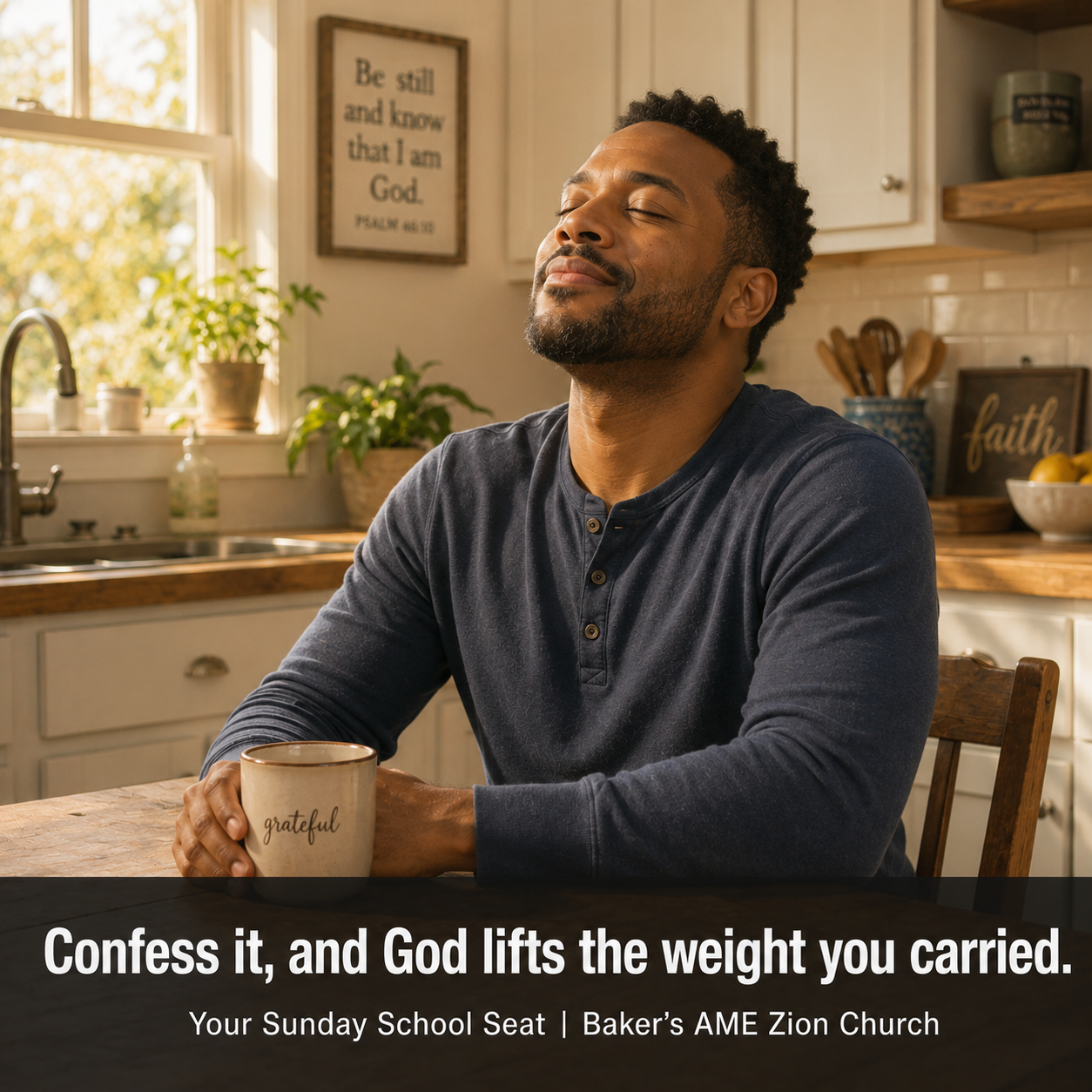
There's a particular kind of tired that no nap fixes — the heaviness of carrying something you've never said out loud. Today's psalm is about finally setting it down.
Psalm 32 — KJV
1 Blessed is he whose transgression is forgiven, whose sin is covered. 2 Blessed is the man unto whom the LORD imputeth not iniquity, and in whose spirit there is no guile. 3 When I kept silence, my bones waxed old through my roaring all the day long. 4 For day and night thy hand was heavy upon me: my moisture is turned into the drought of summer. Selah. 5 I acknowledged my sin unto thee, and mine iniquity have I not hid. I said, I will confess my transgressions unto the LORD; and thou forgavest the iniquity of my sin. Selah. 6 For this shall every one that is godly pray unto thee in a time when thou mayest be found: surely in the floods of great waters they shall not come nigh unto him. 7 Thou art my hiding place; thou shalt preserve me from trouble; thou shalt compass me about with songs of deliverance. Selah. 8 I will instruct thee and teach thee in the way which thou shalt go: I will guide thee with mine eye. 9 Be ye not as the horse, or as the mule, which have no understanding: whose mouth must be held in with bit and bridle, lest they come near unto thee. 10 Many sorrows shall be to the wicked: but he that trusteth in the LORD, mercy shall compass him about. 11 Be glad in the LORD, and rejoice, ye righteous: and shout for joy, all ye that are upright in heart.
Psalm 32 — WEB
1 Blessed is he whose disobedience is forgiven, whose sin is covered. 2 Blessed is the man to whom Yahweh doesn't impute iniquity, in whose spirit there is no deceit. 3 When I kept silence, my bones wasted away through my groaning all day long. 4 For day and night your hand was heavy on me. My strength was sapped in the heat of summer. Selah. 5 I acknowledged my sin to you. I didn't hide my iniquity. I said, I will confess my transgressions to Yahweh, and you forgave the iniquity of my sin. Selah. 6 For this, let everyone who is godly pray to you in a time when you may be found. Surely when the great waters overflow, they shall not reach to him. 7 You are my hiding place. You will preserve me from trouble. You will surround me with songs of deliverance. Selah. 8 I will instruct you and teach you in the way which you shall go. I will counsel you with my eye on you. 9 Don't be like the horse, or like the mule, which have no understanding, who are controlled by bit and bridle, or else they will not come near to you. 10 Many sorrows come to the wicked, but loving kindness shall surround him who trusts in Yahweh. 11 Be glad in Yahweh, and rejoice, you righteous! Shout for joy, all you who are upright in heart!
Explanation
This is one of David's psalms of confession, and he doesn't start with the sin — he starts with the joy on the other side of it. "Blessed is he whose transgression is forgiven, whose sin is covered." He's telling us where the road ends before he describes the road, because he wants us to know it's worth the walk.
Then he gets honest about the cost of hiding. Verses 3 and 4 are some of the most physical descriptions of guilt in Scripture. When he kept silent, his bones wasted away, he groaned all day, his strength dried up like a creek bed in August heat. Anyone who has sat on a secret knows this feeling. Unconfessed wrong doesn't stay tucked away quietly; it leaks out as exhaustion, irritability, and that low hum of dread you can't name.
Verse 5 is the turn, and it happens fast — almost as fast as it happens in real life once you finally decide to stop running. "I acknowledged my sin unto thee... and thou forgavest." He barely finishes the sentence about confessing before God has already forgiven. That's the good news hiding in this psalm: God isn't reluctant. He's been waiting for you to stop hiding.
And notice what forgiveness opens up. God says in verse 8, "I will instruct thee and teach thee in the way which thou shalt go." Confession doesn't just clear the past; it reopens the relationship. God moves from being the heavy hand in verse 4 to the guiding eye in verse 8. He'd rather lead you gently than have to steer you like a stubborn mule.
This is the perfect place to be the day before we study Saul. Because on Sunday we meet a man whose sins were public and serious, and we watch God not only forgive him but commission him. Psalm 32 tells us the inner experience of what happened to Saul: the crushing weight of the old life, and the flood of relief when mercy has the last word. The psalm even ends where a forgiven life belongs — in rejoicing.
So here's the practical invitation for a Saturday. Is there something you've been keeping silent about, carrying alone, hoping it'll fade? It won't fade; it'll just get heavier. Take David's path. Bring it honestly to God, name it, don't dress it up. You may be surprised how quickly the weight lifts, and how the same God who forgives is ready to start guiding you forward. You were never meant to carry it. Set it down and let the rejoicing start.
Thought for the Day
Confess it, and God lifts the weight you carried.
Reflection Question
What have you been keeping silent that God is inviting you to bring into the light?
Prayer
Lord, I'm tired of carrying what I've never said out loud. Today I stop hiding. I bring it to You honestly, trusting that You forgive the moment I confess. Thank You for being my hiding place instead of my judge. Now teach me the way I should go, and let the weight I've carried turn into a song. Amen.
This week we walk toward Sunday's lesson: Saul of Tarsus, How a Pharisee Became a Christian.