
Saturday, August 29 — What You Do With What You Have
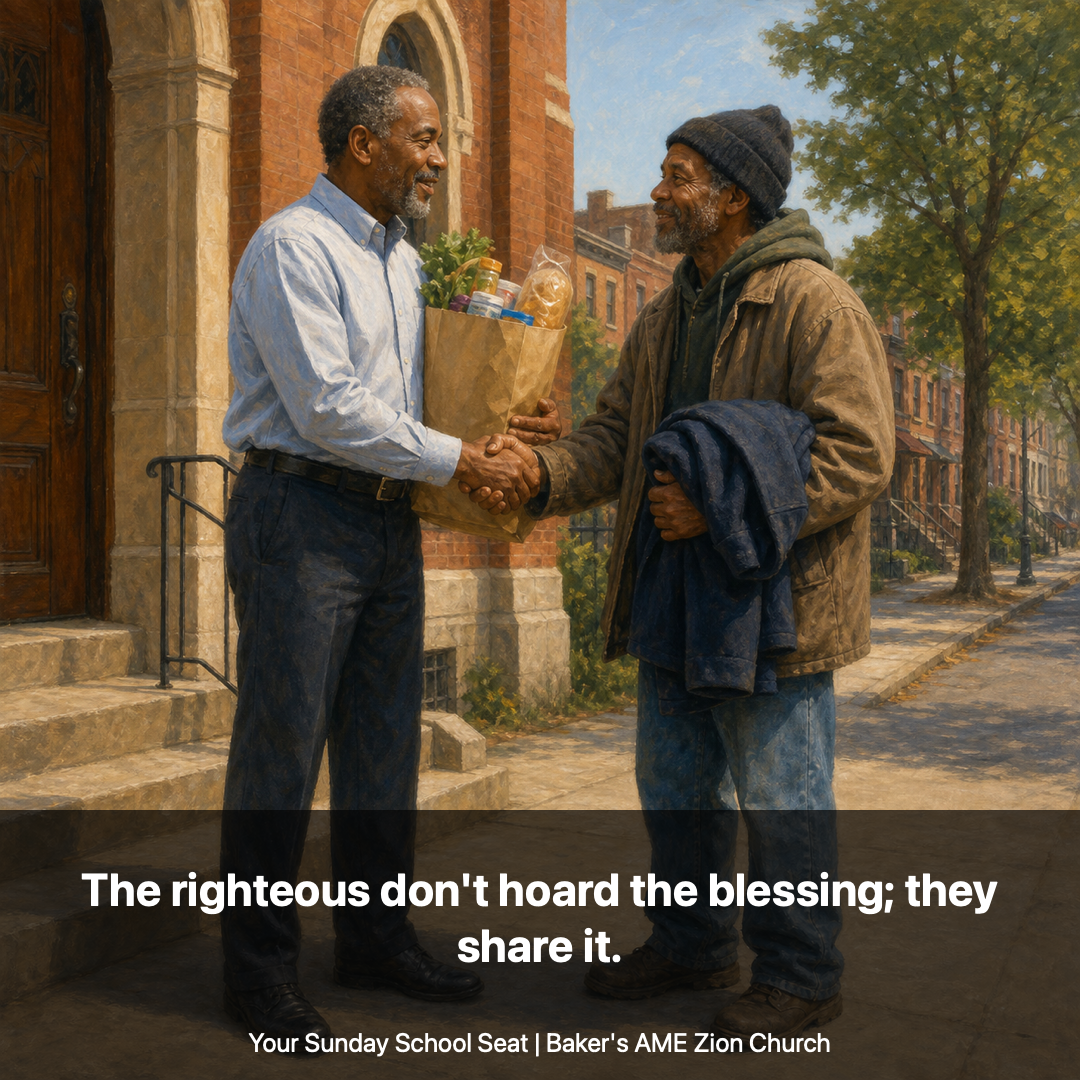
Job is defending his life before God, and his argument isn't about sacrifices or prayers. It's about how he treated the poor, the widow, and the fatherless — and about the wealth he refused to worship.
Job 31:16-28 — KJV
16 If I have withheld the poor from their desire, or have caused the eyes of the widow to fail; 17 Or have eaten my morsel myself alone, and the fatherless hath not eaten thereof; 18 (For from my youth he was brought up with me, as with a father, and I have guided her from my mother's womb;) 19 If I have seen any perish for want of clothing, or any poor without covering; 20 If his loins have not blessed me, and if he were not warmed with the fleece of my sheep; 21 If I have lifted up my hand against the fatherless, when I saw my help in the gate: 22 Then let mine arm fall from my shoulder blade, and mine arm be broken from the bone. 23 For destruction from God was a terror to me, and by reason of his highness I could not endure. 24 If I have made gold my hope, or have said to the fine gold, Thou art my confidence; 25 If I rejoiced because my wealth was great, and because mine hand had gotten much; 26 If I beheld the sun when it shined, or the moon walking in brightness; 27 And my heart hath been secretly enticed, or my mouth hath kissed my hand: 28 This also were an iniquity to be punished by the judge: for I should have denied the God that is above.
Job 31:16-28 — WEB
16 "If I have withheld the poor from their desire, or have caused the eyes of the widow to fail, 17 or have eaten my morsel alone, and the fatherless has not eaten of it 18 (no, from my youth he grew up with me as with a father, her have I guided from my mother's womb); 19 if I have seen any perish for want of clothing, or that the needy had no covering; 20 if his heart hasn't blessed me, if he hasn't been warmed with my sheep's fleece; 21 if I have lifted up my hand against the fatherless, because I saw my help in the gate, 22 then let my shoulder fall from the shoulder blade, and my arm be broken from the bone. 23 For calamity from God is a terror to me. Because of his majesty, I can do nothing. 24 "If I have made gold my hope, and have said to the fine gold, 'You are my confidence'; 25 If I have rejoiced because my wealth was great, and because my hand had gotten much; 26 if I have seen the sun when it shined, or the moon moving in splendor, 27 and my heart has been secretly enticed, and my hand threw a kiss from my mouth, 28 this also would be an iniquity to be punished by the judges, for I should have denied the God who is above.
Explanation
By this point in the book of Job, our man has lost nearly everything and endured round after round of accusation from his friends. Here he mounts his defense — not a list of religious rituals, but an accounting of how he lived among people who could do nothing for him. He points to the poor whose desires he did not withhold, the widow whose eyes he did not cause to fail, the fatherless he fed at his own table and raised almost as his own. Job's righteousness wasn't private and internal. It was measured at the level of a hungry stranger's plate and a cold man's blanket.
Then the passage takes a turn that connects it to everything we've read this week. Job says that if he had made gold his hope, if he had gloated over his wealth or trusted his fortune the way some people trust the sun and moon, that too would have been a sin — a quiet denial of "the God who is above." Here's a wealthy man insisting that the danger of riches isn't the having; it's the worshiping. He held his fortune with an open hand precisely because he refused to let it become his god. His provision flowed to others because it never became his idol.
That's the exact intersection our week has been driving toward. All week we've watched faithful people put their resources to work for others: Peter's stewards, the Shunammite's spare room, the Proverbs woman's open hand, the servants who invested their talents. Job adds the warning underneath all of it — the reason people bury their gifts and close their doors is usually that they've quietly started to trust their stuff more than their God. Tomorrow, Lydia will hold her purple-trade wealth the way Job describes: loosely, generously, as something to be spent on God's people rather than hoarded for herself.
So this Saturday, as the week's chores and errands and bills press in, Job hands us a mirror. Two questions, really. First: does anyone eat, stay warm, or stand a little taller because of what God has entrusted to you? And second, quieter and harder: what are you actually trusting? It's possible to be generous with your hands while your heart is slowly bowing to your bank balance. The righteous provide for others, Job says, and they can do it freely because their confidence was never in the gold to begin with. Give it away. And keep your heart free.
Thought for the Day
What we share proves what we really believe.
Reflection Question
Is there anything you've quietly begun to trust more than God — and how might loosening your grip bless someone else?
Prayer
Lord, You see straight through my hands to my heart. Keep me from the slow idolatry of trusting what I own. Make me generous to the poor, the widow, and the forgotten — not for show, but because my confidence rests in You alone. Let my open hand be honest proof of where my hope truly lies. Amen.
This week we walk toward Sunday's lesson: Lydia, Judged to Be Faithful.