
Monday, October 12 — Live Fully, Die Unafraid
Most of us plan for the day we retire. Paul is writing from a guarded room, planning for the possibility that he won't.
Philippians 1:21-30 — KJV
21 For to me to live is Christ, and to die is gain. 22 But if I live in the flesh, this is the fruit of my labour: yet what I shall choose I wot not. 23 For I am in a strait betwixt two, having a desire to depart, and to be with Christ; which is far better: 24 Nevertheless to abide in the flesh is more needful for you. 25 And having this confidence, I know that I shall abide and continue with you all for your furtherance and joy of faith; 26 That your rejoicing may be more abundant in Jesus Christ for me by my coming to you again. 27 Only let your conversation be as it becometh the gospel of Christ: that whether I come and see you, or else be absent, I may hear of your affairs, that ye stand fast in one spirit, with one mind striving together for the faith of the gospel; 28 And in nothing terrified by your adversaries: which is to them an evident token of perdition, but to you of salvation, and that of God. 29 For unto you it is given in the behalf of Christ, not only to believe on him, but also to suffer for his sake; 30 Having the same conflict which ye saw in me, and now hear to be in me.
Philippians 1:21-30 — WEB
21 For to me to live is Christ, and to die is gain. 22 But if I live on in the flesh, this will bring fruit from my work; yet I don't know what I will choose. 23 But I am in a dilemma between the two, having the desire to depart and be with Christ, which is far better. 24 Yet, to remain in the flesh is more needful for your sake. 25 Having this confidence, I know that I will remain, yes, and remain with you all, for your progress and joy in the faith, 26 that your rejoicing may abound in Christ Jesus in me through my presence with you again. 27 Only let your way of life be worthy of the Good News of Christ, that, whether I come and see you or am absent, I may hear of your state, that you stand firm in one spirit, with one soul striving for the faith of the Good News; 28 and in nothing frightened by the adversaries, which is for them a proof of destruction, but to you of salvation, and that from God. 29 Because it has been granted to you on behalf of Christ, not only to believe in him, but also to suffer on his behalf, 30 having the same conflict which you saw in me, and now hear is in me.
Explanation
Philippians is a thank-you note written from confinement. Paul is under guard, most likely in Rome, waiting on a verdict that could go either way, and he is writing to a church in Philippi, a city proud of its Roman citizenship, that has been supporting him. The letter is known for joy, which is what makes this passage so striking. Paul is doing the thing most of us avoid at all costs: he looks at his own death and calls both options good.
"For to me to live is Christ, and to die is gain" is not a bumper sticker. It is a statement about what Paul's whole life is organized around. If Christ is the center, then dying moves him closer to the center, and living means more fruitful work among people he loves. He is "in a strait betwixt two," pressed from both sides, and then he settles it by thinking of others: staying "is more needful for you." That is not bravado. It is the calm of someone whose identity cannot be repossessed. Then he turns to the Philippians: whatever happens to me, let your way of life be worthy of the gospel, stand firm together in one spirit, and don't be frightened by those who oppose you. He even says that suffering for Christ has been "granted" to them, part of the same calling and the same struggle he is in.
Here is the thread to Sunday. This week's lesson is about a people who lost their moral compass, ended up under a foreign king, and then needed courage when God raised up a deliverer. Philippians shows what that kind of courage is made of. It is not a clenched jaw. It is a settled answer to the question "what do I most belong to?" Israel under Eglon had forgotten the answer. Paul, under guard, has not. And the rest God promises later this week begins in the same place: you can only rest once you have decided who is in charge.
Most of our fears are smaller versions of Paul's. The layoff rumor. The phone call about a child. The appointment we keep rescheduling. The conversation we dread. We tell ourselves the stakes are everything, and sometimes they are. Paul doesn't deny the stakes. He changes the question: if the worst happened, what would still be mine? And notice the phrase "striving together." Courage is easier in a row of folding chairs than alone at three in the morning. Who is standing next to you this week?
Thought for the Day
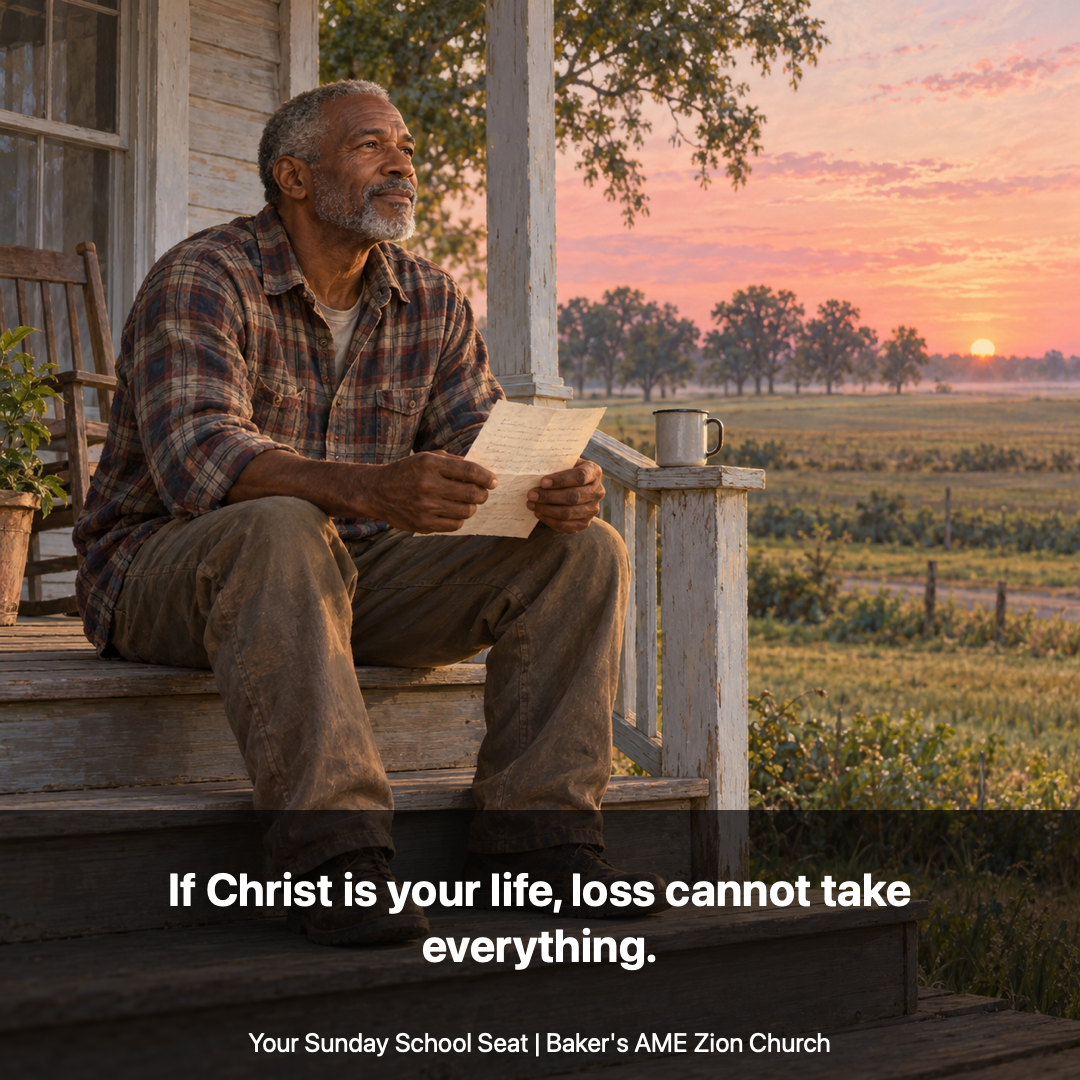
If Christ is your life, loss cannot take everything.
Reflection Question
What are you most afraid of losing right now, and what would still be yours if you lost it?
Prayer
Lord, we confess that we hold some things too tightly and fear some things too much. Teach us to say with Paul that Christ is our life and that nothing can finally take us from You. Give us courage for what is in front of us, and put steady people beside us so we do not face it alone. Make our ordinary days worthy of the good news we say we believe.
This week we walk toward Sunday's lesson: God Works Through Ehud.