

A daily walk through Scripture, preparing our hearts for Sunday.
Tuesday, May 5 — Hand It Over
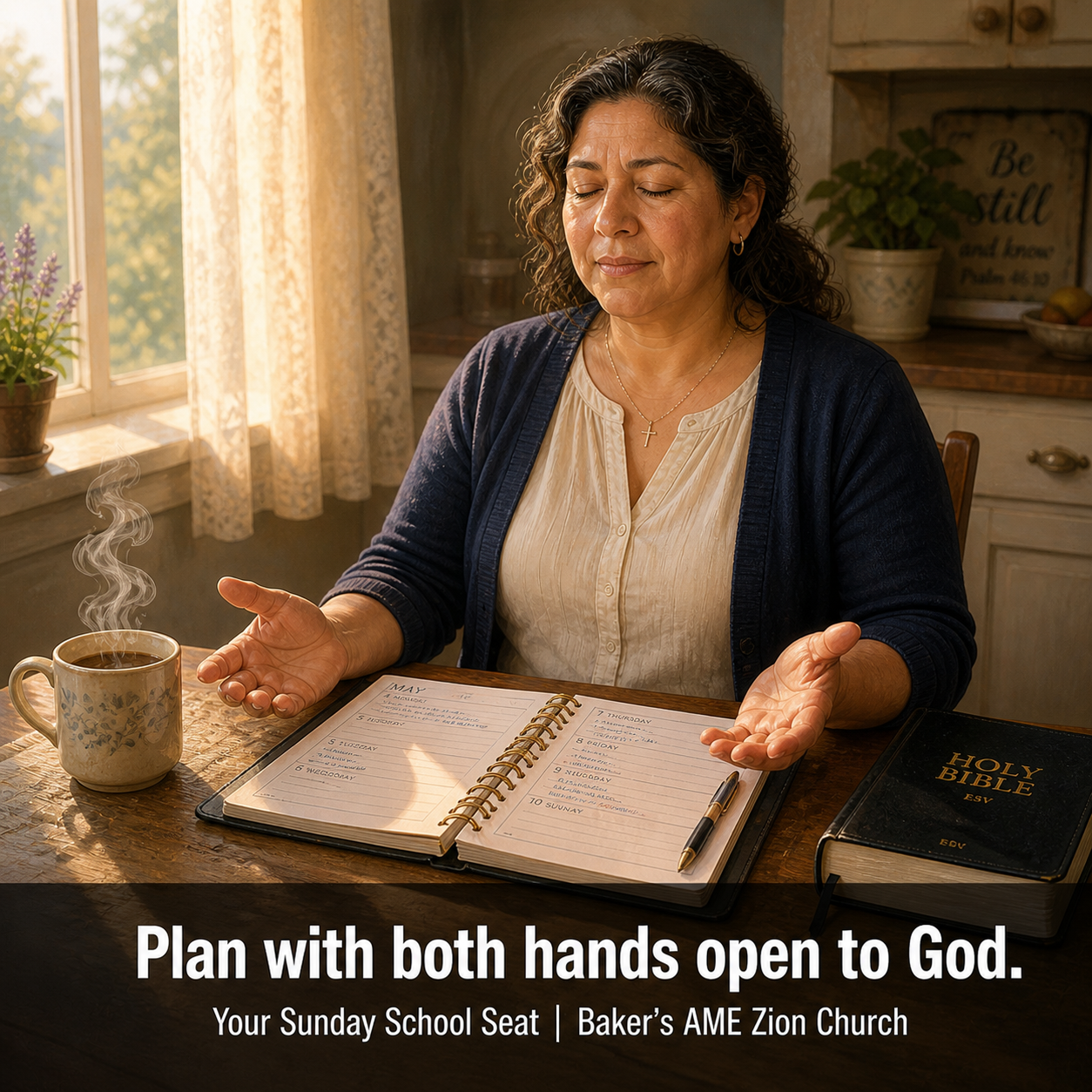
You can plan all you want. The plans are not the problem. The problem is what you do with them when they hit the air.
Proverbs 16:1-3, 8-9 — KJV
The preparations of the heart in man, and the answer of the tongue, is from the LORD. All the ways of a man are clean in his own eyes; but the LORD weigheth the spirits. Commit thy works unto the LORD, and thy thoughts shall be established. ... Better is a little with righteousness than great revenues without right. A man's heart deviseth his way: but the LORD directeth his steps.
Proverbs 16:1-3, 8-9 — WEB
The plans of the heart belong to man, but the answer of the tongue is from the LORD. All the ways of a man are clean in his own eyes, but the LORD weighs the motives. Commit your deeds to the LORD, and your plans shall succeed. ... Better is a little with righteousness, than great revenues with injustice. A man's heart plans his course, but the LORD directs his steps.
Explanation
Proverbs is a strange and wonderful book. It is wisdom literature — short, dense, pithy lines that turn over slowly in your mind, like a stone you keep picking up off your desk. Most of these proverbs are credited to Solomon, the king who, when given a single wish, asked God for wisdom instead of money. The book reads like the field notes of a person who has been paying attention for a very long time.
Today's verses are about the gap between what we plan and what actually happens. The proverbs do not mock our planning. Plans are good. The Bible has no patience with people who refuse to think ahead. But it draws a line between planning and controlling. Verse 9 has been read and reread for three thousand years because it tells the truth so cleanly: a man's heart devises his way, but the LORD directs his steps. You can lay out your map all you want. The road still does what the road does.
The hinge of the passage is verse 3. Commit your works to the LORD, and your plans shall succeed. The Hebrew word for "commit" is one of those wonderfully physical words. It means literally to roll something — to roll your work onto God like rolling a heavy stone off your own back and onto someone strong enough to carry it. Notice what is not being asked of you. You are not being asked to stop working. You are not being asked to give up your goals. You are being asked to put the weight of them down at the right address.
Most of us are exhausted because we are trying to be both the worker and the guarantor. We do the labor and we also try to manage every outcome. We do the deal and we also try to manage what the client thinks. We raise the kids and we also try to lock in the future. It is too much. We were not built for it. The proverb pulls our hands off the steering wheel of things we never had control of in the first place and tells us to do our part with a quiet heart.
There is a small word in verse 8 that is easy to miss: better. Better is a little with righteousness than great revenues without right. The world keeps telling us that more is the goal. The proverb says the goal is integrity. A small honest paycheck blesses you. A bigger crooked one corrodes you. The way you do the work matters more than how much of it you have.
This is the wisdom we carry into our week of useful work. Plan honestly. Commit your work to the Lord. Then go do it without choking the life out of yourself trying to control what was never yours to control.
Thought for the day: You do the work. You do not have to do God's job too.
Reflection question: What plan or project have you been gripping so tightly that you have forgotten to roll it onto the Lord? What would it look like to actually let go today?
Prayer
Lord, we are planners and worriers, and we get those two things confused. Teach us to think clearly, work faithfully, and trust you with the parts we cannot see. Loosen our grip where we have been trying to be God instead of letting you be God. Make our small days righteous days. Amen.
This week we walk toward Sunday's lesson: Useful Work as Christian Duty.
Monday, May 4 — Work Was Always the Plan
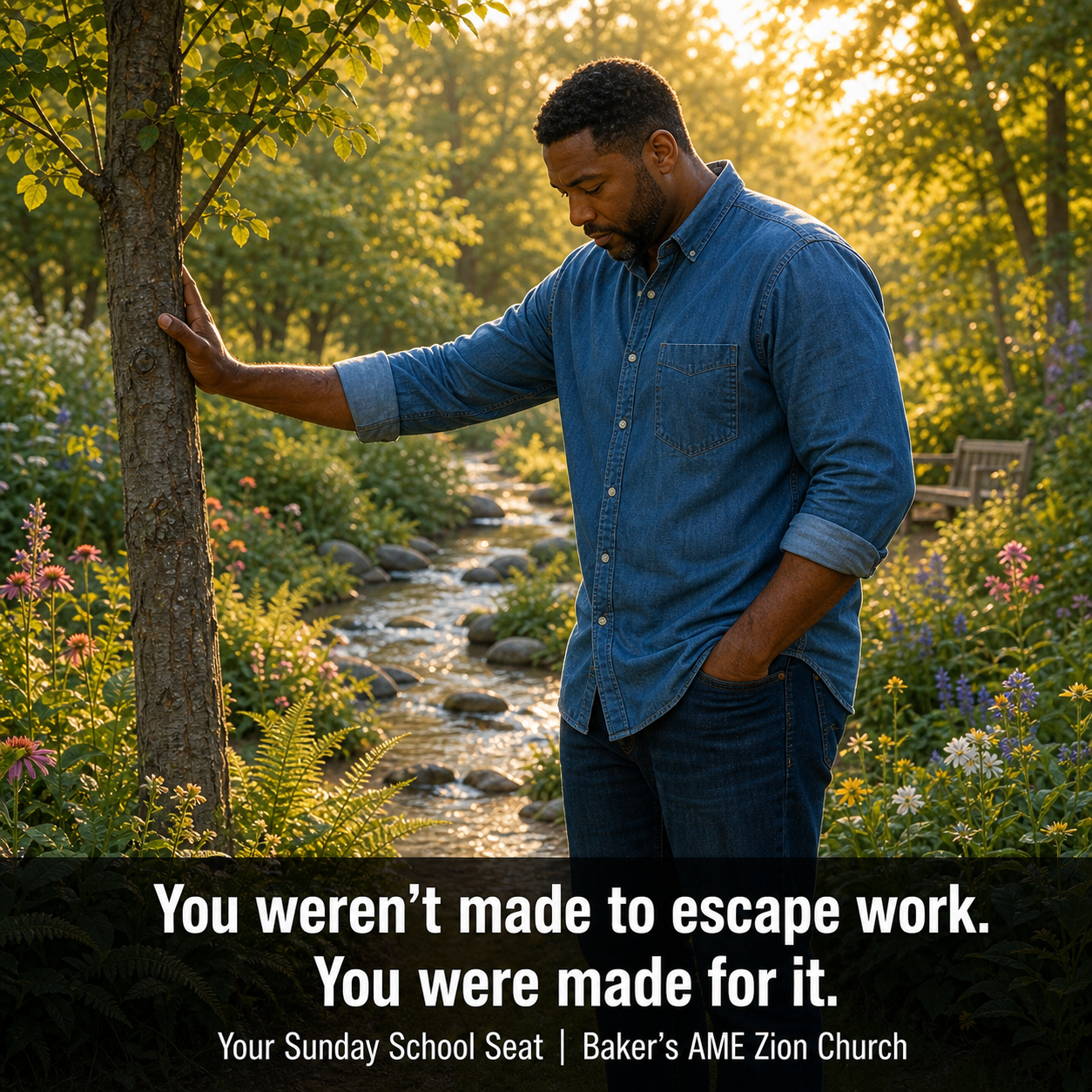
There is a moment, right at the beginning of the Bible, before sin shows up, before the snake says a word, before anything has gone wrong, when God hands a man a job.
Genesis 2:4-10, 15 — KJV
These are the generations of the heavens and of the earth when they were created, in the day that the LORD God made the earth and the heavens, and every plant of the field before it was in the earth, and every herb of the field before it grew: for the LORD God had not caused it to rain upon the earth, and there was not a man to till the ground. But there went up a mist from the earth, and watered the whole face of the ground. And the LORD God formed man of the dust of the ground, and breathed into his nostrils the breath of life; and man became a living soul. And the LORD God planted a garden eastward in Eden; and there he put the man whom he had formed. And out of the ground made the LORD God to grow every tree that is pleasant to the sight, and good for food; the tree of life also in the midst of the garden, and the tree of knowledge of good and evil. And a river went out of Eden to water the garden; and from thence it was parted, and became into four heads. ... And the LORD God took the man, and put him into the garden of Eden to dress it and to keep it.
Genesis 2:4-10, 15 — WEB
This is the history of the generations of the heavens and of the earth when they were created, in the day that the LORD God made the earth and the heavens. No plant of the field was yet in the earth, and no herb of the field had yet sprung up; for the LORD God had not caused it to rain on the earth. There was not a man to till the ground, but a mist went up from the earth, and watered the whole surface of the ground. The LORD God formed man from the dust of the ground, and breathed into his nostrils the breath of life; and man became a living soul. The LORD God planted a garden eastward, in Eden, and there he put the man whom he had formed. Out of the ground the LORD God made every tree to grow that is pleasant to the sight, and good for food, including the tree of life in the middle of the garden and the tree of the knowledge of good and evil. A river went out of Eden to water the garden; and from there it was parted, and became the source of four rivers. ... The LORD God took the man, and put him into the garden of Eden to cultivate and keep it.
Explanation
Most of us have heard, somewhere along the line, that work is a punishment. That it shows up in Genesis 3 because Adam and Eve sinned. That if they had only kept their hands off that fruit, we'd all be lounging in some endless paradise instead of fighting traffic on Monday morning.
That's not what the text says.
Look closely. Before the fall, before the curse, before there was a single broken thing in the world, God plants a garden and puts the man into it "to dress it and to keep it." The Hebrew words behind those phrases carry the weight of careful labor — to till, to cultivate, to serve, to guard. This is not punishment. This is the first thing humans were given to do. Work was designed into us before sin ever entered the room.
That changes how we read everything that comes after. The aching back at the end of a shift, the long stretch on your feet, the email you have to send before you sleep — none of that is a curse on the work itself. The curse in Genesis 3 is on the difficulty, the thorns, the sweat. The work itself was always good.
This matters for the week ahead. Our Sunday lesson lands on the question of useful work as Christian duty, and you cannot understand that question rightly if you start from the assumption that God merely tolerates labor. He doesn't. He invented it. He worked six days himself before he asked anyone else to do anything. The first human resume he wrote was for a gardener, and the garden was Eden.
Take a moment today to look at the work in front of you with new eyes. The spreadsheet, the sermon notes, the diaper, the lesson plan, the truck route, the casserole, the sales call. None of it is beneath the dignity God gave you in the dust of the ground. He breathed his own breath into you and put something in your hands.
You are not just earning a paycheck this week. You are doing something humans were made to do, in the image of a God who, before he made anything else, made the world. Whatever you have to do today, do it knowing that hands in the soil were holy long before any preacher ever said so.
Thought for the day: Work is not the curse. Work is the calling. The curse is the thorns.
Reflection question: Where in your daily work do you most often feel that what you do is "just a job," and what would change if you saw it as part of how God made you to live?
Prayer
God of the garden, you put the first man to work because you loved him, not because you were punishing him. Help us today to carry that truth into whatever our hands find to do. Where the work is hard, give us strength. Where the work feels small, remind us that you made nothing small. Whatever we set our hands to, let it be a kind of worship. Amen.
This week we walk toward Sunday's lesson: Useful Work as Christian Duty.
Sunday, May 3 — The God Who Loves the City You Hate
The Book of Jonah does not end with revival. It ends with a pouting prophet under a dead plant, and a question God asks him that He is still asking us.
Jonah 4:6-11 — KJV
6 And the LORD God prepared a gourd, and made it to come up over Jonah, that it might be a shadow over his head, to deliver him from his grief. So Jonah was exceeding glad of the gourd. 7 But God prepared a worm when the morning rose the next day, and it smote the gourd that it withered. 8 And it came to pass, when the sun did arise, that God prepared a vehement east wind; and the sun beat upon the head of Jonah, that he fainted, and wished in himself to die, and said, It is better for me to die than to live. 9 And God said to Jonah, Doest thou well to be angry for the gourd? And he said, I do well to be angry, even unto death. 10 Then said the LORD, Thou hast had pity on the gourd, for the which thou hast not laboured, neither madest it grow; which came up in a night, and perished in a night: 11 And should not I spare Nineveh, that great city, wherein are more than sixscore thousand persons that cannot discern between their right hand and their left hand; and also much cattle?
Jonah 4:6-11 — WEB
6 Yahweh God prepared a vine, and made it to come up over Jonah, that it might be a shade over his head, to deliver him from his discomfort. So Jonah was exceedingly glad because of the vine. 7 But God prepared a worm at dawn the next day, and it chewed on the vine, so that it withered. 8 When the sun arose, God prepared a sultry east wind; and the sun beat on Jonah's head, so that he fainted, and requested for himself that he might die, and said, "It is better for me to die than to live." 9 God said to Jonah, "Is it right for you to be angry about the vine?" He said, "I am right to be angry, even to death." 10 Yahweh said, "You have been concerned for the vine, for which you have not labored, neither made it grow; which came up in a night, and perished in a night. 11 Shouldn't I be concerned for Nineveh, that great city, in which are more than one hundred twenty thousand persons who can't discern between their right hand and their left hand; and also much livestock?"
Explanation
Jonah has just watched the biggest revival in the Bible. The entire city of Nineveh, from king to cattle, has repented. If Jonah were a modern preacher, he'd be on every podcast this side of the Jordan. Instead, he stomps out of the city, builds himself a cranky little booth on a hill overlooking Nineveh, and sits down to watch — hoping that maybe, just maybe, God will change His mind and burn the place down anyway. He actually tells God, back in verse 2, that he ran in the first place because he was afraid God would forgive these people. I knew you were a gracious God. That's the problem.
So God, tender and patient as always, teaches him a lesson that would be funny if it weren't so serious. He makes a plant grow up to shade Jonah's head. Jonah is, the text says, exceedingly glad about the plant. For one verse of the book, Jonah is happy. Then God sends a worm, the plant dies, the sun comes up scorching, and Jonah melts into self-pity. It is better for me to die than to live. All because of a plant.
And God asks the question the whole book has been walking toward. You cared about the plant. You didn't grow it. You didn't labor over it. It came up in a night, and perished in a night. And you — you are so angry over this little vine. Should not I care about Nineveh? One hundred and twenty thousand people who cannot tell their right hand from their left — plus all the animals.
The book ends on that question. No resolution. No confession from Jonah. Just the question hanging in the air, waiting for the reader — waiting for us — to answer.
This is the higher patriotism, and it is the whole point of our week. Earthly patriotism says, my city matters because it is mine. God's patriotism says, every city matters because they are Mine. Jonah's heart was big enough for a plant he didn't grow but not for a city full of confused, lost, beloved human beings. God is gently exposing the scale of Jonah's compassion — and ours.
Who is your Nineveh this morning? A country on the other side of a border dispute? A neighborhood you've stopped driving through? A political party you've decided is beneath prayer? An ethnic group, a class of people, a generation younger or older than yours, a family member you've written off? Ask honestly. God always has one in mind for us.
The higher patriotism is not less love for your country. It is a love so ordered by God that it spills over the borders. God loves the city you hate. He loves the person whose name makes you flinch. He prepared a plant, a worm, and a whole book of the Bible to ask you — gently, persistently — if your compassion is as big as His.
Today is Sunday school. We save you a seat.
Thought for the Day. God loves the city you hate. He always has. He is asking if you are ready to love it too.
Reflection Question. Who is your Nineveh — the person or people whose name catches in your throat when you try to pray for them — and what is one specific step toward loving them this week?
Prayer. Lord, we are all a little bit Jonah. We care about our comforts more than our neighbors. We can grieve a dead plant and shrug at a hurting city. Enlarge our hearts. Give us Your patriotism — the higher kind, the kind that refuses to stop at a border or a party line or a prejudice. Show us our Nineveh, and walk us back into it, not to condemn it, but to love it like You do. In Jesus' name, Amen.
Today is Sunday school. We save you a seat.
Saturday, May 2 — The Second-Chance Preacher
Most of us know the first half of Jonah's story — the boat, the storm, the fish. What we sometimes forget is that the whole thing gets a second act, and the second act is where the real lesson waits.
Jonah 3:1-5 — KJV
1 And the word of the LORD came unto Jonah the second time, saying, 2 Arise, go unto Nineveh, that great city, and preach unto it the preaching that I bid thee. 3 So Jonah arose, and went unto Nineveh, according to the word of the LORD. Now Nineveh was an exceeding great city of three days' journey. 4 And Jonah began to enter into the city a day's journey, and he cried, and said, Yet forty days, and Nineveh shall be overthrown. 5 So the people of Nineveh believed God, and proclaimed a fast, and put on sackcloth, from the greatest of them even to the least of them.
Jonah 3:1-5 — WEB
1 Yahweh's word came to Jonah the second time, saying, 2 "Arise, go to Nineveh, that great city, and preach to it the message that I give you." 3 So Jonah arose, and went to Nineveh, according to Yahweh's word. Now Nineveh was an exceedingly great city, three days' journey across. 4 Jonah began to enter into the city a day's journey, and he cried out, and said, "In forty days, Nineveh will be overthrown!" 5 The people of Nineveh believed God; and they proclaimed a fast, and put on sackcloth, from their greatest even to their least.
Explanation
Four words in verse 1 quietly carry the whole Gospel: the second time. Jonah had been told to go to Nineveh once. He ran the other direction, booked passage to Tarshish, nearly got his shipmates killed in a storm, ended up swallowed whole, prayed a very honest prayer in the belly of a fish, and got coughed up onto a beach. And then the word of the Lord comes to him a second time. Same assignment. No lecture.
That is grace with work boots on. God did not retire Jonah to the bench after the boat incident. He didn't find a better prophet. He came to the same flawed, grumpy, still-prejudiced man and said, Arise, go. The message had not changed. The messenger had not really changed, as we'll see tomorrow. But God was going to do His work through this particular second-chance preacher anyway.
Nineveh was, let's be honest, a terrifying assignment. It was the capital of the Assyrian Empire, which, in Jonah's lifetime, was famous in the ancient world for breathtaking cruelty — the kind of violence that got carved onto palace walls as propaganda. Jonah had every nationalistic reason to hate this place. This was the enemy. And he had to walk into the middle of it with a five-word sermon: Yet forty days, and Nineveh shall be overthrown.
That's the shortest sermon in the Bible. No altar call. No three points. No gentle invitation. Just a deadline. If any of us preached a sermon that blunt today, we would not be invited back. And yet — the whole city repents. From the greatest to the least. The king takes off his robe and sits in ashes. The livestock are fasting. It's a revival the size of a metropolitan area, sparked by a reluctant preacher with a bad attitude.
Notice what the text is and isn't saying. It is not saying Jonah was a great preacher. It is saying the people of Nineveh believed God. Not Jonah. God. The miracle is not Jonah's eloquence — there isn't any. The miracle is that the Holy Spirit was already at work in that city before Jonah ever got there, and his five stubborn words were enough because God had prepared the soil.
As we walk into tomorrow's lesson on "The Higher Patriotism," this matters more than we might think. God loves cities Jonah hated. God prepares revivals in places we've written off. And God uses second-chance people — bitter people, tired people, people who'd rather be anywhere else — because He is not limited by our enthusiasm. If you've been running from something God asked you to do, today is a very good day to notice: the word of the Lord often comes a second time.
Thought for the Day. The shortest sermon in the Bible was preached by the most reluctant preacher and brought the biggest city in the ancient world to its knees. God does not need you to be willing. He just needs you to be walking.
Reflection Question. Where has the word of the Lord come to you "a second time" — an old calling, an old assignment, an old obedience — and what would it look like to finally arise and go?
Prayer. Lord, thank You that Your word comes to us a second time. And a third. And a seventy-seventh. Thank You for being a God of patient reassignments. Where we have been running, turn us around. Where we have written off a city or a person, soften our hearts. Use us even in our reluctance, because the work has always been Yours. In Jesus' name, Amen.
This week we walk toward Sunday's lesson: The Higher Patriotism.
Friday, May 1 — The Passport in Your Back Pocket
Philippi was a Roman colony, and its citizens were extremely proud of that. Paul — a Roman citizen himself — writes them a letter that casually reminds them their real passport is issued somewhere else entirely.
Philippians 3:17-21 — KJV
17 Brethren, be followers together of me, and mark them which walk so as ye have us for an ensample. 18 (For many walk, of whom I have told you often, and now tell you even weeping, that they are the enemies of the cross of Christ: 19 Whose end is destruction, whose God is their belly, and whose glory is in their shame, who mind earthly things.) 20 For our conversation is in heaven; from whence also we look for the Saviour, the Lord Jesus Christ: 21 Who shall change our vile body, that it may be fashioned like unto his glorious body, according to the working whereby he is able even to subdue all things unto himself.
Philippians 3:17-21 — WEB
17 Brothers, be imitators together of me, and note those who walk this way, even as you have us for an example. 18 For many walk, of whom I told you often, and now tell you even weeping, as the enemies of the cross of Christ, 19 whose end is destruction, whose god is the belly, and whose glory is in their shame, who think about earthly things. 20 For our citizenship is in heaven, from where we also wait for a Savior, the Lord Jesus Christ, 21 who will change the body of our humiliation to be conformed to the body of his glory, according to the working by which he is able even to subject all things to himself.
Explanation
Philippi was a military retirement town. When Rome conquered new territory, Rome would sometimes settle veteran soldiers in a city, give them land, and essentially plant a little Rome inside a foreign province. Philippi was one of those places. The people there had Latin names, Roman legal rights, togas on the holidays, and a very loud sense of national pride. They knew what citizenship meant. They valued it the way some people value generational American roots.
So when Paul drops this line — our citizenship is in heaven — every Philippian reader feels it. He's not using a vague spiritual metaphor. He's using their most political, most prized, most identity-shaping word. Our politeuma — the same root we get "politics" from — is in heaven. We live here, but we are enrolled on a different register.
Before he gets there, though, Paul makes a sad contrast. Many walk… as enemies of the cross of Christ, whose end is destruction, whose god is their belly, whose glory is in their shame, who think about earthly things. This is Paul in his weeping voice, not his angry voice. He's not talking about pagans out there. He's talking about people who showed up to church but whose actual loyalty is to appetite, to reputation, to the next thing money can buy. Their god is their belly. Their glory is in their shame. They're organized entirely around this life.
And Paul says, weeping: don't be those people. You have a savior coming from heaven, not a product coming from Amazon. Your body, as tired and aching as it is today, will one day be transformed to match His glory. The story isn't ending in a nursing home. The story is ending in a resurrection.
So what does heavenly citizenship have to do with earthly patriotism? Everything. A person whose deepest identity is secured somewhere else becomes, strangely, a much better neighbor where they actually are. They don't need this country to be perfect in order to serve it. They don't need their party to win in order to love their neighbor. They don't need the economy to cooperate in order to be generous. They have another passport in their back pocket, and that passport frees them to invest here without worshipping here.
Earthly citizenship that forgets heaven turns into idolatry. Heavenly citizenship that forgets earth turns into escapism. The higher patriot remembers both — here and there — and lets the there shape everything about the here.
Thought for the Day. You carry a passport from a country you have not seen yet. Let it change how you walk through this one.
Reflection Question. What would change today — in your spending, your speech, your worries — if you genuinely remembered that your citizenship is in heaven?
Prayer. Lord Jesus, remind us today whose we are. We are citizens of a country not yet visible, waiting for a Savior who is surely coming. Keep our god from being our belly. Keep our glory from being our shame. Free us to love the place we live without worshipping it, because our truest home is still ahead. Come, Lord Jesus. In Your name, Amen.
This week we walk toward Sunday's lesson: The Higher Patriotism.
Thursday, April 30 — When the Superpowers Are All Dust
The ancient world trusted horses the way we trust markets and missiles. The Psalmist is not impressed with any of it.
Psalm 33:10-22 — KJV
10 The LORD bringeth the counsel of the heathen to nought: he maketh the devices of the people of none effect. 11 The counsel of the LORD standeth for ever, the thoughts of his heart to all generations. 12 Blessed is the nation whose God is the LORD; and the people whom he hath chosen for his own inheritance. 13 The LORD looketh from heaven; he beholdeth all the sons of men. 14 From the place of his habitation he looketh upon all the inhabitants of the earth. 15 He fashioneth their hearts alike; he considereth all their works. 16 There is no king saved by the multitude of an host: a mighty man is not delivered by much strength. 17 An horse is a vain thing for safety: neither shall he deliver any by his great strength. 18 Behold, the eye of the LORD is upon them that fear him, upon them that hope in his mercy; 19 To deliver their soul from death, and to keep them alive in famine. 20 Our soul waiteth for the LORD: he is our help and our shield. 21 For in him shall our heart rejoice, because we have trusted in his holy name. 22 Let thy mercy, O LORD, be upon us, according as we hope in thee.
Psalm 33:10-22 — WEB
10 Yahweh brings the counsel of the nations to nothing. He makes the thoughts of the peoples to be of no effect. 11 The counsel of Yahweh stands fast forever, the thoughts of his heart to all generations. 12 Blessed is the nation whose God is Yahweh, the people whom he has chosen for his own inheritance. 13 Yahweh looks from heaven. He sees all the sons of men. 14 From the place of his habitation he looks out on all the inhabitants of the earth, 15 he who fashions all of their hearts; and he considers all of their works. 16 There is no king saved by the multitude of an army. A mighty man is not delivered by great strength. 17 A horse is a vain thing for safety, neither does he deliver any by his great power. 18 Behold, Yahweh's eye is on those who fear him, on those who hope in his loving kindness, 19 to deliver their soul from death, to keep them alive in famine. 20 Our soul has waited for Yahweh. He is our help and our shield. 21 For our heart rejoices in him, because we have trusted in his holy name. 22 Let your loving kindness be on us, Yahweh, since we have hoped in you.
Explanation
The people who first sang this psalm lived in a world bristling with superpowers. Egypt to the south, Assyria and Babylon to the north, Persia on the rise in the east. All of them had chariots, all of them had horses, all of them had diplomats scheming at the long table of empire. And a little hill country kingdom called Israel, with no horses worth mentioning, sings a song where the refrain is essentially: none of that is what's actually holding up the world.
The Lord brings the counsel of the nations to nothing. The diplomats think they're writing history at the table. God is writing it under the table. Blessed is the nation whose God is the Lord — and the verse does not say "blessed is the nation with the best army, strongest currency, most advanced technology." It says whose God is the Lord. That's not an accessory to national greatness. That is the only thing that makes a people blessed in the first place.
Then the Psalmist goes after the idols by name. A horse is a vain thing for safety. In the ancient world, a horse was the most expensive, fastest, most intimidating weapon on the battlefield. Nations measured their security in chariots. The Psalmist says: vain. Cannot save. Cannot deliver. There is no king saved by a great army.
We do not have cavalry anymore, but we have our own horses. The S&P 500. The Pentagon budget. The political party we are sure is the only thing standing between us and ruin. The gun in the nightstand. The retirement account. The right president. None of these are evil in themselves. They become idols the moment we look at them instead of God and whisper, you are what's keeping us safe.
This week we are walking toward a lesson on the higher patriotism, and here is a hard thing it asks of us: to love our country without worshipping it. To support strong defenses without thinking the defense is our salvation. To participate in the economy without our soul being tied to a number on a screen. Our soul waits for the Lord. He is our help and our shield. Not the horse. Not the chariot. Not the party. Not the portfolio.
This doesn't make you less engaged. It makes you more free. You can vote without despair. You can save without greed. You can serve without illusions. Because the thing actually holding up your life was never any of those horses anyway.
Thought for the Day. A horse is a vain thing for safety. Whatever you've been sizing up as your savior this week, it isn't one. The Lord is.
Reflection Question. What "horse" have you quietly been trusting in for your security — and what would it look like to let God be your help and shield instead?
Prayer. Lord, we confess the horses we've saddled with our hope. Financial accounts. Political outcomes. Our own careful planning. Forgive us for measuring our safety in anything but Your mercy. Blessed is the nation whose God is the Lord — make us that kind of people, in the pews and in the voting booth and in the quiet of our own worrying. Our soul waits for You. You are our help and our shield. In Jesus' name, Amen.
This week we walk toward Sunday's lesson: The Higher Patriotism.
Wednesday, April 29 — Pray for the Ones You Didn't Vote For
There is a name right now that makes your jaw tighten when you hear it on the news. Maybe a president, maybe a governor, maybe a local school board member. Paul has an instruction for you about that name, and it's going to sound harder than it reads.
1 Timothy 2:1-8 — KJV
1 I exhort therefore, that, first of all, supplications, prayers, intercessions, and giving of thanks, be made for all men; 2 For kings, and for all that are in authority; that we may lead a quiet and peaceable life in all godliness and honesty. 3 For this is good and acceptable in the sight of God our Saviour; 4 Who will have all men to be saved, and to come unto the knowledge of the truth. 5 For there is one God, and one mediator between God and men, the man Christ Jesus; 6 Who gave himself a ransom for all, to be testified in due time. 7 Whereunto I am ordained a preacher, and an apostle, (I speak the truth in Christ, and lie not;) a teacher of the Gentiles in faith and verity. 8 I will therefore that men pray every where, lifting up holy hands, without wrath and doubting.
1 Timothy 2:1-8 — WEB
1 I exhort therefore, first of all, that petitions, prayers, intercessions, and givings of thanks be made for all men, 2 for kings and all who are in high places, that we may lead a tranquil and quiet life in all godliness and reverence. 3 For this is good and acceptable in the sight of God our Savior, 4 who desires all people to be saved and come to full knowledge of the truth. 5 For there is one God and one mediator between God and men, the man Christ Jesus, 6 who gave himself as a ransom for all, the testimony in its own times, 7 to which I was appointed a preacher and an apostle—I am telling the truth in Christ, not lying—a teacher of the Gentiles in faith and truth. 8 I desire therefore that the men in every place pray, lifting up holy hands without anger and doubting.
Explanation
Remember who the "king" was when Paul wrote this. Most scholars place 1 Timothy in the mid-60s AD, which means the man on the throne was Nero — the emperor who would, by the end of the decade, roll Christians in pitch and burn them as garden torches. And Paul, who was going to be beheaded on that same emperor's orders, writes to young Timothy: first of all, pray for kings. Not last. Not when you feel like it. First of all.
He names four kinds of prayer — petitions, prayers, intercessions, thanksgivings. Then he gives the reason: that we may lead a quiet and peaceable life in all godliness and reverence. Paul is not naive. He knows emperors can make life hell. But he knows something else: if the people in power are pressed on by the prayers of the saints, even their worst policies get complicated by the strange weather of grace.
And then the reason behind the reason — God desires all people to be saved. Even Nero. Even the ones we have written off. Even the ones whose faces make us change the channel. The one mediator between God and men gave Himself a ransom for all. If Christ's blood is wide enough to cover the kings, our prayers had better be wide enough to name them.
Paul closes with a detail that feels personal: lifting up holy hands without anger and doubting. He knows how we pray about politicians. With clenched fists. Through gritted teeth. With a little smug hope that God might actually smite this one. Paul says: stop. Pray without anger. Unclench. Open the hands. The praying posture is the healing posture.
This is the higher patriotism in its practical form. Earthly patriotism roots for its side and wants the other side to lose. Higher patriotism prays for the other side because God does. You can disagree with a leader's policies with everything in you, and you can still pray for their soul, their family, their wisdom, their protection. In fact, if you can't, Paul would suggest your patriotism isn't yet high enough.
Try this today. Whatever name makes your jaw tighten — pray it. Not through gritted teeth. Pray that they would meet Christ. Pray that their children would be well. Pray that they would make one good decision today. You may not change the country that way, but God will almost certainly change you.
Thought for the Day. You cannot hate a person and pray for them honestly at the same time. Prayer is the slow, quiet retraining of our hearts toward people God has not given up on.
Reflection Question. Whose name do you most need to add to your prayer list this week — and what would it cost you to pray for them without anger?
Prayer. Lord, we confess that we pray with clenched hands more often than open ones, especially about those in authority. Teach us to pray without anger. Teach us to lift up names we'd rather not. Remind us that You desire all people to be saved — even the ones we have already dismissed. Make us higher patriots in the only place that matters, on our knees. In Jesus' name, Amen.
This week we walk toward Sunday's lesson: The Higher Patriotism.
Tuesday, April 28 — A Holy Nation on Borrowed Ground
Christians have always lived a strange double life — belonging fully to the country we're in, and belonging more fully to a kingdom it cannot see. Peter writes today's letter to people trying to figure out how to do that without losing their minds or their witness.
1 Peter 2:4-12 — KJV
4 To whom coming, as unto a living stone, disallowed indeed of men, but chosen of God, and precious, 5 Ye also, as lively stones, are built up a spiritual house, an holy priesthood, to offer up spiritual sacrifices, acceptable to God by Jesus Christ. 6 Wherefore also it is contained in the scripture, Behold, I lay in Sion a chief corner stone, elect, precious: and he that believeth on him shall not be confounded. 7 Unto you therefore which believe he is precious: but unto them which be disobedient, the stone which the builders disallowed, the same is made the head of the corner, 8 And a stone of stumbling, and a rock of offence, even to them which stumble at the word, being disobedient: whereunto also they were appointed. 9 But ye are a chosen generation, a royal priesthood, an holy nation, a peculiar people; that ye should shew forth the praises of him who hath called you out of darkness into his marvellous light: 10 Which in time past were not a people, but are now the people of God: which had not obtained mercy, but now have obtained mercy. 11 Dearly beloved, I beseech you as strangers and pilgrims, abstain from fleshly lusts, which war against the soul; 12 Having your conversation honest among the Gentiles: that, whereas they speak against you as evildoers, they may by your good works, which they shall behold, glorify God in the day of visitation.
1 Peter 2:4-12 — WEB
4 coming to him, a living stone, rejected indeed by men, but chosen by God, precious. 5 You also as living stones are built up as a spiritual house, to be a holy priesthood, to offer up spiritual sacrifices, acceptable to God through Jesus Christ. 6 Because it is contained in Scripture, "Behold, I lay in Zion a chief cornerstone, chosen and precious. He who believes in him will not be disappointed." 7 For you who believe therefore is the honor, but for those who are disobedient, "The stone which the builders rejected has become the chief cornerstone," 8 and, "a stumbling stone and a rock of offense." For they stumble at the word, being disobedient, to which also they were appointed. 9 But you are a chosen race, a royal priesthood, a holy nation, a people for God's own possession, that you may proclaim the excellence of him who called you out of darkness into his marvelous light. 10 In the past, you were not a people, but now are God's people, who had not obtained mercy, but now have obtained mercy. 11 Beloved, I beg you as foreigners and pilgrims, to abstain from fleshly lusts, which war against the soul, 12 having good behavior among the nations, so in that of which they speak against you as evildoers, they may by your good works, which they see, glorify God in the day of visitation.
Explanation
Peter is writing to Christians scattered across Asia Minor — modern Turkey — in the shadow of an empire that didn't trust them. They were a strange minority. They didn't go to the pagan temples. They wouldn't burn incense to Caesar. Their loyalty looked suspicious from the outside. And so Peter does something pastoral and revolutionary: he tells them who they are.
You are a chosen race. A royal priesthood. A holy nation. A people for God's own possession. Every word of that language comes straight out of Exodus 19, where God said it about Israel at Sinai. Peter is taking the old vocabulary of national identity and reapplying it to this mixed community of Jews and Gentiles scattered across the Roman world. You are a nation, he says — but not the kind Rome recognizes. Your citizenship is written in a different book.
Then he turns the practical corner. I beg you, as foreigners and pilgrims… That word "pilgrim" doesn't mean you're just passing through and nothing matters. It means you live here without your ultimate loyalty being swallowed by here. And then comes the pivot: have such good conduct among the nations that even your accusers, when they see your good works, will glorify God. Your manners are your embassy. Your patience in traffic is diplomacy. The way you talk to the cashier is foreign policy.
This is the week of "The Higher Patriotism," and Peter is showing us its shape. A higher patriot is not someone who loves their country less — it is someone whose love has been ordered and disciplined by citizenship in a better one. That citizenship makes them better neighbors, not worse. It makes them quieter in argument, slower to anger, more honest in business, more generous to strangers. It makes them the kind of people outsiders accuse of being different and then, somewhere down the line, thank God for.
In our current moment, with politics loud and tempers short, this matters. Our loudest patriotism is often our worst advertisement. But a quiet, holy, well-behaved citizen of heaven — that is a sermon the neighbors can read without opening a Bible. Pay your taxes. Keep your word. Tell the truth in meetings. Be kind to people who annoy you. That is the royal priesthood at work.
You are a foreigner here. Act like a very good one.
Thought for the Day. Your manners are your mission field. You are never not representing the kingdom you belong to.
Reflection Question. Where are you most tempted to let your earthly loyalties speak louder than your heavenly citizenship — and what would holy conduct look like there today?
Prayer. Father, we thank You for calling us out of darkness into Your marvelous light. Remind us today who we are — chosen, royal, holy, Yours. Shape our conduct so that even those who disagree with us see something of You in how we live. Keep us from loud, embarrassing witness and give us the quiet, credible kind. In Jesus' name, Amen.
This week we walk toward Sunday's lesson: The Higher Patriotism.
Monday, April 27 — Build a House in Babylon
There's a particular kind of heartbreak that comes from waking up in a place you never meant to live — a city, a job, a season of life, a set of circumstances you did not choose. Today's reading is a letter to people in exactly that kind of heartbreak.
Jeremiah 29:3-7 — KJV
3 By the hand of Elasah the son of Shaphan, and Gemariah the son of Hilkiah, (whom Zedekiah king of Judah sent unto Babylon to Nebuchadnezzar king of Babylon) saying, 4 Thus saith the LORD of hosts, the God of Israel, unto all that are carried away captives, whom I have caused to be carried away from Jerusalem unto Babylon; 5 Build ye houses, and dwell in them; and plant gardens, and eat the fruit of them; 6 Take ye wives, and beget sons and daughters; and take wives for your sons, and give your daughters to husbands, that they may bear sons and daughters; that ye may be increased there, and not diminished. 7 And seek the peace of the city whither I have caused you to be carried away captives, and pray unto the LORD for it: for in the peace thereof shall ye have peace.
Jeremiah 29:3-7 — WEB
3 by the hand of Elasah the son of Shaphan, and Gemariah the son of Hilkiah, (whom Zedekiah king of Judah sent to Babylon to Nebuchadnezzar king of Babylon). It said: 4 Yahweh of Armies, the God of Israel, says to all the captives whom I have caused to be carried away captive from Jerusalem to Babylon: 5 "Build houses and dwell in them. Plant gardens and eat their fruit. 6 Take wives and father sons and daughters. Take wives for your sons, and give your daughters to husbands, that they may bear sons and daughters. Multiply there, and don't be diminished. 7 Seek the peace of the city where I have caused you to be carried away captive, and pray to Yahweh for it; for in its peace you will have peace."
Explanation
Jeremiah wrote this letter around 597 BC, after Nebuchadnezzar had hauled the first wave of Jerusalem's leadership, craftsmen, and soldiers off to Babylon in chains. The temple still stood back home, but these exiles were now a long walk from everything they had ever loved. And they had a theology problem: how do you worship the God of a specific land while living on foreign soil? How do you sing the Lord's song in a strange place?
False prophets were circulating a comforting lie: any day now, any minute, God will bring you back. Don't unpack. Don't settle. Don't invest. Jeremiah's letter goes the other way. Build houses. Plant gardens. Marry. Have children. Have grandchildren. Pray for the welfare of Babylon — because your welfare is wrapped up in Babylon's welfare.
That is a staggering instruction. Pray for Babylon. The city that burned their homes. The empire that put their kings in fetters. That city's welfare? Yes. Because your God did not stop being God at the city limits.
This is where our week on "The Higher Patriotism" begins, and it begins in a surprising place: in exile. The Bible's first lesson about loving a nation is given to people who have no reason to love the nation they're in. God doesn't tell them to resist, and He doesn't tell them to assimilate. He tells them to invest. Build something real. Contribute. Pray.
Most of us, if we're honest, live in some version of Babylon. Maybe it's a workplace that doesn't share our values. A neighborhood that feels like a rental, not a home. A country where half the people voted opposite you last November. A hospital floor. A recovery meeting. A school where your child has to be twice as good to be seen as half as valuable.
The temptation is always the same — keep your bags packed, stay bitter, refuse to plant anything because you might have to leave it. But Jeremiah's word is, Plant anyway. Pray anyway. The city you're frustrated with is the city God has placed you in, and its peace is tangled up with yours.
Thought for the Day. You cannot pray for a city's welfare and hate its people at the same time. God places us in Babylons to love them, not to endure them.
Reflection Question. What "Babylon" has God placed you in right now — and what would it look like this week to seek its peace instead of just surviving it?
Prayer. Lord, You see where we live and You know it is not always where we would have chosen. Give us courage to build something real here — to plant gardens, to pray for our neighbors, to invest in the welfare of places we did not pick. Teach us that our peace is tied to the peace of the city around us. In Jesus' name, Amen.
This week we walk toward Sunday's lesson: The Higher Patriotism.
Sunday, April 26 — The Words On Your Doorpost
Here we are. Six days of readings have walked us up to the front door of today's lesson. Now the scripture opens that door and shows us what is supposed to be happening inside the house — morning, noon, and night. Come on in. We saved you a seat.
Deuteronomy 6:3-9 — KJV 3 Hear therefore, O Israel, and observe to do it; that it may be well with thee, and that ye may increase mightily, as the LORD God of thy fathers hath promised thee, in the land that floweth with milk and honey. 4 Hear, O Israel: The LORD our God is one LORD: 5 And thou shalt love the LORD thy God with all thine heart, and with all thy soul, and with all thy might. 6 And these words, which I command thee this day, shall be in thine heart: 7 And thou shalt teach them diligently unto thy children, and shalt talk of them when thou sittest in thine house, and when thou walkest by the way, and when thou liest down, and when thou risest up. 8 And thou shalt bind them for a sign upon thine hand, and they shall be as frontlets between thine eyes. 9 And thou shalt write them upon the posts of thy house, and on thy gates.
Deuteronomy 6:3-9 — WEB 3 Hear therefore, Israel, and be careful to do it; that it may be well with you, and that you may increase mightily, as Yahweh, the God of your fathers, has promised to you, in a land flowing with milk and honey. 4 Hear, Israel: Yahweh is our God. Yahweh is one. 5 You shall love Yahweh your God with all your heart, with all your soul, and with all your might. 6 These words, which I command you today, shall be on your heart, 7 and you shall teach them diligently to your children, and shall talk of them when you sit in your house, and when you walk by the way, and when you lie down, and when you rise up. 8 You shall bind them for a sign on your hand, and they shall be for frontlets between your eyes. 9 You shall write them on the door posts of your house and on your gates.
Explanation
This passage is so important it has its own name. Jewish people call it the Shema, from the first Hebrew word: Hear.For thousands of years, faithful Jews have recited these words twice a day. Jesus himself grew up saying them. When a scribe asked him which commandment was greatest, he quoted right from this passage. "Hear, O Israel: the Lord our God is one Lord. And thou shalt love the Lord thy God with all thine heart, and with all thy soul, and with all thy might." Everything — every other command, every other law, every other act of devotion — hangs off that single, enormous sentence. Everything else is commentary.
Moses is speaking to Israel on the plains of Moab, right before they enter the Promised Land. A new generation is about to step into a new country, and he knows how easily prosperity can erase the memory of faithfulness. So he tells them how to keep God central once they have houses and fields and full pantries: put these words on your heart first, and then pour them into every corner of ordinary life. "Teach them diligently unto thy children." Not outsource them. Not delegate them. You teach them. And not just in formal religious settings — "when thou sittest in thine house, and when thou walkest by the way, and when thou liest down, and when thou risest up." Sitting. Walking. Lying down. Rising up. That's every hour of the day. That's the whole life of the home.
Then come the images — bind them on your hand, wear them between your eyes, write them on your doorposts and gates. Some of our Jewish friends still do this literally, with phylacteries and mezuzahs. The point for all of us is the same. Faith in a Christian home is not a Sunday event. It is a woven thing. It shows up in what the family talks about in the car on the way to school. It shows up in the prayer said over a grilled cheese. It shows up in the question a child asks at bedtime and the honest answer a parent gives. It shows up in the way a grandparent speaks about Jesus when they think nobody is listening. It shows up on the doorposts — in the small, visible, daily reminders that this house belongs to the Lord.
This week we walked together toward this lesson. On Monday we learned that a house is built through wisdom. On Tuesday we watched Jesus grow up inside a real family. On Wednesday we saw marriage shaped by Christlike, self-giving love. On Thursday Joshua stood up and said, "As for me and my house." On Friday he set up a stone so nobody would forget. On Saturday Jesus reminded us that marriage is covenant, not contract. And today, on Sunday, Moses hands us the master key: teach these things to your children, in every ordinary moment, so that the love of God is the air your home breathes.
The Christian home in a modern world doesn't look exactly like it did in 1960 or 1860 or 60 A.D. Your family may have one parent, two parents, grandparents raising grandchildren, blended children, adult children long moved out, or no children at all. The shape of the household has always varied. The calling has not. Love the Lord with everything you are. Write his words on the doorposts of wherever you live. Talk about him when you sit down and when you stand up. Be the adult in your corner of the world who keeps telling the next generation who God is and what he has done. And when you're weary of doing it — and you will be — come to Sunday school. Come to worship. Come home to the church that has been doing this faithfully for centuries, through slavery and freedom, through hard times and harvest, through every modern world that thought it was the last one.
We saved you a seat.
Thought for the Day: Hear, O Israel, the Lord our God is one. Love him with everything you have — and write it on the doorposts of wherever you live.
Reflection: What is one word of faith you will speak — or one act of faith you will do — inside your own home today, so that the people who live there, or visit there, know who this house serves?
Prayer: Lord our God, you are one. We love you with all our heart, with all our soul, with all our strength. Forgive us for the weeks we let the Shema slip out of our houses. Put your words back on our hearts, and through our hearts, onto our lips, and through our lips, into the ears of our children, our grandchildren, our neighbors, our friends. Make this house yours. Make every house in this congregation yours. And thank you for saving a seat for each of us at the table of your people. In the strong name of Jesus, amen.
Today is Sunday school. We save you a seat.
Saturday, April 25 — What God Joined Together
Today's passage is one Jesus himself handled with a steady, serious tenderness — and we would do well to handle it the same way. Many people reading this have been close to divorce, either their own or somebody's they love. What Jesus says isn't a verdict. It's a vision.
Matthew 19:3-9 — KJV 3 The Pharisees also came unto him, tempting him, and saying unto him, Is it lawful for a man to put away his wife for every cause? 4 And he answered and said unto them, Have ye not read, that he which made them at the beginning made them male and female, 5 And said, For this cause shall a man leave father and mother, and shall cleave to his wife: and they twain shall be one flesh? 6 Wherefore they are no more twain, but one flesh. What therefore God hath joined together, let not man put asunder. 7 They say unto him, Why did Moses then command to give a writing of divorcement, and to put her away? 8 He saith unto them, Moses because of the hardness of your hearts suffered you to put away your wives: but from the beginning it was not so. 9 And I say unto you, Whosoever shall put away his wife, except it be for fornication, and shall marry another, committeth adultery: and whoso marrieth her which is put away doth commit adultery.
Matthew 19:3-9 — WEB 3 Pharisees came to him, testing him, and saying, "Is it lawful for a man to divorce his wife for any reason?" 4 He answered, "Haven't you read that he who made them from the beginning made them male and female, 5 and said, 'For this cause a man shall leave his father and mother, and shall be joined to his wife; and the two shall become one flesh?' 6 So then, they are no more two, but one flesh. What therefore God has joined together, don't let man tear apart." 7 They asked him, "Why then did Moses command us to give her a bill of divorce and divorce her?" 8 He said to them, "Moses, because of the hardness of your hearts, allowed you to divorce your wives, but from the beginning it has not been so. 9 I tell you that whoever divorces his wife, except for sexual immorality, and marries another, commits adultery; and he who marries her when she is divorced commits adultery."
Explanation
The Pharisees didn't come to Jesus with a real pastoral question. They came trying to catch him. In first-century Judaism, there was an active argument between two rabbinic schools about divorce — one read Deuteronomy 24 loosely and let a man divorce his wife for almost any reason, including a burned dinner; the other read it strictly and limited divorce to serious offenses. The Pharisees wanted Jesus to land on one side of the controversy and alienate the other. Instead, he does what he often does — he goes over their heads and underneath their feet at the same time. He goes back to the beginning.
"Have ye not read, that he which made them at the beginning made them male and female?" Jesus takes them back past Moses, past Deuteronomy, past the debate entirely, and plants his feet in Genesis. Marriage is not a human legal arrangement that Moses invented and lawyers can manage. Marriage is a creation reality. Two become one. A man leaves his father and mother and is joined to his wife. God himself is the one doing the joining. "What therefore God hath joined together, let not man put asunder." The verb translated put asunder is harsh — it means to tear, to rip apart. That is how Jesus describes divorce. Not a clean paperwork transaction. A tearing.
Then the Pharisees push back. "Why did Moses command a certificate of divorce, then?" And Jesus makes a distinction they don't expect. Moses allowed — he didn't command. The concession was made because of the hardness of human hearts. Divorce was permitted as a mercy, protecting women in an ancient world that could have discarded them even worse without that certificate. But hard-heartedness was never the design. "From the beginning it was not so."
This is a passage that deserves gentle honesty from the pulpit. Many people reading this today are divorced, or the children of divorce, or in marriages hanging by a thread. Jesus is not ashamed of any of them. He is not throwing stones. He is painting a picture of what marriage was meant to be, in the hope that his people would take that picture seriously enough to fight for it before they give up on it. Marriage in the Christian vision is not a temporary arrangement maintained by feelings. It is covenant — a sacred joining that God himself is present in. That doesn't mean there are never hard, heartbroken endings. Jesus names one exception in verse 9, and the rest of the New Testament will name another. But it means a marriage is meant to be fought for, protected, nourished, and returned to again and again, not discarded at the first inconvenience.
And for our walk toward Sunday's lesson on the Christian home, here is the word: the modern world treats marriage as a contract you can exit. The God of the beginning treats marriage as a covenant that forms one flesh. A Christian household doesn't need to be afraid of this text. It can lean into it. You were joined by God. Keep showing up for each other. Get help when you need it. Forgive when you can. Repent when you should. And trust that the One who joined you is also the One who can heal you.
Thought for the Day: The world treats marriage as a contract. Jesus treats it as a joining. Fight for what God has put together.
Reflection: What is one thing you can do this week — whether you are married, single, or somewhere in between — to honor the covenant relationships in your life instead of treating them as disposable?
Prayer: Lord Jesus, you take our relationships seriously, and you take us gently. For marriages that are strong, we thank you and ask you to protect them. For marriages that are struggling, we pray for counselors, friends, and your own healing presence. For those of us walking through the grief of divorce or the loneliness of a difficult home, comfort us — you have never once turned away from a broken heart. Teach us to love with covenant love, the kind that keeps its word when feelings fade. Amen.
This week we walk toward Sunday's lesson: The Christian Home in a Modern World.
Friday, April 24 — The Stone That Remembers
Anybody who has ever said "this time I really mean it" knows how quickly good intentions evaporate. Monday's resolve rarely makes it to Wednesday. Which is why, when the people of Israel made their commitment at Shechem, Joshua didn't just write it in a book — he set up a stone.
Joshua 24:22-28 — KJV 22 And Joshua said unto the people, Ye are witnesses against yourselves that ye have chosen you the LORD, to serve him. And they said, We are witnesses. 23 Now therefore put away, said he, the strange gods which are among you, and incline your heart unto the LORD God of Israel. 24 And the people said unto Joshua, The LORD our God will we serve, and his voice will we obey. 25 So Joshua made a covenant with the people that day, and set them a statute and an ordinance in Shechem. 26 And Joshua wrote these words in the book of the law of God, and took a great stone, and set it up there under an oak, that was by the sanctuary of the LORD. 27 And Joshua said unto all the people, Behold, this stone shall be a witness unto us; for it hath heard all the words of the LORD which he spake unto us: it shall be therefore a witness unto you, lest ye deny your God. 28 So Joshua let the people depart, every man unto his inheritance.
Joshua 24:22-28 — WEB 22 Joshua said to the people, "You are witnesses against yourselves that you have chosen Yahweh yourselves, to serve him." They said, "We are witnesses." 23 "Now therefore put away the foreign gods which are among you, and incline your heart to Yahweh, the God of Israel." 24 The people said to Joshua, "We will serve Yahweh our God, and we will listen to his voice." 25 So Joshua made a covenant with the people that day, and made for them a statute and an ordinance in Shechem. 26 Joshua wrote these words in the book of the law of God; and he took a great stone, and set it up there under the oak that was by the sanctuary of Yahweh. 27 Joshua said to all the people, "Behold, this stone shall be a witness against us, for it has heard all Yahweh's words which he spoke to us. It shall be therefore a witness against you, lest you deny your God." 28 So Joshua sent the people away, every man to his inheritance.
Explanation
Yesterday Joshua put the question to the people; today they answer, and he makes sure the answer sticks. This is the back half of the same covenant ceremony at Shechem. Joshua presses them again: "You are witnesses against yourselves." It's a legal phrase. You heard what you said. I heard what you said. You can't take it back quietly later. And then comes a demand most of us want to skip over — "Put away the strange gods which are among you." Apparently even after all those miracles in the wilderness, little household idols were still tucked away in saddlebags and tent corners. You cannot serve the Lord while you're still holding onto other loyalties. Covenant means clearing the shelf.
Then Joshua does something that feels almost strange to modern ears. He takes a great stone and sets it up under an oak tree beside the sanctuary. "This stone shall be a witness unto us; for it hath heard all the words of the LORD which he spake unto us." He personifies a rock. He calls it a witness. He plants a marker in the ground so that years later, when the memory gets fuzzy and the passion cools, the children and grandchildren passing that oak tree can ask, "What's that stone doing there?" — and somebody will have to tell the story.
Joshua knew something about human nature that we would do well to remember. We forget. Passions fade. Promises blur. Monday's tears dry up by Thursday. Left to ourselves, we drift. So God's people have always marked things. Stones of remembrance. Altars. Feast days. Hymns. Communion. Baptism certificates. The wedding ring on your finger is a little Shechem stone — a thing you can touch to remind you what you said and who was listening.
For the Christian home in a modern world, this matters more than we realize. Our homes need their own witnessing stones. What are yours? Maybe it's the Bible that stays open on the kitchen counter instead of tucked in a drawer. Maybe it's grace before supper, even when supper is take-out in the car between practices. Maybe it's a family verse on the wall, a hymn sung on a birthday, a tradition of going to Sunday school together. These are not magic charms. They are reminders. They quietly say to everybody in the house, this is who we are, this is what we chose, this is the God we serve.
And Joshua's stone also reminds us that covenant is honest about the possibility of failure. "Lest ye deny your God." He knew Israel might drift. The stone wasn't decoration — it was accountability. A Christian home is not built on the fantasy that we will never fail. It is built on the commitment to keep coming back to the stone, keep remembering what we said, keep putting away the strange gods that keep sneaking back in. The grace of God is big enough for the drift. The witness of the stone is what brings us home.
Thought for the Day: Every faithful home needs a witnessing stone — something that keeps telling the truth even when we forget what we promised.
Reflection: What small, visible practice could you set up this week that would function as a stone of witness in your home — something you can see, hear, or touch that reminds you whose you are?
Prayer: Faithful God, we are prone to drift. Monday's resolve rarely makes it to Friday without your help. Set up stones in our households that keep the memory alive — the open Bible, the shared prayer, the quiet habit of worship. When we are tempted to take our vows back, let the stone cry out the truth we already spoke. Keep us from strange gods, and draw our hearts back to you. In Jesus' name, amen.
This week we walk toward Sunday's lesson: The Christian Home in a Modern World.
Thursday, April 23 — As For Me And My House
You have probably seen the verse on a wooden sign at somebody's front door. "As for me and my house, we will serve the Lord." It's a lovely sentiment tacked up in a hallway. But the day Joshua said it, it wasn't decor — it was a line in the dirt.
Joshua 24:15-21 — KJV 15 And if it seem evil unto you to serve the LORD, choose you this day whom ye will serve; whether the gods which your fathers served that were on the other side of the flood, or the gods of the Amorites, in whose land ye dwell: but as for me and my house, we will serve the LORD. 16 And the people answered and said, God forbid that we should forsake the LORD, to serve other gods; 17 For the LORD our God, he it is that brought us up and our fathers out of the land of Egypt, from the house of bondage, and which did those great signs in our sight, and preserved us in all the way wherein we went, and among all the people through whom we passed: 18 And the LORD drave out from before us all the people, even the Amorites which dwelt in the land: therefore will we also serve the LORD; for he is our God. 19 And Joshua said unto the people, Ye cannot serve the LORD: for he is an holy God; he is a jealous God; he will not forgive your transgressions nor your sins. 20 If ye forsake the LORD, and serve strange gods, then he will turn and do you hurt, and consume you, after that he hath done you good. 21 And the people said unto Joshua, Nay; but we will serve the LORD.
Joshua 24:15-21 — WEB 15 If it seems evil to you to serve Yahweh, choose today whom you will serve; whether the gods which your fathers served that were beyond the River, or the gods of the Amorites, in whose land you dwell; but as for me and my house, we will serve Yahweh." 16 The people answered, "Far be it from us that we should forsake Yahweh, to serve other gods; 17 for it is Yahweh our God who brought us and our fathers up out of the land of Egypt, from the house of bondage, and who did those great signs in our sight, and preserved us in all the way in which we went, and among all the peoples through the middle of whom we passed. 18 Yahweh drove out from before us all the peoples, even the Amorites who lived in the land. Therefore we also will serve Yahweh; for he is our God." 19 Joshua said to the people, "You can't serve Yahweh, for he is a holy God. He is a jealous God. He will not forgive your disobedience nor your sins. 20 If you forsake Yahweh, and serve foreign gods, then he will turn and do you evil, and consume you, after he has done you good." 21 The people said to Joshua, "No, but we will serve Yahweh."
Explanation
Joshua is old. He has led Israel across the Jordan, around the walls of Jericho, and into the land God promised their ancestors. Now, gathered at Shechem — a site heavy with covenant memory, the place where Abraham first built an altar when he entered the land — Joshua calls the tribes together for a farewell address. And the speech he gives isn't a victory lap. It's a question. Who are you going to serve now that the dust has settled?
He names the competition honestly. There are the old gods their fathers worshiped on the other side of the Euphrates, back in the Mesopotamian world Abraham left behind. There are the new gods of the Amorites, the familiar local deities of the land they just moved into. Neither one of those choices has been erased simply because Israel is finally home. Joshua doesn't pretend those pulls aren't real. He lays them out on the table and then speaks for the only household he can speak for — his own. "As for me and my house, we will serve the LORD."
Notice that he doesn't say "as for me." He says "me and my house." In the ancient Near East, the head of a household was responsible for the spiritual direction of everyone under his roof — wife, children, servants, extended family. Joshua is not coercing them. He's leading them. He is putting his own family's allegiance on public record before he invites anyone else to do the same. That order matters. It is much easier to tell a nation what to worship than to go home and live it in your own kitchen.
The people respond well — "God forbid that we should forsake the Lord" — and they recite the salvation history. They remember Egypt. They remember the signs. They remember being preserved. Good theology. But Joshua doesn't let them off easy. "Ye cannot serve the Lord," he warns, "for he is an holy God; he is a jealous God." He is pressing them to count the cost. The God of Israel is not a casual commitment, a hobby, or a cultural habit. To serve him is to serve him alone.
For the Christian home in a modern world, this passage does two hard things. First, it names the competing gods. We have them too, and they are not usually made of wood. Career. Comfort. Screens. Approval. The quiet gods we bow to without realizing we've knelt. Second, it asks whoever leads the household to put their own allegiance on the table first. You can't legislate the faith of the people under your roof. But you can go first. You can make it plain what your house serves — by where your money goes, where your time goes, where your attention goes, who you pray for at the dinner table, whether a Bible ever gets opened on a weeknight. A Christian home is not an inherited label. It is a decision that keeps getting made.
Thought for the Day: "As for me and my house" is not a slogan for the wall. It's a line in the dirt for the week.
Reflection: If somebody watched your household for seven days — your calendar, your spending, your conversations — what would they say you actually serve? What's one thing you can put down this week to make your answer clearer?
Prayer: God of Joshua, you asked our ancestors to choose, and you are still asking us. We confess we have knelt quietly before smaller gods — comfort, career, image, distraction — without meaning to. Forgive us. Give us the courage to lead our own houses first, not by lecturing but by showing. Let our calendars and our checkbooks and our dinner tables say what our lips say: that we will serve you. Amen.
This week we walk toward Sunday's lesson: The Christian Home in a Modern World.
Wednesday, April 22 — Love That Washes Feet
If you have ever read Ephesians 5 and braced yourself before turning the page, you're not alone. Today we lean in instead of flinching — because when this passage is read slowly, with Jesus in the center of it, what it actually teaches about marriage is stronger and sweeter than the cultural shouting match usually allows.
Ephesians 5:21-33 — KJV 21 Submitting yourselves one to another in the fear of God. 22 Wives, submit yourselves unto your own husbands, as unto the Lord. 23 For the husband is the head of the wife, even as Christ is the head of the church: and he is the saviour of the body. 24 Therefore as the church is subject unto Christ, so let the wives be to their own husbands in every thing. 25 Husbands, love your wives, even as Christ also loved the church, and gave himself for it; 26 That he might sanctify and cleanse it with the washing of water by the word, 27 That he might present it to himself a glorious church, not having spot, or wrinkle, or any such thing; but that it should be holy and without blemish. 28 So ought men to love their wives as their own bodies. He that loveth his wife loveth himself. 29 For no man ever yet hated his own flesh; but nourisheth and cherisheth it, even as the Lord the church: 30 For we are members of his body, of his flesh, and of his bones. 31 For this cause shall a man leave his father and mother, and shall be joined unto his wife, and they two shall be one flesh. 32 This is a great mystery: but I speak concerning Christ and the church. 33 Nevertheless let every one of you in particular so love his wife even as himself; and the wife see that she reverence her husband.
Ephesians 5:21-33 — WEB 21 subjecting yourselves to one another in the fear of Christ. 22 Wives, be subject to your own husbands, as to the Lord. 23 For the husband is the head of the wife, as Christ also is the head of the assembly, being himself the savior of the body. 24 But as the assembly is subject to Christ, so let the wives also be to their own husbands in everything. 25 Husbands, love your wives, even as Christ also loved the assembly, and gave himself up for it, 26 that he might sanctify it, having cleansed it by the washing of water with the word, 27 that he might present the assembly to himself gloriously, not having spot or wrinkle or any such thing, but that it should be holy and without defect. 28 Even so husbands also ought to love their own wives as their own bodies. He who loves his own wife loves himself. 29 For no man ever hated his own flesh, but nourishes and cherishes it, even as the Lord also does the assembly, 30 because we are members of his body, of his flesh and bones. 31 "For this cause a man will leave his father and mother and will be joined to his wife. The two will become one flesh." 32 This mystery is great, but I speak concerning Christ and of the assembly. 33 Nevertheless each of you must also love his own wife even as himself, and let the wife see that she respects her husband.
Explanation
Paul is writing to the church at Ephesus, a city soaked in Greco-Roman household codes that told everybody exactly where they belonged — and kept women, children, and enslaved people at the bottom of the ladder. What Paul does in this chapter is not rubber-stamp the culture. It's quietly subvert it. Read verse 21 first, because it is the roof over everything that follows: "Submitting yourselves one to another in the fear of God." Mutual submission is the governing principle. Every instruction that follows lives underneath that one. That is a revolutionary sentence in a Roman household code.
Then Paul gets specific. To wives: honor your husband the way the church honors Christ. To husbands: love your wife the way Christ loved the church — and Christ loved the church by giving himself up for her. Paul isn't handing husbands a crown. He's handing them a towel and a basin. The head of the church is the one who washed feet and hung on a cross. "Headship" in this passage doesn't mean "in charge of." It means "responsible for laying your life down first." If you strip the word of Christ's self-giving example, you've got something Paul didn't write.
And to wives, the word translated "reverence" or "respect" in verse 33 isn't cowering. It's the kind of honor you give somebody whose character you can trust. In a world that told a woman her worth was attached to her husband's status, Paul tells husbands their first job is to treasure her — to nourish and cherish her, the same verbs a mother uses over a baby she loves. "He that loveth his wife loveth himself." A husband who diminishes his wife is wounding his own body. Paul cannot imagine it.
This is the scripture that the modern world most often reads cynically, and the church most often reads poorly. But when it's read rightly, it paints a picture of the Christian marriage that our moment is starving for: two people yoked together, each one tending to the other, neither one dominating, neither one disappearing. A home where a husband's strength is spent protecting his wife's flourishing. A home where a wife's trust is earned by a husband's Christlike love, not demanded by his position. In our Sunday school walk toward the Christian home in a modern world, this is a non-negotiable cornerstone. Marriage in the household of faith is not a power contest. It is a shared cross and a shared crown.
Some of us are reading this inside a marriage that has drifted a long way from this picture. Some of us are reading it single, or widowed, or divorced, wondering where we fit. Hear the good news anyway: the model Paul draws is first about Christ and his people. Every Christian home — with one spouse, two, children, no children — sits inside that larger marriage. Jesus has already loved us that way. Our homes are meant to echo it.
Thought for the Day: The head of a Christian home is not the one at the top of the table. It's the one with a towel over the shoulder.
Reflection: What would change this week if you stopped asking what your spouse (or your people) owe you, and started asking what Christ is calling you to lay down for them?
Prayer: Lord Jesus, you loved your bride by giving yourself up for her. Teach us to love like that — in our marriages, our families, our friendships, our church. Heal the homes where your name has been used as a weapon instead of a blessing. Where there is fear, bring honor. Where there is dominance, bring tenderness. Where there is quiet resentment, bring a fresh start. Make our homes echo the way you love us. Amen.
This week we walk toward Sunday's lesson: The Christian Home in a Modern World.
Tuesday, April 21 — The Boy Who Grew Up
Any parent who has ever turned around in a crowded store and panicked because they can't spot their child for ten seconds knows a little bit about what Mary and Joseph went through — except theirs lasted three days. Today's passage is one of the most honest family stories in the Bible, and it's hiding in plain sight.
Luke 2:40-52 — KJV 40 And the child grew, and waxed strong in spirit, filled with wisdom: and the grace of God was upon him. 41 Now his parents went to Jerusalem every year at the feast of the passover. 42 And when he was twelve years old, they went up to Jerusalem after the custom of the feast. 43 And when they had fulfilled the days, as they returned, the child Jesus tarried behind in Jerusalem; and Joseph and his mother knew not of it. 44 But they, supposing him to have been in the company, went a day's journey; and they sought him among their kinsfolk and acquaintance. 45 And when they found him not, they turned back again to Jerusalem, seeking him. 46 And it came to pass, that after three days they found him in the temple, sitting in the midst of the doctors, both hearing them, and asking them questions. 47 And all that heard him were astonished at his understanding and answers. 48 And when they saw him, they were amazed: and his mother said unto him, Son, why hast thou thus dealt with us? behold, thy father and I have sought thee sorrowing. 49 And he said unto them, How is it that ye sought me? wist ye not that I must be about my Father's business? 50 And they understood not the saying which he spake unto them. 51 And he went down with them, and came to Nazareth, and was subject unto them: but his mother kept all these sayings in her heart. 52 And Jesus increased in wisdom and stature, and in favour with God and man.
Luke 2:40-52 — WEB 40 The child was growing, and was becoming strong in spirit, being filled with wisdom, and the grace of God was upon him. 41 His parents went every year to Jerusalem at the feast of the Passover. 42 When he was twelve years old, they went up to Jerusalem according to the custom of the feast, 43 and when they had fulfilled the days, as they were returning, the boy Jesus stayed behind in Jerusalem. Joseph and his mother didn't know it, 44 but supposing him to be in the company, they went a day's journey, and they looked for him among their relatives and acquaintances. 45 When they didn't find him, they returned to Jerusalem, looking for him. 46 After three days they found him in the temple, sitting in the middle of the teachers, both listening to them, and asking them questions. 47 All who heard him were amazed at his understanding and his answers. 48 When they saw him, they were astonished, and his mother said to him, "Son, why have you treated us this way? Behold, your father and I were anxiously looking for you." 49 He said to them, "Why were you looking for me? Didn't you know that I must be in my Father's house?" 50 They didn't understand the saying which he spoke to them. 51 And he went down with them, and came to Nazareth. He was subject to them, and his mother kept all these sayings in her heart. 52 And Jesus increased in wisdom and stature, and in favor with God and men.
Explanation
Luke is the only Gospel writer who slips us a story from Jesus' boyhood, and it's a doozy. Twelve years old is a threshold age in the Jewish world — the shoulder between childhood and the beginning of religious responsibility. Mary and Joseph had traveled to Jerusalem for Passover, probably with a caravan of relatives and neighbors from Nazareth, as pilgrims did every year. On the way home, Jesus wasn't in the group. They assumed he was with cousins or friends. He wasn't. Three days of frantic searching later, they found him in the temple, asking questions and holding his own with the teachers.
Notice how honest Luke is about the parents. Mary's words aren't composed or pious — they are what any mama would say: "Son, why hast thou thus dealt with us?" There's relief and frustration tangled together. And then Jesus' answer — his first recorded words in the Gospel — is startling: "Wist ye not that I must be about my Father's business?" Even at twelve, he knew something about himself and about God that Mary and Joseph were still catching up to. Luke tells us plainly: "They understood not." This is a real family. There are missed assumptions, worry, silence on the ride home, and a mother who doesn't yet get it but stores every word in her heart to chew on later.
Here is what's quietly beautiful about this passage. After that moment in the temple, Jesus went home. "He went down with them, and came to Nazareth, and was subject unto them." The Son of God — the one who just claimed the temple as his Father's house — got back in the wagon, did his chores, respected his parents, and grew up inside an ordinary Galilean household. Luke closes with one of the most underrated verses in scripture: "Jesus increased in wisdom and stature, and in favour with God and man." He grew in four directions at once — mentally, physically, spiritually, socially. That kind of whole-person growth doesn't happen in a vacuum. It happened in a home.
As we walk toward Sunday's lesson on the Christian home in a modern world, this passage hands us a gift. Christ himself honored his human family. He didn't skip childhood. He didn't skip obedience. He didn't skip the slow work of growing up under a mother's watchful eye and a father's trade. The home is not a pit stop on the way to the spiritual life — the home is where the spiritual life is often formed. Your kitchen table, your evening routines, your hard conversations in the car, your Sunday morning rush — these ordinary moments are the soil where whole people grow. God didn't think that work was beneath him. He sanctified it by living inside it.
Thought for the Day: Jesus was perfect and still chose to grow up slowly, inside a real family. Your home is holier than you think.
Reflection: Where in your family life are you tempted to rush past the ordinary — and how could you let God meet you in the slow work of growing up, or raising someone who is?
Prayer: Lord Jesus, you didn't float above the household — you grew up inside one. Thank you for honoring the ordinary. Help us to see the dinner table, the bedtime story, the hard question in the car, and the long ride home as places where you are still quietly at work. Give parents patience. Give children honor. Give all of us the grace to grow in wisdom and stature, in favor with God and each other. Amen.
This week we walk toward Sunday's lesson: The Christian Home in a Modern World.
Monday, April 20 — The Blueprint Starts With Wisdom
There's a humbling moment anybody who has tried to hang a heavy picture knows well — you pound the nail in, step back proud, and three days later the whole thing is on the floor. What looked solid wasn't. This week's readings start by asking a sharper version of that question: what is your house really built on?
Proverbs 24:1-6 — KJV 1 Be not thou envious against evil men, neither desire to be with them. 2 For their heart studieth destruction, and their lips talk of mischief. 3 Through wisdom is an house builded; and by understanding it is established: 4 And by knowledge shall the chambers be filled with all precious and pleasant riches. 5 A wise man is strong; yea, a man of knowledge increaseth strength. 6 For by wise counsel thou shalt make thy war: and in multitude of counsellors there is safety.
Proverbs 24:1-6 — WEB 1 Don't be envious of evil men, neither desire to be with them; 2 for their hearts plot violence and their lips talk about mischief. 3 Through wisdom a house is built; by understanding it is established; 4 by knowledge the rooms are filled with all rare and beautiful treasure. 5 A wise man has great power, and a knowledgeable man increases strength, 6 for by wise guidance you wage your war, and victory is in many advisors.
Explanation
Proverbs is Israel's wisdom literature — not abstract theology, but practical sayings about how life actually works. This passage sits inside a section scholars call "The Sayings of the Wise," gathered for ordinary people learning how to live well under God. The writer hands us something like a blueprint. But before he draws a single wall, he makes us look up from the page and check who we're envying while we build.
"Be not thou envious against evil men." That's not a random opening — it's a hinge. The temptation he names is looking over the fence at somebody who cut every corner and came out with what looks like the better house. Shady money, shady relationships, shady shortcuts. And you're tired, and their driveway is nicer, and your flesh whispers, I want that. Right on the heels of that warning, the promise arrives: "Through wisdom is an house builded." The Hebrew word for house, bayit, is bigger than walls and a roof. It means household, family, lineage, legacy — the kind of house that outlasts you. Wisdom builds it. Understanding establishes it. Knowledge fills its rooms with something more valuable than furniture — "precious and pleasant riches." That's the whole economy turned on its head. The real wealth of a home isn't what you can see when you walk in the door. It's what's quietly holding the walls up.
This week we're walking toward a lesson about the Christian home in a modern world, and the first thing scripture wants us to hear is this: your home is not built by the money coming in, the zip code you live in, or the furniture in the Instagram post. It's built by wisdom — God's wisdom — quietly woven into the bones of daily life. A Christian home in 2026 doesn't need a bigger mortgage. It needs a stronger foundation.
So ask yourself what your house is actually built on. Ambition? Fear? Comparison? The exhausting need to keep up with the couple across the street? Proverbs 24 calls us back to something simpler and harder: wise counsel. "In multitude of counsellors there is safety." Who do you invite into your decisions? Who prays over your marriage, your kids, your money, your health? If the honest answer is "nobody, really," that's where the rebuild starts. You don't build a house alone, and you don't rebuild one alone either. The wisest move this week might be to pull up a chair for somebody who loves God, loves you, and will tell you the truth.
Thought for the Day: The strongest house on the block is the one built on wisdom you can't see from the street.
Reflection: What is one corner of your home life right now that you're trying to build without wisdom — and who could you invite in as a trusted counselor?
Prayer: Lord, we have all tried to build something that looked right from the outside but wobbled from the inside. Teach us to start again with your wisdom as the foundation. Fill the rooms of our lives with what actually lasts — honesty, patience, love, and the fear of you. When we are tempted to envy the shortcuts of others, remind us that your way is slower and stronger. Put wise voices around us, and give us the humility to listen. In Jesus' name, amen.
This week we walk toward Sunday's lesson: The Christian Home in a Modern World.