

A daily walk through Scripture, preparing our hearts for Sunday.
Sunday, May 31 — Don't Worship Alone
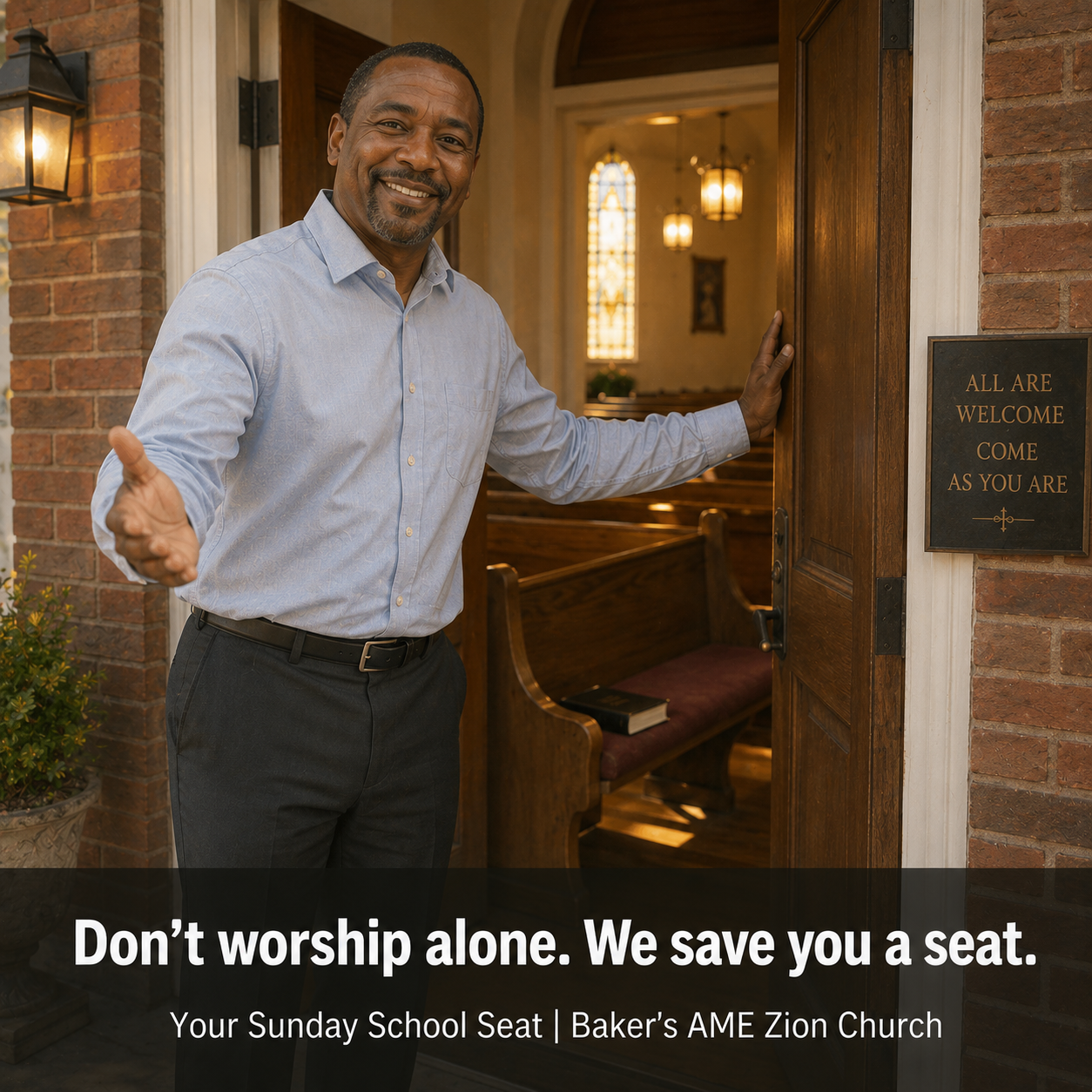
We have walked all week toward this moment. Hebrews 10 will not let us miss the point.
Hebrews 10:19-25 — KJV 19 Having therefore, brethren, boldness to enter into the holiest by the blood of Jesus, 20 By a new and living way, which he hath consecrated for us, through the veil, that is to say, his flesh; 21 And having an high priest over the house of God; 22 Let us draw near with a true heart in full assurance of faith, having our hearts sprinkled from an evil conscience, and our bodies washed with pure water. 23 Let us hold fast the profession of our faith without wavering; (for he is faithful that promised;) 24 And let us consider one another to provoke unto love and to good works: 25 Not forsaking the assembling of ourselves together, as the manner of some is; but exhorting one another: and so much the more, as ye see the day approaching.
Hebrews 10:19-25 — WEB 19 Having therefore, brothers, boldness to enter into the holy place by the blood of Jesus, 20 by the way which he dedicated for us, a new and living way, through the veil, that is to say, his flesh, 21 and having a great priest over the house of God, 22 let's draw near with a true heart in fullness of faith, having our hearts sprinkled from an evil conscience, and having our body washed with pure water, 23 let's hold fast the confession of our hope without wavering; for he who promised is faithful. 24 Let's consider how to provoke one another to love and good works, 25 not forsaking our own assembling together, as the custom of some is, but exhorting one another, and so much the more as you see the Day approaching.
The book of Hebrews was written to a community that was getting tired. Some of them had suffered for their faith. Some had drifted. Many were tempted to step quietly back into the religious lives they had left behind. The writer of Hebrews spends most of the letter showing them, in careful detail, what Jesus has done — how His sacrifice is greater than the old temple sacrifices, how His priesthood is greater than the old priesthood, how His new covenant fulfills what the old covenant had only promised. Then in chapter 10, the argument turns into an exhortation. Having therefore — given all of this — let us.
The writer issues three "let us" statements that anchor the whole Christian life. Let us draw near. Let us hold fast. Let us consider one another. Together they describe a life of worship that is intimate with God, settled in hope, and built around community.
Notice they don't end with let us draw near. The writer knows we cannot survive a long faith alone. So he adds: let us consider one another to provoke unto love and to good works. That word "provoke" sounds harsh in English, but the Greek means something closer to stir up or spur on. Think of how good a friend's encouragement feels when you have been wobbling. Think of the way one person showing up reliably can hold up another person through a year they didn't think they'd survive. That is what the writer is asking us to be for each other.
And then the line. Not forsaking the assembling of ourselves together, as the manner of some is. The writer acknowledges with quiet honesty that some had already stopped coming. He doesn't shame them. He just names what happens. Faith left alone gets thin. Hope left alone gets quiet. Love left alone forgets how to act. The remedy he prescribes is gathering. Not because the building is magic. Because being in the room with other believers does something to a soul that nothing else can do.
This is the whole point of the week. Fellowship through worship is not optional Christianity. It is the design. Psalm 95 called us to come and sing. Psalm 122 made us glad to go. Romans 12 invited us to bring our whole selves. Nehemiah 8 promised that joy would become our strength. Matthew 18 taught us to have the hard conversations that keep us together. Acts 4 showed us a community whose worship spilled over into shared lives. And Hebrews 10 ties the whole week together with one simple plea: keep showing up.
If you are reading this on Sunday morning, the rest of the day is an answer to a question this week has been quietly asking you. Will you go? Will you walk in? Will you sit beside somebody? Will you sing — even soft? The Lord who entered the holy place by His own blood has opened the way for you to come near. And He has given you a family to come near with.
We save you a seat. Not as a slogan. As a promise. The door is open. Your spot is waiting. Come on in.
Thought for the Day: Don't worship alone. We save you a seat.
Reflection: What is one thing keeping me from showing up — and is it bigger than what Christ has done?
Prayer: Lord Jesus, You opened the way to the Father by Your own body and Your own blood. We come near today with hearts full of faith and need. Hold us fast when we are tempted to drift. Stir us up to love and good works. Set us beside other believers who will spur us on, and make us the kind of friends who do that for somebody else. We thank You for the church You have given us. We thank You for the seat that is always saved. Amen.
Today is Sunday school. We save you a seat.
Saturday, May 30 — Worship Spills Over
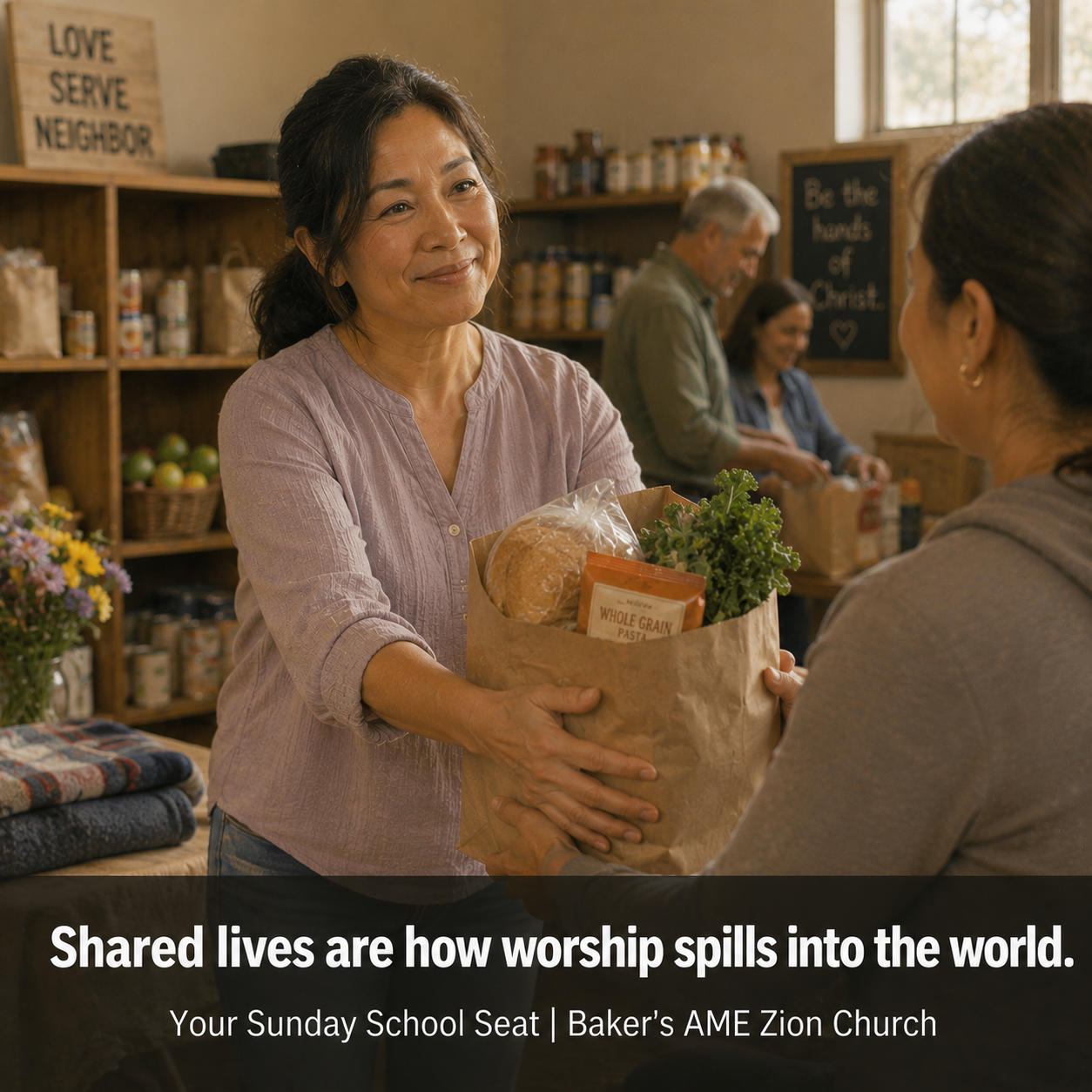
When worship has done its work in a community, you can find the evidence in their wallets, their pantries, and their guest rooms.
Acts 4:32-37 — KJV 32 And the multitude of them that believed were of one heart and of one soul: neither said any of them that ought of the things which he possessed was his own; but they had all things common. 33 And with great power gave the apostles witness of the resurrection of the Lord Jesus: and great grace was upon them all. 34 Neither was there any among them that lacked: for as many as were possessors of lands or houses sold them, and brought the prices of the things that were sold, 35 And laid them down at the apostles' feet: and distribution was made unto every man according as he had need. 36 And Joses, who by the apostles was surnamed Barnabas, (which is, being interpreted, The son of consolation,) a Levite, and of the country of Cyprus, 37 Having land, sold it, and brought the money, and laid it at the apostles' feet.
Acts 4:32-37 — WEB 32 The multitude of those who believed were of one heart and soul. Not one of them claimed that anything of the things which he possessed was his own, but they had all things in common. 33 With great power, the apostles gave their testimony of the resurrection of the Lord Jesus. Great grace was on them all. 34 For neither was there among them any who lacked, for as many as were owners of lands or houses sold them, and brought the proceeds of the things that were sold, 35 and laid them at the apostles' feet, and distribution was made to each, according as anyone had need. 36 Joses, who by the apostles was also called Barnabas (which is, being interpreted, Son of Encouragement), a Levite, a man of Cyprus by race, 37 having a field, sold it, and brought the money and laid it at the apostles' feet.
Luke pulls back the curtain on the earliest church and gives us a snapshot we cannot look away from. One heart and one soul. Nobody calling their possessions their own. Nobody lacking anything. The resurrection of Jesus being proclaimed with great power, and great grace settling on everyone who believed it. This is what happened when the Spirit fell on a community of people who had recently been frightened disciples behind locked doors. Their worship reorganized their economy.
That is worth sitting with. Real worship is never private for long. If it is real, it leaks. Into your bank account. Into your calendar. Into the way you think about what is yours. The Jerusalem church wasn't following a program. They weren't running a capital campaign. They had been so changed by what Jesus had done that they couldn't quite remember why they had ever held on so tightly.
Then Luke does something only Luke would do. He gives us a name. Joses, who by the apostles was surnamed Barnabas, which is, being interpreted, The son of consolation. Out of a whole crowd of generous people, Luke pauses to introduce one of them. He'll mention Barnabas many more times in Acts. Barnabas will be the one who vouches for the brand-new convert Paul when nobody else trusts him. Barnabas will be the one who takes a chance on young John Mark after Paul gives up on him. The pattern in his life is already showing up here in chapter 4. He sees what is needed and brings what he has, and he keeps doing it for the rest of his life.
This is fellowship through worship at its fullest. Worship in the Spirit had so reshaped that community that the resurrection wasn't just a doctrine they affirmed on Sundays. It was a practice that showed up Monday through Saturday. Need was met. People without were brought in. The line between "mine" and "ours" got blurry on purpose.
We don't all need to sell our houses this morning. But none of us are exempt from the question Acts 4 is asking. What in our lives still has too tight a grip on us? Where could we loosen our fingers a little? Whose need have we noticed and quietly walked past? Worship that never makes it past the parking lot isn't worship that has finished its work.
Tomorrow is Sunday. The week has been an invitation: come and sing, walk together, bring your whole self, let joy become strength, have the hard conversation, share what you have. Today is the day to do the smallest version of any of those that we can manage. The Barnabas in the story didn't start by selling the field. He started by paying attention. So can we.
Thought for the Day: Shared lives are how worship spills into the world.
Reflection: What is one thing I am holding too tightly that the body around me needs?
Prayer: Spirit of God, the same Spirit who shook a room and rearranged a community in Jerusalem, do that same work in us. Loosen our grip. Open our eyes to the people around us who are quietly in need. Make us the kind of believers whose worship doesn't end at the door. Raise up Barnabases in our church and let us be one of them. Amen.
This week we walk toward Sunday's lesson: Fellowship Through Worship.
Friday, May 29 — The Hard Conversation

Real fellowship is not the absence of conflict. According to Jesus, it is the willingness to walk into it.
Matthew 18:15-20 — KJV 15 Moreover if thy brother shall trespass against thee, go and tell him his fault between thee and him alone: if he shall hear thee, thou hast gained thy brother. 16 But if he will not hear thee, then take with thee one or two more, that in the mouth of two or three witnesses every word may be established. 17 And if he shall neglect to hear them, tell it unto the church: but if he neglect to hear the church, let him be unto thee as an heathen man and a publican. 18 Verily I say unto you, Whatsoever ye shall bind on earth shall be bound in heaven: and whatsoever ye shall loose on earth shall be loosed in heaven. 19 Again I say unto you, That if two of you shall agree on earth as touching any thing that they shall ask, it shall be done for them of my Father which is in heaven. 20 For where two or three are gathered together in my name, there am I in the midst of them.
Matthew 18:15-20 — WEB 15 "If your brother sins against you, go, show him his fault between you and him alone. If he listens to you, you have gained back your brother. 16 But if he doesn't listen, take one or two more with you, that at the mouth of two or three witnesses every word may be established. 17 If he refuses to listen to them, tell it to the assembly. If he refuses to hear the assembly also, let him be to you as a Gentile or a tax collector. 18 Most certainly I tell you, whatever things you bind on earth will have been bound in heaven, and whatever things you release on earth will have been released in heaven. 19 Again, assuredly I tell you, that if two of you will agree on earth concerning anything that they will ask, it will be done for them by my Father who is in heaven. 20 For where two or three are gathered together in my name, there I am in the middle of them."
We tend to remember verse 20 — where two or three are gathered together in my name, there am I in the midst of them — as a sweet promise for prayer meetings. And it is. But Jesus did not say it in a context of cozy fellowship. He said it at the end of a teaching about church conflict. The "two or three" He was talking about were the witnesses you might bring along when a hard conversation with a fellow believer could not be avoided.
That changes the whole feel of the passage. Jesus is not naive about the church. He knows people will hurt each other. Promises will be broken. Words will land wrong. Sins, small and large, will leak into the most loving congregations. So He gives us a process. Not a hotline to gossip. Not a system to embarrass anybody. A process designed to keep relationships alive.
Notice the first step. Go and tell him his fault between thee and him alone. You don't go to your cousin first. You don't post about it. You don't bring it up in the choir room. You go directly to the person, privately, and you have the conversation. The goal — Jesus says it plainly — is to gain your brother. The point is restoration, not victory.
If that doesn't work, Jesus says, bring one or two others. Not a crowd. A small circle of witnesses to help you both hear each other clearly. Only if that fails do you involve the wider church. And even then, the goal is still the same. The aim, at every step, is to keep this person inside the family.
This is some of the hardest teaching in the Bible to actually obey. Most of us would rather avoid the conversation. We would rather complain to a friend, or quietly back away from the person, or post something vague online. Jesus is asking for something braver and rarer. Show up. Sit down. Tell the truth in love. Listen back.
And then — and here is the part that fits our week — Jesus promises His presence in the middle of that hard work. Where two or three are gathered in His name, He is there. Fellowship through worship is not just singing the same songs in the same room. It is also the costly love that refuses to let a relationship quietly die. The church is not a building where people are nice to each other. The church is a community where people are honest enough to stay.
If there is somebody you have been avoiding this week, today might be the day. Not to win. Not to vent. To gain a brother. To gain a sister. Christ promised to be in the room with you.
Thought for the Day: Real fellowship requires honest conversations and open doors.
Reflection: Is there one person I have been avoiding instead of speaking to honestly?
Prayer: Lord Jesus, You have not asked us to be a church of polite strangers. You have asked us to be a family that knows how to come back together. Give us the courage for the conversations we have been putting off. Keep our hearts gentle and our motives clean. Be in the middle of the room when we sit down. Amen.
This week we walk toward Sunday's lesson: Fellowship Through Worship.
Thursday, May 28 — Joy Is Your Strength
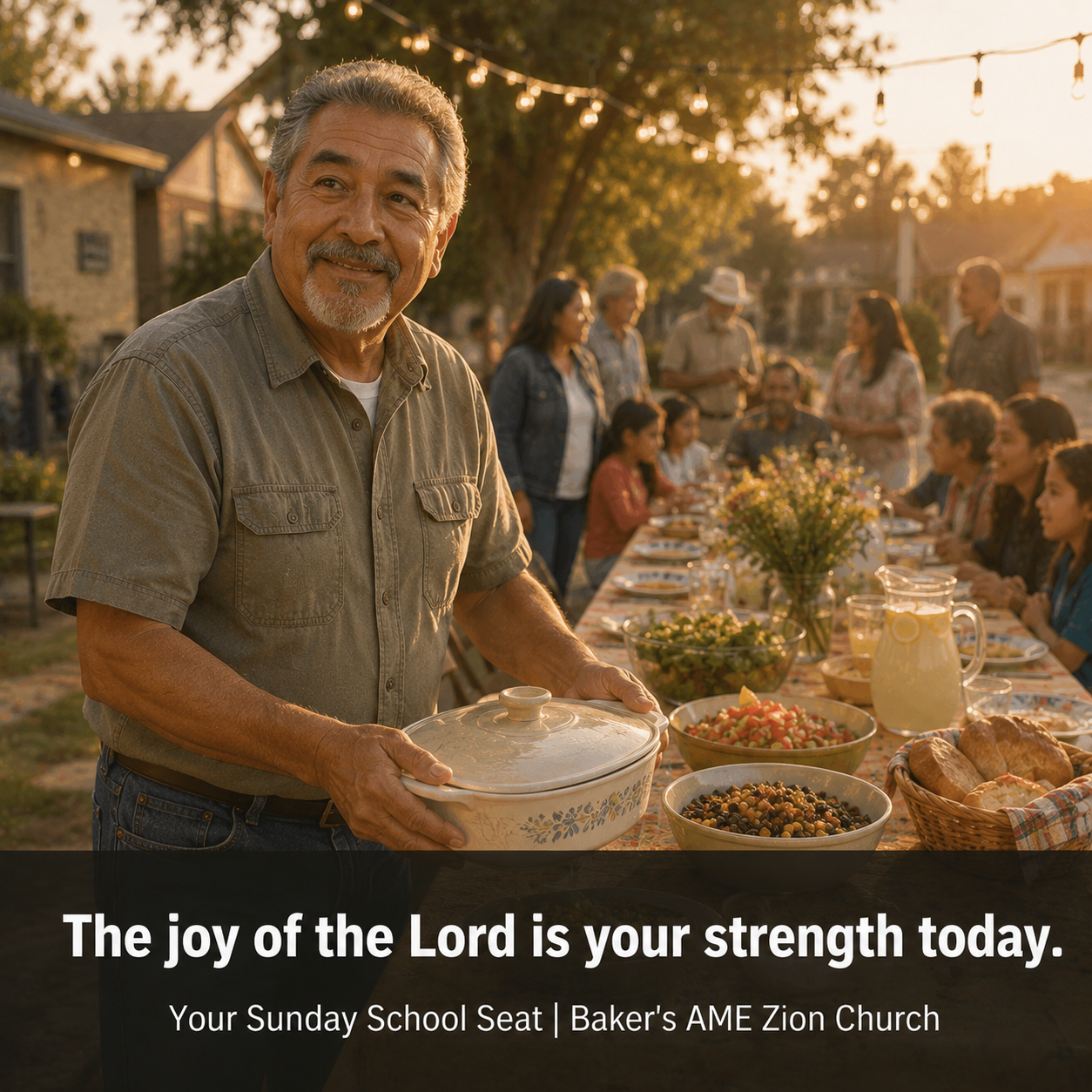
If you have ever cried in church for reasons you couldn't quite name, Nehemiah 8 will sound familiar.
Nehemiah 8:9-12 — KJV 9 And Nehemiah, which is the Tirshatha, and Ezra the priest the scribe, and the Levites that taught the people, said unto all the people, This day is holy unto the LORD your God; mourn not, nor weep. For all the people wept, when they heard the words of the law. 10 Then he said unto them, Go your way, eat the fat, and drink the sweet, and send portions unto them for whom nothing is prepared: for this day is holy unto our Lord: neither be ye sorry; for the joy of the LORD is your strength. 11 So the Levites stilled all the people, saying, Hold your peace, for the day is holy; neither be ye grieved. 12 And all the people went their way to eat, and to drink, and to send portions, and to make great mirth, because they had understood the words that were declared unto them.
Nehemiah 8:9-12 — WEB 9 Nehemiah, who was the governor, Ezra the priest the scribe, and the Levites who taught the people, said to all the people, "Today is holy to Yahweh your God. Don't mourn, nor weep." For all the people wept, when they heard the words of the law. 10 Then he said to them, "Go your way. Eat the fat, drink the sweet, and send portions to him for whom nothing is prepared, for today is holy to our Lord. Don't be grieved, for the joy of Yahweh is your strength." 11 So the Levites stilled all the people, saying, "Hold your peace, for the day is holy; don't be grieved." 12 All the people went their way to eat, to drink, to send portions, and to celebrate, because they had understood the words that were declared to them.
To feel the weight of this scene, you have to know what came before it. The people of Judah had spent decades in exile in Babylon. Their temple was destroyed. Their city was rubble. A whole generation grew up without ever standing on the ground their grandparents had loved. Then a remnant returned, slowly rebuilt the walls under Nehemiah's leadership, and on this particular day, gathered together at the Water Gate in Jerusalem to hear Ezra read aloud from the Book of the Law.
And they wept. Of course they did. They were hearing words their grandparents had taught them, words they had recited in exile when they wondered if any of it still applied to them. They were hearing what they had lost and what God had not let go of. The tears were repentance and homesickness and gratitude all tangled together. Anyone who has sat in a pew and felt something old break loose in their chest knows what that moment was.
What is striking is the response from their leaders. Nehemiah and Ezra do not tell the people to keep weeping. They don't double down on grief. They say stop. This day is holy. Go your way, eat the fat, drink the sweet — and here is the line that has carried God's people ever since — the joy of the LORD is your strength.
Two things to notice. The first is that worship moves us. Real encounters with God's word produce real emotion, and that is not weakness. The people wept because they finally understood. The tears were honest. But the second thing is that God doesn't leave His people in lament. The aim of worship is not to feel bad about yourself. The aim of worship is joy that becomes strength for the road ahead. Strength to rebuild walls. Strength to raise children in a city that had forgotten how to be a city. Strength to wait for the next thing God was going to do.
Then notice what verse 10 says about how that joy is expressed: send portions unto them for whom nothing is prepared.The very first thing Ezra tells them to do with their joy is feed somebody who couldn't afford the feast. Fellowship through worship is not just a feeling in your chest. It is a casserole in somebody else's kitchen. It is a paid-off light bill nobody else knows about. It is making sure the table has room for the person who almost didn't come.
If you have come into this Thursday tired, hear the word again. The joy of the Lord is your strength. Not your performance. Not your willpower. His joy. And it shows up in your hands long before it shows up on your face.
Thought for the Day: The joy of the Lord is your strength today.
Reflection: Who in my life this week needs a portion from my table — and have I noticed?
Prayer: Lord, You meet us where the tears are honest and You do not leave us there. Fill us with the kind of joy that becomes strength for the long week ahead. Then turn that joy outward. Show us the neighbor for whom nothing is prepared. Let our worship reach their kitchen table. Amen.
This week we walk toward Sunday's lesson: Fellowship Through Worship.
Wednesday, May 27 — Bring Your Whole Self
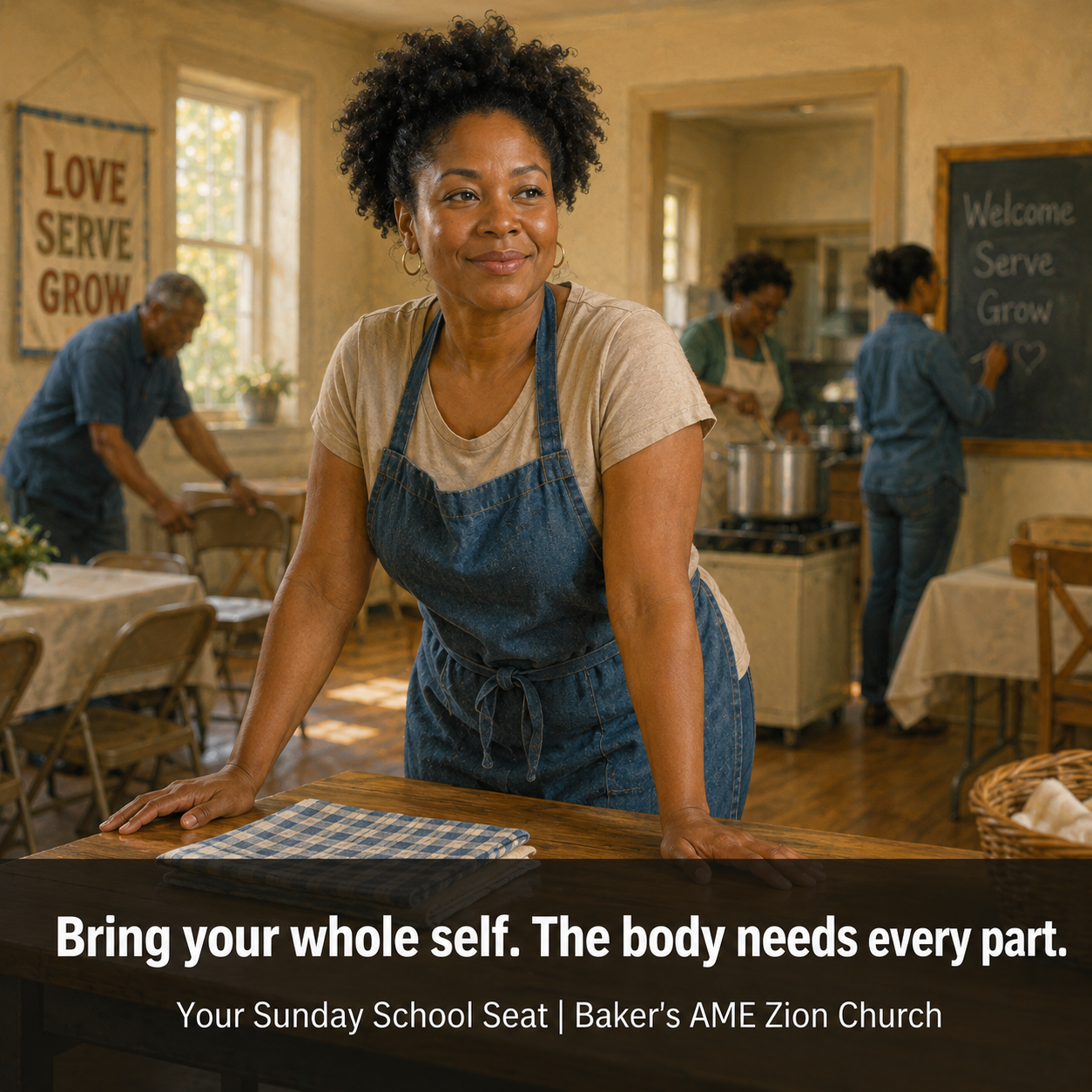
Worship isn't a song you sing for an hour on Sunday. According to Paul, it's a whole life laid on the table.
Romans 12:1-8 — KJV 1 I beseech you therefore, brethren, by the mercies of God, that ye present your bodies a living sacrifice, holy, acceptable unto God, which is your reasonable service. 2 And be not conformed to this world: but be ye transformed by the renewing of your mind, that ye may prove what is that good, and acceptable, and perfect, will of God. 3 For I say, through the grace given unto me, to every man that is among you, not to think of himself more highly than he ought to think; but to think soberly, according as God hath dealt to every man the measure of faith. 4 For as we have many members in one body, and all members have not the same office: 5 So we, being many, are one body in Christ, and every one members one of another. 6 Having then gifts differing according to the grace that is given to us, whether prophecy, let us prophesy according to the proportion of faith; 7 Or ministry, let us wait on our ministering: or he that teacheth, on teaching; 8 Or he that exhorteth, on exhortation: he that giveth, let him do it with simplicity; he that ruleth, with diligence; he that sheweth mercy, with cheerfulness.
Romans 12:1-8 — WEB 1 Therefore I urge you, brothers, by the mercies of God, to present your bodies a living sacrifice, holy, acceptable to God, which is your spiritual service. 2 Don't be conformed to this world, but be transformed by the renewing of your mind, so that you may prove what is the good, well-pleasing, and perfect will of God. 3 For I say through the grace that was given me, to every man who is among you, not to think of himself more highly than he ought to think; but to think reasonably, as God has apportioned to each person a measure of faith. 4 For even as we have many members in one body, and all the members don't have the same function, 5 so we, who are many, are one body in Christ, and individually members of one another. 6 Having gifts differing according to the grace that was given to us: if prophecy, let's prophesy according to the proportion of our faith; 7 or service, let's give ourselves to service; or he who teaches, to his teaching; 8 or he who exhorts, to his exhorting; he who gives, let him do it with generosity; he who rules, with diligence; he who shows mercy, with cheerfulness.
Romans 12 sits at a pivot point in Paul's longest letter. The first eleven chapters are a careful argument about what God has done in Christ — sin, grace, faith, the long mystery of how Jew and Gentile come together at one table. Then chapter 12 begins with that small but enormous word: therefore. In light of everything God has done, here is what now happens to us. The doctrine ends. The shape of a life begins.
And the first thing Paul names is worship. Not church attendance. Worship as the offering of an entire body. The Greek word translated "reasonable" (KJV) or "spiritual" (WEB) carries the sense of logical, fitting, what makes sense. Paul is saying: given who God is and what God has done, the only sensible response is to hand your whole self over. Not just your Sunday morning. Your hands. Your schedule. Your money. Your phone. Your appetites. Your time after dinner. All of it, on the altar, alive.
Then in verses 3 through 8, Paul does something beautiful. He moves immediately from individual surrender to community life. The body language is not accidental. Paul will not let us imagine that worship is a solo project. The moment you give yourself to God, you discover you have been joined to other people who are doing the same thing. We are members of one body, and — here is the line that always stops me — members one of another. You don't belong only to God. You belong to the people God has placed beside you.
And we don't all carry the same gifts. Some teach. Some give. Some show up early and stack chairs. Some make a casserole for a family that just lost somebody. Some pray quietly for a congregation that will never hear about it. Paul lists these gifts side by side without ranking them. He wants us to understand that the body needs all of them. The teacher needs the giver. The leader needs the merciful. The loud-voiced needs the quiet. Nobody is bringing too little. Everybody is bringing something.
This is the heart of fellowship through worship. You bring your whole self, and so does the person next to you, and somehow what gets offered together is more than what any of us could have carried alone. Don't shrink your gift. Don't envy somebody else's. Don't sit out. The body needs you exactly the way God made you.
Thought for the Day: Bring your whole self. The body needs every part.
Reflection: What gift have I been holding back because it doesn't look like somebody else's?
Prayer: God of mercies, we lay ourselves down again today — not in pieces, but whole. Take our hands and our hours and our quiet strengths. Show us where we belong in the body. Free us from the foolishness of thinking we have nothing to offer. Free us also from the pride of thinking our gift is the only one that matters. Amen.
This week we walk toward Sunday's lesson: Fellowship Through Worship.
Tuesday, May 26 — Glad to Go

There is a kind of joy that shows up in your feet before it ever reaches your face. Psalm 122 is a song about that.
Psalm 122 — KJV 1 I was glad when they said unto me, Let us go into the house of the LORD. 2 Our feet shall stand within thy gates, O Jerusalem. 3 Jerusalem is builded as a city that is compact together: 4 Whither the tribes go up, the tribes of the LORD, unto the testimony of Israel, to give thanks unto the name of the LORD. 5 For there are set thrones of judgment, the thrones of the house of David. 6 Pray for the peace of Jerusalem: they shall prosper that love thee. 7 Peace be within thy walls, and prosperity within thy palaces. 8 For my brethren and companions' sakes, I will now say, Peace be within thee. 9 Because of the house of the LORD our God I will seek thy good.
Psalm 122 — WEB 1 I was glad when they said to me, "Let's go to Yahweh's house!" 2 Our feet are standing within your gates, Jerusalem! 3 Jerusalem is built as a city that is compact together, 4 where the tribes go up, even Yah's tribes, according to an ordinance for Israel, to give thanks to Yahweh's name. 5 For there are set thrones for judgment, the thrones of David's house. 6 Pray for the peace of Jerusalem. Those who love you will prosper. 7 Peace be within your walls, and prosperity within your palaces. 8 For my brothers' and companions' sakes, I will now say, "Peace be within you." 9 For the sake of the house of Yahweh our God, I will seek your good.
Psalm 122 is one of the "Songs of Ascents" — a small collection of psalms (120 through 134) that Israelites sang as they walked up to Jerusalem for the great pilgrimage feasts. Three times a year they left their villages, gathered their families and provisions, and made the journey to the temple together. These songs were the music of the road. You can almost picture it: dust on sandals, kids riding on shoulders, conversation rising and falling, the whole crowd singing the same line as the city walls come into view.
What grabs me about this psalm is the very first word. "Glad." Not dutiful. Not punctual. Glad. The psalmist remembers the moment somebody said, "Let's go," and his whole spirit lifted. That's a feeling worth holding onto in a week about fellowship through worship. Worship was never meant to be the thing you have to drag yourself toward. It was meant to be the thing you can't quite wait for.
The psalm also makes a quiet point we should not miss. The pilgrim isn't going up by himself. The whole psalm is plural — let us go, our feet, my brethren and companions. Worship in Israel was a community act. The tribes went up together. They prayed for the peace of the city not just because they liked the architecture but because they loved the people who would be inside those walls with them. Fellowship through worship is not a phrase the psalmist would have needed explained to him. It was just how worship worked.
Now think about your own week. Most of us live in a culture that has done a thorough job convincing us we can do everything alone. Spiritual practice has been quietly rebranded as a private hobby — a podcast on the commute, a verse on the phone, a quiet moment with coffee. Those things are good. None of them are the whole thing. There is something Psalm 122 knows that we forget. Joy multiplies when you walk toward God with other people. The body remembers being in a room with other voices. The soul remembers being known.
If gathering has gotten hard lately — and for a lot of us it has, since the pandemic years rearranged habits we didn't know were that fragile — Psalm 122 is an invitation back. Not a guilt trip. An invitation. Someone is saying, "Let's go." May we be glad to hear it.
Thought for the Day: Joy walks with us toward the house of God.
Reflection: When was the last time I felt glad — not just willing — to gather with God's people?
Prayer: God, You have planted a longing in us to come home to You with others. Forgive the seasons we have let that longing go quiet. Stir up gladness in our feet again. Make us the kind of friend who says, "Let's go," and the kind of soul who is glad to hear it. Amen.
This week we walk toward Sunday's lesson: Fellowship Through Worship.
Monday, May 25 — Come and Sing
Some mornings the alarm goes off and singing is the very last thing on the list. Psalm 95 starts there anyway, and it doesn't apologize for the invitation.
Psalm 95 — KJV 1 O come, let us sing unto the LORD: let us make a joyful noise to the rock of our salvation. 2 Let us come before his presence with thanksgiving, and make a joyful noise unto him with psalms. 3 For the LORD is a great God, and a great King above all gods. 4 In his hand are the deep places of the earth: the strength of the hills is his also. 5 The sea is his, and he made it: and his hands formed the dry land. 6 O come, let us worship and bow down: let us kneel before the LORD our maker. 7 For he is our God; and we are the people of his pasture, and the sheep of his hand. To day if ye will hear his voice, 8 Harden not your heart, as in the provocation, and as in the day of temptation in the wilderness: 9 When your fathers tempted me, proved me, and saw my work. 10 Forty years long was I grieved with this generation, and said, It is a people that do err in their heart, and they have not known my ways: 11 Unto whom I sware in my wrath that they should not enter into my rest.
Psalm 95 — WEB 1 Oh come, let's sing to Yahweh. Let's shout aloud to the rock of our salvation! 2 Let's come before his presence with thanksgiving. Let's extol him with songs! 3 For Yahweh is a great God, a great King above all gods. 4 In his hand are the deep places of the earth. The heights of the mountains are also his. 5 The sea is his, and he made it. His hands formed the dry land. 6 Oh come, let's worship and bow down. Let's kneel before Yahweh, our Maker, 7 for he is our God. We are the people of his pasture, and the sheep in his care. Today, oh that you would listen to his voice! 8 Don't harden your heart, as at Meribah, as in the day of Massah in the wilderness, 9 when your fathers tempted me, tested me, and saw my work. 10 Forty long years I was grieved with that generation, and said, "It is a people that errs in their heart. They have not known my ways." 11 Therefore I swore in my wrath, "They won't enter into my rest."
Psalm 95 is one of Israel's "enthronement psalms" — songs the gathered people sang to celebrate God as their true King. Many scholars believe it was used as a call to worship at the beginning of a service, the way an opening hymn pulls a congregation to its feet on Sunday morning. What is striking, though, is that the psalm has two halves that look like they belong to different songs. The first six and a half verses are pure exuberance: come, sing, shout, kneel. Then in verse 7, the music stops mid-measure: "Today if ye will hear his voice, harden not your heart."
The psalmist is saying something we don't always like to hear. Worship is never just music. It is also memory and responsibility. Israel remembers who God is — the One whose hand holds the deep places of the earth and the heights of the mountains, the Shepherd who kept watch over a wandering people. And then they remember what happened when their ancestors stood in the wilderness, heard God speak, and let their hearts go hard anyway. Worship that doesn't change us has missed the point.
This is where our week begins. We are walking toward Sunday's lesson on fellowship through worship, and the first thing the Bible wants us to know is that fellowship starts with response. Before we ever get to the question of how to worship together, we have to deal with whether we are willing to come at all.
Most of us aren't going to shout this morning. We probably won't even sing loud in the car. But the psalm isn't really about volume. It's about what happens inside a person who remembers. God has already done something. He made the world. He has kept watch over years of our lives we can't fully account for. He has held a family together that should have come apart, or kept a body going that probably shouldn't still be walking. Worship is the response to all that. It doesn't require a great voice. It requires a heart that hasn't gone hard. Monday morning is a good place to start.
Thought for the Day: Worship begins when we stop performing and start responding.
Reflection: Where in my week am I most tempted to let my heart go hard instead of stay soft to God?
Prayer: Lord, before this week picks up speed, we stop and remember who You are. You made the seas and the dry land. You have shepherded us through years we don't fully understand. Soften any place in us that has grown hard without us noticing. Help us hear Your voice today, before anything else fills our ears. Amen.
This week we walk toward Sunday's lesson: Fellowship Through Worship.
Sunday, May 24 — The Sabbath Was Made for You
Today is Sunday school. The whole week has been pointing here. Jesus settles the recreation question with one of the most liberating sentences in the Gospels: the Sabbath was made for man, not man for the Sabbath.
Mark 2:18-28 — KJV 18 And the disciples of John and of the Pharisees used to fast: and they come and say unto him, Why do the disciples of John and of the Pharisees fast, but thy disciples fast not? 19 And Jesus said unto them, Can the children of the bridechamber fast, while the bridegroom is with them? as long as they have the bridegroom with them, they cannot fast. 20 But the days will come, when the bridegroom shall be taken away from them, and then shall they fast in those days. 21 No man also seweth a piece of new cloth on an old garment: else the new piece that filled it up taketh away from the old, and the rent is made worse. 22 And no man putteth new wine into old bottles: else the new wine doth burst the bottles, and the wine is spilled, and the bottles will be marred: but new wine must be put into new bottles. 23 And it came to pass, that he went through the corn fields on the sabbath day; and his disciples began, as they went, to pluck the ears of corn. 24 And the Pharisees said unto him, Behold, why do they on the sabbath day that which is not lawful? 25 And he said unto them, Have ye never read what David did, when he had need, and was an hungred, he, and they that were with him? 26 How he went into the house of God in the days of Abiathar the high priest, and did eat the shewbread, which is not lawful to eat but for the priests, and gave also to them which were with him? 27 And he said unto them, The sabbath was made for man, and not man for the sabbath: 28 Therefore the Son of man is also Lord of the sabbath.
Mark 2:18-28 — WEB 18 John's disciples and the Pharisees were fasting, and they came and asked him, "Why do John's disciples and the disciples of the Pharisees fast, but your disciples don't fast?" 19 Jesus said to them, "Can the groomsmen fast while the bridegroom is with them? As long as they have the bridegroom with them, they can't fast. 20 But the days will come when the bridegroom will be taken away from them, and then they will fast in that day. 21 No one sews a piece of unshrunk cloth on an old garment, or else the patch shrinks and the new tears away from the old, and a worse hole is made. 22 No one puts new wine into old wineskins, or else the new wine will burst the skins, and the wine pours out, and the skins will be destroyed; but they put new wine into fresh wineskins." 23 He was going on the Sabbath day through the grain fields, and his disciples began, as they went, to pluck the ears of grain. 24 The Pharisees said to him, "Behold, why do they do that which is not lawful on the Sabbath day?" 25 He said to them, "Did you never read what David did when he had need and was hungry—he, and those who were with him? 26 How he entered into God's house at the time of Abiathar the high priest, and ate the show bread, which is not lawful to eat except for the priests, and gave also to those who were with him?" 27 He said to them, "The Sabbath was made for man, not man for the Sabbath. 28 Therefore the Son of Man is lord even of the Sabbath."
Explanation
Two scenes back to back, and they're both about how God's people are supposed to live with the gifts of God.
In the first, John's disciples and the Pharisees fast. They notice Jesus's followers don't. They confront him about it. Jesus's answer is striking: you don't fast at a wedding. The bridegroom is right here. Then he says something that should reorient us — you don't put new wine in old wineskins. Don't try to pour the freshness of the kingdom into rigid containers built for something else.
In the second scene, Jesus's disciples are walking through grain fields on the Sabbath, and they're hungry, so they pluck a few heads of grain to eat as they go. The Pharisees are scandalized. They've built layers of rules around the Sabbath. Plucking grain counts as harvesting. Harvesting is work. Therefore — gotcha. Jesus answers them with a story about David eating bread that wasn't lawful for him to eat, when his men were hungry. And then he says the line: the Sabbath was made for man, not man for the Sabbath.
Read that line slowly. The Sabbath — the great day of rest, the centerpiece of Israel's recreational rhythm, the gift God built into the very structure of the week — was made for you. Not the other way around. You are not a slave to the rest. The rest is a servant of you. God invented Sabbath so that human beings would have a regular, weekly chance to stop, breathe, eat, gather, worship, laugh, and remember they are loved by their Maker.
This whole week has been moving here. Monday, Jesus blessed a wedding. Tuesday, Sarah laughed and Abraham threw a feast. Wednesday, Zechariah saw old folks resting and children playing. Thursday, Paul told the Colossians not to let religious bullies steal their joy. Friday, Jesus called out a generation that wouldn't dance. Saturday, Jeremiah promised mourning would turn into dancing. And today Jesus puts the keystone in the arch: rest, joy, and recreation are gifts — not loopholes.
The Christian view of recreation isn't permission to be lazy. It isn't an excuse to coast. It's a recognition that you were made by a God who built rest into the rhythm of creation. He rested on the seventh day. He invited his people into rest. He came as a man and ate at parties and walked through grain fields and let his disciples grab a snack.
You are loved. You don't have to earn your rest. You don't have to apologize for your joy. The Lord of the Sabbath is gentle with his people, and he invites you, this morning, into the kind of rest that restores your soul.
Welcome to Sunday school.
Thought for the Day The Sabbath was made for you. Not the other way around.
Reflection Question What would it look like to receive rest this week as a gift, instead of negotiating with it?
Prayer Lord of the Sabbath, you who built rest into the bones of the week, thank you that you are gentle with us. Forgive us for the years we've treated rest as weakness and joy as luxury. Lead us today into the kind of stillness that restores our souls. Bless this Sunday school hour. Bless every seat in every classroom. And meet us, as you always do, right where we are. Amen.
Today is Sunday school. We save you a seat.
Saturday, May 23 — He Turns Mourning Into Dancing
Jeremiah is writing to people whose world has been broken. And in the middle of the wreckage, God sends a song. The mourning is not the last word.
Jeremiah 31:10-14 — KJV 10 Hear the word of the LORD, O ye nations, and declare it in the isles afar off, and say, He that scattered Israel will gather him, and keep him, as a shepherd doth his flock. 11 For the LORD hath redeemed Jacob, and ransomed him from the hand of him that was stronger than he. 12 Therefore they shall come and sing in the height of Zion, and shall flow together to the goodness of the LORD, for wheat, and for wine, and for oil, and for the young of the flock and of the herd: and their soul shall be as a watered garden; and they shall not sorrow any more at all. 13 Then shall the virgin rejoice in the dance, both young men and old together: for I will turn their mourning into joy, and will comfort them, and make them rejoice from their sorrow. 14 And I will satiate the soul of the priests with fatness, and my people shall be satisfied with my goodness, saith the LORD.
Jeremiah 31:10-14 — WEB 10 "Hear Yahweh's word, you nations, and declare it in the distant islands. Say, 'He who scattered Israel will gather him, and keep him, as a shepherd does his flock.' 11 For Yahweh has ransomed Jacob, and redeemed him from the hand of him who was stronger than he. 12 They will come and sing in the height of Zion, and will flow to the goodness of Yahweh, to the grain, to the new wine, to the oil, and to the young of the flock and of the herd. Their soul will be as a watered garden. They will not sorrow any more at all. 13 Then the virgin will rejoice in the dance; the young men and the old together; for I will turn their mourning into joy, and will comfort them, and make them rejoice from their sorrow. 14 I will satiate the soul of the priests with abundance, and my people will be satisfied with my goodness," says Yahweh.
Explanation
Jeremiah is the prophet we don't always want to read. He's known as the weeping prophet for a reason. He spent decades watching his country fall apart. He warned Judah that exile was coming, and they didn't listen, and then it came, and his warnings were vindicated in the worst possible way. He saw Jerusalem burn. He saw children die. He grieved like few prophets ever grieved.
And then, somewhere in the middle of his book, you turn the page to chapter 31, and the tone shifts. The man who has been weeping for chapters starts to sing.
What does the song sound like? Not abstract theology. Not dry hope. The song is concrete. People will come back to Zion. They will sing. They will eat — wheat, wine, oil. The herds will be young and the gardens will be watered. Young women will dance. Young men and old men will dance together. The priests will be satisfied with abundance. And — here's the line that has comforted believers for twenty-six centuries — I will turn their mourning into joy, and will comfort them, and make them rejoice from their sorrow.
Notice what restoration looks like in God's hands. It looks like a community gathering to feast and dance. It looks like generations celebrating in the same space. It looks like work and produce and wine and oil. It looks like the ordinary good things of human life, returning, and being received with joy.
This is the Christian view of recreation in seed form. Jeremiah is telling a wounded people: God is not finished with you. The mourning is real, but it is not the last word. There is dancing on the other side. There is feasting on the other side. There is togetherness on the other side, where the young and the old aren't isolated by their grief but united in their joy.
You may be reading this on a Saturday morning in a season that feels a lot like Jeremiah's earlier chapters. A loved one has died. A marriage has cracked. A career has come apart. A child is far away. And God says: I will turn it.
Notice he doesn't say he will erase it. The mourning was real. The exile was real. The losses you carry are real. He says he will turn it — that he will take the very stuff of your sorrow and weave it into a different garment. The same heart that learned to mourn will learn to dance. The same community that buried each other will gather to feast.
If you're tired today, hear this: the dancing is on the way. He has not forgotten his promise.
Thought for the Day He doesn't erase the mourning. He turns it into joy.
Reflection Question What sorrow are you carrying that you've stopped believing God can turn into anything else?
Prayer Faithful God, you who saw Jeremiah weep and gave him a song anyway, see us where we sit today. We bring you our mourning — the losses, the disappointments, the heaviness we don't always name. We trust you to do what only you can do: not erase our grief, but transform it. Teach us to wait for the dancing, and give us the courage to take the first step when it comes. Amen.
This week we walk toward Sunday's lesson: The Christian View of Recreation.
Friday, May 22 — We Played the Flute for You

Jesus is calling out a crowd that can't be pleased. John was too austere; Jesus was too celebratory. Sometimes the problem isn't the music — it's the people refusing to dance.
Matthew 11:7-11, 16-19 — KJV 7 And as they departed, Jesus began to say unto the multitudes concerning John, What went ye out into the wilderness to see? A reed shaken with the wind? 8 But what went ye out for to see? A man clothed in soft raiment? behold, they that wear soft clothing are in kings' houses. 9 But what went ye out for to see? A prophet? yea, I say unto you, and more than a prophet. 10 For this is he, of whom it is written, Behold, I send my messenger before thy face, which shall prepare thy way before thee. 11 Verily I say unto you, Among them that are born of women there hath not risen a greater than John the Baptist: notwithstanding he that is least in the kingdom of heaven is greater than he. … 16 But whereunto shall I liken this generation? It is like unto children sitting in the markets, and calling unto their fellows, 17 And saying, We have piped unto you, and ye have not danced; we have mourned unto you, and ye have not lamented. 18 For John came neither eating nor drinking, and they say, He hath a devil. 19 The Son of man came eating and drinking, and they say, Behold a man gluttonous, and a winebibber, a friend of publicans and sinners. But wisdom is justified of her children.
Matthew 11:7-11, 16-19 — WEB 7 As these went their way, Jesus began to say to the multitudes concerning John, "What did you go out into the wilderness to see? A reed shaken by the wind? 8 But what did you go out to see? A man in soft clothing? Behold, those who wear soft clothing are in kings' houses. 9 But why did you go out? To see a prophet? Yes, I tell you, and much more than a prophet. 10 For this is he, of whom it is written, 'Behold, I send my messenger before your face, who will prepare your way before you.' 11 Most certainly I tell you, among those who are born of women there has not arisen anyone greater than John the Baptizer; yet he who is least in the Kingdom of Heaven is greater than he. … 16 "But to what shall I compare this generation? It is like children sitting in the marketplaces, who call to their companions 17 and say, 'We played the flute for you, and you didn't dance. We mourned for you, and you didn't lament.' 18 For John came neither eating nor drinking, and they say, 'He has a demon.' 19 The Son of Man came eating and drinking, and they say, 'Behold, a gluttonous man and a drunkard, a friend of tax collectors and sinners!' But wisdom is justified by her children."
Explanation
Jesus offers one of his sharpest pieces of social commentary in these verses, and he does it with a children's playground in mind. Picture a marketplace in a Galilean village. Kids are out there trying to play games. Some of them start a wedding game — they pull out the flutes, they call to their friends to come dance. The friends sit and stare. So they switch. They start a funeral game — they wail and mourn and call to their friends to come weep with them. The friends still sit and stare. Whatever the rest of them try, the cool kids on the side won't engage.
That, Jesus says, is the spiritual posture of his generation toward God's messengers.
Look how he sets it up. John the Baptist came as the funeral. He lived in the wilderness. He didn't drink. He didn't eat regular food. He preached repentance with locusts in his beard and called the religious leaders a brood of vipers. And what did people say? He has a demon. He's too extreme. Too dark. Too weird.
Then Jesus came as the wedding. He went to dinner parties. He sat down with tax collectors. He let people pour expensive perfume on him. He laughed. He ate. He drank. And what did people say? Look at him. A glutton. A drunkard. A friend of sinners. He's too loose. Too celebratory. Too suspicious.
The point is not that John was wrong or Jesus was wrong. The point is that some people will refuse to be moved either way. They have made cynicism a permanent posture. Whatever invitation God sends — to repent or to feast, to grieve or to celebrate — they sit on the sidelines and criticize the people who actually got up.
This matters for our week on recreation. Because we live in a generation that is a lot like the marketplace kids. We've grown skeptical of celebration. We've grown skeptical of repentance. We've grown skeptical of joy and we've grown skeptical of grief. We can find a reason to criticize anyone who is fully present to the moment — whether they're weeping or dancing.
Jesus's last line is the one I'd hold onto: wisdom is justified by her children. In other words: don't worry about what the cynics say. The proof of God's wisdom is the fruit it bears in the lives of those who actually take him at his word.
So when God's flute plays this week — and it might play through a friend, a meal, a song, a Sunday service — get up. Dance. Don't sit on the sidelines waiting for the perfect circumstances. The music is real. The invitation is real. Your joy is part of how God's wisdom shows up in the world.
Thought for the Day The music is playing. Don't let cynics keep you sitting down.
Reflection Question Where has cynicism convinced you to sit out an invitation God is actually extending?
Prayer Lord, guard us from the spirit of the marketplace — that constant, tired, critical voice that finds something wrong with every invitation you send. When you call us to repent, give us tender hearts. When you call us to celebrate, give us our voices back. Help us hear your music wherever it plays today, and let us be the kind of people who get up and dance. Amen.
This week we walk toward Sunday's lesson: The Christian View of Recreation.
Thursday, May 21 — Don't Let Them Steal Your Joy
Paul's writing to a church being browbeaten by religious people who've made a hobby of measuring everyone else. His pastoral counsel is short: don't let them. Christ already paid for your freedom.
Colossians 2:16-23 — KJV 16 Let no man therefore judge you in meat, or in drink, or in respect of an holyday, or of the new moon, or of the sabbath days: 17 Which are a shadow of things to come; but the body is of Christ. 18 Let no man beguile you of your reward in a voluntary humility and worshipping of angels, intruding into those things which he hath not seen, vainly puffed up by his fleshly mind, 19 And not holding the Head, from which all the body by joints and bands having nourishment ministered, and knit together, increaseth with the increase of God. 20 Wherefore if ye be dead with Christ from the rudiments of the world, why, as though living in the world, are ye subject to ordinances, 21 (Touch not; taste not; handle not; 22 Which all are to perish with the using;) after the commandments and doctrines of men? 23 Which things have indeed a shew of wisdom in will worship, and humility, and neglecting of the body; not in any honour to the satisfying of the flesh.
Colossians 2:16-23 — WEB 16 Let no one therefore judge you in eating or drinking, or with respect to a feast day or a new moon or a Sabbath day, 17 which are a shadow of the things to come; but the body is Christ's. 18 Let no one rob you of your prize by self-abasement and worshipping of the angels, dwelling in the things which he has not seen, vainly puffed up by his fleshly mind, 19 and not holding firmly to the Head, from whom all the body, being supplied and knit together through the joints and ligaments, grows with God's growth. 20 If you died with Christ from the elemental spirits of the world, why, as though living in the world, do you subject yourselves to ordinances, 21 "Don't handle, nor taste, nor touch" 22 (all of which perish with use), according to the precepts and doctrines of men? 23 These things indeed appear like wisdom in self-imposed worship, humility, and severity to the body, but aren't of any value against the indulgence of the flesh.
Explanation
The church at Colossae had a problem. A group of teachers had moved in and started measuring people. They had rules about food and drink. Rules about which days were holy and which were not. Rules about what you could touch and what you couldn't. They wore their austerity like a badge. And they implied — sometimes loudly, sometimes by side-eye — that anyone who wasn't following their rules wasn't quite as spiritual as they were.
Paul's response is sharp. He says: Don't let anyone judge you in eating or drinking or feast days. He says: Don't let anyone rob you of your reward. He calls their teaching "self-imposed worship" and "severity to the body" that has "the appearance of wisdom" but no real power against the actual problem of the human heart.
Translation: stop letting religious bullies steal your joy.
This is enormously relevant to a week on recreation. Because somewhere in our spiritual lives, most of us have absorbed a quiet message that real Christians don't enjoy too much. Real Christians don't laugh too loud. Real Christians don't take vacations that look too fun. Real Christians feel a little guilty about their hobbies. Real Christians are suspicious of the body and its pleasures, and the closer we get to God, the more we should look like we're suffering through life.
Paul says: that's not the gospel. That's a counterfeit. It looks impressive — austerity always does — but it has no power to make the heart holy. You can deprive yourself of every pleasure under the sun and still be petty, jealous, and unkind. The flesh isn't conquered by giving up dessert.
So what does this mean practically? It means the food on your table, the music you love, the friends you laugh with, the hobby you pick up on Saturday morning — these aren't threats to your spiritual life. They're often gifts from the same God who gave you breath. The question isn't whether you enjoy them. The question is whether your heart is anchored in Christ while you do.
Here's a small test. When you enjoy something good — a meal, a movie, a walk, a conversation — does it draw you toward gratitude, toward generosity, toward loving people better? If yes, that's a sign the pleasure is rightly ordered. The fruit of joy in Christ is more love, not less.
Don't let anyone shame you out of the goodness God has set in front of you. The Father who fed five thousand on a hillside knows what he's doing.
Thought for the Day Christ paid for your freedom. Don't hand it back to bullies.
Reflection Question Whose voice in your life keeps shrinking your joy — and is it actually the voice of Christ?
Prayer Father, forgive us for the times we've let other people define what holiness looks like. Forgive us for the joys we've apologized for that you actually gave us. Help us walk in the freedom Christ bought for us — not as an excuse for sin, but as the open posture of grateful children. Anchor our hearts in you, and let our laughter be loud and clean. Amen.
This week we walk toward Sunday's lesson: The Christian View of Recreation.
Wednesday, May 20 — When the Streets Fill with Play
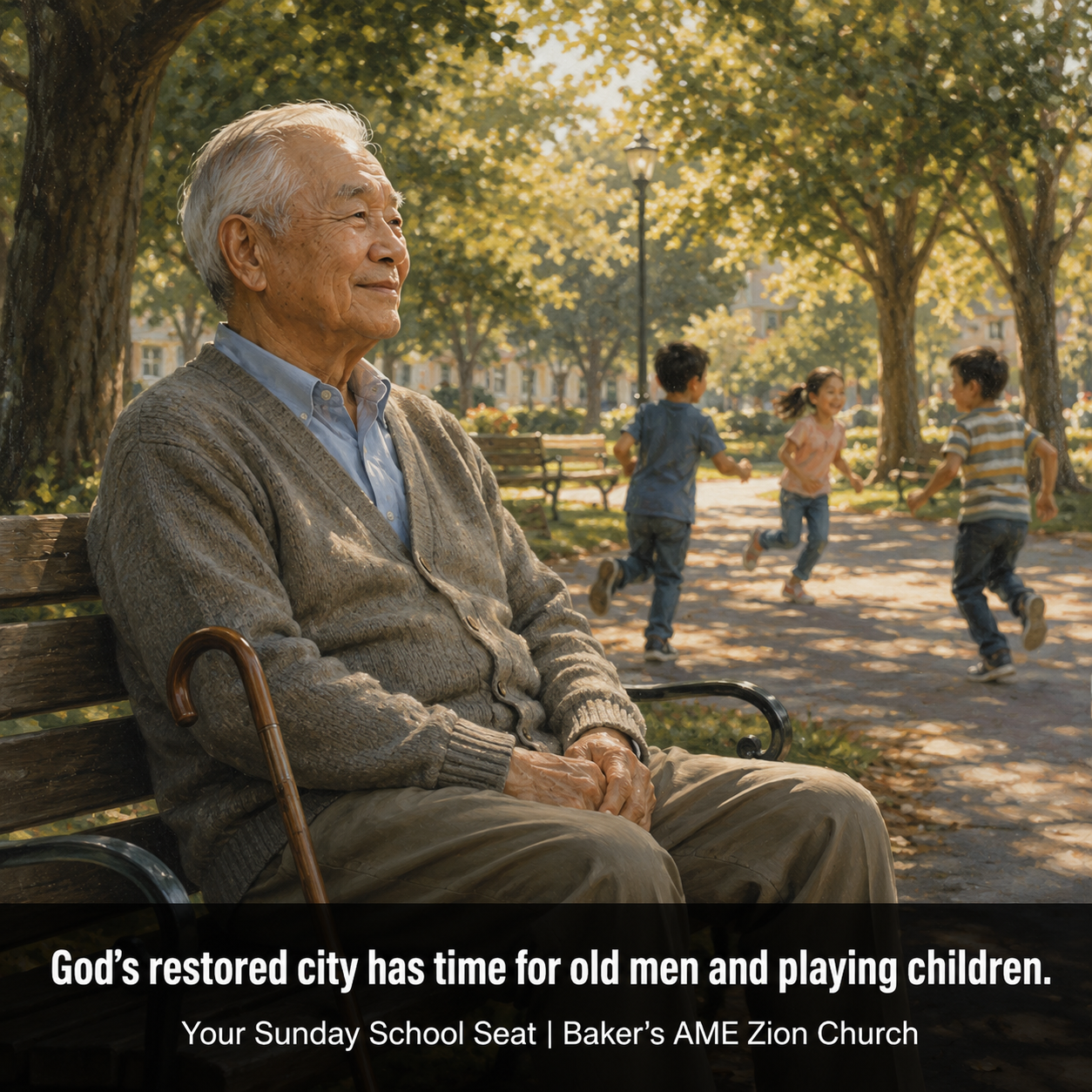
Zechariah is preaching to a community sitting in rubble — and God's vision of restoration isn't a temple or a treasury. It's old people on benches and kids playing in the street.
Zechariah 8:1-5 — KJV 1 Again the word of the LORD of hosts came to me, saying, 2 Thus saith the LORD of hosts; I was jealous for Zion with great jealousy, and I was jealous for her with great fury. 3 Thus saith the LORD; I am returned unto Zion, and will dwell in the midst of Jerusalem: and Jerusalem shall be called a city of truth; and the mountain of the LORD of hosts the holy mountain. 4 Thus saith the LORD of hosts; There shall yet old men and old women dwell in the streets of Jerusalem, and every man with his staff in his hand for very age. 5 And the streets of the city shall be full of boys and girls playing in the streets thereof.
Zechariah 8:1-5 — WEB 1 The word of Yahweh of Armies came to me. 2 Yahweh of Armies says: "I am jealous for Zion with great jealousy, and I am jealous for her with great wrath." 3 Yahweh says: "I have returned to Zion, and will dwell in the middle of Jerusalem. Jerusalem shall be called 'The City of Truth;' and the mountain of Yahweh of Armies, 'The Holy Mountain.'" 4 Yahweh of Armies says: "Old men and old women will again dwell in the streets of Jerusalem, every man with his staff in his hand for the multitude of days. 5 The streets of the city will be full of boys and girls playing in its streets."
Explanation
Zechariah is prophesying to a community trying to come back from the bottom. The exiles have returned to Jerusalem. The temple is half-rebuilt and the work has stalled. The walls are still in pieces. The economy is fragile. The older folks remember what the city used to look like, and the younger ones have only ever known it broken. People are tired. Discouraged. Wondering if it was worth coming home at all.
And into this exhaustion, God speaks. He says: I'm coming back. And here's what restoration is going to look like.
Now you might expect God to describe a restored temple. Or a powerful king. Or armies, or wealth, or political power. He doesn't. The picture God paints of a redeemed Jerusalem is small and tender and astonishing: old men and old women sitting safely in the streets, leaning on their canes, swapping stories. And kids — boys and girls — playing in those same streets. Not afraid. Not hidden. Just playing.
That's the picture. That's what the Lord of Hosts says shalom looks like.
Think about what those two images have in common. Old people in the street and children at play are both signs of safety. They are both signs of time enjoyed. Neither group is producing economic output in this picture. Neither is fighting a war. Neither is rushing somewhere. They are simply being, in a place that is no longer afraid. That, the prophet says, is the city God dwells in.
This is huge for us as we think about the Christian view of recreation. The kingdom of God is not just rescue from sin — though it is that. It's not just heaven later — though it is that too. It's also streets safe enough for play. It's an old man on a bench with his cane. It's a little girl chasing a ball without looking over her shoulder. The Hebrew word shalom doesn't just mean the absence of war. It means the kind of peace where children can play in the road.
Here's the question for us. If God's vision of restoration includes recreation — rest, play, leisure, gathering — then how should that shape the lives we build now? How we run our households? How we treat our elders? How we structure our weeks?
A city where no one has time to play is not yet a city God is finished with.
Thought for the Day God's restored city has time for old men and playing children.
Reflection Question Where, in your life or community, is there no longer time to play — and what would it take to recover that?
Prayer Lord of Hosts, you who measure flourishing in laughter and not in productivity, teach us to long for the city you described. Where elders are honored with rest. Where children play without fear. Where streets are safe. Make our homes small previews of that city. And give us the courage to slow down enough to let your shalom catch up with us. Amen.
This week we walk toward Sunday's lesson: The Christian View of Recreation.
Tuesday, May 19 — God Made Me to Laugh
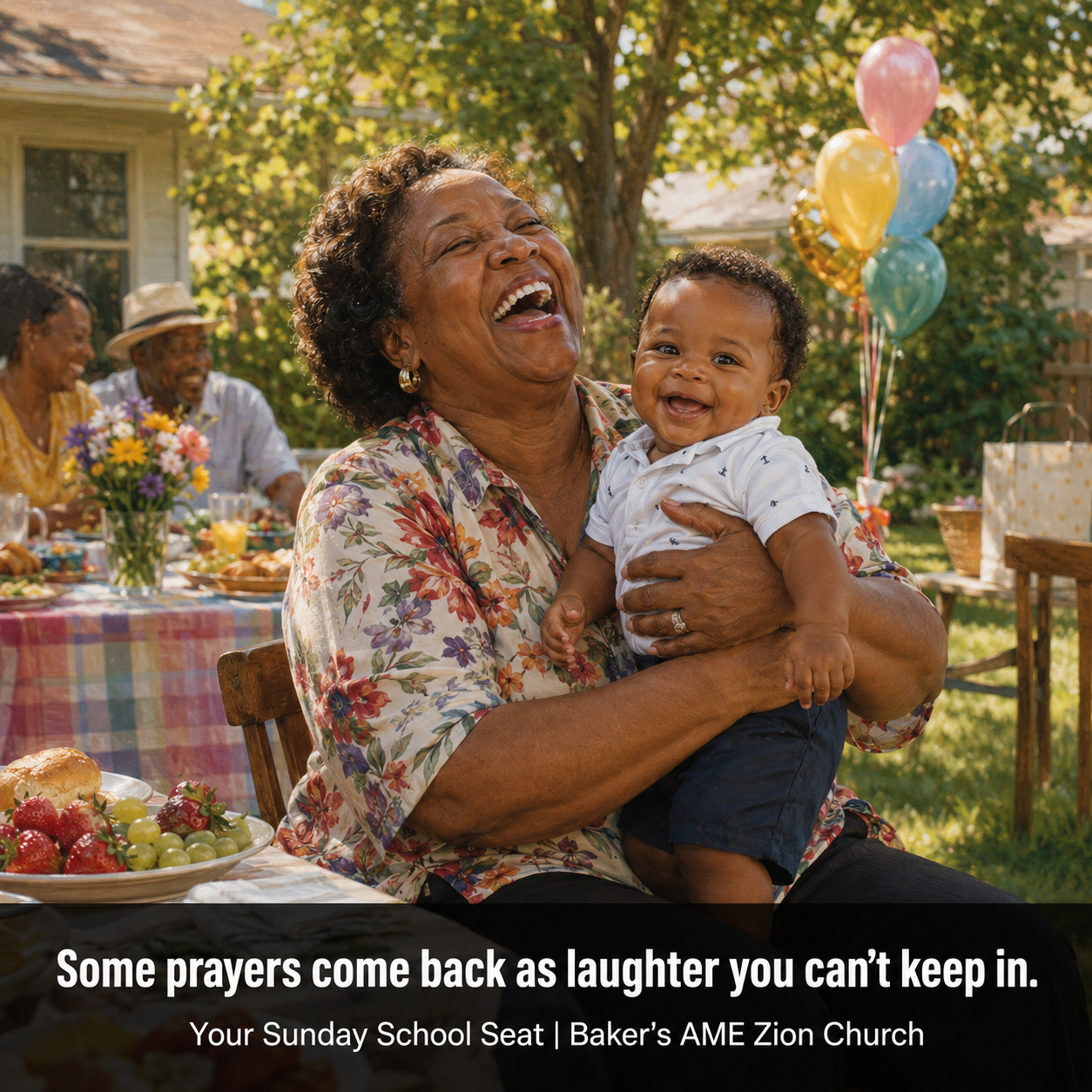
Sarah laughed. First out of disbelief, then out of sheer joy. Sometimes God's promises arrive late enough that you'd given up — and that's exactly when they break you wide open.
Genesis 21:1-8 — KJV 1 And the LORD visited Sarah as he had said, and the LORD did unto Sarah as he had spoken. 2 For Sarah conceived, and bare Abraham a son in his old age, at the set time of which God had spoken to him. 3 And Abraham called the name of his son that was born unto him, whom Sarah bare to him, Isaac. 4 And Abraham circumcised his son Isaac being eight days old, as God had commanded him. 5 And Abraham was an hundred years old, when his son Isaac was born unto him. 6 And Sarah said, God hath made me to laugh, so that all that hear will laugh with me. 7 And she said, Who would have said unto Abraham, that Sarah should have given children suck? for I have born him a son in his old age. 8 And the child grew, and was weaned: and Abraham made a great feast the same day that Isaac was weaned.
Genesis 21:1-8 — WEB 1 Yahweh visited Sarah as he had said, and Yahweh did to Sarah as he had spoken. 2 Sarah conceived, and bore Abraham a son in his old age, at the set time of which God had spoken to him. 3 Abraham called his son who was born to him, whom Sarah bore to him, Isaac. 4 Abraham circumcised his son Isaac when he was eight days old, as God had commanded him. 5 Abraham was one hundred years old when his son Isaac was born to him. 6 Sarah said, "God has made me laugh. Everyone who hears will laugh with me." 7 She said, "Who would have said to Abraham that Sarah would nurse children? For I have borne him a son in his old age." 8 The child grew and was weaned. Abraham made a great feast on the day that Isaac was weaned.
Explanation
The name Isaac means "he laughs." Sarah picked it. And there's something striking about the fact that this woman — who once laughed in disbelief when she overheard the Lord telling Abraham she'd have a son in her old age — chose laughter as the permanent name of the answer to her prayer.
Sarah was about ninety. Abraham was a hundred. They had been waiting on this child for somewhere around twenty-five years. They had tried to make it happen on their own — that's what the Hagar story is about, a few chapters earlier — and they had failed in painful ways. And then, when they had nothing left but their wrinkles and their grief, God showed up. And he kept his word.
Notice what Abraham does next: he throws a feast. A great feast, the text says. Not a small thing. Not a quiet, dignified moment. A feast. The kind of celebration that involves cooking for days, inviting the whole community, laughter spilling out of the tents into the desert evening. They didn't whisper their gratitude. They threw a party.
This week's theme is the Christian view of recreation, and here's something we don't always notice: throughout scripture, God's people mark the milestones of grace with celebration. Weaning a child. Bringing in a harvest. Surviving a war. Watching a son or daughter walk through a door we didn't think they'd reach. The right response to grace, biblically speaking, is often a feast.
If you were raised in a stoic household, this can feel foreign. We're more comfortable with grim endurance than open joy. We say things like, "I'm just grateful," in the same flat tone we use to read traffic reports. But Sarah's laughter has a different quality. It's loud. It's contagious. It says: I cannot believe this is happening. I cannot keep this in.
What has God done for you that you haven't celebrated yet? Maybe it's the kid who finally came home. Maybe it's the diagnosis that turned out better than expected. Maybe it's the marriage you thought wouldn't make it through last year. Maybe it's just that you woke up one more time.
Sarah named the answer to her prayer "he laughs." That's a theology, in a single word. Recreation, in the deepest sense, is what we do when grace is so good we can't sit still.
Thought for the Day Some prayers come back as laughter you can't keep in.
Reflection Question What unspoken answer to prayer have you not yet stopped to celebrate?
Prayer Father, you remember the things we've forgotten to thank you for. The mercies we treated as small. The doors that opened that we walked through without looking back. Today, give us Sarah's laugh — the kind that startles us with how good you've been. And teach us to mark your faithfulness with feasts, not just thank-yous. Amen.
This week we walk toward Sunday's lesson: The Christian View of Recreation.
Monday, May 18 — Jesus Came to the Party
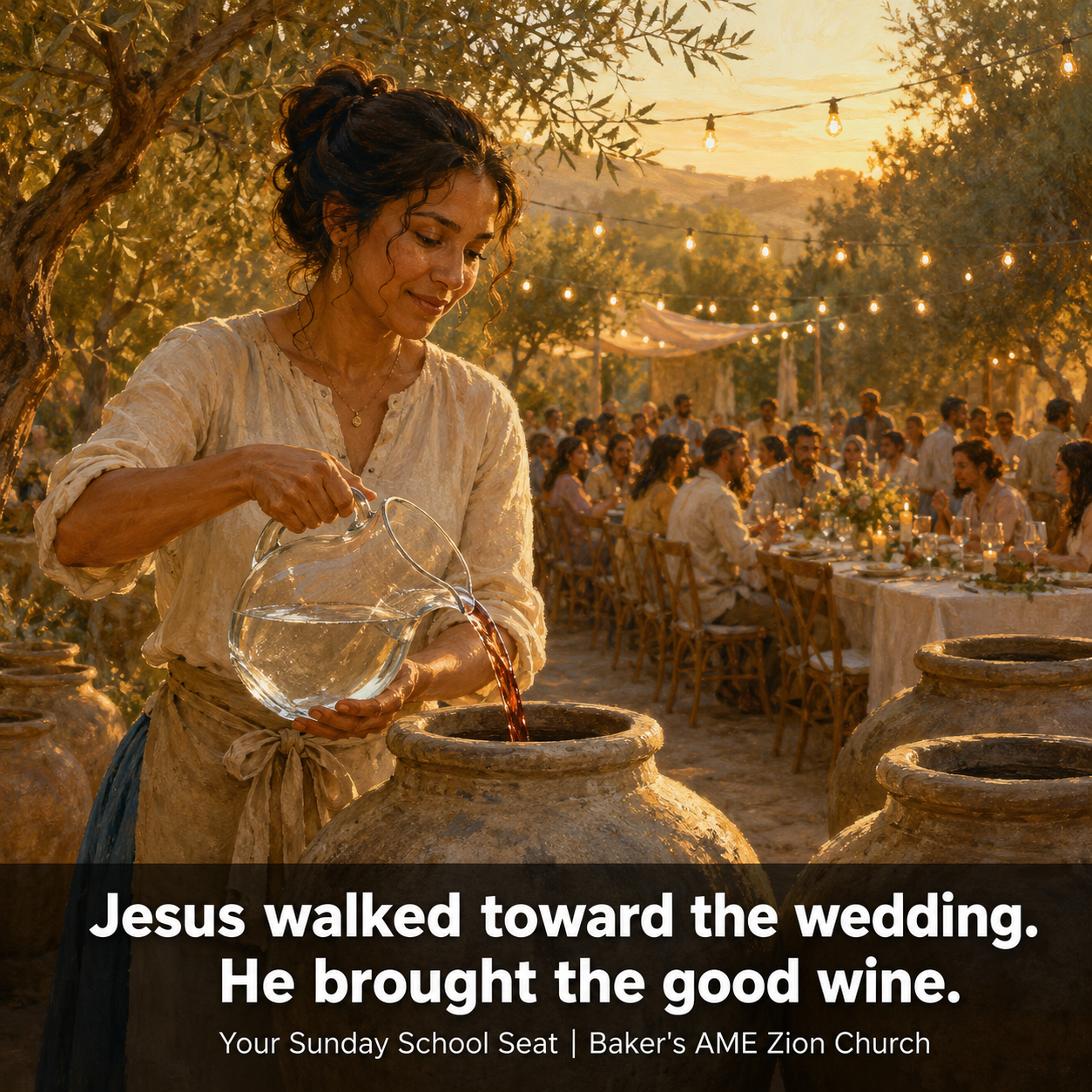
There's a reason the first miracle in John's Gospel happens at a wedding reception and not on a mountaintop. Stay with me — this matters more than you'd think.
John 2:1-11 — KJV 1 And the third day there was a marriage in Cana of Galilee; and the mother of Jesus was there: 2 And both Jesus was called, and his disciples, to the marriage. 3 And when they wanted wine, the mother of Jesus saith unto him, They have no wine. 4 Jesus saith unto her, Woman, what have I to do with thee? mine hour is not yet come. 5 His mother saith unto the servants, Whatsoever he saith unto you, do it. 6 And there were set there six waterpots of stone, after the manner of the purifying of the Jews, containing two or three firkins apiece. 7 Jesus saith unto them, Fill the waterpots with water. And they filled them up to the brim. 8 And he saith unto them, Draw out now, and bear unto the governor of the feast. And they bare it. 9 When the ruler of the feast had tasted the water that was made wine, and knew not whence it was: (but the servants which drew the water knew;) the governor of the feast called the bridegroom, 10 And saith unto him, Every man at the beginning doth set forth good wine; and when men have well drunk, then that which is worse: but thou hast kept the good wine until now. 11 This beginning of miracles did Jesus in Cana of Galilee, and manifested forth his glory; and his disciples believed on him.
John 2:1-11 — WEB 1 The third day, there was a wedding in Cana of Galilee. Jesus' mother was there. 2 Jesus also was invited, with his disciples, to the wedding. 3 When the wine ran out, Jesus' mother said to him, "They have no wine." 4 Jesus said to her, "Woman, what does that have to do with you and me? My hour has not yet come." 5 His mother said to the servants, "Whatever he says to you, do it." 6 Now there were six water pots of stone set there after the Jews' way of purifying, containing two or three metretes apiece. 7 Jesus said to them, "Fill the water pots with water." So they filled them up to the brim. 8 He said to them, "Now draw some out, and take it to the ruler of the feast." So they took it. 9 When the ruler of the feast tasted the water now become wine, and didn't know where it came from (but the servants who had drawn the water knew), the ruler of the feast called the bridegroom 10 and said to him, "Everyone serves the good wine first, and when the guests have drunk freely, then that which is worse. You have kept the good wine until now!" 11 This beginning of his signs Jesus did in Cana of Galilee, and revealed his glory; and his disciples believed in him.
Explanation
The first miracle. People remember that. But notice where it happens. Not in the temple. Not on a mountainside. Not in some dramatic moment of healing or resurrection. The first miracle Jesus performs in John's Gospel happens at a wedding reception.
That should tell us something.
Weddings in first-century Galilee weren't an afternoon affair. They were week-long celebrations. Family came in from miles around. Neighbors pitched in. There was music, dancing, eating, drinking, laughter. The whole village shut down to celebrate. And it was at one of these — somewhere in the middle of the third day — that the wine ran out. In that culture, that was a disaster. Hospitality was sacred. The host would have been humiliated; the family's honor wounded. The party was about to grind to a halt.
And Jesus's mother turns to him and says, "They have no wine."
Notice what Jesus doesn't do. He doesn't lecture anyone. He doesn't pull out a scroll and say, "Well, perhaps this is a good moment to reflect on the dangers of overindulgence." He doesn't suggest the celebration has run its course. He saves the party. He turns six stone jars of water — about 150 gallons — into wine so good the master of the banquet can't believe they served the cheap stuff first.
Here's what I want us to notice this week as we move toward Sunday's lesson on the Christian view of recreation: Jesus didn't just tolerate the celebration. He extended it. He honored it. He blessed it.
We've inherited, somewhere along the way, a strange idea that the holier we get, the more solemn we become. That joy is suspicious. That a good time is something we apologize for. But the first public act of God's Son in John's account is to keep a wedding feast going.
The God who flung galaxies into space and shaped the human heart for love also made wedding feasts and laughter and the kind of music that pulls you out of your chair. Recreation isn't something we squeeze in around the edges of a serious Christian life. It's part of how we were designed to live.
If your week has been heavy — if you've been carrying a lot — hear this: the same Jesus who walked toward the cross also walked toward the wedding. And he showed up smiling. He brought the good wine.
Maybe today, you can let yourself enjoy something small. A meal. A laugh. A walk. A song. Not because you've earned it. But because joy is part of the Kingdom too.
Thought for the Day Jesus walked toward the wedding. He brought the good wine.
Reflection Question What's one ordinary joy you've been treating as a guilty pleasure that God might actually be inviting you into?
Prayer Lord, thank you that you didn't come into this world too holy for laughter. Thank you that you blessed a wedding, multiplied the wine, and kept the celebration going. Loosen the tightness in our shoulders today. Help us receive joy as the gift you intended it to be. Amen.
This week we walk toward Sunday's lesson: The Christian View of Recreation.
Sunday, May 17 — The Sermon on Contentment
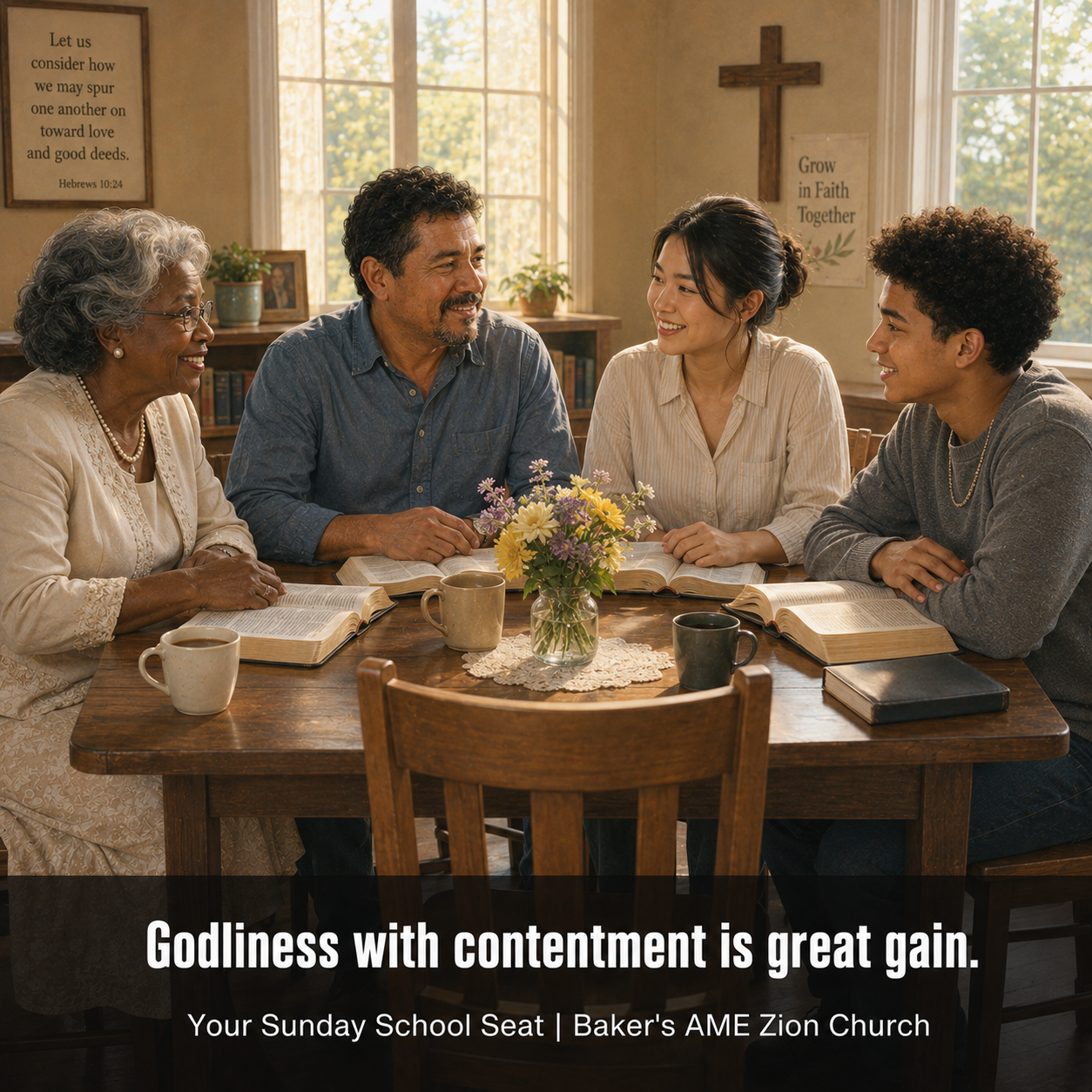
All week we've been walking toward this Sunday — and Paul's words to Timothy bring it home. Industry, money, work, possessions. None of it is the point. All of it is a tool.
1 Timothy 6:6-8, 17-19 — KJV 6 But godliness with contentment is great gain. 7 For we brought nothing into this world, and it is certain we can carry nothing out. 8 And having food and raiment let us be therewith content. 17 Charge them that are rich in this world, that they be not highminded, nor trust in uncertain riches, but in the living God, who giveth us richly all things to enjoy; 18 That they do good, that they be rich in good works, ready to distribute, willing to communicate; 19 Laying up in store for themselves a good foundation against the time to come, that they may lay hold on eternal life.
1 Timothy 6:6-8, 17-19 — WEB 6 But godliness with contentment is great gain. 7 For we brought nothing into the world, and we certainly can't carry anything out. 8 But having food and clothing, we will be content with that. 17 Charge those who are rich in this present age that they not be high-minded, nor have their hope set on the uncertainty of riches, but on the living God, who richly provides us with everything to enjoy; 18 that they do good, that they be rich in good works, that they be ready to distribute, willing to share; 19 laying up in store for themselves a good foundation against the time to come, that they may lay hold of eternal life.
Paul wrote 1 Timothy to a young pastor leading the church in Ephesus — a wealthy port city full of merchants, traders, and temple money. Timothy was navigating false teachers who treated godliness like a means to financial gain. Paul corrects them with a turn of phrase that has been quoted ever since: godliness with contentment is great gain. The riches you can carry are not the riches you can keep.
Verses 6-8 strip life down to the essentials. We brought nothing into this world. We're not taking anything out either. If we have food and clothing, that should be enough. It's a sentence that doesn't preach well in a consumer culture, but it lands like cold water — clarifying. We will spend much of our lives chasing things we cannot keep. Paul is gently asking us to come up for air.
Then Paul turns to those who are rich in this present age — and notice he doesn't tell them to liquidate everything. He gives them a different kind of charge. Don't be high-minded. Don't trust uncertain riches. Trust the living God, who richly gives us all things to enjoy. Do good. Be rich in good works. Be ready to give. Be willing to share. Lay up for yourselves a foundation for the life that is truly life.
So here is the culmination of "The Christian Spirit in Industry." We've spent the week walking through diligence (Proverbs), grace in labor (Matthew), prophetic warning (Amos), wages and patience (James), doing all in Jesus' name (Colossians), and gleaning generosity (Deuteronomy). And Paul ties the whole basket together this morning. The Christian spirit in industry isn't simply about how we work, what we earn, or how much we give. It is about who we are becoming in the doing.
A contented soul is rare in any economy. A generous one is rarer still. Paul says these are the people who have laid hold of life that is truly life — not the upgraded life of more possessions, but the deeper life of Christ.
This morning we put on our coats and head to the building together. Some of us are tired from the week. Some of us are carrying questions. Some of us are bringing joy. Whatever we bring, the table is set. The lesson is ready. And we have saved you a seat.
Thought for the Day Godliness with contentment is great gain.
Reflection What in your life are you holding too tightly that God is asking you to enjoy and share?
Prayer Father, You have given us so much. Forgive us for the moments we've measured our lives by what we own instead of who we are in You. Teach us contentment — the deep, free kind that doesn't depend on circumstance. Make us generous. Make us grateful. And as we step into worship this morning, settle our hearts to receive what You have for us. Amen.
Today is Sunday school. We save you a seat.
Saturday, May 16 — Leave Some for the Stranger
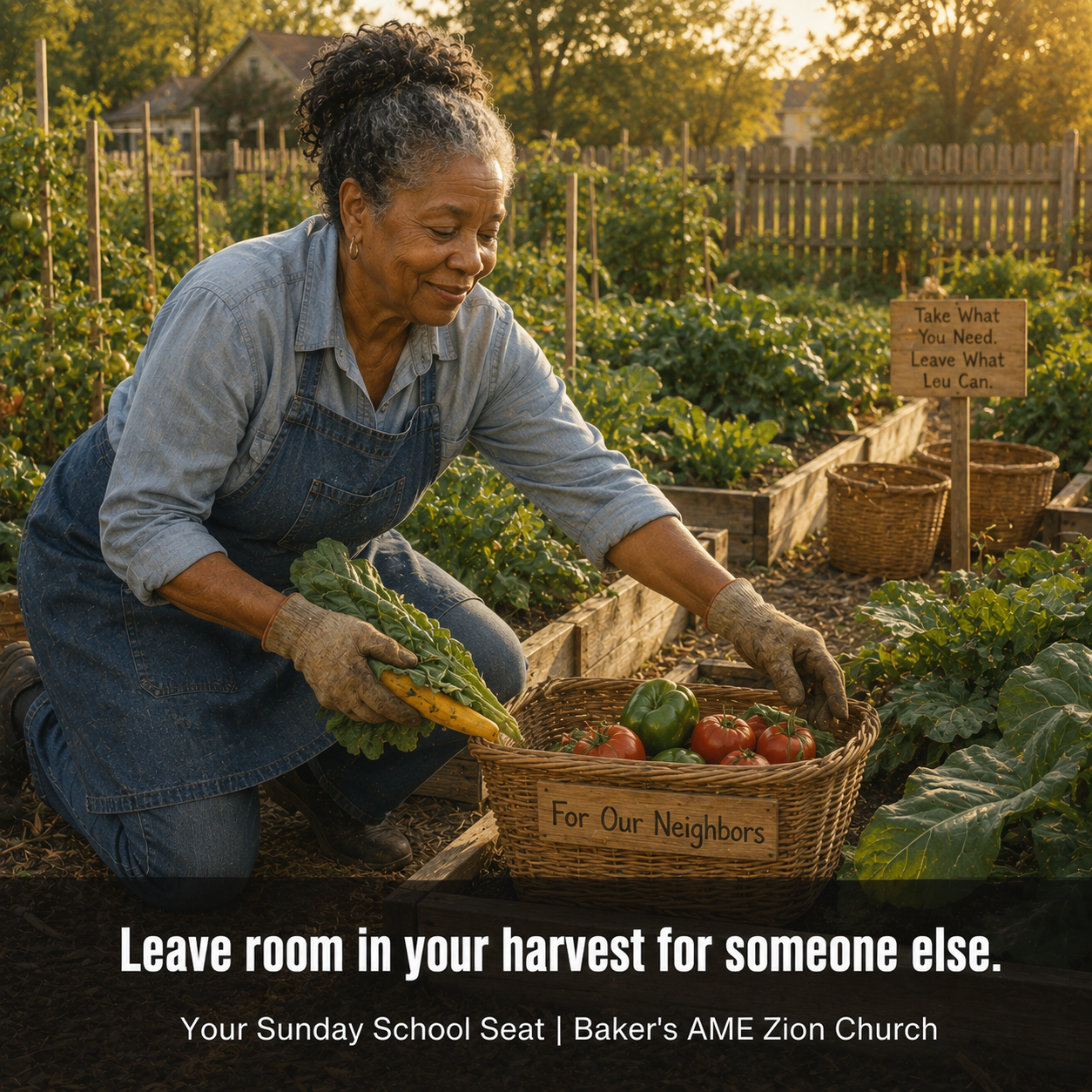
God's law has a generosity built into it that most modern economics doesn't. Don't strip the field bare. Leave something for the people who don't have a field.
Deuteronomy 24:14-21 — KJV 14 Thou shalt not oppress an hired servant that is poor and needy, whether he be of thy brethren, or of thy strangers that are in thy land within thy gates: 15 At his day thou shalt give him his hire, neither shall the sun go down upon it; for he is poor, and setteth his heart upon it: lest he cry against thee unto the LORD, and it be sin unto thee. 16 The fathers shall not be put to death for the children, neither shall the children be put to death for the fathers: every man shall be put to death for his own sin. 17 Thou shalt not pervert the judgment of the stranger, nor of the fatherless; nor take a widow's raiment to pledge: 18 But thou shalt remember that thou wast a bondman in Egypt, and the LORD thy God redeemed thee thence: therefore I command thee to do this thing. 19 When thou cuttest down thine harvest in thy field, and hast forgot a sheaf in the field, thou shalt not go again to fetch it: it shall be for the stranger, for the fatherless, and for the widow: that the LORD thy God may bless thee in all the work of thine hands. 20 When thou beatest thine olive tree, thou shalt not go over the boughs again: it shall be for the stranger, for the fatherless, and for the widow. 21 When thou gatherest the grapes of thy vineyard, thou shalt not glean it afterward: it shall be for the stranger, for the fatherless, and for the widow.
Deuteronomy 24:14-21 — WEB 14 You shall not oppress a hired servant who is poor and needy, whether he is one of your brothers, or one of the foreigners who are in your land within your gates. 15 In his day you shall give him his wages, neither shall the sun go down on it; for he is poor and sets his heart on it; lest he cry against you to Yahweh, and it be sin to you. 16 The fathers shall not be put to death for the children, neither shall the children be put to death for the fathers. Every man shall be put to death for his own sin. 17 You shall not deprive the foreigner or the fatherless of justice, nor take a widow's clothing in pledge; 18 but you shall remember that you were a slave in Egypt, and Yahweh your God redeemed you there. Therefore I command you to do this thing. 19 When you reap your harvest in your field, and have forgotten a sheaf in the field, you shall not go again to get it. It shall be for the foreigner, for the fatherless, and for the widow; that Yahweh your God may bless you in all the work of your hands. 20 When you beat your olive tree, you shall not go over the boughs again. It shall be for the foreigner, for the fatherless, and for the widow. 21 When you harvest your vineyard, you shall not glean it after yourselves. It shall be for the foreigner, for the fatherless, and for the widow.
Deuteronomy was Moses' final sermon to a generation of Israelites preparing to enter the promised land. Most of the people he was speaking to were the children and grandchildren of slaves. They had grown up hearing how God brought their families out of Egypt with a strong hand. Now they were about to plant fields, raise livestock, and become an economy of their own. And before they crossed the Jordan, Moses gave them laws to make sure they didn't forget what slavery felt like.
Chapter 24, verses 14-21, lays out a practical ethic. Don't oppress a hired worker — whether that worker is one of your own or a foreigner living in your gates. Pay him his wages the same day, before sundown, because he's poor and depending on it. Don't pervert justice for the foreigner or the orphan. Don't take a widow's last piece of clothing as collateral. And here's the kicker: when you reap your fields, leave a sheaf behind. When you beat your olive tree, don't go back over the branches. When you harvest your vineyard, don't pick it twice. Leave it for the foreigner, the orphan, and the widow.
Built into the ancient farmer's economy was an intentional inefficiency — a holy waste that wasn't waste at all. Maximizing wasn't the highest virtue. Mercy was. And the reason given is haunting and beautiful: remember that you were a slave in Egypt, and the Lord your God redeemed you.
The ethic of "The Christian Spirit in Industry" isn't a New Testament invention. It is woven all the way back through Moses. God has always cared about how the worker is paid, how the foreigner is treated, how the widow is fed, and what we do at the edges of our own success. The corners of the field belong to those who don't have one.
In our economy, the corners look different. They look like the person who cleans your building. The single mom on your block. The stranger who just moved in. The unhoused man at the intersection. The worker who can't afford the rent in the neighborhood she serves. We are not asked to fix everything. But we are asked not to glean every last grape of our own lives without looking up.
The Lord your God redeemed you. Don't forget it.
Thought for the Day Leave room in your harvest for someone else.
Reflection What "corner of your field" — your time, money, attention — could you leave for someone this week?
Prayer God of every generation, You have been generous with us, and You remember the stranger and the worker when we forget. Make us a people who do not strip our fields bare. Where we have margin — of time, money, energy — let us leave some for those who have less. Help us remember we were redeemed. Help us live like it. Amen.
This week we walk toward Sunday's lesson: The Christian Spirit in Industry.
Friday, May 15 — Whatever You Do
Most of us aren't going to be famous Christians. We're going to be ordinary ones — at the desk, at the register, at the school pickup line. Paul says that's exactly the point.
Colossians 3:12-17 — KJV 12 Put on therefore, as the elect of God, holy and beloved, bowels of mercies, kindness, humbleness of mind, meekness, longsuffering; 13 Forbearing one another, and forgiving one another, if any man have a quarrel against any: even as Christ forgave you, so also do ye. 14 And above all these things put on charity, which is the bond of perfectness. 15 And let the peace of God rule in your hearts, to the which also ye are called in one body; and be ye thankful. 16 Let the word of Christ dwell in you richly in all wisdom; teaching and admonishing one another in psalms and hymns and spiritual songs, singing with grace in your hearts to the Lord. 17 And whatsoever ye do in word or deed, do all in the name of the Lord Jesus, giving thanks to God and the Father by him.
Colossians 3:12-17 — WEB 12 Put on therefore, as God's chosen ones, holy and beloved, a heart of compassion, kindness, lowliness, humility, and perseverance; 13 bearing with one another, and forgiving each other, if any man has a complaint against any; even as Christ forgave you, so you also do. 14 Above all these things, walk in love, which is the bond of perfection. 15 And let the peace of God rule in your hearts, to which also you were called in one body, and be thankful. 16 Let the word of Christ dwell in you richly; in all wisdom teaching and admonishing one another with psalms, hymns, and spiritual songs, singing with grace in your heart to the Lord. 17 Whatever you do, in word or in deed, do all in the name of the Lord Jesus, giving thanks to God the Father, through him.
Colossians was written by Paul (likely from prison) to a small church in Colossae, a town in modern-day Turkey he had never visited. False teaching had crept in, and Paul writes to anchor them in Christ — and then in chapter 3, he gets practical. Verses 12-17 are some of the most concrete instructions in the New Testament about how Christians ought to act in everyday relationships.
Paul says: put on. Like clothing. Every morning. Compassion. Kindness. Humility. Gentleness. Patience. Bear with each other when you're getting on each other's nerves. Forgive grievances the way Christ forgave you — which means more often than is comfortable, and more freely than makes sense. Above all, put on love. It is the belt that holds the whole outfit together. Let the peace of Christ rule in your hearts. Let the word of Christ live in you. Teach. Sing. Be thankful.
Then comes verse 17 — the line that holds the whole industrial week together: "And whatever you do, in word or deed, do all in the name of the Lord Jesus, giving thanks to God the Father through him."
Whatever. You. Do.
Not just preaching. Not just praying. Not just the Sunday parts of life. The Monday parts. The Tuesday morning meetings. The Wednesday lunch break. The Thursday inspection. The Friday afternoon when you'd rather just go home. The diaper changes. The driving. The dishes. The data entry. The customer service. The construction site. The classroom. The hospital floor. The kitchen.
Sunday's lesson is "The Christian Spirit in Industry," and Paul is laying out what that spirit actually looks like in a body. It isn't a halo. It's a posture. It's how you treat your coworker when you've already explained that thing twice. It's how you talk to the cashier on a hard day. It's how you handle the customer who is being unfair. It's the integrity you carry into the meeting where no one is checking. It's the kindness you bring home after a thankless shift. It's the gratitude you stitch into ordinary moments before they slip past.
Some weeks the world will not notice. But heaven does. And whatever you do — whatever — you do in His name.
Thought for the Day Whatever you do today, do it in His name.
Reflection What ordinary task today can you carry into the name of Jesus?
Prayer Lord Jesus, take all of it — the meaningful work and the mundane, the praised and the unseen. Clothe me in the patience and kindness I do not naturally have. Help me forgive freely and love deeply. Whatever I do today, in word or deed, let it be done in Your name. Amen.
This week we walk toward Sunday's lesson: The Christian Spirit in Industry.
Thursday, May 14 — The Wages That Cry Out
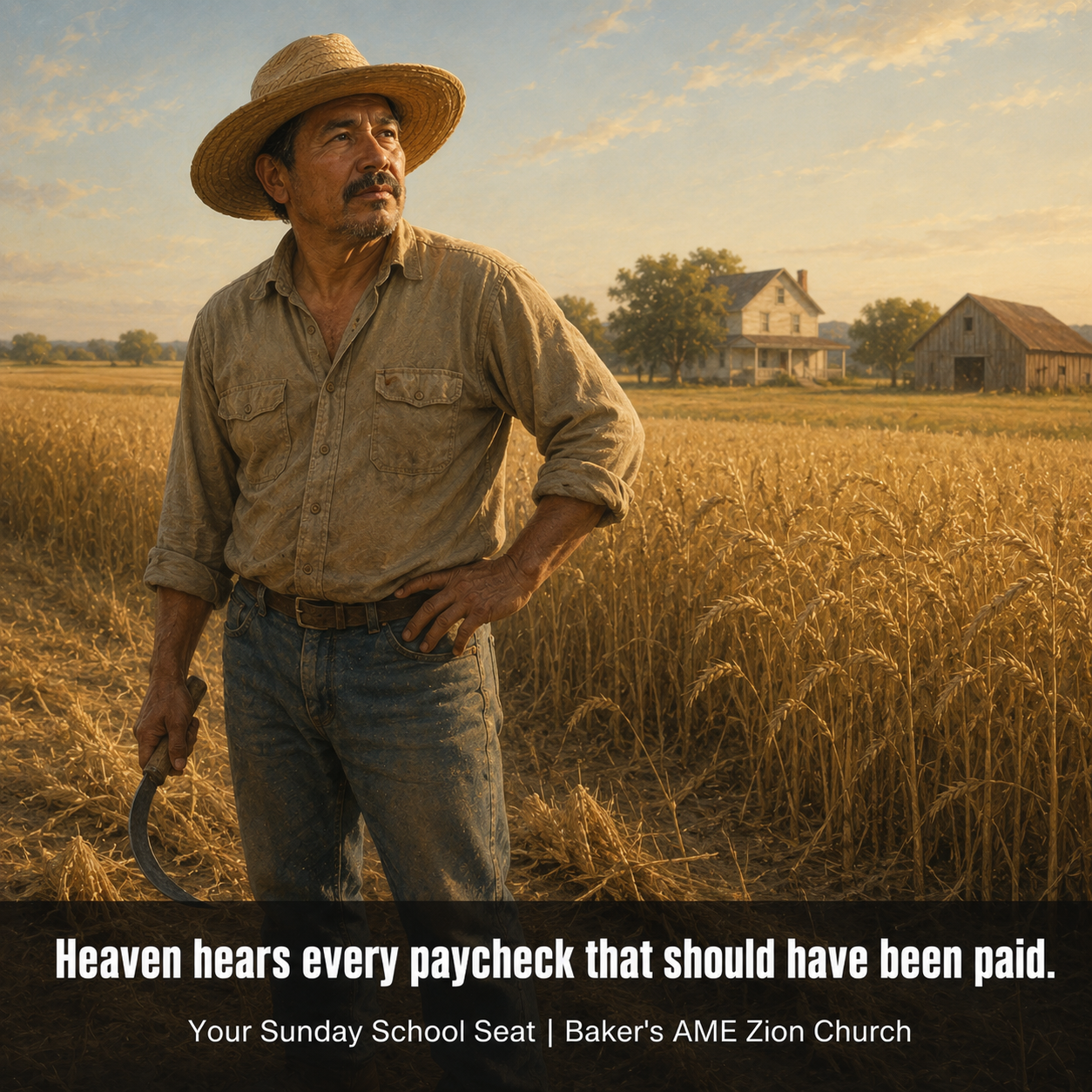
James doesn't soften his words for the rich. And the part that should make us all stop is verse 4 — the unpaid wages of workers crying out to God.
James 5:1-11 — KJV 1 Go to now, ye rich men, weep and howl for your miseries that shall come upon you. 2 Your riches are corrupted, and your garments are motheaten. 3 Your gold and silver is cankered; and the rust of them shall be a witness against you, and shall eat your flesh as it were fire. Ye have heaped treasure together for the last days. 4 Behold, the hire of the labourers who have reaped down your fields, which is of you kept back by fraud, crieth: and the cries of them which have reaped are entered into the ears of the Lord of sabaoth. 5 Ye have lived in pleasure on the earth, and been wanton; ye have nourished your hearts, as in a day of slaughter. 6 Ye have condemned and killed the just; and he doth not resist you. 7 Be patient therefore, brethren, unto the coming of the Lord. Behold, the husbandman waiteth for the precious fruit of the earth, and hath long patience for it, until he receive the early and latter rain. 8 Be ye also patient; stablish your hearts: for the coming of the Lord draweth nigh. 9 Grudge not one against another, brethren, lest ye be condemned: behold, the judge standeth before the door. 10 Take, my brethren, the prophets, who have spoken in the name of the Lord, for an example of suffering affliction, and of patience. 11 Behold, we count them happy which endure. Ye have heard of the patience of Job, and have seen the end of the Lord; that the Lord is very pitiful, and of tender mercy.
James 5:1-11 — WEB 1 Come now, you rich, weep and howl for your miseries that are coming on you. 2 Your riches are corrupted and your garments are moth-eaten. 3 Your gold and your silver are corroded, and their corrosion will be for a testimony against you and will eat your flesh like fire. You have laid up your treasure in the last days. 4 Behold, the wages of the laborers who mowed your fields, which you have kept back by fraud, cry out, and the cries of those who reaped have entered into the ears of the Lord of Armies. 5 You have lived in luxury on the earth, and taken your pleasure. You have nourished your hearts as in a day of slaughter. 6 You have condemned and you have murdered the righteous one. He doesn't resist you. 7 Be patient therefore, brothers, until the coming of the Lord. Behold, the farmer waits for the precious fruit of the earth, being patient over it, until it receives the early and late rain. 8 You also be patient. Establish your hearts, for the coming of the Lord is at hand. 9 Don't grumble, brothers, against one another, so that you won't be judged. Behold, the judge stands at the door. 10 Take, brothers, for an example of suffering and of perseverance, the prophets who spoke in the name of the Lord. 11 Behold, we call them blessed who endured. You have heard of the perseverance of Job, and have seen the Lord in the outcome, and how the Lord is full of compassion and mercy.
James, traditionally believed to be the brother of Jesus and a leader of the Jerusalem church, wrote to scattered Jewish believers struggling under economic pressure. The early church included poor day laborers who had been cheated, widows with no protection, and small farmers losing their land. James writes with the bluntness of a prophet and the warmth of a pastor.
He opens chapter 5 with a thunderclap. Weep and howl, you rich, for your miseries are coming. Your hoarded wealth is rotting. Your fine garments are moth-eaten. Your gold and silver are corroding — and the corrosion itself will testify against you in the day of judgment. Then comes the line that should land on every employer, every business owner, every manager and supervisor and homeowner who hires help: the wages of the workers who reaped your fields, which you have kept back by fraud, are crying out — and the cries have entered the ears of the Lord of armies.
In other words: the paychecks you held back, the hours you shaved off the timesheet, the contractor you "forgot" to pay, the worker you exploited because you knew they couldn't fight back — God hears all of it. The cries don't disappear. They reach heaven.
James pivots in verse 7 from warning to encouragement. To the workers, the cheated, the patient ones still waiting on justice, he says: be patient like the farmer waiting for the rain. Strengthen your hearts. The Lord is near. Don't grumble against each other in the meantime. Look at the prophets who suffered and stayed faithful. Look at Job, whose endurance we still talk about. The Lord is full of compassion and mercy.
Sunday is closing in on us, and "The Christian Spirit in Industry" is sharpening into something costly. James will not let us read this passage as if it's only about other people. He's asking us — what does our money say about us? What do our employees say about us? What do the people who clean our offices, drive our deliveries, pick our food, and care for our children say about us when they go home?
There is good news in the patience James promises. But it does not let any of us off the hook for how we treat the worker.
Thought for the Day Heaven hears every paycheck that should have been paid.
Reflection Is there a worker, a debt, or a wage you've owed someone that needs to be made right?
Prayer Lord, You are the God who hears the cry of the worker. Search me. Show me where I have been careless or unjust with what I owe — money, time, recognition, fairness. Give me the courage to make it right. And give me patience when I am the one waiting on what was promised to me. Amen.
This week we walk toward Sunday's lesson: The Christian Spirit in Industry.
Wednesday, May 13 — When the Marketplace Forgets the Poor
Amos was not the kind of prophet anyone wanted at the dinner table. He told the truth about money, and the powerful never wanted to hear it.
Amos 5:6-15 — KJV 6 Seek the LORD, and ye shall live; lest he break out like fire in the house of Joseph, and devour it, and there be none to quench it in Bethel. 7 Ye who turn judgment to wormwood, and leave off righteousness in the earth, 8 Seek him that maketh the seven stars and Orion, and turneth the shadow of death into the morning, and maketh the day dark with night: that calleth for the waters of the sea, and poureth them out upon the face of the earth: The LORD is his name: 9 That strengtheneth the spoiled against the strong, so that the spoiled shall come against the fortress. 10 They hate him that rebuketh in the gate, and they abhor him that speaketh uprightly. 11 Forasmuch therefore as your treading is upon the poor, and ye take from him burdens of wheat: ye have built houses of hewn stone, but ye shall not dwell in them; ye have planted pleasant vineyards, but ye shall not drink wine of them. 12 For I know your manifold transgressions and your mighty sins: they afflict the just, they take a bribe, and they turn aside the poor in the gate from their right. 13 Therefore the prudent shall keep silence in that time; for it is an evil time. 14 Seek good, and not evil, that ye may live: and so the LORD, the God of hosts, shall be with you, as ye have spoken. 15 Hate the evil, and love the good, and establish judgment in the gate: it may be that the LORD God of hosts will be gracious unto the remnant of Joseph.
Amos 5:6-15 — WEB 6 Seek Yahweh, and you will live; lest he break out like fire in the house of Joseph, and it devour, and there be no one to quench it in Bethel. 7 You who turn justice to wormwood, and cast down righteousness to the earth: 8 seek him who made the Pleiades and Orion, and turns the shadow of death into the morning, and makes the day dark with night; who calls for the waters of the sea, and pours them out on the surface of the earth, Yahweh is his name, 9 who brings sudden destruction on the strong, so that destruction comes on the fortress. 10 They hate him who reproves in the gate, and they abhor him who speaks blamelessly. 11 Therefore, because you trample on the poor, and take taxes from him of wheat: You have built houses of cut stone, but you will not dwell in them. You have planted pleasant vineyards, but you shall not drink their wine. 12 For I know how many your offenses, and how great are your sins— you who afflict the just, who take a bribe, and who turn away the needy in the courts. 13 Therefore a prudent person keeps silent in such a time, for it is an evil time. 14 Seek good, and not evil, that you may live; and so Yahweh, the God of Armies, will be with you, as you say. 15 Hate evil, love good, and establish justice in the courts. It may be that Yahweh, the God of Armies, will be gracious to the remnant of Joseph.
Amos was a working man — a herdsman from Tekoa, a small town south of Jerusalem — who showed up in the northern kingdom of Israel during the reign of Jeroboam II. The economy was booming. The temples were full. Religious life looked alive. But underneath the surface, the poor were being crushed. The rich were buying up land, exploiting labor, rigging the courts, and feeling holy about it.
Amos shows up with a message no one ordered. Seek the Lord and live, he says, or fire is coming. He calls out the powerful for turning justice into wormwood — bitter, poisonous — and casting righteousness to the ground. Then he reminds them who the Lord is: the One who made the Pleiades and Orion, who turns death's shadow into morning, who calls the seas to flood the earth. The God you ignore in the courts is the God who hung the constellations.
Then Amos drops the indictment. They hate the man who speaks honestly in the gate — the gate being the place where business deals were made and disputes were settled. They've trampled the poor and taxed them out of their grain. They've built fine stone houses and planted lush vineyards, but Amos warns: you won't live in those houses. You won't drink that wine. God sees the bribes. God sees how the poor are turned away from justice in the courts. And the prudent stay quiet, because telling the truth has become dangerous.
The midweek pause of "The Christian Spirit in Industry" requires this hard look. We live inside an economy too — one with payday loans, wage theft, gentrification, and quiet exploitation that hides behind professional language. Amos is not talking about people who happen to be wealthy. He's talking about a system that treats human beings as inventory. And he's saying that worship without justice is not worship. It's noise.
But Amos doesn't just diagnose. He invites. Seek good and not evil. Hate evil, love good, establish justice in the courts. There is still room for grace, even in a corrupted marketplace. The God of armies hasn't given up on the remnant of Joseph — and He hasn't given up on us either.
The question isn't whether God notices injustice. He does. The question is whether we will let Him reshape how we participate.
Thought for the Day Worship without justice is just noise to God.
Reflection Where might Christ be calling you to refuse the easy silence and speak honestly?
Prayer God of justice, You see what we sometimes prefer not to see. Forgive us for the comfortable silences. Give us courage where we have been quiet, integrity where we have cut corners, and love where we have looked away. Make us people who seek good in the marketplace, not just in the sanctuary. Amen.
This week we walk toward Sunday's lesson: The Christian Spirit in Industry.
Tuesday, May 12 — When Grace Isn't Fair
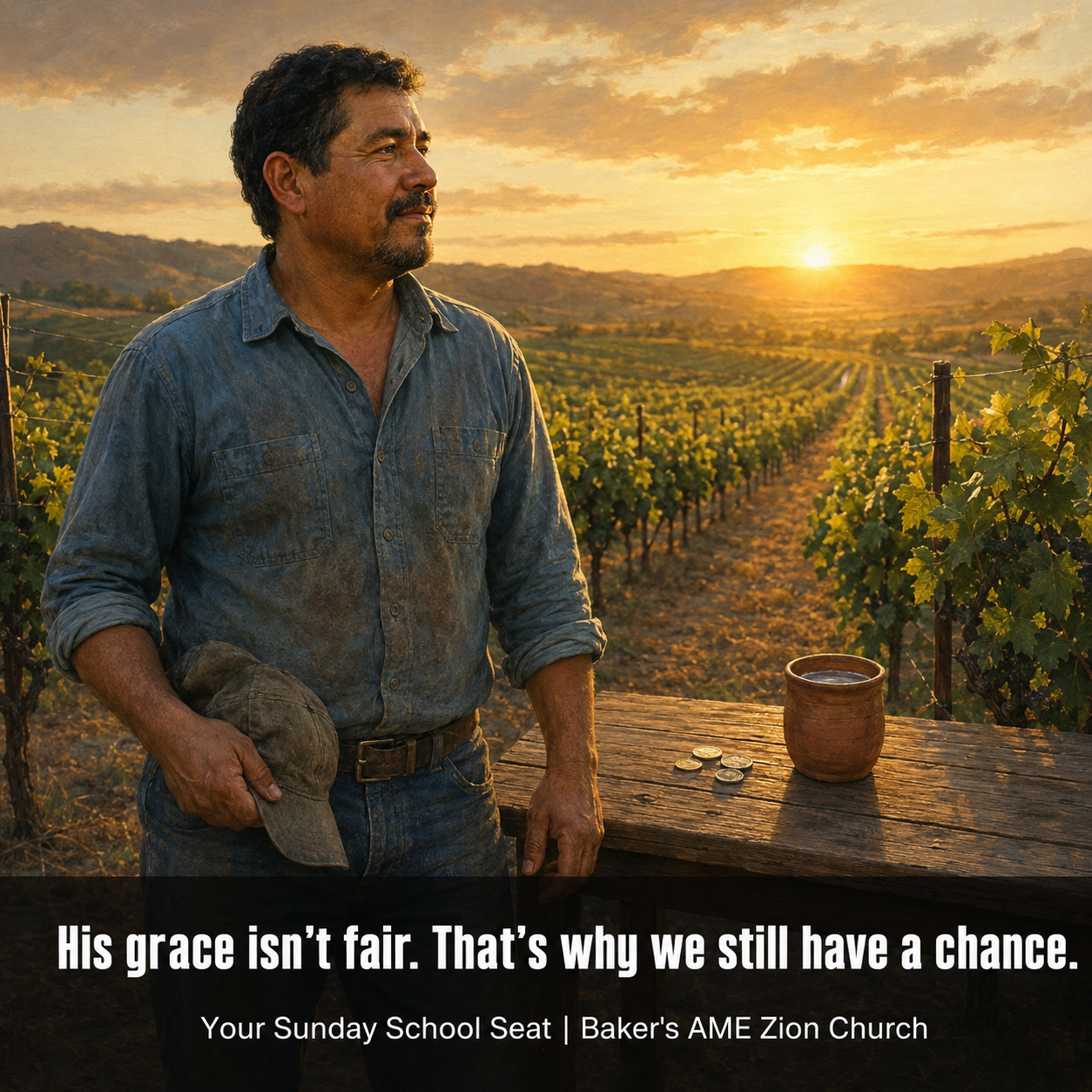
We grew up being told life isn't fair. Then we read Jesus' parables and realize grace isn't either — and that's actually the good news.
Matthew 20:1-16 — KJV 1 For the kingdom of heaven is like unto a man that is an householder, which went out early in the morning to hire labourers into his vineyard. 2 And when he had agreed with the labourers for a penny a day, he sent them into his vineyard. 3 And he went out about the third hour, and saw others standing idle in the marketplace, 4 And said unto them; Go ye also into the vineyard, and whatsoever is right I will give you. And they went their way. 5 Again he went out about the sixth and ninth hour, and did likewise. 6 And about the eleventh hour he went out, and found others standing idle, and saith unto them, Why stand ye here all the day idle? 7 They say unto him, Because no man hath hired us. He saith unto them, Go ye also into the vineyard; and whatsoever is right, that shall ye receive. 8 So when even was come, the lord of the vineyard saith unto his steward, Call the labourers, and give them their hire, beginning from the last unto the first. 9 And when they came that were hired about the eleventh hour, they received every man a penny. 10 But when the first came, they supposed that they should have received more; and they likewise received every man a penny. 11 And when they had received it, they murmured against the goodman of the house, 12 Saying, These last have wrought but one hour, and thou hast made them equal unto us, which have borne the burden and heat of the day. 13 But he answered one of them, and said, Friend, I do thee no wrong: didst not thou agree with me for a penny? 14 Take that thine is, and go thy way: I will give unto this last, even as unto thee. 15 Is it not lawful for me to do what I will with mine own? Is thine eye evil, because I am good? 16 So the last shall be first, and the first last: for many be called, but few chosen.
Matthew 20:1-16 — WEB 1 "For the Kingdom of Heaven is like a man who was the master of a household, who went out early in the morning to hire laborers for his vineyard. 2 When he had agreed with the laborers for a denarius a day, he sent them into his vineyard. 3 He went out about the third hour, and saw others standing idle in the marketplace. 4 He said to them, 'You also go into the vineyard, and whatever is right I will give you.' So they went their way. 5 Again he went out about the sixth and the ninth hour, and did likewise. 6 About the eleventh hour he went out, and found others standing idle. He said to them, 'Why do you stand here all day idle?' 7 They said to him, 'Because no one has hired us.' He said to them, 'You also go into the vineyard, and you will receive whatever is right.' 8 When evening had come, the lord of the vineyard said to his manager, 'Call the laborers and pay them their wages, beginning from the last to the first.' 9 When those who were hired at about the eleventh hour came, they each received a denarius. 10 When the first came, they supposed that they would receive more; and they likewise each received a denarius. 11 When they received it, they murmured against the master of the household, 12 saying, 'These last have spent one hour, and you have made them equal to us who have borne the burden of the day and the scorching heat!' 13 "But he answered one of them, 'Friend, I am doing you no wrong. Didn't you agree with me for a denarius? 14 Take that which is yours, and go your way. It is my desire to give to this last just as much as to you. 15 Isn't it lawful for me to do what I want to with what I own? Or is your eye evil, because I am good?' 16 So the last will be first, and the first last; for many are called, but few chosen."
Jesus tells this parable in Matthew 20 right after a hard conversation with Peter about who's first in the kingdom. The disciples have been doing the math of discipleship — what do we get for following you? — and Jesus answers with a story.
A landowner goes out at dawn to hire workers for his vineyard. Standard wage: a denarius — a single day's pay, just enough to feed a family. He goes back at nine in the morning, again at noon, again at three, again even at five o'clock — one hour before quitting time. He hires every laborer he finds. When evening comes, he pays everyone the same. The ones who worked all day are furious. The ones who barely worked an hour go home with full pockets.
The parable rubs us the wrong way for a reason. It's supposed to. The all-day workers aren't villains — they have a point. They worked through the heat, and the latecomers walked in with cool foreheads. Anybody would feel some kind of way about that. But the master answers gently: I'm not cheating you. We agreed on a denarius. You got a denarius. Why is your eye evil because I am generous?
This is where Sunday's theme of Christian spirit in industry takes a sharp turn. We can do the work all day and still miss the kingdom if our hearts curdle into resentment. The vineyard owner — God — runs his economy by grace, not strict accounting. He gives what He chooses to give. Every worker leaves with what they need. No one leaves cheated. But envy can ruin even an honest day's wage.
Maybe you've been the all-day worker. The one who's been faithful for decades. Tithing. Serving. Showing up before the doors open. And someone walks in last week, mess and all, and they get all the celebration. It stings. Jesus knows it stings. He's not dismissing the labor — He's stretching the heart.
Or maybe you're the eleventh-hour worker. Maybe you came late to faith, late to recovery, late to owning your life, late to forgiveness. The denarius is still yours. The Father doesn't hand out partial portions to people who showed up after lunch.
The kingdom doesn't run on punch clocks. It runs on a generosity we didn't earn and can't outpace.
Thought for the Day His grace isn't fair. That's why we still have a chance.
Reflection Are you working faithfully — or working with one eye on what others are getting?
Prayer Father, thank You for being more generous than I deserve. Search my heart for the places where envy has crept into my service. Loosen my grip on what's "fair." Help me trust that Your goodness toward someone else is never a subtraction from Your goodness toward me. Make me grateful in the vineyard today. Amen.
This week we walk toward Sunday's lesson: The Christian Spirit in Industry.