

A daily walk through Scripture, preparing our hearts for Sunday.
Friday, July 3 — Arise, Shine; Your Light Has Come
After a long stretch of darkness, the first light of morning can feel almost like a command — get up, it's time. That is exactly the tone of today's reading.
Isaiah 60:1-8 — KJV
1 Arise, shine; for thy light is come, and the glory of the LORD is risen upon thee. 2 For, behold, the darkness shall cover the earth, and gross darkness the people: but the LORD shall arise upon thee, and his glory shall be seen upon thee. 3 And the Gentiles shall come to thy light, and kings to the brightness of thy rising. 4 Lift up thine eyes round about, and see: all they gather themselves together, they come to thee: thy sons shall come from far, and thy daughters shall be nursed at thy side. 5 Then thou shalt see, and flow together, and thine heart shall fear, and be enlarged; because the abundance of the sea shall be converted unto thee, the forces of the Gentiles shall come unto thee. 6 The multitude of camels shall cover thee, the dromedaries of Midian and Ephah; all they from Sheba shall come: they shall bring gold and incense; and they shall shew forth the praises of the LORD. 7 All the flocks of Kedar shall be gathered together unto thee, the rams of Nebaioth shall minister unto thee: they shall come up with acceptance on mine altar, and I will glorify the house of my glory. 8 Who are these that fly as a cloud, and as the doves to their windows?
Isaiah 60:1-8 — WEB
1 "Arise, shine; for your light has come, and Yahweh's glory has risen on you. 2 For, behold, darkness will cover the earth, and thick darkness the peoples; but Yahweh will arise on you, and his glory shall be seen on you. 3 Nations will come to your light, and kings to the brightness of your rising. 4 "Lift up your eyes all around, and see: they all gather themselves together. They come to you. Your sons will come from far away, and your daughters will be carried in arms. 5 Then you shall see and be radiant, and your heart will thrill and be enlarged; because the abundance of the sea will be turned to you. The wealth of the nations will come to you. 6 A multitude of camels will cover you, the dromedaries of Midian and Ephah. All from Sheba will come. They will bring gold and frankincense, and will proclaim the praises of Yahweh. 7 All the flocks of Kedar will be gathered together to you. The rams of Nebaioth will serve you. They will be accepted as offerings on my altar; and I will beautify my glorious house. 8 "Who are these who fly as a cloud, and as the doves to their windows?
Explanation
Isaiah speaks these words to a people who had been through exile — defeat, displacement, the slow grief of feeling forgotten. Into that long night God says one word twice: "Arise, shine." It is not advice; it is a summons. And notice the order. The command to shine comes only after the reason: "for your light has come, and the glory of the LORD is risen upon you." God does not tell them to manufacture their own light. He tells them to reflect a light He is bringing. They shine because He has risen on them, the way the moon glows only with the sun's borrowed brightness.
Verse 2 is honest about the surrounding conditions. "Darkness will cover the earth, and thick darkness the peoples." The light does not arrive because the world finally got bright. It arrives in the middle of the dark. That is how God's glory usually shows up — not after the trouble clears, but right in it, so that the contrast makes Him visible.
Then watch where the chapter goes, because it is the same direction the whole week has been heading. "Nations will come to your light, and kings to the brightness of your rising." Camels from Midian, gold from Sheba, ships and flocks from far-off places — the outsiders are not coming to attack this time. They are coming to worship. The light God kindles in His people becomes a light that draws the whole world home. By Friday this thread is unmistakable: God's plan was never a private blessing for insiders. It was a lamp set in a window for everyone still out in the dark.
Sunday's centurion is one of those who saw the light from far off and came. He was exactly the kind of distant outsider Isaiah pictured streaming toward the glory of God. The light was on, and he walked toward it.
So what does this mean on an ordinary Friday? It means your job is not to generate light by sheer effort — you will exhaust yourself trying. Your job is to arise and reflect the light already given. Maybe you are tired. Maybe the darkness around you feels thick this week — a diagnosis, a strained marriage, a worry about a child, the news. Hear the summons anyway: get up, turn your face toward the One who has risen on you, and let a little of His light land on the people near you. You may never know who is in the dark, watching your small steady glow, deciding to walk toward it.
Thought for the Day You don't make the light. You arise and reflect it.
Reflection Question Where is the darkness thickest in your life right now, and what would it look like to "arise and shine" there instead of waiting for it to lift?
Prayer Lord, the night has felt long, and I cannot brighten it on my own. Thank You that Your glory rises even while the darkness is still thick. Help me get up and turn toward You, and let Your light shine through me to someone who needs to see it. Make my small reflection part of the way You draw the world home. Amen.
This week we walk toward Sunday's lesson: The Believing Centurion, A Gentile Whose Faith Jesus Commended.
Thursday, July 2 — Strangers Brought Near through Christ

Most of us know what it feels like to be on the outside of something — the new job, the family you married into, the room where everyone already knows each other. Today Paul speaks directly to that feeling.
Ephesians 2:11-22 — KJV
11 Wherefore remember, that ye being in time past Gentiles in the flesh, who are called Uncircumcision by that which is called the Circumcision in the flesh made by hands; 12 That at that time ye were without Christ, being aliens from the commonwealth of Israel, and strangers from the covenants of promise, having no hope, and without God in the world: 13 But now in Christ Jesus ye who sometimes were far off are made nigh by the blood of Christ. 14 For he is our peace, who hath made both one, and hath broken down the middle wall of partition between us; 15 Having abolished in his flesh the enmity, even the law of commandments contained in ordinances; for to make in himself of twain one new man, so making peace; 16 And that he might reconcile both unto God in one body by the cross, having slain the enmity thereby: 17 And came and preached peace to you which were afar off, and to them that were nigh. 18 For through him we both have access by one Spirit unto the Father. 19 Now therefore ye are no more strangers and foreigners, but fellowcitizens with the saints, and of the household of God; 20 And are built upon the foundation of the apostles and prophets, Jesus Christ himself being the chief corner stone; 21 In whom all the building fitly framed together groweth unto an holy temple in the Lord: 22 In whom ye also are builded together for an habitation of God through the Spirit.
Ephesians 2:11-22 — WEB
11 Therefore remember that once you, the Gentiles in the flesh, who are called "uncircumcision" by that which is called "circumcision" (in the flesh, made by hands), 12 that you were at that time separate from Christ, alienated from the commonwealth of Israel, and strangers from the covenants of the promise, having no hope and without God in the world. 13 But now in Christ Jesus you who once were far off are made near in the blood of Christ. 14 For he is our peace, who made both one, and broke down the middle wall of partition, 15 having abolished in his flesh the hostility, the law of commandments contained in ordinances, that he might create in himself one new man of the two, making peace, 16 and might reconcile them both in one body to God through the cross, having killed the hostility through it. 17 He came and preached peace to you who were far off and to those who were near. 18 For through him we both have our access in one Spirit to the Father. 19 So then you are no longer strangers and foreigners, but you are fellow citizens with the saints and of the household of God, 20 being built on the foundation of the apostles and prophets, Christ Jesus himself being the chief cornerstone; 21 in whom the whole building, fitted together, grows into a holy temple in the Lord; 22 in whom you also are built together for a habitation of God in the Spirit.
Explanation
Yesterday Paul described what God did for us as individuals — dead, then made alive. Today he widens the lens to what God did between us. He tells the Gentile believers to remember where they started: outsiders to Israel, strangers to the promises, "having no hope and without God in the world." That is a hard sentence to read about yourself. But Paul makes them remember the distance precisely so they can feel the size of what closed it.
There was, in the actual temple in Jerusalem, a literal barrier — a stone wall with a warning that any Gentile who crossed it would be responsible for his own death. Paul almost certainly has that wall in mind when he says Christ "broke down the middle wall of partition." The cross did not just reconcile people to God vertically; it tore down the fence between people horizontally. "For he is our peace, who made both one." Jesus did not negotiate a truce between two groups. He made one new humanity out of the two.
This is the deep current under Sunday's lesson. The centurion was the very picture of "far off" — a Gentile and a soldier of the occupying army, the kind of man a faithful Jew kept his distance from. Yet Jesus would say of him, "I have not found so great faith, no, not in Israel." The wall was already coming down. The "far off" were already being brought near. What Paul explains as doctrine, the centurion lived as a story.
For us, this passage does two things at once. First, it answers our loneliness. If you have ever felt like a stranger — too new, too different, too broken to belong — the gospel says that in Christ you are not a guest who might be asked to leave. You are family, "fellow citizens with the saints and of the household of God," a brick built right into God's own temple. You belong by blood, His blood, not by fitting in.
Second, it gives us a job. If Christ tore down the wall, we have no business rebuilding it. The divisions we are tempted to maintain — by race, by class, by politics, by whose people are "in" — He already abolished at the cross. A church that quietly keeps the outsider outside is patching a wall Jesus died to demolish. The same grace that brought you near is meant to flow through you to the next person standing on the outside, wondering if there is room. There is. Christ made it.
Thought for the Day Christ tore down the wall. Don't rebuild what He died to remove.
Reflection Question Who feels like an outsider in your world right now, and what is one concrete way you could help them feel brought near this week?
Prayer Lord Jesus, You are our peace. Thank You for bringing me near when I was far off and for making me part of Your household, not a stranger at the door. Forgive me for the walls I am tempted to keep standing. Make me a builder of welcome, not division, and let someone on the outside find a home through me. Amen.
This week we walk toward Sunday's lesson: The Believing Centurion, A Gentile Whose Faith Jesus Commended.
Wednesday, July 1 — God Makes Us Alive through Christ
If you have ever felt spiritually numb — going through the motions, technically alive but not really living — Paul has a word for you this morning, and it starts with two of the best words in the Bible.
Ephesians 2:1-10 — KJV
1 And you hath he quickened, who were dead in trespasses and sins; 2 Wherein in time past ye walked according to the course of this world, according to the prince of the power of the air, the spirit that now worketh in the children of disobedience: 3 Among whom also we all had our conversation in times past in the lusts of our flesh, fulfilling the desires of the flesh and of the mind; and were by nature the children of wrath, even as others. 4 But God, who is rich in mercy, for his great love wherewith he loved us, 5 Even when we were dead in sins, hath quickened us together with Christ, (by grace ye are saved;) 6 And hath raised us up together, and made us sit together in heavenly places in Christ Jesus: 7 That in the ages to come he might shew the exceeding riches of his grace in his kindness toward us through Christ Jesus. 8 For by grace are ye saved through faith; and that not of yourselves: it is the gift of God: 9 Not of works, lest any man should boast. 10 For we are his workmanship, created in Christ Jesus unto good works, which God hath before ordained that we should walk in them.
Ephesians 2:1-10 — WEB
1 You were made alive when you were dead in transgressions and sins, 2 in which you once walked according to the course of this world, according to the prince of the power of the air, the spirit who now works in the children of disobedience. 3 We also all once lived among them in the lusts of our flesh, doing the desires of the flesh and of the mind, and were by nature children of wrath, even as the rest. 4 But God, being rich in mercy, for his great love with which he loved us, 5 even when we were dead through our trespasses, made us alive together with Christ (by grace you have been saved), 6 and raised us up with him, and made us to sit with him in the heavenly places in Christ Jesus, 7 that in the ages to come he might show the exceeding riches of his grace in kindness toward us in Christ Jesus; 8 for by grace you have been saved through faith, and that not of yourselves; it is the gift of God, 9 not of works, that no one would boast. 10 For we are his workmanship, created in Christ Jesus for good works, which God prepared before that we would walk in them.
Explanation
Paul wrote this letter to a mixed congregation in Ephesus — Jews and Gentiles together, people from very different backgrounds learning to be one church. Before he tells them anything about how to live, he tells them what God has done. And he does not soften the starting point: we were dead. Not sick, not struggling, not behind — dead in our trespasses, walking through a life that looked busy but had no real pulse to it. That is honest about something we all sense in our quieter moments.
Then the whole passage turns on two words in verse 4: "But God." Everything before them describes our condition; everything after describes His character. He is "rich in mercy," moved by "his great love," and what He does about our deadness is not to coach us back to health but to raise us. The same power that lifted Christ out of the tomb is the power that lifted us off the floor.
Notice how many times Paul insists this is a gift. "By grace you have been saved through faith, and that not of yourselves; it is the gift of God, not of works, that no one would boast." This is the great relief of the Christian life. You did not climb your way up to God. He came down to you while you were still in no condition to help yourself. Nobody gets bragging rights. Everybody gets grace.
And here is the connection to Sunday. The centurion we will meet did not come to Jesus with a résumé. He came with empty hands, saying, "Lord, I am not worthy." That posture — admitting you bring nothing and trusting Christ to bring everything — is exactly the grace Paul is describing. The Gentile soldier lived out Ephesians 2 before Paul ever wrote it.
But grace does not leave us idle. Verse 10 is the beautiful turn: "we are his workmanship, created in Christ Jesus for good works." We are not saved by good works, but we are saved for them. The word "workmanship" is the root of our word "poem." You are God's craftsmanship, His handiwork, made alive on purpose and for a purpose. So today, if you have felt numb, hear both halves: God did the raising, freely; and He has good work prepared with your name on it. You do not earn the life. You live the life He gave.
Thought for the Day We were dead. But God. Grace did the rest.
Reflection Question Are you still trying to earn what God already gave you for free — and what would change if you simply received it today?
Prayer Father, thank You for those two words: "but God." When I was dead and could do nothing, You loved me and made me alive in Christ. I cannot boast and I do not need to. Help me stop trying to earn what You have already given, and free me to walk in the good work You prepared for me. Let my life be Your poem today. Amen.
This week we walk toward Sunday's lesson: The Believing Centurion, A Gentile Whose Faith Jesus Commended.
Tuesday, June 30 — May All Nations Serve the Lord
We all want leaders who actually care about the people no one else notices. Today's psalm paints a portrait of exactly that kind of king.
Psalm 72:1-13 — KJV
1 Give the king thy judgments, O God, and thy righteousness unto the king's son. 2 He shall judge thy people with righteousness, and thy poor with judgment. 3 The mountains shall bring peace to the people, and the little hills, by righteousness. 4 He shall judge the poor of the people, he shall save the children of the needy, and shall break in pieces the oppressor. 5 They shall fear thee as long as the sun and moon endure, throughout all generations. 6 He shall come down like rain upon the mown grass: as showers that water the earth. 7 In his days shall the righteous flourish; and abundance of peace so long as the moon endureth. 8 He shall have dominion also from sea to sea, and from the river unto the ends of the earth. 9 They that dwell in the wilderness shall bow before him; and his enemies shall lick the dust. 10 The kings of Tarshish and of the isles shall bring presents: the kings of Sheba and Seba shall offer gifts. 11 Yea, all kings shall fall down before him: all nations shall serve him. 12 For he shall deliver the needy when he crieth; the poor also, and him that hath no helper. 13 He shall spare the poor and needy, and shall save the souls of the needy.
Psalm 72:1-13 — WEB
1 God, give the king your justice; your righteousness to the royal son. 2 He will judge your people with righteousness, and your poor with justice. 3 The mountains shall bring prosperity to the people. The hills bring the fruit of righteousness. 4 He will judge the poor of the people. He will save the children of the needy, and will break the oppressor in pieces. 5 They shall fear you while the sun endures; and as long as the moon, throughout all generations. 6 He will come down like rain on the mown grass, as showers that water the earth. 7 In his days, the righteous shall flourish, and abundance of peace, until the moon is no more. 8 He shall have dominion also from sea to sea, from the River to the ends of the earth. 9 Those who dwell in the wilderness shall bow before him. His enemies shall lick the dust. 10 The kings of Tarshish and of the islands will bring tribute. The kings of Sheba and Seba shall offer gifts. 11 Yes, all kings shall fall down before him. All nations shall serve him. 12 For he will deliver the needy when he cries; the poor, who has no helper. 13 He will have pity on the poor and needy. He will save the souls of the needy.
Explanation
Psalm 72 carries the heading "for Solomon," and it reads like a coronation prayer — the kind of blessing spoken over a new king as he takes the throne. But listen to what the people actually ask God to give him. Not military glory first. Not wealth first. They ask for righteousness and justice, and they define both immediately by who benefits: the poor, the needy, the children of the helpless, the one with no one to defend him.
That is a striking way to measure a kingdom. The psalm says a good reign comes down "like rain on the mown grass" — gentle, life-giving, reaching the lowest blade. Power, in God's design, is supposed to water what is small, not trample it. Verse 12 gives the reason the king is honored at all: "he will deliver the needy when he cries, the poor, who has no helper." His greatness is tied directly to his tenderness.
Then the vision opens outward, just as it did in Monday's reading. Kings from Tarshish and the far islands, from Sheba and Seba, come bringing gifts. "All nations shall serve him." No earthly Israelite king ever ruled that widely, and the people knew it. So this psalm always pointed past Solomon to a greater King — one whose justice would actually reach the ends of the earth and gather every nation under one righteous reign.
That King is Jesus, and this is the thread toward Sunday. The centurion we will meet on Sunday is one of those "far off" people the psalm imagined — a Roman, a foreigner, an outsider — drawn to bow before Israel's King. The psalm dreamed of all nations serving the Lord; the Gospel shows it beginning, one surprising believer at a time.
For us, this psalm asks a quiet but pointed question about how we use whatever authority we hold. Most of us are not kings, but we all have some power somewhere — over employees, over children, over a classroom, over the cashier we could be kind to or cruel to. The mark of a godly use of power is not how loudly it announces itself but who it lifts. Do the people with no leverage over you experience you as rain or as drought? The King we serve delivers the one who has no helper. Those of us who follow Him are called to lead the same way, wherever our small kingdoms happen to be.
Thought for the Day Real power waters what is small instead of trampling it.
Reflection Question Where do you hold a little authority — and does the most powerless person in that space experience you as rain or as drought?
Prayer Lord, You are the King whose justice reaches the forgotten. Thank You for caring about the people the world overlooks, including me on the days I feel small. Wherever You have given me influence, make me gentle and fair. Let me use what I have to lift someone who cannot repay me, the way You have lifted us all. Amen.
This week we walk toward Sunday's lesson: The Believing Centurion, A Gentile Whose Faith Jesus Commended.
Monday, June 29 — A Light to the Nations
Some mornings you wonder if your work has mattered at all. The prophet in today's reading felt the same way — and God answered him with something far bigger than he expected.
Isaiah 49:1-6 — KJV
1 Listen, O isles, unto me; and hearken, ye people, from far; The LORD hath called me from the womb; from the bowels of my mother hath he made mention of my name. 2 And he hath made my mouth like a sharp sword; in the shadow of his hand hath he hid me, and made me a polished shaft; in his quiver hath he hid me; 3 And said unto me, Thou art my servant, O Israel, in whom I will be glorified. 4 Then I said, I have laboured in vain, I have spent my strength for nought, and in vain: yet surely my judgment is with the LORD, and my work with my God. 5 And now, saith the LORD that formed me from the womb to be his servant, to bring Jacob again to him, Though Israel be not gathered, yet shall I be glorious in the eyes of the LORD, and my God shall be my strength. 6 And he said, It is a light thing that thou shouldest be my servant to raise up the tribes of Jacob, and to restore the preserved of Israel: I will also give thee for a light to the Gentiles, that thou mayest be my salvation unto the end of the earth.
Isaiah 49:1-6 — WEB
1 Listen, islands, to me. Listen, you peoples, from afar: Yahweh has called me from the womb; from the inside of my mother he has mentioned my name. 2 He has made my mouth like a sharp sword. He has hidden me in the shadow of his hand. He has made me a polished shaft. He has kept me close in his quiver. 3 He said to me, "You are my servant, Israel, in whom I will be glorified." 4 But I said, "I have labored in vain. I have spent my strength in vain for nothing; yet surely the justice due to me is with Yahweh, and my reward with my God." 5 Now Yahweh, he who formed me from the womb to be his servant, says to bring Jacob again to him, and to gather Israel to him, for I am honorable in Yahweh's eyes, and my God has become my strength. 6 Indeed, he says, "It is too light a thing that you should be my servant to raise up the tribes of Jacob, and to restore the preserved of Israel. I will also give you as a light to the nations, that you may be my salvation to the end of the earth."
Explanation
This passage is the second of Isaiah's "Servant Songs," written to a people in exile — far from home, far from the temple, wondering if God had forgotten them. The Servant who speaks here is called before birth, named in the womb, shaped like a polished arrow kept in God's quiver until the right moment. That image is worth sitting with. An arrow does nothing on its own; it waits. The Servant's whole identity is being held and aimed by Someone else.
Then comes the honest part. In verse 4 the Servant admits what many of us feel: "I have labored in vain. I have spent my strength for nothing." This is not a faithless complaint; it is faith speaking through fatigue. He has poured himself out and seen little fruit. And notice he does not pretend otherwise. He brings the disappointment straight to God and leaves it there — "yet surely my reward is with the LORD." Faith is not the absence of that weary feeling. Faith is what you do with it.
God's answer is the heart of the song. He does not shrink the Servant's assignment to match his discouragement — He enlarges it. Restoring Israel, God says, is "too light a thing." So He widens the mission to the whole world: "I will also give you as a light to the nations." The God of one struggling people turns out to be the God of every people, to the ends of the earth.
That is the thread that runs through this entire week and lands on Sunday's lesson about the believing centurion — a Gentile, an outsider, a Roman soldier whose faith Jesus praised above anyone in Israel. The light was always meant to reach past the expected borders. It was meant to reach people like him. It was meant to reach people like us.
So if this morning your work feels small or unseen — the shift no one thanked you for, the prayers that seem to bounce off the ceiling, the parenting that wears you to the bone — hear what God told a tired prophet. Your labor is not measured by what you can see today. You are being held in the quiver, and the aim is wider than you know.
Thought for the Day Your tired work is held by God, aimed wider than you know.
Reflection Question Where does your work feel "in vain" right now — and what would it change to trust that God measures it differently than you do?
Prayer Lord, some days I am tired and I cannot see the fruit of what I am doing. Thank You that You called me before I could earn it and that You hold my labor even when I can't feel it. Widen my vision today. Help me trust that the light You carry reaches further than my eyes can follow, and let me be part of that reach. Amen.
This week we walk toward Sunday's lesson: The Believing Centurion, A Gentile Whose Faith Jesus Commended.
Week of June 29"The Believing Centurion, A Gentile Whose Faith Jesus Commended"
Picture a light left on in a window — and somebody far off in the dark deciding to walk toward it. That's the shape of this whole week.
This week's Sunday school lesson is "The Believing Centurion, A Gentile Whose Faith Jesus Commended." A Roman officer — an outsider, a soldier of the occupying army — left Jesus amazed: "I have not found so great faith, no, not in Israel." In about five minutes, this explainer walks all seven of the week's daily readings and shows how each one traces God's light reaching past every border to the outsider, building straight to that centurion taking a seat at God's table.
This week's daily readings: 📖 Monday, June 29 — Isaiah 49:1-6 — A Light to the Nations 📖 Tuesday, June 30 — Psalm 72:1-13 — May All Nations Serve the Lord 📖 Wednesday, July 1 — Ephesians 2:1-10 — God Makes Us Alive through Christ 📖 Thursday, July 2 — Ephesians 2:11-22 — Strangers Brought Near through Christ 📖 Friday, July 3 — Isaiah 60:1-8 — Arise, Shine; Your Light Has Come 📖 Saturday, July 4 — Isaiah 60:9-14 — The Coastlands Await God's Light 📖 Sunday, July 5 — Matthew 8:5-13 — A Banquet Spread for All
The good news running under all of it: you don't get a seat at God's table by being worthy — you get it the way the centurion did, by coming with empty hands and trusting Jesus at his word. The outsider sat down with the patriarchs. So can you.
Read the full daily devotionals all week at bakersamezionchurch.org, and come open Sunday's lesson with us. We save you a seat.
Your Sunday School Seat | Baker's AME Zion Church Media Ministry bakersamezionchurch.org | "We Save You a Seat"
#YourSundaySchoolSeat #AMEZion #DailyDevotional #Faith #BlackChurch #SundaySchool #BibleStudy #TheCenturion
Sunday, June 28 — Chosen by God

All week we've heard about shepherds. Today we meet a real one — a working man with dirt under his nails who never asked for a pulpit, and who refused to be silenced by the powerful. This is the lesson the whole week has been walking toward.
Amos 7:10-15 — KJV 10 Then Amaziah the priest of Bethel sent to Jeroboam king of Israel, saying, Amos hath conspired against thee in the midst of the house of Israel: the land is not able to bear all his words. 11 For thus Amos saith, Jeroboam shall die by the sword, and Israel shall surely be led away captive out of their own land. 12 Also Amaziah said unto Amos, O thou seer, go, flee thee away into the land of Judah, and there eat bread, and prophesy there: 13 But prophesy not again any more at Bethel: for it is the king's chapel, and it is the king's court. 14 Then answered Amos, and said to Amaziah, I was no prophet, neither was I a prophet's son; but I was an herdman, and a gatherer of sycomore fruit: 15 And the LORD took me as I followed the flock, and the LORD said unto me, Go, prophesy unto my people Israel.
Amos 7:10-15 — WEB 10 Then Amaziah the priest of Bethel sent to Jeroboam king of Israel, saying, "Amos has conspired against you in the middle of the house of Israel. The land is not able to bear all his words. 11 For Amos says, 'Jeroboam will die by the sword, and Israel shall surely be led away captive out of his land.'" 12 Amaziah also said to Amos, "You seer, go, flee away into the land of Judah, and there eat bread, and prophesy there: 13 but don't prophesy again any more at Bethel; for it is the king's sanctuary, and it is a royal house!" 14 Then Amos answered Amaziah, "I was no prophet, neither was I a prophet's son; but I was a herdsman, and a farmer of sycamore figs; 15 and Yahweh took me from following the flock, and Yahweh said to me, 'Go, prophesy to my people Israel.'"
Explanation
Here is the confrontation the whole book has been building toward. Amaziah is the priest of Bethel — the establishment chaplain, paid by the crown, comfortable in the king's sanctuary. He sends word to King Jeroboam that this troublemaker Amos is dangerous: "the land is not able to bear all his words." Then he turns to Amos and tries the oldest move in the book for silencing a prophet — flattery mixed with a paycheck and a threat. Go back to Judah, he says. Earn your bread preaching somewhere else. But don't you dare prophesy here, because "it is the king's chapel." In other words: this is where power lives, and your kind of truth isn't welcome.
Amos's answer is one of the great moments in scripture. He doesn't claim a prestigious résumé. Just the opposite: "I was no prophet, neither was I a prophet's son; but I was an herdman, and a gatherer of sycomore fruit." He had no seminary, no priestly bloodline, no professional standing. He was a shepherd and a tender of fig trees. His entire authority rested on one sentence: "the LORD took me as I followed the flock, and the LORD said unto me, Go." That's it. That's the whole credential. God called, so Amos went.
This is why our theme is "Standing Up to the Powerful," and why the week put a shepherd at the center. God didn't choose the court chaplain to speak truth to the king. He chose a herdsman. The prophet who told a nation to "let justice roll down" was himself a working man God lifted out of the fields — proof that God's habit is to qualify the called rather than call the qualified. Amaziah had the title; Amos had the calling. Only one of them was actually speaking for God.
Sit with what this means for you. You may feel utterly ordinary — no title, no platform, no special training, just your daily flock of responsibilities. Amos says that's exactly the kind of person God reaches for. The call to stand up for what's right, to speak truth where you work and live, to refuse to be flattered or frightened into silence — that call doesn't wait for credentials. If God has put something on your heart, your ordinary life is not a disqualification. It's the field He's reaching into. The powerful told Amos to be quiet. He answered with where he came from and Who sent him, and he kept on speaking. So can you.
Thought for the Day God doesn't call the qualified — He qualifies the called.
Reflection Question What truth has God put on your heart that you've stayed quiet about because you feel unqualified to speak it?
Prayer Lord, like Amos I often feel ordinary and unqualified. Thank You that You call shepherds and fig-pickers and people like me. Give me the courage to stand up for what's right, even near the seats of power, even when I'm told to be quiet. Let me answer like Amos: You took me, and You sent me. Here I am. Amen.
Today is Sunday school. We save you a seat.
Saturday, June 27 — Jesus Is the Good Shepherd
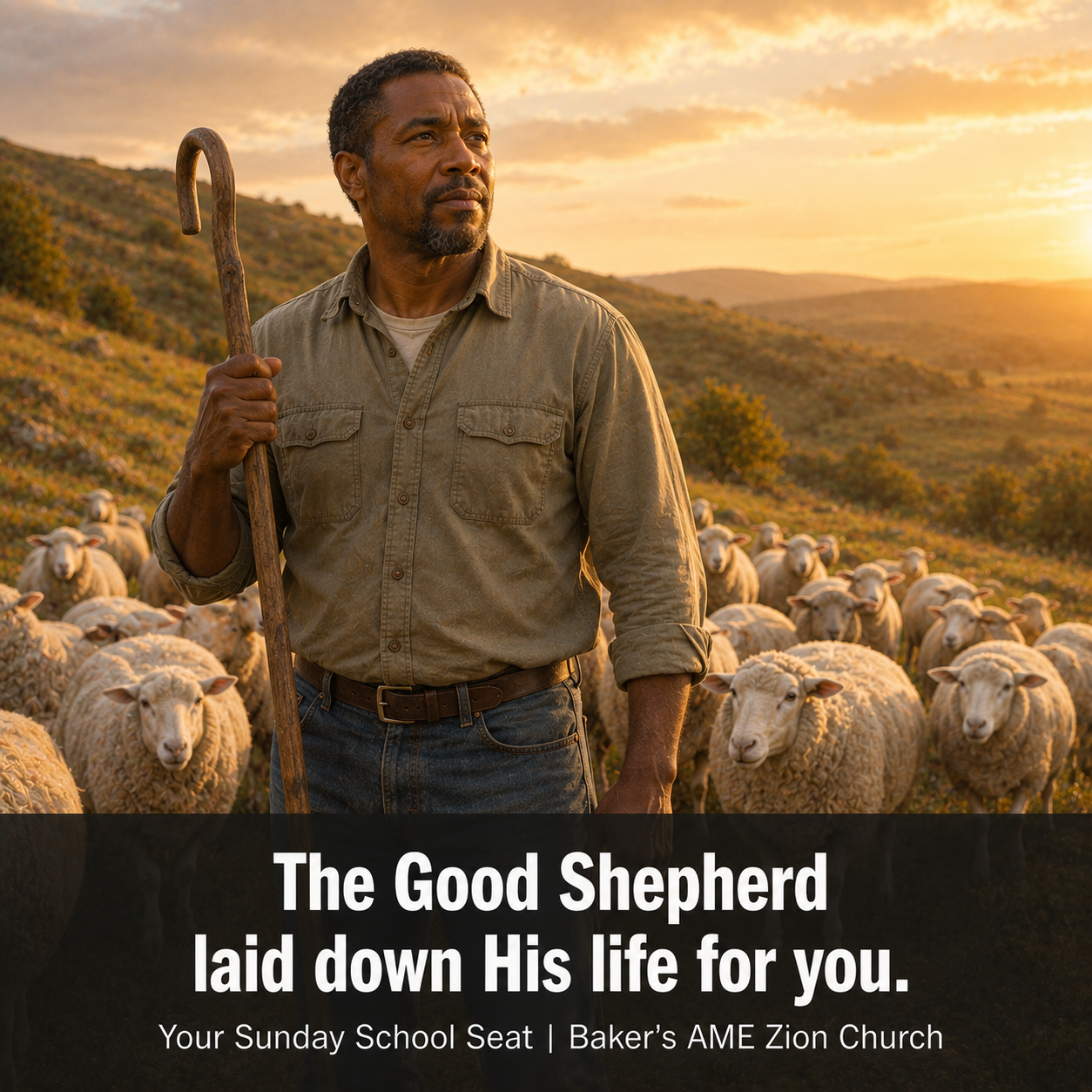
Yesterday Jesus said He was the door. Today He goes further and tells us what it costs Him to be our Shepherd. This is where shepherd language stops being gentle and becomes the whole gospel.
John 10:10-18 — KJV 10 The thief cometh not, but for to steal, and to kill, and to destroy: I am come that they might have life, and that they might have it more abundantly. 11 I am the good shepherd: the good shepherd giveth his life for the sheep. 12 But he that is an hireling, and not the shepherd, whose own the sheep are not, seeth the wolf coming, and leaveth the sheep, and fleeth: and the wolf catcheth them, and scattereth the sheep. 13 The hireling fleeth, because he is an hireling, and careth not for the sheep. 14 I am the good shepherd, and know my sheep, and am known of mine. 15 As the Father knoweth me, even so know I the Father: and I lay down my life for the sheep. 16 And other sheep I have, which are not of this fold: them also I must bring, and they shall hear my voice; and there shall be one fold, and one shepherd. 17 Therefore doth my Father love me, because I lay down my life, that I might take it again. 18 No man taketh it from me, but I lay it down of myself. I have power to lay it down, and I have power to take it again. This commandment have I received of my Father.
John 10:10-18 — WEB 10 The thief only comes to steal, kill, and destroy. I came that they may have life, and may have it abundantly. 11 I am the good shepherd. The good shepherd lays down his life for the sheep. 12 He who is a hired hand, and not a shepherd, who doesn't own the sheep, sees the wolf coming, leaves the sheep, and flees. The wolf snatches the sheep, and scatters them. 13 The hired hand flees because he is a hired hand, and doesn't care for the sheep. 14 I am the good shepherd. I know my own, and I'm known by my own; 15 even as the Father knows me, and I know the Father. I lay down my life for the sheep. 16 I have other sheep, which are not of this fold. I must bring them also, and they will hear my voice. They will become one flock with one shepherd. 17 Therefore the Father loves me, because I lay down my life, that I may take it again. 18 No one takes it away from me, but I lay it down by myself. I have power to lay it down, and I have power to take it again. I received this commandment from my Father.
Explanation
Jesus draws a hard line between two kinds of people who stand near the flock. There's the thief, who comes only "to steal, and to kill, and to destroy," and against that backdrop Jesus announces His own purpose: "I am come that they might have life, and that they might have it more abundantly." Then He sets the good shepherd beside the hireling. The hired hand works for a paycheck, so when the wolf shows up, he calculates the risk and runs — the sheep were never really his. The good shepherd, who owns the sheep and loves them, stands his ground. And the measure of that love is total: "the good shepherd giveth his life for the sheep."
Twice in these verses Jesus says it plainly — He lays down His life. And He insists no one is taking it from Him; He gives it freely. This is the cross spoken in advance, in pasture language. The Shepherd doesn't just lead the sheep to safety from a comfortable distance; He puts His own body between the flock and the wolf. He dies so the sheep can live.
This is the summit of the whole week, the day before Sunday's lesson, and the threads pull together here. Amos was God's voice calling a comfortable people back to justice. But Israel needed more than a warning; it needed a Shepherd willing to do what no prophet could — lay down his life and take it up again. The God who loves justice in Amos is the God who loves you enough to die for you in Jesus. Justice and sacrificial love meet at the same cross.
There's a quiet challenge tucked in here too. Most of us are tempted, somewhere, to be hirelings — to care for people only as long as it's convenient, to flee when the wolf of cost or conflict shows up. A marriage, a friendship, a hard ministry, a difficult child: the hireling does the math and leaves; the shepherd stays. Jesus shows us a love that doesn't run, and then He pours that same love into us so we can begin to love that way ourselves. Tomorrow we'll meet Amos, a man who refused to run from a hard assignment. Today we remember why anyone would have the courage to stay: because the Good Shepherd stayed for us first.
Thought for the Day The Good Shepherd laid down His life for you.
Reflection Question Where are you tempted to be a hireling — to flee when love gets costly — and what would it look like to stay?
Prayer Jesus, my Good Shepherd, thank You for not running when the wolf came for me. You laid down Your life so that I could have life, full and abundant. Where I'm tempted to flee from the people You've given me, give me the courage to stay. Fill me with the love that stays. Amen.
This week we walk toward Sunday's lesson: Amos, A Herdsman Called of God to Be a Prophet.
Friday, June 26 — Good and Safe Pastures
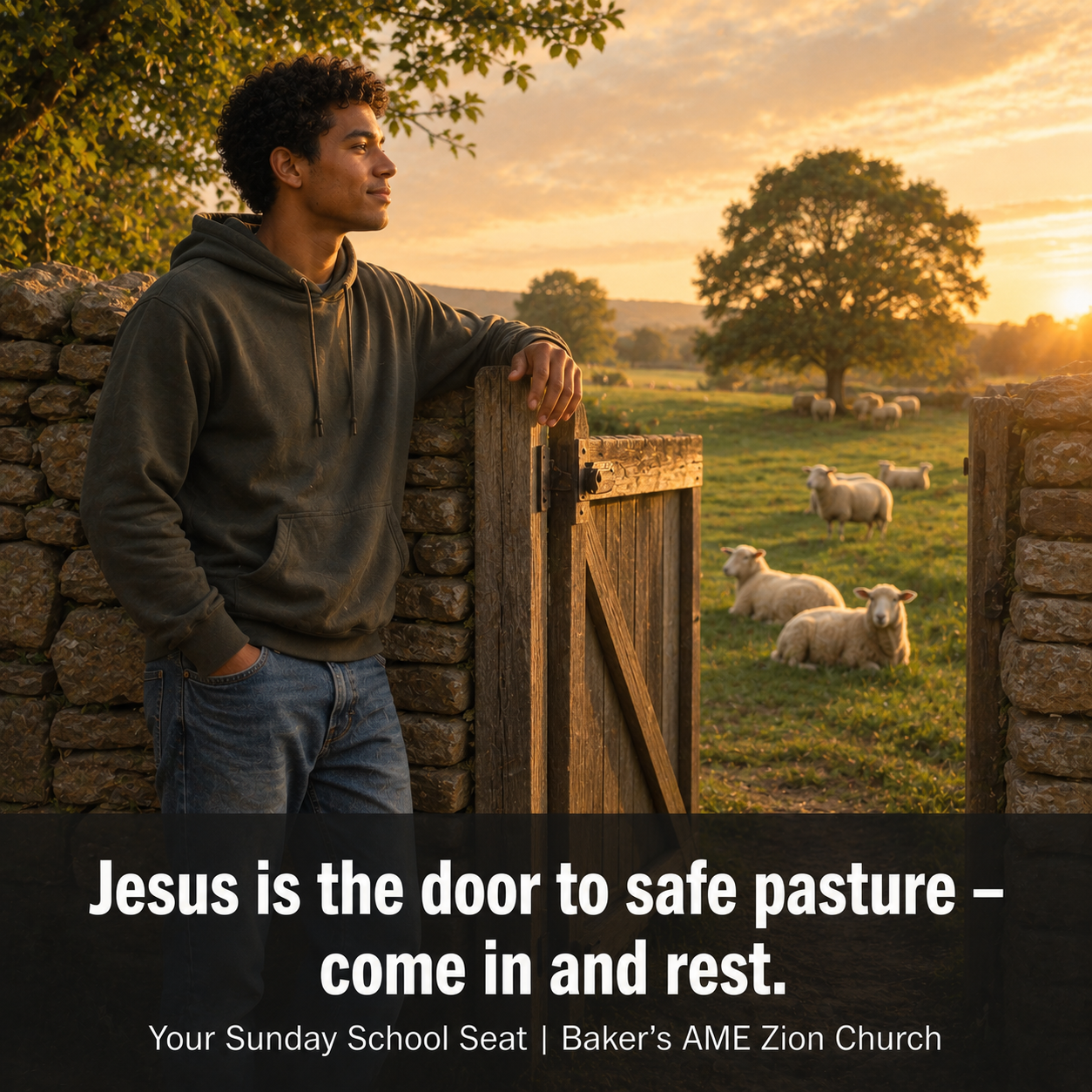
After three days walking through Amos's hard warnings, today's reading feels like a hand on your shoulder. Jesus has been talking about justice and judgment all week through the prophets; now He shows us the tender face of the God behind it all.
John 10:1-9 — KJV 1 Verily, verily, I say unto you, He that entereth not by the door into the sheepfold, but climbeth up some other way, the same is a thief and a robber. 2 But he that entereth in by the door is the shepherd of the sheep. 3 To him the porter openeth; and the sheep hear his voice: and he calleth his own sheep by name, and leadeth them out. 4 And when he putteth forth his own sheep, he goeth before them, and the sheep follow him: for they know his voice. 5 And a stranger will they not follow, but will flee from him: for they know not the voice of strangers. 6 This parable spake Jesus unto them: but they understood not what things they were which he spake unto them. 7 Then said Jesus unto them again, Verily, verily, I say unto you, I am the door of the sheep. 8 All that ever came before me are thieves and robbers: but the sheep did not hear them. 9 I am the door: by me if any man enter in, he shall be saved, and shall go in and out, and find pasture.
John 10:1-9 — WEB 1 "Most certainly, I tell you, one who doesn't enter by the door into the sheep fold, but climbs up some other way, the same is a thief and a robber. 2 But one who enters in by the door is the shepherd of the sheep. 3 The gatekeeper opens the gate for him, and the sheep listen to his voice. He calls his own sheep by name, and leads them out. 4 Whenever he brings out his own sheep, he goes before them, and the sheep follow him, for they know his voice. 5 They will by no means follow a stranger, but will flee from him; for they don't know the voice of strangers." 6 Jesus spoke this parable to them, but they didn't understand what he was telling them. 7 Jesus therefore said to them again, "Most certainly, I tell you, I am the sheep's door. 8 All who came before me are thieves and robbers, but the sheep didn't listen to them. 9 I am the door. If anyone enters in by me, he will be saved, and will go in and go out, and will find pasture."
Explanation
Jesus paints a scene His listeners knew well. At night, sheep from several flocks were gathered into a stone-walled fold with a single opening. A gatekeeper kept watch, and only the true shepherd came in through the door — anyone climbing over the wall was, by definition, up to no good. In the morning the shepherd called, and here's the detail that warms the whole passage: he "calleth his own sheep by name." This isn't crowd control. It's a shepherd who knows each animal personally, and sheep who can pick his voice out of a noisy fold.
Then Jesus does something striking. He says, "I am the door." He isn't just describing a good shepherd in general; He's identifying Himself as the way in. To come to God, you come through Him — and what waits on the other side is safety and provision: "he shall be saved, and shall go in and out, and find pasture." That last phrase paints contentment. A sheep that can go out to graze and come back in to rest without fear is a sheep that trusts its shepherd completely.
This is the gentle turn in our week, and it matters. Amos showed us a God who refuses fake worship and fights for the oppressed. It would be easy to walk away picturing only a God of thunder. But the same justice-loving God leans down in Jesus and calls you by name. The Shepherd who confronts the powerful is the Shepherd who keeps you safe. Strength and tenderness are not at war in God; they're the same love facing two directions.
So on a Friday, when the week has worn you thin, hear what kind of voice is calling you. Not the stranger's voice — not the anxious noise of the news, the boss, the bills, the inner critic that says you don't measure up. Those are the voices we're meant to flee. The Shepherd's voice knows your actual name and leads you toward rest, not exhaustion. The practical work of faith is partly just learning to tell the voices apart, so that we follow the one that leads to good pasture instead of the ones that wear the sheep out. Today, let yourself be led somewhere safe. You have a Shepherd, and there's a door with your name on the other side of it.
Thought for the Day Jesus is the door to safe pasture — come in and rest.
Reflection Question Whose voice have you been following lately — the Shepherd's, or a stranger's that only leaves you anxious and tired?
Prayer Good Shepherd, thank You that You know me by name and not by number. Quiet the stranger voices that scatter and exhaust me. Teach me to recognize Your voice and to follow it through the door into safety and rest. Lead me to good pasture today, and help me trust that You go before me. Amen.
This week we walk toward Sunday's lesson: Amos, A Herdsman Called of God to Be a Prophet.
Thursday, June 25 — Let Justice Roll Down like Water
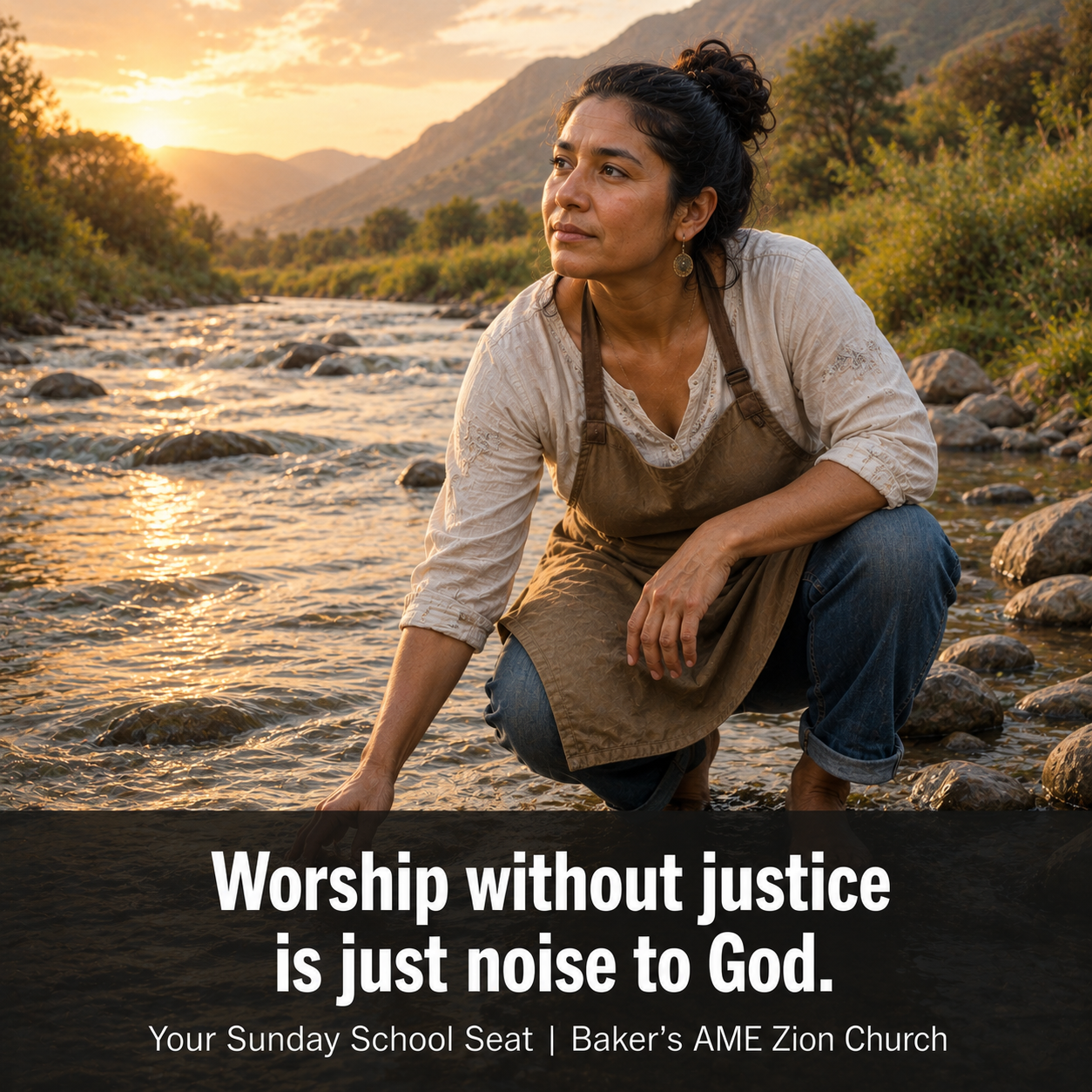
You can do everything "right" at church — show up, sing loud, give your offering — and still have God say, "Stop." That's an uncomfortable thought. It's also today's text, and it's the verse Dr. King made famous.
Amos 5:21-27 — KJV 21 I hate, I despise your feast days, and I will not smell in your solemn assemblies. 22 Though ye offer me burnt offerings and your meat offerings, I will not accept them: neither will I regard the peace offerings of your fat beasts. 23 Take thou away from me the noise of thy songs; for I will not hear the melody of thy viols. 24 But let judgment run down as waters, and righteousness as a mighty stream. 25 Have ye offered unto me sacrifices and offerings in the wilderness forty years, O house of Israel? 26 But ye have borne the tabernacle of your Moloch and Chiun your images, the star of your god, which ye made to yourselves. 27 Therefore will I cause you to go into captivity beyond Damascus, saith the LORD, whose name is The God of hosts.
Amos 5:21-27 — WEB 21 I hate, I despise your feasts, and I can't stand your solemn assemblies. 22 Yes, though you offer me your burnt offerings and meal offerings, I will not accept them; neither will I regard the peace offerings of your fat animals. 23 Take away from me the noise of your songs! I will not listen to the music of your harps. 24 But let justice roll on like rivers, and righteousness like a mighty stream. 25 "Did you bring to me sacrifices and offerings in the wilderness forty years, house of Israel? 26 You also carried the tent of your king and the shrine of your images, the star of your god, which you made for yourselves. 27 Therefore will I cause you to go into captivity beyond Damascus," says Yahweh, whose name is the God of Armies.
Explanation
Yesterday Amos warned that the day of the Lord was coming. Today he tells us why God is so displeased — and the answer should make every church-going person sit up. Israel's worship was not lacking. The feast days were full, the offerings were generous, the choir was loud. By every visible measure, this was a religious people. And God says He hates it.
That word "hate" is shocking on God's lips toward worship He Himself once commanded. But Amos has already shown us the streets outside the sanctuary: courts that took bribes, merchants who cheated the poor, comfortable people trampling the needy. So the worship had become a kind of cover story. The same hands lifted in the assembly were the hands squeezing the vulnerable on Monday. God refuses to "smell" those offerings — He won't even listen to the music — because worship divorced from justice isn't worship at all. It's noise.
Then comes verse 24, the thunderclap: "But let judgment run down as waters, and righteousness as a mighty stream." In a dry land, a wadi could sit empty for months and then fill with a flood that nothing could stop. That's the picture. God doesn't want a trickle of fairness when it's convenient; He wants justice to flood the whole landscape, unstoppable and life-giving, watering everything it touches.
This is the beating heart of Sunday's lesson. Amos was a herdsman with no credentials, standing up to the powerful, and this single verse is the reason his words still shake walls three thousand years later. Centuries afterward, a young preacher in Montgomery would lift this verse over a movement, because it says something permanent: God measures our worship by what happens to the vulnerable when the service ends.
So the question for a Thursday is not "Did I go to church?" but "Does justice flow from my life, or does it just trickle when someone's watching?" It's worth asking how I treat the cashier, the coworker no one defends, the person who can do nothing for me. It's worth asking whether my giving and my singing are connected to how I actually live, or whether they've quietly become a performance that lets me feel right while doing wrong. God is not impressed by the noise. He's looking for the river. Let it roll.
Thought for the Day Worship without justice is just noise to God.
Reflection Question Is there a gap between the worship you offer on Sunday and the justice you practice on Monday — and what's one place to close it this week?
Prayer Lord, I don't want my worship to be noise. Search the space between my songs and my life, and show me where they don't match. Let justice roll through me like a river — into my home, my work, my words. May my praise and my practice finally tell the same true story. Amen.
This week we walk toward Sunday's lesson: Amos, A Herdsman Called of God to Be a Prophet.
Wednesday, June 24 — The Lord's Day Is Coming
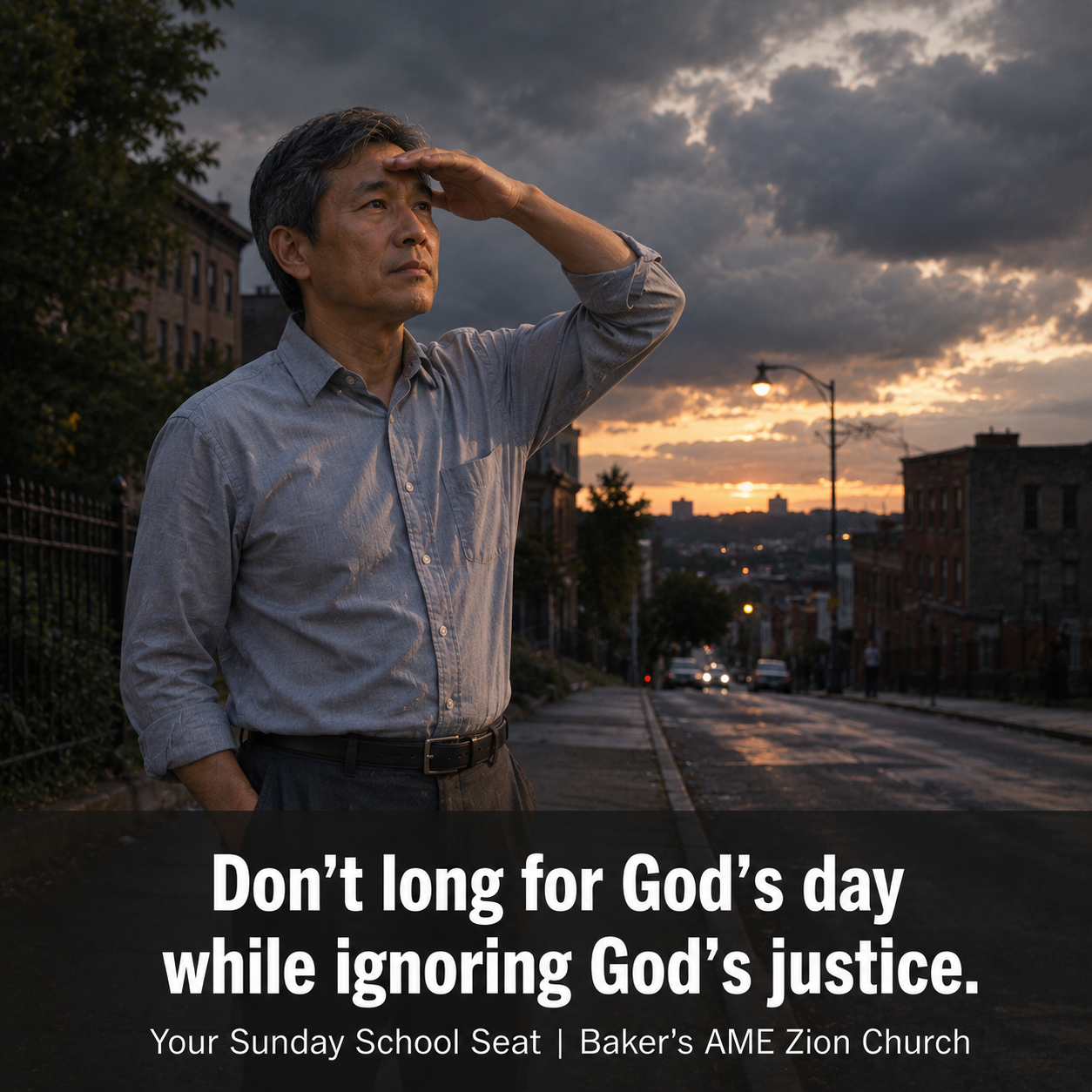
We tend to imagine that "the day of the Lord" is automatically good news. Amos asked a harder question: good news for whom? Today the prophet makes us check our assumptions.
Amos 5:16-20 — KJV 16 Therefore the LORD, the God of hosts, the Lord, saith thus; Wailing shall be in all streets; and they shall say in all the highways, Alas! alas! and they shall call the husbandman to mourning, and such as are skilful of lamentation to wailing. 17 And in all vineyards shall be wailing: for I will pass through thee, saith the LORD. 18 Woe unto you that desire the day of the LORD! to what end is it for you? the day of the LORD is darkness, and not light. 19 As if a man did flee from a lion, and a bear met him; or went into the house, and leaned his hand on the wall, and a serpent bit him. 20 Shall not the day of the LORD be darkness, and not light? even very dark, and no brightness in it?
Amos 5:16-20 — WEB 16 Therefore Yahweh, the God of Armies, the Lord, says: "Wailing will be in all the wide ways; and they will say in all the streets, 'Alas! Alas!' and they will call the farmer to mourning, and those who are skillful in lamentation to wailing. 17 In all vineyards there will be wailing; for I will pass through the middle of you," says Yahweh. 18 "Woe to you who desire the day of Yahweh! Why do you long for the day of Yahweh? It is darkness, and not light. 19 As if a man fled from a lion, and a bear met him; Or he went into the house and leaned his hand on the wall, and a snake bit him. 20 Won't the day of Yahweh be darkness, and not light? Even very dark, and no brightness in it?
Explanation
Amos preached during a boom. Under King Jeroboam II, Israel's borders were secure and the markets were busy. The comfortable people of the land assumed that prosperity proved God's favor, and they looked forward to "the day of the LORD" as a kind of national victory celebration — the day God would show up and put their enemies in their place.
Amos detonates that assumption. The day is coming, he says, but it will be "darkness, and not light." Instead of a parade there will be wailing in every street and vineyard. Why? Because God is going to "pass through" — and the same presence that rescues the oppressed will be terrifying to those who built their comfort on the backs of the poor. The day of the Lord is only good news if you're on the side of justice.
Then Amos paints one of the most vivid pictures in the Bible. A man runs from a lion and — relief! — escapes, only to run straight into a bear. He makes it home, leans his hand against the wall to catch his breath, and a snake bites him. There is no safe corner. You cannot outrun God's reckoning by changing rooms. For people who thought their religion and their wealth had bought them a permanent exemption, that's a chilling image.
This is the heart of where the week is heading. On Sunday we meet Amos the herdsman standing up to the powerful, and here we hear why he had to. Comfortable, religious people had convinced themselves that God graded on a curve and they were passing. Amos says the day of accountability falls on everyone, and longing for it while ignoring justice is like cheering for a storm you think will only hit your neighbors.
It lands close to home. It is easy to want God to "show up" — to fix the country, judge the people we disagree with, vindicate our side. Amos turns the spotlight around and asks what God's arrival would expose in us. Do we long for justice only when we picture ourselves on the winning end of it? The honest move this Wednesday is to stop assuming we're automatically the good guys in the story and ask God to pass through our own streets first — our spending, our grudges, the people we quietly step over. The day is coming. The only question is whether we'll greet it ready.
Thought for the Day Don't long for God's day while ignoring God's justice.
Reflection Question When you imagine God "showing up" to set things right, do you picture yourself among the rescued or among the exposed — and why?
Prayer Holy God, I confess I sometimes want justice for others and mercy only for myself. Pass through my streets. Show me where I've grown comfortable while ignoring what You care about. Make me ready for Your day — not by hiding, but by living justly and humbly now. Amen.
This week we walk toward Sunday's lesson: Amos, A Herdsman Called of God to Be a Prophet.
Tuesday, June 23 — A Shepherd Who Seeks the Lost

Think about the last time you turned the whole house upside down looking for one small thing — your keys, your phone, a child's favorite toy. That frantic, single-minded search is exactly how Jesus describes the heart of God.
Luke 15:1-7 — KJV 1 Then drew near unto him all the publicans and sinners for to hear him. 2 And the Pharisees and scribes murmured, saying, This man receiveth sinners, and eateth with them. 3 And he spake this parable unto them, saying, 4 What man of you, having an hundred sheep, if he lose one of them, doth not leave the ninety and nine in the wilderness, and go after that which is lost, until he find it? 5 And when he hath found it, he layeth it on his shoulders, rejoicing. 6 And when he cometh home, he calleth together his friends and neighbours, saying unto them, Rejoice with me; for I have found my sheep which was lost. 7 I say unto you, that likewise joy shall be in heaven over one sinner that repenteth, more than over ninety and nine just persons, which need no repentance.
Luke 15:1-7 — WEB 1 Now all the tax collectors and sinners were coming close to him to hear him. 2 The Pharisees and the scribes murmured, saying, "This man welcomes sinners, and eats with them." 3 He told them this parable. 4 "Which of you men, if you had one hundred sheep, and lost one of them, wouldn't leave the ninety-nine in the wilderness, and go after the one that was lost, until he found it? 5 When he has found it, he carries it on his shoulders, rejoicing. 6 When he comes home, he calls together his friends and his neighbors, saying to them, 'Rejoice with me, for I have found my sheep which was lost!' 7 I tell you that even so there will be more joy in heaven over one sinner who repents, than over ninety-nine righteous people who need no repentance."
Explanation
Jesus tells this story because of a complaint. The religious insiders are grumbling that He keeps the wrong company — He "receiveth sinners, and eateth with them." In that culture, sharing a meal meant acceptance, belonging, friendship. So the scandal wasn't that Jesus talked to outsiders; it was that He treated them like family. The parable of the lost sheep is His answer to that grumbling.
A flock of a hundred sheep was a modest holding, and one missing animal might seem like an acceptable loss. But the shepherd doesn't run the numbers that way. He leaves the ninety-nine and goes after the one "until he find it." There's no scolding when he finds it, no lecture about wandering off — he simply lifts it onto his shoulders, the tender, exhausting way a shepherd carries an animal too weak to walk home, and he throws a party. Heaven, Jesus says, sounds like that party.
This connects to our week in a way worth pausing over. On Sunday we'll see God reach down and pull a farmer named Amos out of the fields to carry a message. The God of Amos is the same God of this parable: a God who goes and gets people. Sometimes He sends a prophet to a whole nation; sometimes He shoulders one weary, wandering soul. The seeking is the same.
Here's the part that's easy to miss. Jesus aims this story at the grumblers — the dependable ninety-nine who never wandered and are quietly proud of it. He isn't shaming them; He's inviting them to feel what heaven feels. Are you glad when someone with a messy past finds their way to God, or does some part of you keep score? It's a real question for church people, because the temptation to resent grace is as old as the gospel itself.
And if today you're the one who feels lost — far off, fallen through the cracks, not the kind of person who "belongs" in a pew — the parable is mostly for you. You are not a rounding error to God. You are the one He left the ninety-nine to find. He isn't waiting at home, arms crossed, for you to find your own way back. He's out in the wilderness, looking, and He won't stop until you're on His shoulders and the music starts.
Thought for the Day Heaven throws a party when one lost sheep is found.
Reflection Question Are you more like the searching shepherd, the rejoicing heaven, or the grumbling crowd — and who is the "one" you've stopped looking for?
Prayer Jesus, thank You for being the kind of Shepherd who comes looking for me. When I wander, find me. When I'm found, give me Your joy over others instead of a scorecard. Teach me to welcome the people You welcome, and to celebrate every homecoming as heaven does. Amen.
This week we walk toward Sunday's lesson: Amos, A Herdsman Called of God to Be a Prophet.
Monday, June 22 — The Lord Loves Justice

Some mornings you look at the wreckage — a relationship, a budget, a city block, a season of your life — and you wonder if anything good can be built on top of all that rubble. Pull up a chair. Today's reading is for you.
Isaiah 61:4-9 — KJV 4 And they shall build the old wastes, they shall raise up the former desolations, and they shall repair the waste cities, the desolations of many generations. 5 And strangers shall stand and feed your flocks, and the sons of the alien shall be your plowmen and your vinedressers. 6 But ye shall be named the Priests of the LORD: men shall call you the Ministers of our God: ye shall eat the riches of the Gentiles, and in their glory shall ye boast yourselves. 7 For your shame ye shall have double; and for confusion they shall rejoice in their portion: therefore in their land they shall possess the double: everlasting joy shall be unto them. 8 For I the LORD love judgment, I hate robbery for burnt offering; and I will direct their work in truth, and I will make an everlasting covenant with them. 9 And their seed shall be known among the Gentiles, and their offspring among the people: all that see them shall acknowledge them, that they are the seed which the LORD hath blessed.
Isaiah 61:4-9 — WEB 4 They will rebuild the old ruins. They will raise up the places long devastated. They will repair the ruined cities, that have been devastated for many generations. 5 Strangers will stand and feed your flocks, and foreigners will work your fields and your vineyards. 6 But you will be called Yahweh's priests. Men will call you the servants of our God. You will eat the wealth of the nations, and you will boast in their glory. 7 Instead of your shame you will have double. Instead of dishonor, they will rejoice in their portion. Therefore in their land, they will possess double. Everlasting joy will be to them. 8 "For I, Yahweh, love justice. I hate robbery and iniquity. I will give them their reward in truth, and I will make an everlasting covenant with them. 9 Their offspring will be known among the nations, and their offspring among the peoples. All who see them will acknowledge them, that they are the offspring which Yahweh has blessed."
Explanation
Isaiah spoke these words to a people who knew what loss looked like. The northern part of the nation had already fallen, and Judah was staring down its own exile in Babylon. When Isaiah talks about "old wastes" and "former desolations," he is not being poetic for effect — he is naming real burned cities, real broken walls, real families scattered across foreign roads. Into that grief he announces something almost too good to believe: the ruins will be rebuilt, and the very people who were humiliated will be the ones doing the building.
Notice the engine that drives the whole promise. It is verse 8: "For I the LORD love judgment." The older word "judgment" and the modern word "justice" are reaching for the same thing — God's commitment to making crooked things straight. God isn't rebuilding these lives because the people earned it. God is rebuilding them because justice is simply who God is. The same God who "hate[s] robbery for burnt offering" — who refuses to be bought off with religious performance while people are being cheated — is the God who promises double honor in place of shame.
This is exactly where our week begins, because on Sunday we meet a farmer named Amos who will thunder about justice rolling down like water. Isaiah and Amos are singing in the same key. Long before Amos stood up to the powerful, God had already declared which side He was on. Justice isn't a mood God falls into. It's His settled love.
So what does that mean on a Monday? It means the broken places in your life are not the end of your story, and it means God notices when you've been wronged. If you have been cheated, overlooked, or worn down by "the desolations of many generations" handed to you, hear this: God loves justice too much to leave you in the rubble forever. And it means something for how you live, too. People who are rebuilt by a just God are called to build justly — to be honest in the small transactions, fair to the people under our authority, and tender toward those still sitting in their own wreckage. The week starts here: God is a rebuilder, and His blueprint is justice.
Thought for the Day God loves justice, so He builds tomorrow on yesterday's ruins.
Reflection Question Where in your life are you still standing in the rubble, waiting to believe that God intends to rebuild it?
Prayer Lord, You see the broken places I try to hide. You know the wrongs done to me and the wrongs I've done to others. Thank You that You are a God who loves justice and rebuilds ruins. Help me trust You with what feels beyond repair, and make me fair and honest in everything I touch today. Amen.
This week we walk toward Sunday's lesson: Amos, A Herdsman Called of God to Be a Prophet.
Sunday, June 21 — A Death in the Family

Grief is the receipt for love. The deeper the loss, the more it tells you how much there was to lose.
2 Samuel 1:17, 19-27 — KJV
17 And David lamented with this lamentation over Saul and over Jonathan his son: 19 The beauty of Israel is slain upon thy high places: how are the mighty fallen! 20 Tell it not in Gath, publish it not in the streets of Askelon; lest the daughters of the Philistines rejoice, lest the daughters of the uncircumcised triumph. 21 Ye mountains of Gilboa, let there be no dew, neither let there be rain, upon you, nor fields of offerings: for there the shield of the mighty is vilely cast away, the shield of Saul, as though he had not been anointed with oil. 22 From the blood of the slain, from the fat of the mighty, the bow of Jonathan turned not back, and the sword of Saul returned not empty. 23 Saul and Jonathan were lovely and pleasant in their lives, and in their death they were not divided: they were swifter than eagles, they were stronger than lions. 24 Ye daughters of Israel, weep over Saul, who clothed you in scarlet, with other delights, who put on ornaments of gold upon your apparel. 25 How are the mighty fallen in the midst of the battle! O Jonathan, thou wast slain in thine high places. 26 I am distressed for thee, my brother Jonathan: very pleasant hast thou been unto me: thy love to me was wonderful, passing the love of women. 27 How are the mighty fallen, and the weapons of war perished!
2 Samuel 1:17, 19-27 — WEB
17 David lamented with this lamentation over Saul and over Jonathan his son 19 "Your glory, Israel, was slain on your high places! How the mighty have fallen! 20 Don't tell it in Gath. Don't publish it in the streets of Ashkelon, lest the daughters of the Philistines rejoice, lest the daughters of the uncircumcised triumph. 21 You mountains of Gilboa, let there be no dew or rain on you, and no fields of offerings; for there the shield of the mighty was defiled and cast away, the shield of Saul was not anointed with oil. 22 From the blood of the slain, from the fat of the mighty, Jonathan's bow didn't turn back. Saul's sword didn't return empty. 23 Saul and Jonathan were lovely and pleasant in their lives. In their death, they were not divided. They were swifter than eagles. They were stronger than lions. 24 You daughters of Israel, weep over Saul, who clothed you delicately in scarlet, who put ornaments of gold on your clothing. 25 How the mighty have fallen in the middle of the battle! Jonathan was slain on your high places. 26 I am distressed for you, my brother Jonathan. You have been very pleasant to me. Your love to me was wonderful, passing the love of women. 27 How the mighty have fallen, and the weapons of war perished!"
Explanation
Today is Sunday school, and we close the week where the friendship of Jonathan and David finally lands: at a graveside. Saul and Jonathan have both died in battle on Mount Gilboa. David — who had every political reason to celebrate the death of the king who hunted him — does not gloat. He grieves. He composes a song, a public lament, and he commands that it be taught to all Israel. This is how he chooses to remember them.
What's striking is that David mourns Saul too. The man who threw spears at him, who chased him through the wilderness, who tried again and again to kill him — David honors him in death, refusing to dishonor the LORD's anointed. "How are the mighty fallen" becomes the haunting refrain of the whole poem, repeated three times like a bell tolling. David will not let bitterness write the eulogy. He remembers what was good and lets the rest go to God.
But it's verse 26 where his heart breaks open. "I am distressed for thee, my brother Jonathan... thy love to me was wonderful." This is the friend who stuck closer than a brother, the Jonathan who defended him at the cost of his own father's spear, the one who handed over a throne out of love. Now he's gone. David doesn't theologize his way around the pain. He doesn't say Jonathan is in a better place or that everything happens for a reason. He just says: I am distressed. You were wonderful to me. And he weeps.
This is the whole week brought to its honest conclusion. We have walked through friendships that encourage, friendships that choose wisely, friendships that stick, friendships that stay, friendships that lay down their lives. And here we learn the last, hardest truth: if you love deeply, one day you will grieve deeply. Grief is not the failure of love. It is the proof of it. David's tears are the receipt for everything Jonathan was to him.
Many of us carry a grief like this. An empty chair at the table. A name we still reach for before we remember. A friendship or a parent or a spouse that death took before we were ready. David gives us permission to mourn honestly and out loud — not to rush past the pain, not to pretend we're fine, but to name what we lost and call it wonderful. Faith does not require us to skip the lament. The Bible put David's grief in writing precisely so we'd know it's holy to weep.
On this Father's Day, some of you are missing a father, and some of you are fathers carrying losses no one sees. Bring it here. The God we worship is not a stranger to grief — He buried His own Son before raising Him. David's lament ends in sorrow, but our story doesn't end at Gilboa. The same God who let David weep is the God who promises that the mighty who have fallen in Christ will rise again. Until then, we love, we lose, we lament, and we hold each other close.
Thought for the Day Grief is the price we pay for real love.
Reflection Question What loss do you need to name honestly before God today?
Prayer Father, You know every empty chair and every name we still reach for. Thank You that grief is not a lack of faith but the evidence of love. Sit with us in our sorrow the way You sat with David, and remind us that for those in Christ, the fallen will rise again. Comfort every grieving heart in this room today. In Jesus' name, Amen.
Today is Sunday school. We save you a seat.
Saturday, June 20 — Fierce and Faithful Friends

A real friend will celebrate you. A rare friend will defend you to his own father — and walk away from a throne to do it.
1 Samuel 20:16-17, 32-34, 42 — KJV
16 So Jonathan made a covenant with the house of David, saying, Let the LORD even require it at the hand of David's enemies. 17 And Jonathan caused David to swear again, because he loved him: for he loved him as he loved his own soul. 32 And Jonathan answered Saul his father, and said unto him, Wherefore shall he be slain? what hath he done? 33 And Saul cast a javelin at him to smite him: whereby Jonathan knew that it was determined of his father to slay David. 34 So Jonathan arose from the table in fierce anger, and did eat no meat the second day of the month: for he was grieved for David, because his father had done him shame. 42 And Jonathan said to David, Go in peace, forasmuch as we have sworn both of us in the name of the LORD, saying, The LORD be between me and thee, and between my seed and thy seed for ever. And he arose and departed: and Jonathan went into the city.
1 Samuel 20:16-17, 32-34, 42 — WEB
16 So Jonathan made a covenant with David's house, saying, "Yahweh will require it at the hand of David's enemies." 17 Jonathan caused David to swear again, for the love that he had for him; for he loved him as he loved his own soul. 32 Jonathan answered Saul his father, and said to him, "Why should he be put to death? What has he done?" 33 Saul cast his spear at him to strike him. By this Jonathan knew that his father was determined to put David to death. 34 So Jonathan arose from the table in fierce anger, and ate no food the second day of the month; for he was grieved for David, because his father had done him shame. 42 Jonathan said to David, "Go in peace, because we have both sworn in Yahweh's name, saying, 'Yahweh is between me and you, and between my offspring and your offspring, forever.'" He arose and departed; and Jonathan went into the city.
Explanation
Now we arrive at the heart of the week. David is a marked man. King Saul, consumed with jealousy, wants him dead. The complication is that Saul's own son, Jonathan, is David's closest friend — and, by birthright, the next king of Israel. Every instinct of self-preservation should make Jonathan David's enemy. David is the rival who stands between Jonathan and the crown. Instead, Jonathan becomes David's fiercest protector.
Away from the palace, the two of them make a covenant. Jonathan binds himself and his house to David in a solemn vow, throwing his loyalty behind the very man who will one day take his throne. Verse 17 tells us why: "he loved him as he loved his own soul." This is not casual affection. Jonathan loves David the way you love your own life — and then chooses David's good over his own future.
The cost becomes painfully clear at the dinner table. When Jonathan defends David and simply asks, "Why should he be put to death? What has he done?" — his own father hurls a spear at him. Saul would rather kill his son than give up his rage. Jonathan leaves the table in "fierce anger," not for himself but grieved for David, and doesn't eat. That phrase — fierce and grieved at once — captures real friendship under pressure. He is angry at injustice and broken-hearted for his friend in the same breath.
The scene ends with the two friends parting, sealing their bond with the name of the LORD between them and between their descendants forever. They both know David is running for his life. They may never sit at a table together again. And so they don't trust the moment — they trust God to hold the covenant they cannot keep in person. "Yahweh is between me and you... forever."
This is the friendship the whole week has been building toward, and it shows us what loyalty costs. Jonathan had everything to gain by abandoning David and everything to lose by defending him. He chose his friend anyway. That kind of friend is rare — the one who will speak up for you in the room where you're being torn down, who will risk the relationship with their own family to do what's right, who will hand you the future that could have been theirs.
Most of us are not choosing between a friend and a literal throne. But we make smaller versions of Jonathan's choice all the time. Will you defend an absent friend when the conversation turns to gossip? Will you tell someone a hard truth that might cost you their comfort but save their life? Will you celebrate a friend's promotion when it was the one you wanted? Faithful friendship is fierce. It shows up most clearly not when it's easy, but when it costs you something real. Be a Jonathan to someone. And thank God for the Jonathans He's given you.
Thought for the Day A true friend defends you even when it costs them.
Reflection Question Would you defend an absent friend in a room where it cost you something?
Prayer Father, make me a friend like Jonathan — willing to speak up, willing to give up my own advantage for someone I love. Thank You for the people who have defended me when I wasn't there to defend myself. When loyalty gets costly, give me the courage to choose faithfulness over self-interest. Hold my closest friendships in Your hands. In Jesus' name, Amen.
This week we walk toward Sunday's lesson: Jonathan and David, A Noble Friendship.
Friday, June 19 — The Greatest Love

We throw the word "love" around for pizza and playlists. Jesus defined it with a cross.
John 15:9-17 — KJV
9 As the Father hath loved me, so have I loved you: continue ye in my love. 10 If ye keep my commandments, ye shall abide in my love; even as I have kept my Father's commandments, and abide in his love. 11 These things have I spoken unto you, that my joy might remain in you, and that your joy might be full. 12 This is my commandment, That ye love one another, as I have loved you. 13 Greater love hath no man than this, that a man lay down his life for his friends. 14 Ye are my friends, if ye do whatsoever I command you. 15 Henceforth I call you not servants; for the servant knoweth not what his lord doeth: but I have called you friends; for all things that I have heard of my Father I have made known unto you. 16 Ye have not chosen me, but I have chosen you, and ordained you, that ye should go and bring forth fruit, and that your fruit should remain: that whatsoever ye shall ask of the Father in my name, he may give it you. 17 These things I command you, that ye love one another.
John 15:9-17 — WEB
9 Even as the Father has loved me, I also have loved you. Remain in my love. 10 If you keep my commandments, you will remain in my love; even as I have kept my Father's commandments, and remain in his love. 11 I have spoken these things to you, that my joy may remain in you, and that your joy may be made full. 12 "This is my commandment, that you love one another, even as I have loved you. 13 Greater love has no one than this, that someone lay down his life for his friends. 14 You are my friends, if you do whatever I command you. 15 No longer do I call you servants, for the servant doesn't know what his lord does. But I have called you friends, for everything that I heard from my Father, I have made known to you. 16 You didn't choose me, but I chose you and appointed you, that you should go and bear fruit, and that your fruit should remain; that whatever you will ask of the Father in my name, he may give it to you. 17 "I command these things to you, that you may love one another.
Explanation
These are some of the last words Jesus spoke to His disciples before the cross. It's the night before everything. He knows what's coming, and instead of talking about Himself, He talks about love and friendship. He has just compared Himself to a vine and His followers to branches. Now He gets specific about what it means to stay connected to Him: "Remain in my love." Not earn it. Not deserve it. Remain in it.
Then Jesus says something that reorders every relationship in the room: "Greater love hath no man than this, that a man lay down his life for his friends." Within hours He would do exactly that. This isn't a poster slogan to Him. It's a prophecy of His own death, spoken to the very people He was about to die for. The greatest love is not a feeling. It's a laying down — of comfort, of rights, of life itself — for the sake of another.
And then the line that should never lose its shock: "No longer do I call you servants... I have called you friends." The God of the universe calls ordinary people His friends. He doesn't keep them at arm's length as hired help who follow orders without explanation. He brings them in close, tells them what the Father is doing, treats them as confidants. The distance between heaven and earth gets closed by a single word — friends.
This is the high point of our week, and it's no accident it lands here. Every human friendship we've studied — Paul and the Romans, Ruth and Naomi, and tomorrow Jonathan and David — is a small reflection of this greater love. Jonathan laid down his crown for David. Ruth laid down her future for Naomi. But Jesus laid down His very life for us, and He calls us to love one another the same way. Our friendships are meant to be little echoes of the cross.
So what does laying down your life look like when you're not literally dying? It looks like laying down your schedule for someone who needs your time. Laying down your pride to apologize first. Laying down your comfort to sit with someone in their pain. Laying down your right to be right for the sake of keeping the relationship. Most of us will never be asked to die for a friend. All of us are asked, daily, to die a little — to our convenience, our ego, our agenda — for the people we love.
There's something fitting about reading these words on Juneteenth, a day that remembers a long-delayed freedom finally arriving. The freedom Christ won was not delayed by His unwillingness — He laid His life down the moment it was time. And He calls His friends free: free to love, free to bear fruit, free to ask the Father anything in His name. That's not the love of a master to a servant. That's the love of a friend who already proved how far He would go.
Thought for the Day Greater love lays down its life for a friend.
Reflection Question Where is Jesus asking you to lay something down for a friend this week?
Prayer Jesus, thank You for laying down Your life while I was still far off, and for calling me friend instead of servant. Teach me to love the way You loved — to lay down my pride, my comfort, and my agenda for the people You've placed around me. Let my friendships be small echoes of Your great love. In Your name, Amen.
This week we walk toward Sunday's lesson: Jonathan and David, A Noble Friendship.
Thursday, June 18 — Friends When All Is Lost

Anyone will travel with you in good weather. The test of a bond is who's still walking beside you after everything falls apart.
Ruth 1:11-18 — KJV
11 And Naomi said, Turn again, my daughters: why will ye go with me? are there yet any more sons in my womb, that they may be your husbands? 12 Turn again, my daughters, go your way; for I am too old to have an husband. If I should say, I have hope, if I should have an husband also to night, and should also bear sons; 13 Would ye tarry for them till they were grown? would ye stay for them from having husbands? nay, my daughters; for it grieveth me much for your sakes that the hand of the LORD is gone out against me. 14 And they lifted up their voice, and wept again: and Orpah kissed her mother in law; but Ruth clave unto her. 15 And she said, Behold, thy sister in law is gone back unto her people, and unto her gods: return thou after thy sister in law. 16 And Ruth said, Intreat me not to leave thee, or to return from following after thee: for whither thou goest, I will go; and where thou lodgest, I will lodge: thy people shall be my people, and thy God my God: 17 Where thou diest, will I die, and there will I be buried: the LORD do so to me, and more also, if ought but death part thee and me. 18 When she saw that she was stedfastly minded to go with her, then she left speaking unto her.
Ruth 1:11-18 — WEB
11 Naomi said, "Go back, my daughters. Why do you want to go with me? Do I still have sons in my womb, that they may be your husbands? 12 Go back, my daughters, go your way; for I am too old to have a husband. If I should say, 'I have hope,' if I should even have a husband tonight, and should also bear sons, 13 would you then wait until they were grown? Would you then refrain from having husbands? No, my daughters, for it grieves me seriously for your sakes, for Yahweh's hand has gone out against me." 14 They lifted up their voices and wept again; then Orpah kissed her mother-in-law, but Ruth stayed with her. 15 She said, "Behold, your sister-in-law has gone back to her people and to her god. Follow your sister-in-law." 16 Ruth said, "Don't urge me to leave you, and to return from following you, for where you go, I will go; and where you stay, I will stay. Your people will be my people, and your God my God. 17 Where you die, I will die, and there I will be buried. May Yahweh do so to me, and more also, if anything but death parts you and me." 18 When Naomi saw that she was steadfastly determined to go with her, she stopped urging her.
Explanation
By the time we reach this scene, Naomi has lost almost everything. Famine drove her family from Bethlehem to Moab. There her husband died. Then both of her sons died, leaving three widows in a world with no safety net for women alone. Naomi decides to go home to Bethlehem, and she does something remarkable — she tries to send her daughters-in-law away. She has nothing left to offer them. No more sons to marry, no future to promise, no reason for them to stay tied to a grieving old woman.
This is grief talking honestly. "The hand of the LORD is gone out against me," Naomi says. She isn't pretending to be okay. And her instinct, even in her own ruin, is to protect the younger women from sharing her loss. Orpah weeps, kisses her, and goes — and the text does not condemn her. She did the reasonable thing. But Ruth does the unreasonable, beautiful thing. She "clave unto her."
Then comes one of the most quoted vows in all of Scripture, words we now read at weddings though Ruth spoke them to her mother-in-law: "Whither thou goest, I will go... thy people shall be my people, and thy God my God." Ruth binds herself to a woman who has nothing, to a country she's never seen, to a God she's choosing freely. She walks toward poverty and uncertainty for the sake of love. This is loyalty with no exit clause.
Here is why this matters for Sunday. Ruth's covenant loyalty to Naomi is the same kind of covenant loyalty Jonathan would later show David. Hebrew has a word for it — hesed — a faithful, committed love that keeps its promises even when it costs you everything. Ruth shows us hesed between two grieving women. Jonathan shows us hesed between two young men in a palace. Both point us, finally, to the hesed of God, who refuses to leave us even when we have nothing to give Him back.
Bring it to your own kitchen table. We all know what it is to face a season where everything seems to be slipping — a marriage strained, a job gone, a diagnosis that rearranges the calendar. In those seasons you find out who your Ruth is. And you find out whether you are willing to be someone's Ruth. Real friendship is not measured at the celebration. It's measured at the funeral, in the waiting room, on the moving day nobody else showed up for.
You may not be able to fix what someone has lost. Ruth couldn't bring back Naomi's husband or sons. But she could refuse to leave. Sometimes the holiest thing you can offer a grieving friend is simply this: I'm not going anywhere.
Thought for the Day Where you go, I will go — love stays.
Reflection Question Who needs you to simply refuse to leave right now?
Prayer Lord, thank You for being the God who will not leave me, even when I have nothing to give back. Teach me the kind of loyalty Ruth showed Naomi — love that stays when staying is costly. Show me who needs me to refuse to walk away, and give me the courage to keep that promise. In Jesus' name, Amen.
This week we walk toward Sunday's lesson: Jonathan and David, A Noble Friendship.
Wednesday, June 17 — A Friend Closer than a Brother

Some people share your blood. A rare few share your battles. Today's proverb is about the second kind.
Proverbs 18:19-24 — KJV
19 A brother offended is harder to be won than a strong city: and their contentions are like the bars of a castle. 20 A man's belly shall be satisfied with the fruit of his mouth; and with the increase of his lips shall he be filled. 21 Death and life are in the power of the tongue: and they that love it shall eat the fruit thereof. 22 Whoso findeth a wife findeth a good thing, and obtaineth favour of the LORD. 23 The poor useth intreaties; but the rich answereth roughly. 24 A man that hath friends must shew himself friendly: and there is a friend that sticketh closer than a brother.
Proverbs 18:19-24 — WEB
19 A brother offended is more difficult than a fortified city. Disputes are like the bars of a fortress. 20 A man's stomach is filled with the fruit of his mouth. With the harvest of his lips he is satisfied. 21 Death and life are in the power of the tongue; those who love it will eat its fruit. 22 Whoever finds a wife finds a good thing, and obtains favor of Yahweh. 23 The poor plead for mercy, but the rich answer harshly. 24 A man of many companions may be ruined, but there is a friend who sticks closer than a brother.
Explanation
Proverbs is wisdom literature — short, punchy sayings collected to teach ordinary people how to live well. These verses cluster around a single theme: the immense power of relationships and the words that hold them together or tear them apart. Verse 19 is brutally honest. An offended brother is "harder to be won than a strong city." Anyone who has ever fallen out with family knows the truth of that. The walls go up fast and come down slow. Blood does not guarantee closeness.
Then the proverb turns to the tongue. "Death and life are in the power of the tongue." The same mouth that can rebuild a friendship can also burn it to the ground. We eat the fruit of our own words — meaning we live, eventually, in the world our speech creates. Speak bitterness long enough and you will live in a bitter place. Speak grace and you build something you'll be glad to live inside.
All of it builds toward the famous last line: "there is a friend that sticketh closer than a brother." Notice what the proverb is admitting. Sometimes the person who shows up is not your relative. Sometimes the one who sticks is the friend God gave you, not the family you were born into. This is not a knock on family — verse 22 honors marriage in the same breath. It's a recognition that real loyalty is forged, not just inherited.
That is exactly the friendship we'll meet on Sunday. Jonathan and David were not brothers by blood. By every earthly calculation, Jonathan should have seen David as a rival for the throne. Instead he became the friend who stuck closer than a brother, who risked his own life and inheritance for David's sake. Proverbs 18:24 is practically Jonathan's portrait, written down before he ever lived it out.
So where does this land on a Wednesday? Right in the middle of your relationships. The proverb gives both a warning and an invitation. The warning: watch your words, because they are planting the world you'll have to live in. The invitation: be the friend who sticks. Anyone can stick around when things are easy. The friend who matters is the one who's still there when the city walls of offense go up, when the bank account is empty, when the diagnosis comes back wrong, when everyone else got busy.
You probably can't be that friend to a hundred people. But you can be that friend to a few. And you can thank God for the ones who have been that friend to you — the ones who stuck closer than a brother when they had every reason to walk away.
Thought for the Day Some friends stick closer than family ever could.
Reflection Question Are you sticking close to someone right now, or have you quietly gone busy?
Prayer Father, thank You for the friends who stuck when they could have walked away. Make me that kind of friend — loyal, present, slow to take offense, careful with my words. Help me speak life and not death, and to build relationships I'll be glad to live inside. In Jesus' name, Amen.
This week we walk toward Sunday's lesson: Jonathan and David, A Noble Friendship.
Tuesday, June 16 — Choose Your Friends Wisely

We like to think we're the ones shaping our circle. More often, our circle is quietly shaping us.
1 Corinthians 15:30-34 — KJV
30 And why stand we in jeopardy every hour? 31 I protest by your rejoicing which I have in Christ Jesus our Lord, I die daily. 32 If after the manner of men I have fought with beasts at Ephesus, what advantageth it me, if the dead rise not? let us eat and drink; for to morrow we die. 33 Be not deceived: evil communications corrupt good manners. 34 Awake to righteousness, and sin not; for some have not the knowledge of God: I speak this to your shame.
1 Corinthians 15:30-34 — WEB
30 Why do we also stand in jeopardy every hour? 31 I affirm, by the boasting in you which I have in Christ Jesus our Lord, I die daily. 32 If I fought with animals at Ephesus for human purposes, what does it profit me? If the dead are not raised, then "let's eat and drink, for tomorrow we die." 33 Don't be deceived! "Evil companionships corrupt good morals." 34 Wake up righteously and don't sin, for some have no knowledge of God. I say this to your shame.
Explanation
Paul is in the middle of the greatest resurrection chapter in the Bible. The Corinthians had people among them claiming there was no resurrection of the dead, and Paul is arguing for everything he has staked his life on. Then, almost in passing, he drops a line so practical it sounds like something your grandmother would say: "Evil companionships corrupt good morals." He's actually quoting a common Greek proverb of his day — borrowing the wisdom of the street to make a spiritual point.
His logic is sharp. If there's no resurrection, why does he put himself in danger every single hour? Why "die daily"? If this life is all there is, you might as well eat, drink, and chase whatever feels good before the lights go out. But Paul isn't living for tomorrow's death. He's living for resurrection. And he warns the church that the company they keep will either keep them awake to that hope or lull them to sleep.
Notice the word "deceived." Bad influence rarely announces itself. Nobody hands you a contract that says, "Sign here to slowly lose your convictions." It happens in small, comfortable increments — a conversation here, a compromise there, an evening where the cynicism in the room becomes the cynicism in your heart. By the time you notice, your standards have quietly relocated. That's why Paul says "be not deceived." The drift feels natural, which is exactly why it's dangerous.
This connects directly to where we're headed on Sunday. Jonathan and David had a friendship that pulled each man toward courage, loyalty, and faith in God. But David's story also includes Saul — a relationship that grew toxic, jealous, and ultimately murderous. Same young man, two very different influences, two very different effects on his soul. The people closest to us are never neutral. They are either waking us up or putting us to sleep.
Now bring it home. Look honestly at the voices you let in close — the group chats, the lunch table, the people whose opinions you check before you check your own conscience. Do they make holiness feel possible or laughable? Do you leave their company more awake to God or more numb to Him? This isn't about cutting everyone off or pretending you're better than anyone. It's about being honest enough to admit that we become like the people we run with.
Choosing friends wisely doesn't mean choosing perfect people. It means choosing people who are facing the same direction you want to face — toward the God who raises the dead, not toward the table that says tomorrow we die. Surround yourself with people who keep you awake.
Thought for the Day Bad company corrupts good character — choose your circle with care.
Reflection Question Do the people closest to you wake you up to God, or numb you to Him?
Prayer Lord, give me the courage to be honest about my own circle. Surround me with people who pull me toward You, and make me that kind of friend to others. Keep me awake to what's true when the voices around me grow comfortable with what's false. Guard my heart from quiet drift. In Jesus' name, Amen.
This week we walk toward Sunday's lesson: Jonathan and David, A Noble Friendship.
Monday, June 15 — Encouraging Each Other's Faith
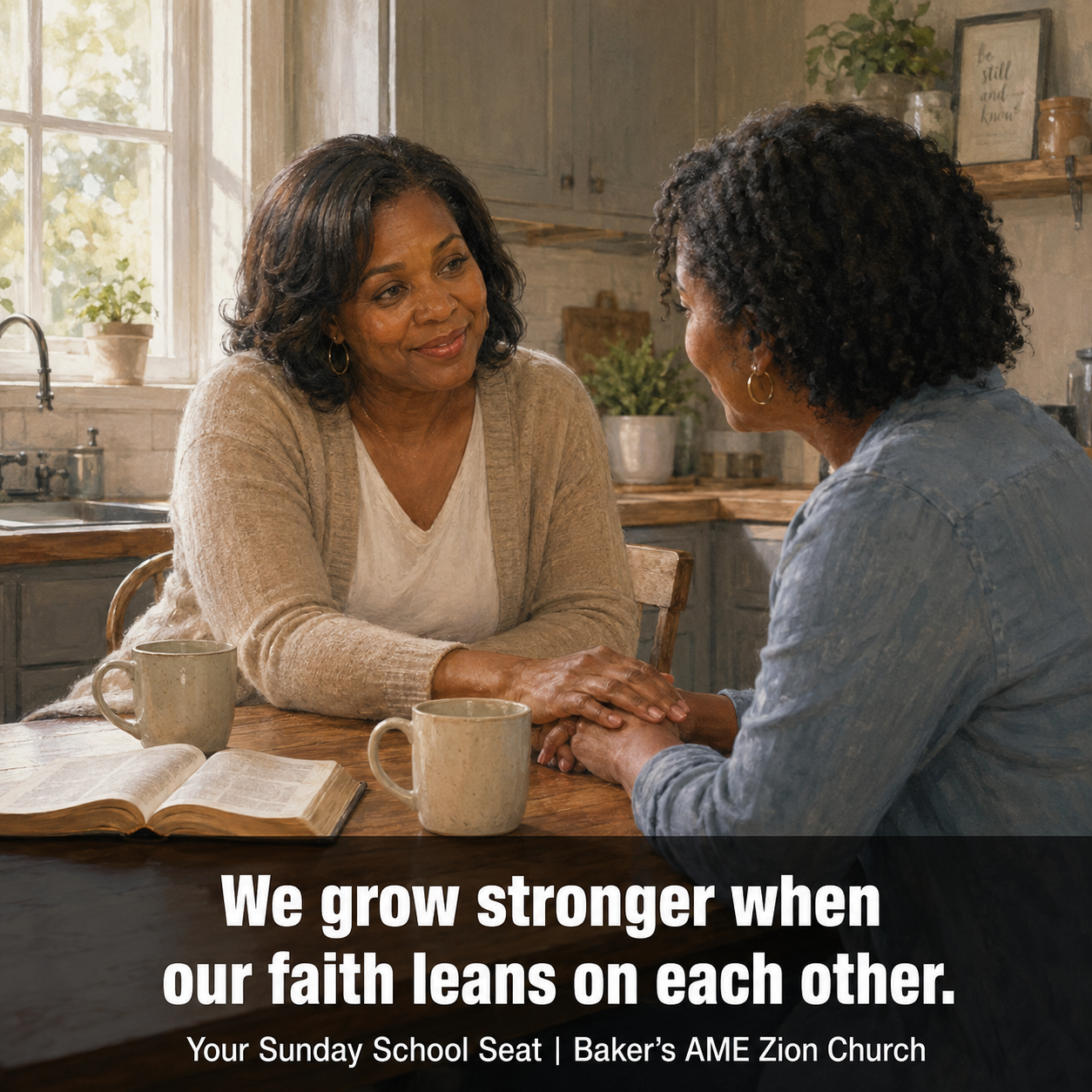
There's a reason we don't say "I'll pray for you" and then disappear. Real faith leans on other people — and Paul knew it better than anyone.
Romans 1:8-12 — KJV
8 First, I thank my God through Jesus Christ for you all, that your faith is spoken of throughout the whole world. 9 For God is my witness, whom I serve with my spirit in the gospel of his Son, that without ceasing I make mention of you always in my prayers; 10 Making request, if by any means now at length I might have a prosperous journey by the will of God to come unto you. 11 For I long to see you, that I may impart unto you some spiritual gift, to the end ye may be established; 12 That is, that I may be comforted together with you by the mutual faith both of you and me.
Romans 1:8-12 — WEB
8 First, I thank my God through Jesus Christ for all of you, that your faith is proclaimed throughout the whole world. 9 For God is my witness, whom I serve in my spirit in the Good News of his Son, how unceasingly I make mention of you always in my prayers, 10 requesting, if by any means now at last I may be prospered by the will of God to come to you. 11 For I long to see you, that I may impart to you some spiritual gift, to the end that you may be established; 12 that is, that I with you may be encouraged in you, each of us by the other's faith, both yours and mine.
Explanation
Paul wrote these words to a church he had never met. He was in Corinth, dreaming of Rome, a city he had longed to visit for years. Before he says a single word of correction or instruction, he opens with gratitude. He thanks God for their faith, tells them he prays for them constantly, and admits something that should stop us in our tracks: he wants to come not only to give them something, but to receive something from them too.
Look closely at verse 12. Paul, the great apostle, the man who wrote half the New Testament, says he longs to be "comforted together with you by the mutual faith both of you and me." He doesn't see himself as the spiritual expert flying in to fix the amateurs. He sees a two-way street. He has something to offer them, and they have something to offer him. That is what real Christian friendship looks like — not a hierarchy, but a household where everyone carries something for everyone else.
This is the perfect place to begin a week about Jonathan and David. Before we get to that famous covenant friendship, Paul reminds us why friendship in the faith matters at all. We were never meant to believe alone. Faith is not a solo sport you practice in private and grade yourself on. It grows in the company of people who pray for you when you forget to pray for yourself, who remind you what's true when your own memory fails.
Think about the people God has placed around you. The friend who texts a verse on the worst morning of your week. The coworker who quietly says, "I've got you covered, go take care of your family." The older woman at church who has been praying your name for years and never told you. That is verse 12 happening in real time. Their faith strengthens yours, and yours strengthens theirs, and neither of you has to carry the whole weight alone.
The danger of our age is that we mistake being connected for being known. We have hundreds of contacts and few real witnesses. Paul models the better way: name your people before God, thank Him for them out loud, and tell them plainly that you need them. This week, as we walk toward Sunday's lesson on Jonathan and David, start by noticing who is already holding you up — and let them know it.
Thought for the Day We grow stronger when our faith leans on each other.
Reflection Question Who has strengthened your faith lately — and have you told them?
Prayer Father, thank You for the people who carry my faith when my own grip slips. Help me to be that kind of friend in return — quick to give thanks, quick to pray, unafraid to admit I need others. Knit us together so that we are stronger for each other than we could ever be alone. In Jesus' name, Amen.
This week we walk toward Sunday's lesson: Jonathan and David, A Noble Friendship.