
A daily walk through Scripture, preparing our hearts for Sunday.
Sunday, July 26 — Whatever He Says, Do It
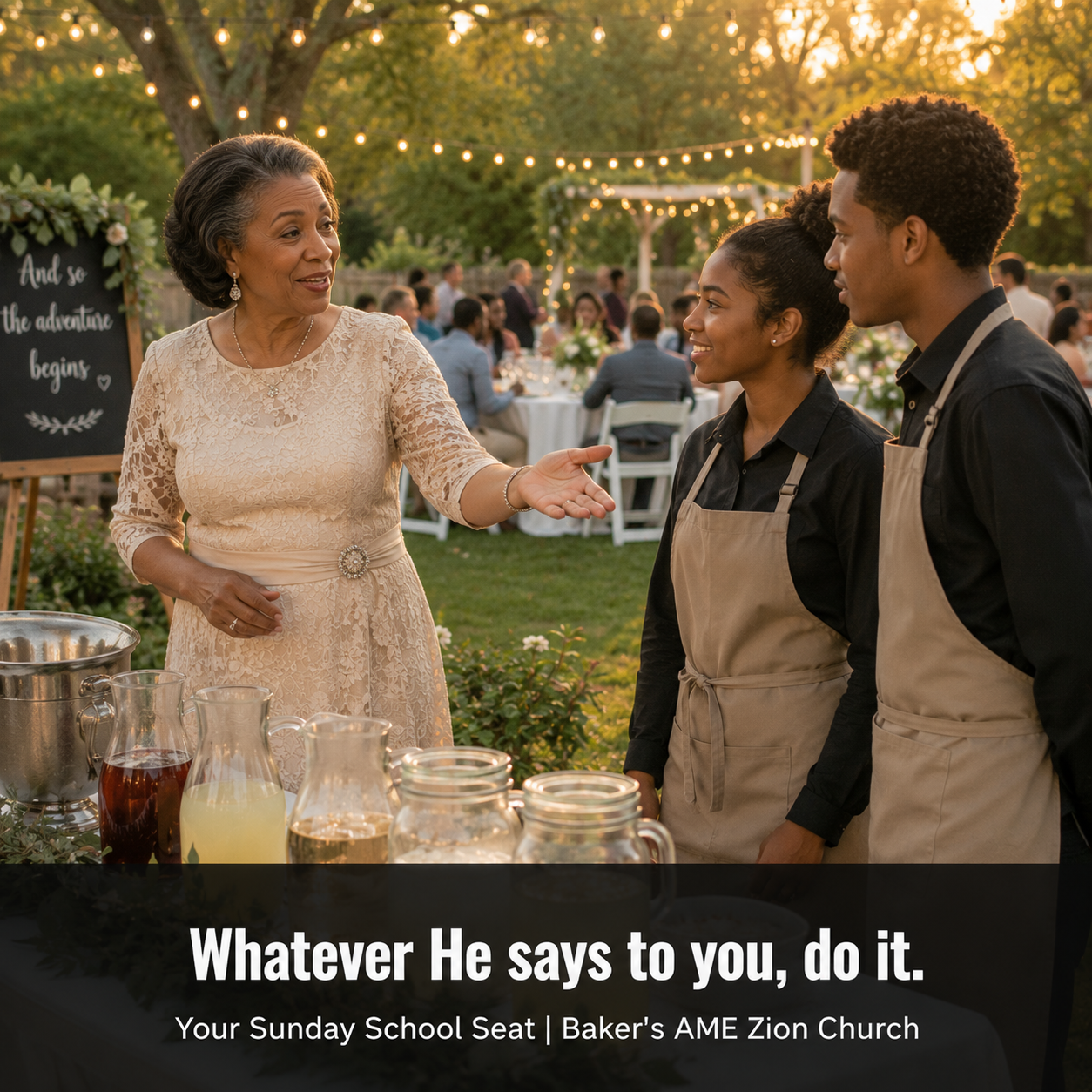
At a wedding that was about to run out of wine, Mary spoke her last recorded words in Scripture. They weren't about her at all. They pointed straight to her Son — and they still point us there today.
John 2:1-5 — KJV 1 And the third day there was a marriage in Cana of Galilee; and the mother of Jesus was there: 2 And both Jesus was called, and his disciples, to the marriage. 3 And when they wanted wine, the mother of Jesus saith unto him, They have no wine. 4 Jesus saith unto her, Woman, what have I to do with thee? mine hour is not yet come. 5 His mother saith unto the servants, Whatsoever he saith unto you, do it.
John 2:1-5 — WEB 1 The third day, there was a wedding in Cana of Galilee. Jesus' mother was there. 2 Jesus also was invited, with his disciples, to the wedding. 3 When the wine ran out, Jesus' mother said to him, "They have no wine." 4 Jesus said to her, "Woman, what does that have to do with you and me? My hour has not yet come." 5 His mother said to the servants, "Whatever he says to you, do it."
Explanation
A wedding in the village of Cana. In that culture a wedding feast could last a week, and running out of wine wasn't a small hiccup — it was a public humiliation that would shame the family for years. Mary notices before anyone else does. And notice what she does with the problem: she doesn't organize a committee, she doesn't scold the host, she doesn't try to fix it herself. She takes it straight to Jesus. "They have no wine." That's it. She simply brings the need to her Son and trusts Him with it.
Jesus' answer sounds abrupt in English — "Woman, what have I to do with thee?" — but it wasn't rude in the original setting; it was a way of saying His timing and His mission belonged to the Father, not to family pressure. And here's the wonderful thing: Mary doesn't argue, doesn't push, doesn't take offense. She simply turns to the servants and says the wisest words a mother ever spoke: "Whatsoever he saith unto you, do it." Then she steps back and lets Jesus be Jesus. Moments later the water becomes wine, and His public ministry begins.
These are the last words we ever hear Mary say in the Bible, and think about what a fitting exit line they are. After a lifetime of saying yes to God, treasuring, pondering, and following, her final recorded instruction is to point other people toward her Son and get out of the way. That is the whole shape of Sunday's lesson. Mary, the mother of Jesus, spent her life living with what she didn't ask for — and she used that life to keep directing people to Jesus, all the way to the end.
That's the invitation for all of us today, on the day we gather for Sunday school. The most important thing you and I can do with our lives is the thing Mary did at Cana: notice the need, bring it to Jesus, then point people to Him and trust Him with the outcome. You don't have to have the answers. You don't have to perform the miracle — that's His job. Your job is to say, with your words and your life, "Whatever He says to you, do it." Bring your empty places to Jesus. Point somebody else to Him this week. And then watch what He does with the water you thought was just water.
Today is Sunday school. Come and sit with us as we learn from the woman who kept saying yes.
Thought for the Day Whatever He says to you, do it.
Reflection Question Who in your life is running low right now — and how could you point them to Jesus this week?
Prayer Lord, like Mary, teach us to bring the empty places straight to You instead of trying to fix them ourselves. Make our lives one long instruction to everyone watching: "Whatever He says to you, do it." Help us point people to You and then trust You with the outcome. Thank You for the woman who kept saying yes, and for the Son she pointed us toward. Amen.
Today is Sunday school. We save you a seat.
Saturday - July 25 — Joy Has a Name

Isaiah wrote these words centuries before the first Christmas, to people sitting in the dark. And he wrote them in the past tense — like the rescue had already happened. That's how sure the promise was.
Isaiah 9:3-7 — KJV 3 Thou hast multiplied the nation, and not increased the joy: they joy before thee according to the joy in harvest, and as men rejoice when they divide the spoil. 4 For thou hast broken the yoke of his burden, and the staff of his shoulder, the rod of his oppressor, as in the day of Midian. 5 For every battle of the warrior is with confused noise, and garments rolled in blood; but this shall be with burning and fuel of fire. 6 For unto us a child is born, unto us a son is given: and the government shall be upon his shoulder: and his name shall be called Wonderful, Counsellor, The mighty God, The everlasting Father, The Prince of Peace. 7 Of the increase of his government and peace there shall be no end, upon the throne of David, and upon his kingdom, to order it, and to establish it with judgment and with justice from henceforth even for ever. The zeal of the LORD of hosts will perform this.
Isaiah 9:3-7 — WEB 3 You have multiplied the nation. You have increased their joy. They rejoice before you according to the joy in harvest, as men rejoice when they divide the plunder. 4 For the yoke of his burden, and the staff of his shoulder, the rod of his oppressor, you have broken as in the day of Midian. 5 For all the armor of the armed man in the noisy battle, and the garments rolled in blood, will be for burning, fuel for the fire. 6 For a child is born to us. A son is given to us; and the government will be on his shoulders. His name will be called Wonderful, Counselor, Mighty God, Everlasting Father, Prince of Peace. 7 Of the increase of his government and of peace there shall be no end, on David's throne, and on his kingdom, to establish it, and to uphold it with justice and with righteousness from that time on, even forever. The zeal of Yahweh of Armies will perform this.
Explanation
Isaiah spoke to a nation living under threat — armies on the border, a people worn down by burden and fear, walking, as the verses just before this say, in darkness. And into that darkness Isaiah announces joy. Not a vague hope, but a specific rescue: the yoke broken, the oppressor's rod snapped like it was on the day God delivered Israel from Midian with Gideon's tiny army. The soldier's blood-stained boots and garments would become fuel for a fire — the machinery of war retired for good.
And how does God do all this? Not with a bigger army. With a baby. "For unto us a child is born, unto us a son is given." The turning point of history arrives not as a general but as an infant, and the government of the whole world will rest on His shoulders. Then Isaiah stacks up the names: Wonderful, Counsellor, the Mighty God, the Everlasting Father, the Prince of Peace. Every name is a promise. Confused? He's your Counsellor. Weak? He's your Mighty God. Fatherless or afraid? He's the Everlasting Father. Anxious? He's the Prince of Peace.
For a week centered on Mary, this passage is the sonogram of the promise she would carry. The child Isaiah announced in the dark is the child Gabriel announced to Mary in Nazareth. When Mary said yes on Thursday and treasured the shepherds' words on Friday, this ancient prophecy was quietly coming true in her arms. The joy Isaiah promised finally had a name — and Mary was the one who got to name Him.
Here's what that means for your Saturday. You may be reading this in a dark stretch of your own — the diagnosis, the empty chair, the job that fell through, the news that keeps you up at night. Isaiah's word to you is that joy is not a matter of pretending the darkness isn't real. Joy is knowing that a Child has already been born, that the government is already on His shoulders, and that "the zeal of the LORD of hosts will perform this." God's own passion guarantees the outcome. Your joy doesn't rest on your circumstances lining up; it rests on a name. When you can't find a reason to rejoice, you can still find a name to hold onto — Wonderful, Counsellor, Mighty God, Everlasting Father, Prince of Peace.
Thought for the Day Unto us a Child is born — joy has a name.
Reflection Question Which of Jesus' names — Wonderful, Counsellor, Mighty God, Everlasting Father, Prince of Peace — do you most need to hold onto today?
Prayer Lord, when we walk through dark stretches, remind us that joy already has a name. You are our Counsellor when we're confused, our Mighty God when we're weak, our Prince of Peace when we're afraid. Thank You that Your own zeal guarantees the outcome. We rest in the Child who was born for us. Amen.
This week we walk toward Sunday's lesson: Mary, The Mother of Jesus.
Friday, July 24 — Treasure and Ponder
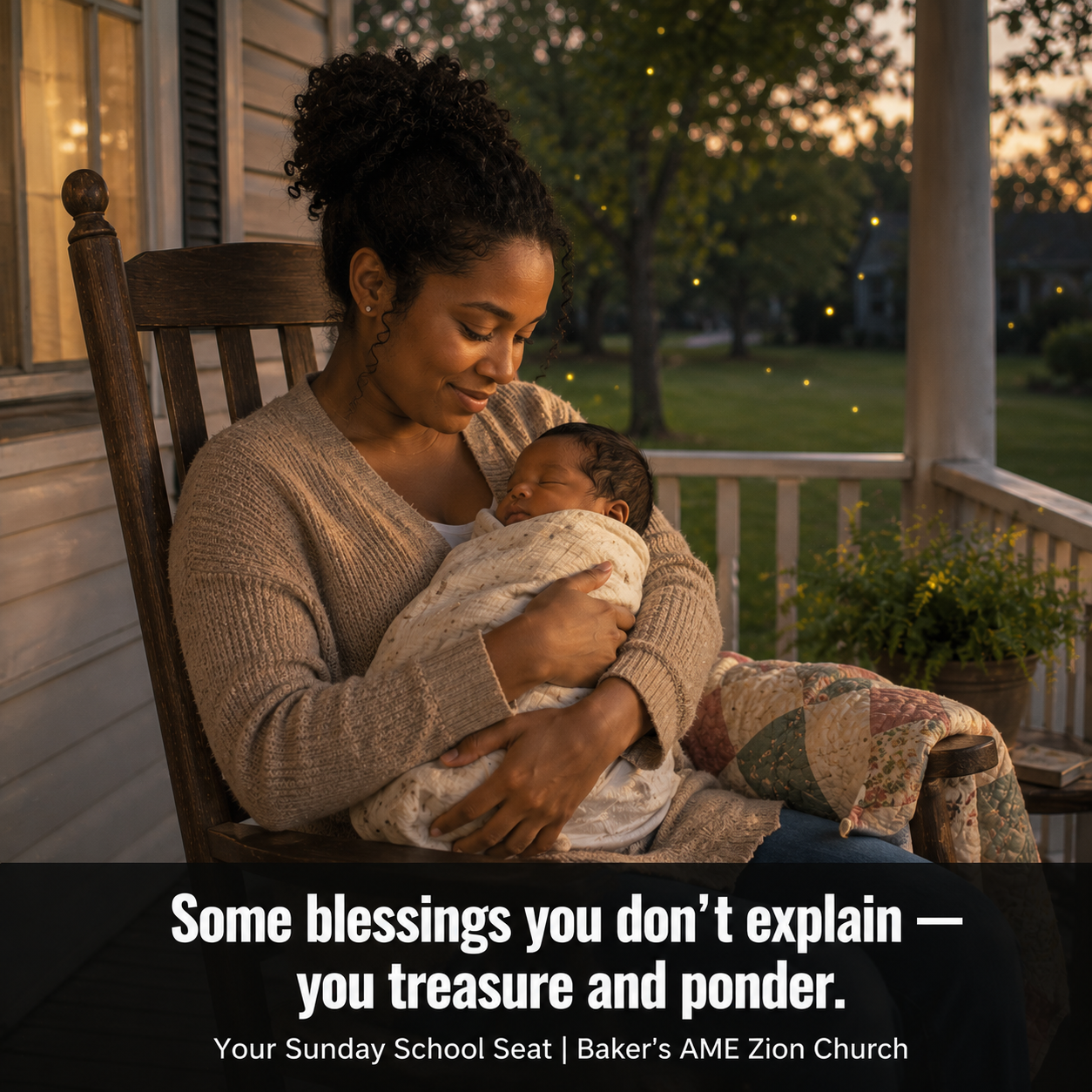
The shepherds burst in loud and breathless, telling everybody what they'd seen. Mary got quiet. Sometimes the deepest response to a blessing isn't a shout — it's a heart that holds on.
Luke 2:15-19 — KJV 15 And it came to pass, as the angels were gone away from them into heaven, the shepherds said one to another, Let us now go even unto Bethlehem, and see this thing which is come to pass, which the Lord hath made known unto us. 16 And they came with haste, and found Mary, and Joseph, and the babe lying in a manger. 17 And when they had seen it, they made known abroad the saying which was told them concerning this child. 18 And all they that heard it wondered at those things which were told them by the shepherds. 19 But Mary kept all these things, and pondered them in her heart.
Luke 2:15-19 — WEB 15 When the angels went away from them into the sky, the shepherds said to one another, "Let's go to Bethlehem, now, and see this thing that has happened, which the Lord has made known to us." 16 They came with haste and found both Mary and Joseph, and the baby was lying in the feeding trough. 17 When they saw it, they publicized widely the saying which was spoken to them about this child. 18 All who heard it wondered at the things which were spoken to them by the shepherds. 19 But Mary kept all these sayings, pondering them in her heart.
Explanation
The scene is loud. Shepherds — night-shift workers, the kind of people nobody expected God to send an announcement to — come running into Bethlehem, having just been serenaded by an army of angels. They find the baby exactly where they were told, and they can't stop talking about it. Verse 17 says they "made known abroad" what they'd heard; verse 18 says everyone who heard it "wondered." It's a room full of amazement and noise.
And then there's Mary in verse 19, doing something completely different. While everybody else is broadcasting, she is keeping. "Mary kept all these things, and pondered them in her heart." The word for "kept" carries the idea of treasuring, guarding, holding something precious. The word for "pondered" means to put things together, to turn them over, to work out what they mean. She's not performing her blessing. She's absorbing it.
There's real wisdom here for us. We live in the age of the shepherds — everything gets published, posted, shared, announced. The instinct when something good happens is to reach for the phone and tell the world. And there's nothing wrong with testifying; the shepherds were right to spread the word. But Mary shows us another spiritual muscle we've almost let go: the ability to hold something sacred quietly, to sit with what God is doing instead of immediately turning it into content.
This ties into Sunday's lesson about living with what you didn't ask for. Mary's life was already unusual and hard — the whispers, the strange circumstances, the road to Bethlehem while nine months pregnant. She couldn't understand all of it yet. So she did the wise thing: she gathered up the pieces she didn't understand and treasured them, trusting that meaning would come with time. Pondering is what you do when you believe God is up to something you can't fully see yet.
Some of you are carrying things right now that you can't explain and shouldn't post. A prayer that got answered in a way too personal to share. A hard season you're still making sense of. A quiet nudge from God you're not ready to announce. Take a page from Mary. Not everything sacred needs an audience. Some blessings you don't explain — you treasure them, you turn them over in your heart, and you let God make the meaning clear in His time. Keep some things for the quiet. That's not hiding your light; that's guarding your treasure.
Thought for the Day Some blessings you don't explain — you treasure and ponder.
Reflection Question What is God doing in your life right now that you should treasure quietly instead of rushing to explain?
Prayer Father, in a world that shares everything, teach us to treasure some things. Give us Mary's quiet heart — able to hold what we don't yet understand and trust You with the meaning. Slow us down enough to ponder what You're doing. Thank You for blessings too sacred for the noise. Amen.
This week we walk toward Sunday's lesson: Mary, The Mother of Jesus.
Thursday, July 23 — Yes Before You Understand
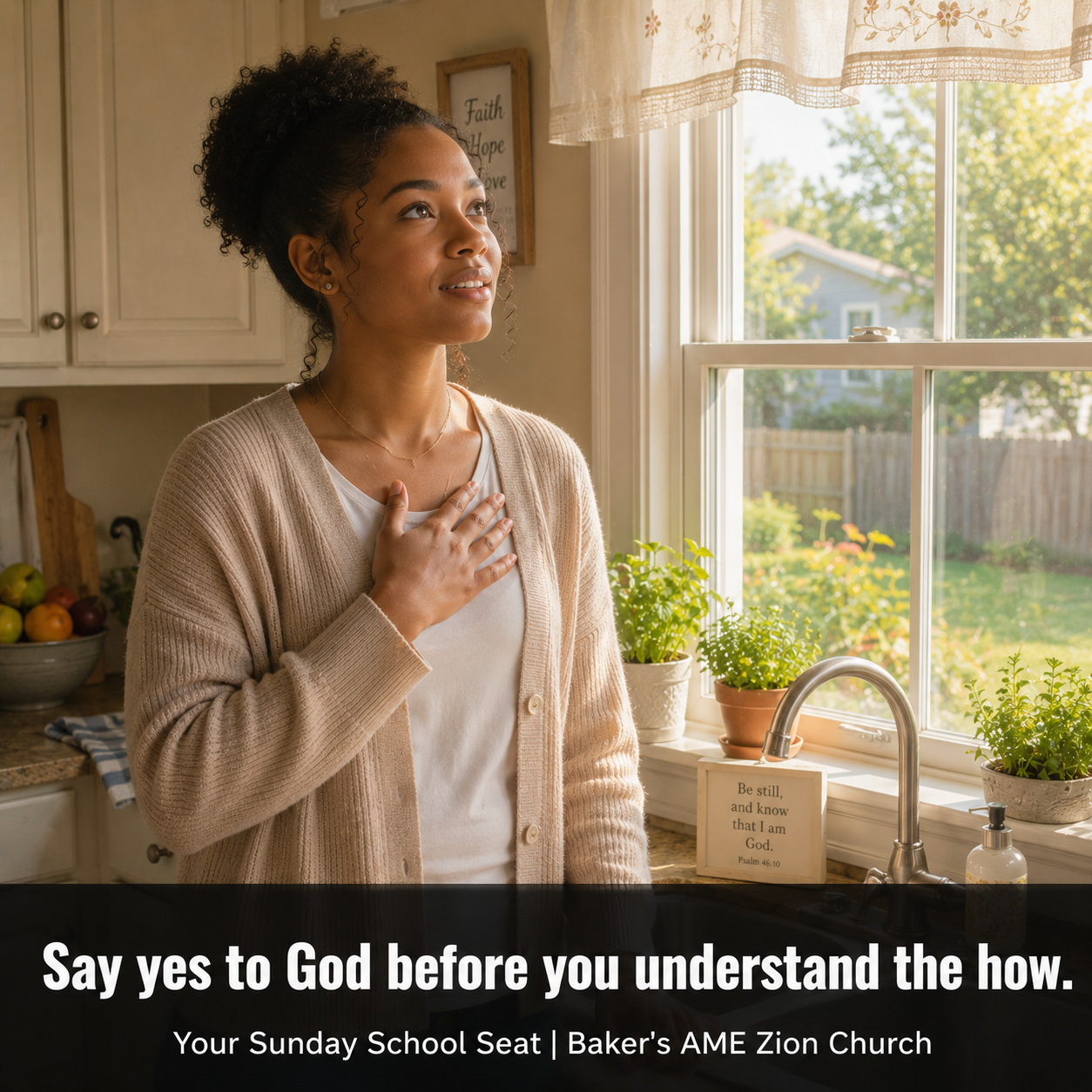
An angel shows up in a small town and tells a teenage girl her whole life is about to change in a way she never asked for. What she says next is one of the bravest sentences in the Bible.
Luke 1:26-38 — KJV 26 And in the sixth month the angel Gabriel was sent from God unto a city of Galilee, named Nazareth, 27 To a virgin espoused to a man whose name was Joseph, of the house of David; and the virgin's name was Mary. 28 And the angel came in unto her, and said, Hail, thou that art highly favoured, the Lord is with thee: blessed art thou among women. 29 And when she saw him, she was troubled at his saying, and cast in her mind what manner of salutation this should be. 30 And the angel said unto her, Fear not, Mary: for thou hast found favour with God. 31 And, behold, thou shalt conceive in thy womb, and bring forth a son, and shalt call his name JESUS. 32 He shall be great, and shall be called the Son of the Highest: and the Lord God shall give unto him the throne of his father David: 33 And he shall reign over the house of Jacob for ever; and of his kingdom there shall be no end. 34 Then said Mary unto the angel, How shall this be, seeing I know not a man? 35 And the angel answered and said unto her, The Holy Ghost shall come upon thee, and the power of the Highest shall overshadow thee: therefore also that holy thing which shall be born of thee shall be called the Son of God. 36 And, behold, thy cousin Elisabeth, she hath also conceived a son in her old age: and this is the sixth month with her, who was called barren. 37 For with God nothing shall be impossible. 38 And Mary said, Behold the handmaid of the Lord; be it unto me according to thy word. And the angel departed from her.
Luke 1:26-38 — WEB 26 Now in the sixth month, the angel Gabriel was sent from God to a city of Galilee, named Nazareth, 27 to a virgin pledged to be married to a man whose name was Joseph, of David's house. The virgin's name was Mary. 28 Having come in, the angel said to her, "Rejoice, you highly favored one! The Lord is with you. Blessed are you among women!" 29 But when she saw him, she was greatly troubled at the saying, and considered what kind of salutation this might be. 30 The angel said to her, "Don't be afraid, Mary, for you have found favor with God. 31 Behold, you will conceive in your womb and give birth to a son, and shall name him 'Jesus.' 32 He will be great and will be called the Son of the Most High. The Lord God will give him the throne of his father David, 33 and he will reign over the house of Jacob forever. There will be no end to his kingdom." 34 Mary said to the angel, "How can this be, seeing I am a virgin?" 35 The angel answered her, "The Holy Spirit will come on you, and the power of the Most High will overshadow you. Therefore also the holy one who is born from you will be called the Son of God. 36 Behold, Elizabeth your relative also has conceived a son in her old age; and this is the sixth month with her who was called barren. 37 For nothing spoken by God is impossible." 38 Mary said, "Behold, the servant of the Lord; let it be done to me according to your word." Then the angel departed from her.
Explanation
Mary was probably a teenager, engaged but not yet married, living in a town so unremarkable people joked about it. She had a plan: marry Joseph, build a quiet life. Then Gabriel walks in and hands her a future she never requested — one that could cost her that engagement, her reputation, maybe her safety. An unmarried pregnancy in that world was not a minor complication.
Watch how she responds, because it's a model of honest faith. First she's troubled — she doesn't fake calm. Then she asks a real question: "How shall this be?" That's not doubt; that's a thoughtful person trying to understand. Gabriel answers not with a full explanation but with a reminder of who God is: the Holy Spirit will handle what you can't, and "with God nothing shall be impossible." And then Mary says it: "Be it unto me according to thy word."
Sit with what that sentence costs. She says yes before she understands how it will work. She doesn't wait for the mechanics to make sense or for the risks to disappear. She hears the character of God, trusts it, and surrenders. This is the heart of Sunday's lesson — living with what you didn't ask for. Mary didn't ask to be the mother of the Messiah. It wasn't on her vision board. But when God asked, she made room in her life for a plan bigger than her own.
Here's where it meets you. Some of the most defining things in your life are things you never asked for. The child with extra needs. The job loss that redirected everything. The caregiving role that landed on you. The calling you'd have skipped if given the choice. We don't get to script our lives the way we think we will. But we do get to decide how we answer when God says, "This is yours now."
Mary shows us the answer doesn't require having it all figured out. It requires trusting the One doing the asking. You can be troubled and still say yes. You can have questions and still surrender. Faith isn't the absence of "how" — it's saying "be it unto me" before the "how" is clear. What's your unasked-for assignment? And can you trust God's character enough to say yes to it today?
Thought for the Day Say yes to God before you understand the how.
Reflection Question What has God placed in your life that you didn't ask for — and what would saying "yes" to it look like?
Prayer Lord, we admit we like to understand before we obey. Give us Mary's courage to say yes to You before the "how" makes sense. When life hands us what we didn't choose, help us trust Your character enough to make room for Your plan. Be it unto us according to Your word. Amen.
This week we walk toward Sunday's lesson: Mary, The Mother of Jesus.
Wednesday, July 22 — Falling in Love with the Word
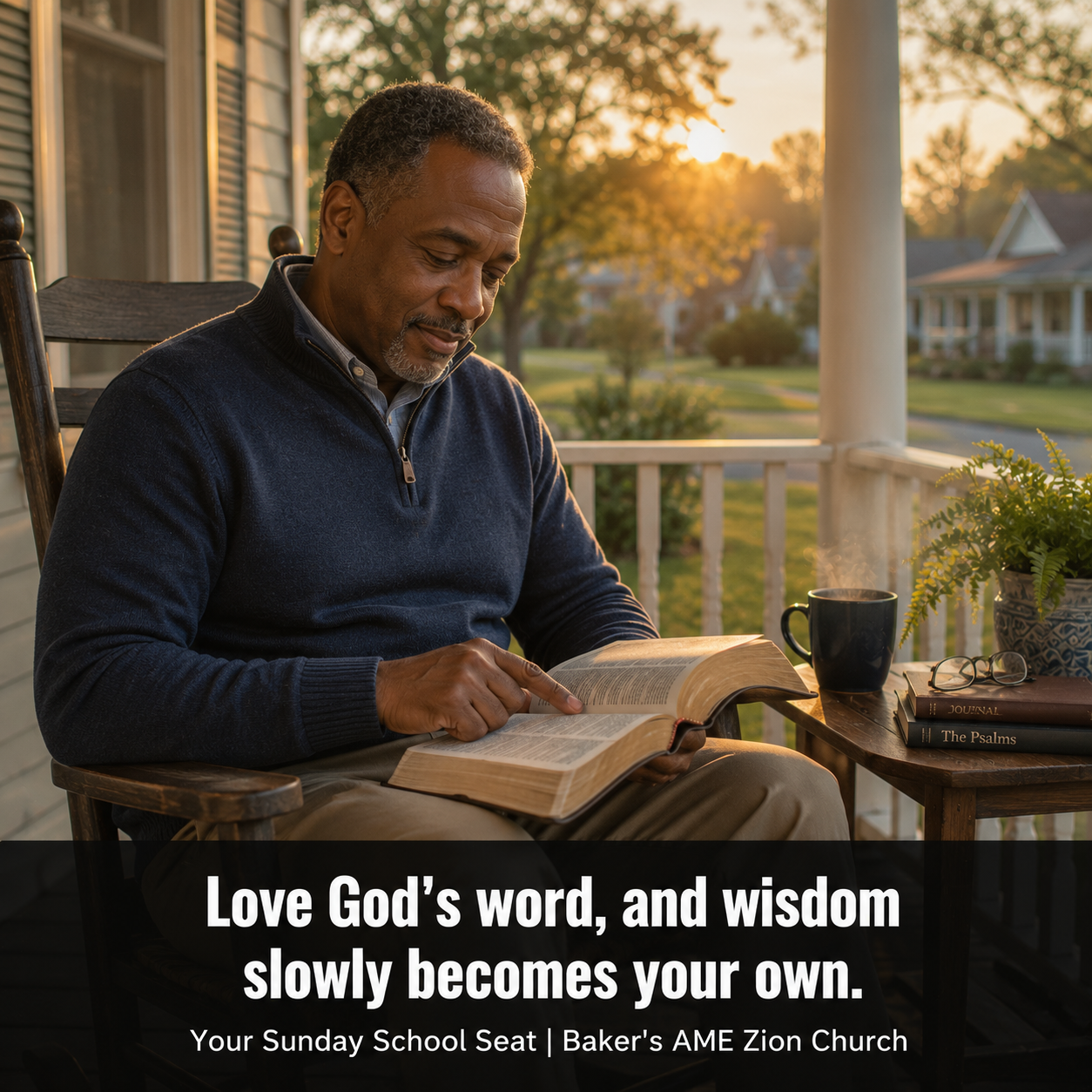
Some people read the Bible like they're paying a bill — get it done, check it off. The writer of Psalm 119 read it like a love letter he couldn't put down.
Psalm 119:97-104 — KJV 97 O how love I thy law! it is my meditation all the day. 98 Thou through thy commandments hast made me wiser than mine enemies: for they are ever with me. 99 I have more understanding than all my teachers: for thy testimonies are my meditation. 100 I understand more than the ancients, because I keep thy precepts. 101 I have refrained my feet from every evil way, that I might keep thy word. 102 I have not departed from thy judgments: for thou hast taught me. 103 How sweet are thy words unto my taste! yea, sweeter than honey to my mouth! 104 Through thy precepts I get understanding: therefore I hate every false way.
Psalm 119:97-104 — WEB 97 How I love your law! It is my meditation all day. 98 Your commandments make me wiser than my enemies, for your commandments are always with me. 99 I have more understanding than all my teachers, for your testimonies are my meditation. 100 I understand more than the aged, because I have kept your precepts. 101 I have kept my feet from every evil way, that I might observe your word. 102 I have not turned aside from your ordinances, for you have taught me. 103 How sweet are your promises to my taste, more than honey to my mouth! 104 Through your precepts, I get understanding; therefore I hate every false way.
Explanation
Psalm 119 is the longest chapter in the Bible, and almost every single verse is about one thing: God's word. This little section sits right in the heart of it, and it reads like a man who has discovered that Scripture isn't a rulebook to endure but a treasure to savor. "O how love I thy law," he says — not "how I tolerate," not "how I obey when I have to," but how I love.
Notice the claim he makes. He says God's word made him wiser than his enemies, gave him more understanding than his teachers, more insight than the elders. That's not arrogance. He's crediting all of it to meditation — turning God's word over in his mind "all the day," the way you keep returning to a good conversation or a song stuck in your head. Wisdom didn't come from being smarter than everybody. It came from staying close to the source.
And there's a link between loving the word and living it. Verse 101: "I have refrained my feet from every evil way, that I might keep thy word." Love for Scripture kept his feet out of trouble. When you truly delight in something, you naturally guard it. His obedience wasn't grim willpower; it flowed from affection.
So why put this psalm in a week about Mary? Because this is exactly the soil Mary grew in. When the angel came, Mary answered with Scripture on her lips. Her song — the Magnificat — is stitched together from the Old Testament she clearly loved and pondered. Mary could say yes to God's word so quickly because she had been meditating on God's word all along. The habits of Wednesday made possible the surrender of Thursday.
Here's the honest application. Most of us don't struggle to believe the Bible is important; we struggle to make it sweet. It competes with the phone, the news, the endless scroll — and honey doesn't stand a chance against a screen that's engineered to hook us. But the psalmist isn't describing a marathon reading plan. He's describing meditation: carrying one verse into your commute, chewing on it at the sink, letting it sit with you at a red light. You don't have to read more to love it more. You have to linger. Pick one verse this week and carry it around all day like a sweet you're in no hurry to finish. That's how the word gets from your eyes down into your feet.
Thought for the Day Love God's word, and wisdom slowly becomes your own.
Reflection Question What one verse could you carry with you all day this week until it turns sweet?
Prayer Father, forgive us for treating Your word like a chore when You meant it as a feast. Give us a fresh love for Scripture — sweeter than honey, steadier than our habits. Teach us to linger over it until it changes the direction of our feet. Make it our meditation all the day. Amen.
This week we walk toward Sunday's lesson: Mary, The Mother of Jesus.
Tuesday, July 21 — Who Counts as Family
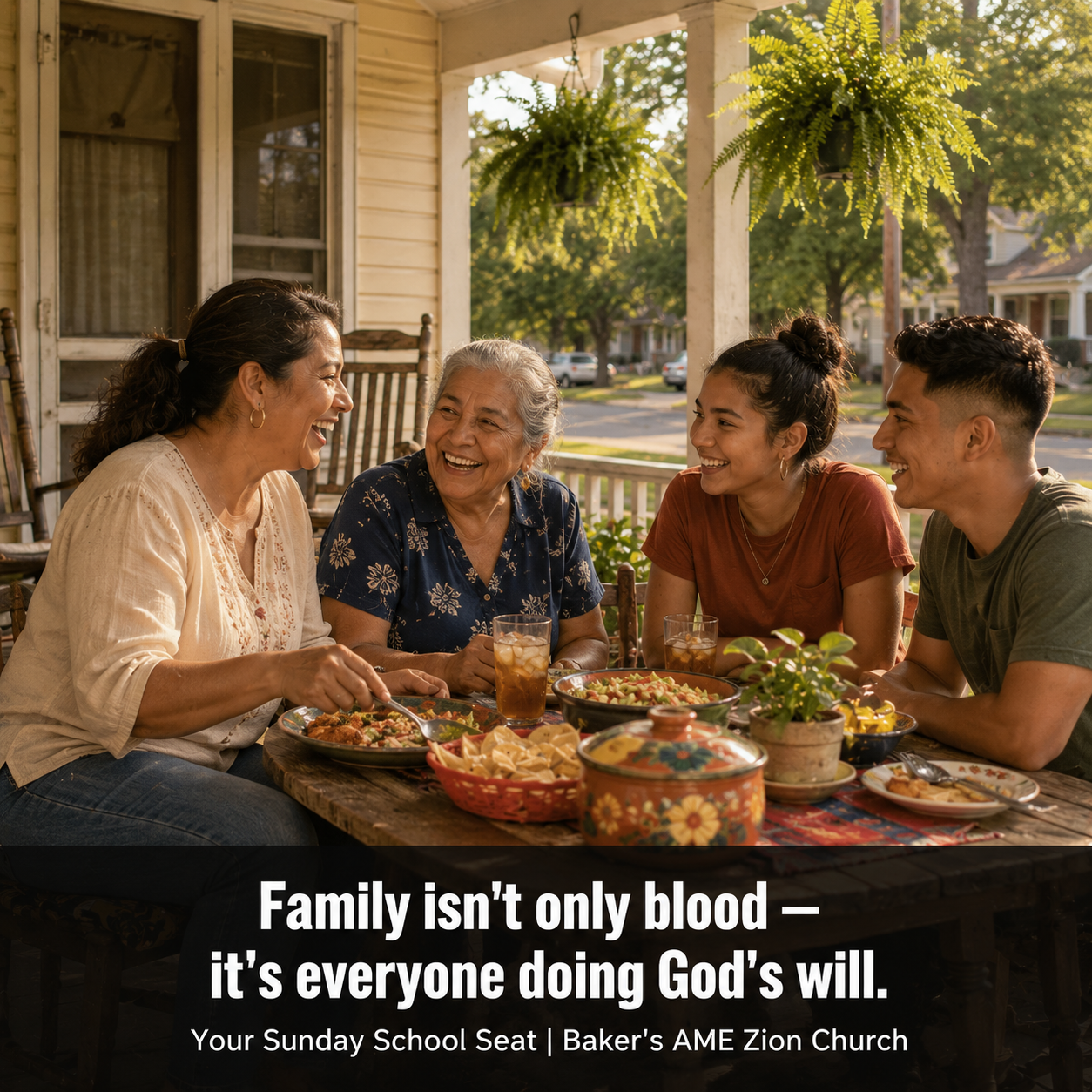
Jesus was preaching to a packed house when someone tapped Him on the shoulder, so to speak, and said, "Your family's outside." What He said back changed who gets to be called family.
Mark 3:31-35 — KJV 31 There came then his brethren and his mother, and, standing without, sent unto him, calling him. 32 And the multitude sat about him, and they said unto him, Behold, thy mother and thy brethren without seek for thee. 33 And he answered them, saying, Who is my mother, or my brethren? 34 And he looked round about on them which sat about him, and said, Behold my mother and my brethren! 35 For whosoever shall do the will of God, the same is my brother, and my sister, and mother.
Luke 11:27-28 — KJV 27 And it came to pass, as he spake these things, a certain woman of the company lifted up her voice, and said unto him, Blessed is the womb that bare thee, and the paps which thou hast sucked. 28 But he said, Yea rather, blessed are they that hear the word of God, and keep it.
Mark 3:31-35 — WEB 31 His mother and his brothers came, and standing outside, they sent to him, calling him. 32 A multitude was sitting around him, and they told him, "Behold, your mother, your brothers, and your sisters are outside looking for you." 33 He answered them, "Who are my mother and my brothers?" 34 Looking around at those who sat around him, he said, "Behold, my mother and my brothers! 35 For whoever does the will of God is my brother, my sister, and mother."
Luke 11:27-28 — WEB 27 It came to pass, as he said these things, a certain woman out of the multitude lifted up her voice, and said to him, "Blessed is the womb that bore you, and the breasts which nursed you!" 28 But he said, "On the contrary, blessed are those who hear the word of God, and keep it."
Explanation
At first glance these verses look like Jesus brushing off His own mother, and that can sit uncomfortably — especially in a week where we're honoring Mary. But look closer. Jesus isn't demoting Mary; He's expanding the definition of family so wide that people who felt like outsiders suddenly belong. And here's the beautiful part: by His own standard, Mary makes the cut better than anyone. Who did the will of God more faithfully than the woman who said, "Be it unto me according to thy word"?
In Mark, the crowd points to His biological relatives waiting outside. Jesus looks around the room — at fishermen, tax collectors, ordinary people leaning in to hear — and says these are my mother and my brothers, because whoever does the will of God is family. In the ancient world, where your bloodline decided your worth and your future, that was a radical reordering. He was saying the family of God is built not on genetics but on obedience and love.
Luke sharpens it. A woman shouts a blessing over Mary's body — essentially, "How lucky your mother is!" Jesus gently redirects: even more blessed are those who hear God's word and keep it. He's not diminishing Mary. He's telling that woman, and us, that the blessing everyone envies in Mary is available to anyone who will hear and obey.
This connects straight to Sunday. We tend to think Mary was blessed because of a one-time biological miracle. But Scripture keeps insisting she was blessed because she heard God's word and kept it — day after day, year after year, all the way to the cross. That's a blessing you and I can share.
Think about your own kitchen table. Some of the people who feel most like family to you don't share your last name — the church mother who checks on you, the coworker who prayed you through the hard year, the friend who shows up when blood relatives don't. And maybe some who do share your blood feel far away. Jesus isn't dismissing your family; He's telling you the household of God has room at the table for everyone willing to do the Father's will. If you've ever felt like you were standing outside, listen: doing God's will is the doorway in. You already belong.
Thought for the Day Family isn't only blood — it's everyone doing God's will.
Reflection Question Who has been family to you in the household of God, and have you told them lately?
Prayer Lord, thank You that Your family has room for us. When we feel like outsiders, remind us that the door in is simply doing Your will. Make us the kind of family to others that we've needed ourselves — present, faithful, and warm. Help us hear Your word and actually keep it. Amen.
This week we walk toward Sunday's lesson: Mary, The Mother of Jesus.
Monday, July 20 — The Promise Inside the Curse
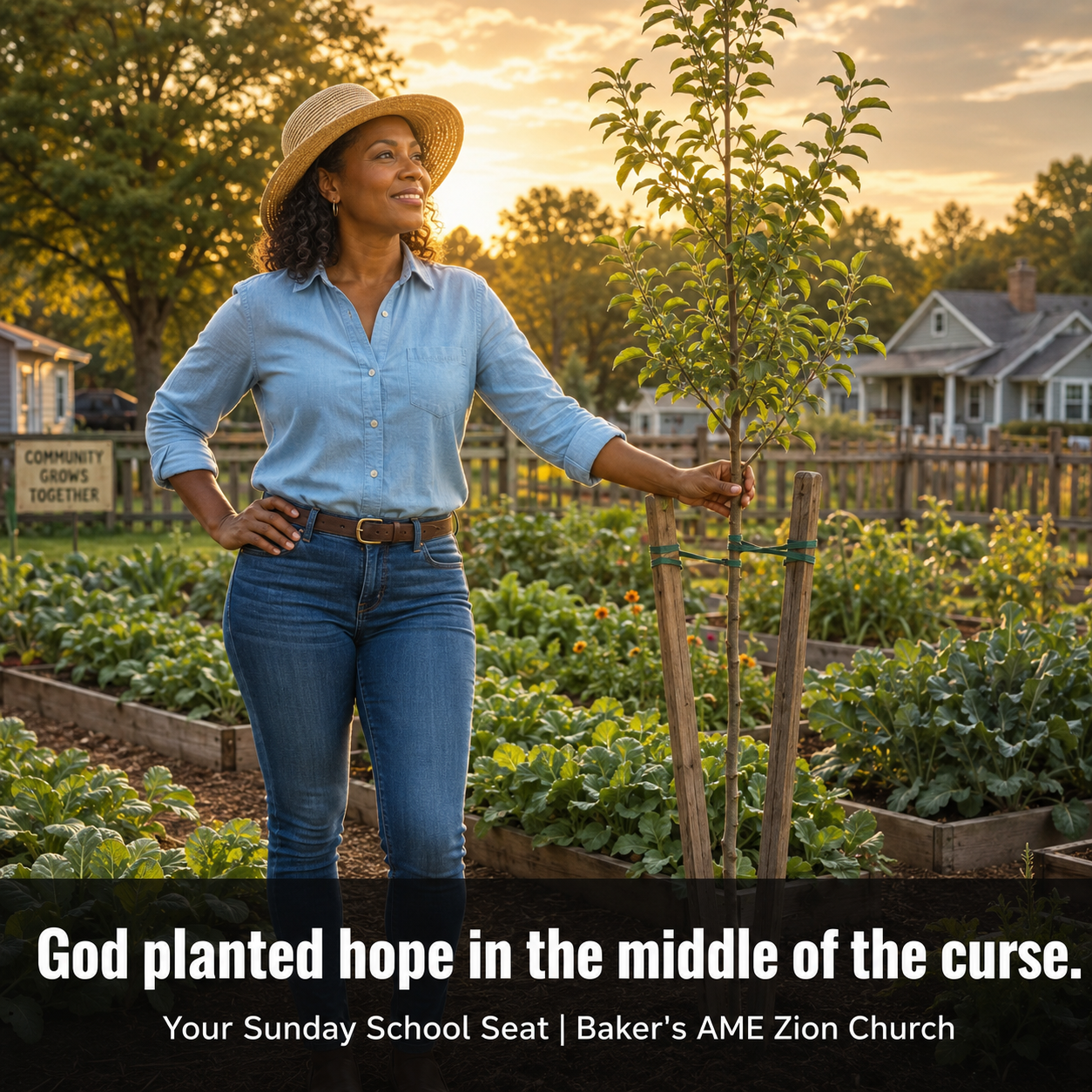
There is a moment in the worst chapter of the Bible where God, in the middle of handing out consequences, quietly slips in a promise. Blink and you'll miss it.
Genesis 3:14-20 — KJV 14 And the LORD God said unto the serpent, Because thou hast done this, thou art cursed above all cattle, and above every beast of the field; upon thy belly shalt thou go, and dust shalt thou eat all the days of thy life: 15 And I will put enmity between thee and the woman, and between thy seed and her seed; it shall bruise thy head, and thou shalt bruise his heel. 16 Unto the woman he said, I will greatly multiply thy sorrow and thy conception; in sorrow thou shalt bring forth children; and thy desire shall be to thy husband, and he shall rule over thee. 17 And unto Adam he said, Because thou hast hearkened unto the voice of thy wife, and hast eaten of the tree, of which I commanded thee, saying, Thou shalt not eat of it: cursed is the ground for thy sake; in sorrow shalt thou eat of it all the days of thy life; 18 Thorns also and thistles shall it bring forth to thee; and thou shalt eat the herb of the field; 19 In the sweat of thy face shalt thou eat bread, till thou return unto the ground; for out of it wast thou taken: for dust thou art, and unto dust shalt thou return. 20 And Adam called his wife's name Eve; because she was the mother of all living.
Genesis 3:14-20 — WEB 14 Yahweh God said to the serpent, "Because you have done this, you are cursed above all livestock, and above every animal of the field. You shall go on your belly and you shall eat dust all the days of your life. 15 I will put hostility between you and the woman, and between your offspring and her offspring. He will bruise your head, and you will bruise his heel." 16 To the woman he said, "I will greatly multiply your pain in childbirth. You will bear children in pain. Your desire will be for your husband, and he will rule over you." 17 To Adam he said, "Because you have listened to your wife's voice, and have eaten from the tree, about which I commanded you, saying, 'You shall not eat of it,' the ground is cursed for your sake. You will eat from it with much labor all the days of your life. 18 It will yield thorns and thistles to you; and you will eat the herb of the field. 19 By the sweat of your face you will eat bread until you return to the ground, for you were taken out of it. For you are dust, and you shall return to dust." 20 The man called his wife Eve, because she would be the mother of all living.
Explanation
This is the aftermath of the garden — the day everything broke. The man and woman have eaten what they were told to leave alone, and now God speaks the consequences plainly. The serpent is cursed. The ground is cursed. Childbearing will come with pain, work will come with sweat, and every human story will now end the same way: dust to dust. It's a heavy passage, and it's honest about how much this world hurts.
But sitting right in the middle of that hard word is verse 15, the verse theologians have called the first gospel. God tells the serpent there will be enmity between his offspring and the woman's offspring, and that one of her descendants will crush his head even while being wounded in the heel. In the very hour humanity falls, God announces a rescue plan and He runs it through a woman's child. Before there is a Mary, before there is a manger, there is a promise attached to "her seed."
That's why our week begins here. This whole week walks toward Sunday's lesson on Mary, and the road actually starts in Genesis. The woman whose child would one day crush evil's head is first hinted at on the worst day in human history. God does not wait for good conditions to make good promises. He plants hope in cursed ground.
Notice too what Adam does in verse 20. Standing under the weight of everything he just lost, he names his wife Eve — "living" — because she would be the mother of all who live. That's a stubborn act of faith. He heard the promise, and he named the future after it.
You know something about promises made in hard seasons. Maybe you got the diagnosis and still signed up for the class. Maybe money was tight and you still tithed. Maybe the marriage was strained and you still showed up to counseling. Naming Eve "living" in a world that just learned about death is exactly the kind of quiet, forward-leaning hope God keeps asking of us. The curse is real — bills, thorns, sweat, grief. But so is the promise. And the promise gets the last word.
Thought for the Day God planted hope in the middle of the curse.
Reflection Question Where in your hardest season right now could you name something "living" — an act of hope in cursed-feeling ground?
Prayer Father, we don't pretend this world doesn't hurt. We feel the thorns and the sweat and the losses. But thank You that even on the worst day, You spoke a promise we could hold. Help us live like people who believe the promise outlasts the curse. In the name of the One who crushed the serpent's head, amen.
This week we walk toward Sunday's lesson: Mary, The Mother of Jesus.
July 20 - 26, 2026: What You Didn’t Ask For
This week on Your Sunday School Seat, we spend seven days with Mary, the mother of Jesus — and discover that her story of living with what she didn't ask for starts long before the manger. From a promise hidden in the garden of Genesis to a wedding in Cana, we trace how one faithful woman kept saying yes to God and kept pointing others to her Son. It all builds toward Sunday's lesson, "Mary, The Mother of Jesus." Watch along, then come join us for Sunday school as we learn from the woman who trusted God before she understood the how.
Monday — The Woman and Her Offspring (Genesis 3:14-20) Tuesday — Doing the Will of God (Mark 3:31-35; Luke 11:27-28) Wednesday — Meditating on God's Law (Psalm 119:97-104) Thursday — Mary Affirms God's Will (Luke 1:26-38) Friday — Mary Contemplates What God Has Done (Luke 2:15-19) Saturday — Rejoice in the Newborn King (Isaiah 9:3-7) Sunday — Mary Points Others to Jesus (John 2:1-5)
Your Sunday School Seat | Baker's AME Zion Church — We Save You a Seat
#YourSundaySchoolSeat #AMEZion #DailyDevotional #Faith #BlackChurch #Mary
Sunday, July 19 — Salvation Climbs Down From the Tree
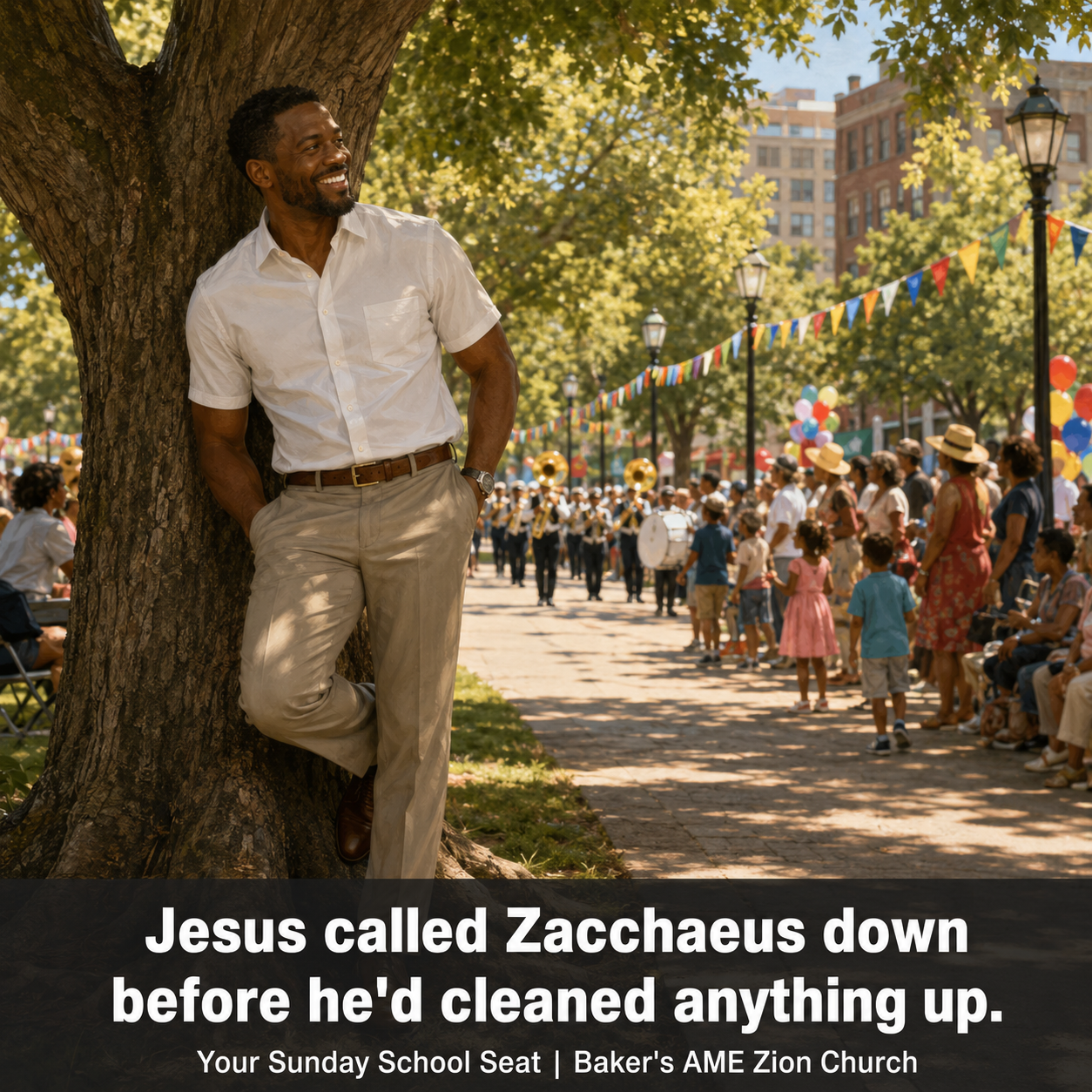
A short man climbs a tree to catch one glimpse of Jesus. He ends up hosting Jesus at his own kitchen table instead.
Luke 19:1-10 — KJV
1 And Jesus entered and passed through Jericho. 2 And, behold, there was a man named Zacchaeus, which was the chief among the publicans, and he was rich. 3 And he sought to see Jesus who he was; and could not for the press, because he was little of stature. 4 And he ran before, and climbed up into a sycomore tree to see him: for he was to pass that way. 5 And when Jesus came to the place, he looked up, and saw him, and said unto him, Zacchaeus, make haste, and come down; for to day I must abide at thy house. 6 And he made haste, and came down, and received him joyfully. 7 And when they saw it, they all murmured, saying, That he was gone to be guest with a man that is a sinner. 8 And Zacchaeus stood, and said unto the Lord; Behold, Lord, the half of my goods I give to the poor; and if I have taken any thing from any man by false accusation, I restore him fourfold. 9 And Jesus said unto him, This day is salvation come to this house, forsomuch as he also is a son of Abraham. 10 For the Son of man is come to seek and to save that which was lost.
Luke 19:1-10 — WEB
1 He entered and was passing through Jericho. 2 There was a man named Zacchaeus. He was a chief tax collector, and he was rich. 3 He was trying to see who Jesus was, and couldn't because of the crowd, because he was short. 4 He ran on ahead, and climbed up into a sycamore tree to see him, for he was going to pass that way. 5 When Jesus came to the place, he looked up and saw him, and said to him, "Zacchaeus, hurry and come down, for today I must stay at your house." 6 He hurried, came down, and received him joyfully. 7 When they saw it, they all murmured, saying, "He has gone in to lodge with a man who is a sinner." 8 Zacchaeus stood and said to the Lord, "Behold, Lord, half of my goods I give to the poor. If I have wrongfully exacted anything of anyone, I restore four times as much." 9 Jesus said to him, "Today, salvation has come to this house, because he also is a son of Abraham. 10 For the Son of Man came to seek and to save that which was lost."
Explanation
Jericho sat on a major trade route, which made it a lucrative posting for a chief tax collector — Zacchaeus wasn't just any publican, he oversaw others, and his wealth reflected years of a system that let Rome's collectors overcharge and pocket the difference, with no real accountability to the people they taxed. That made him doubly hated: a collaborator with the occupying empire, and personally rich off his own people's pockets. Luke tells us he was "little of stature," a small physical detail that becomes the hinge of the whole story — the powerful, wealthy man is, in this one moment, too small to see over the crowd, and has to do something undignified about it. He runs ahead of everyone else in town and climbs a tree like a child.
Jesus does something that would have stunned everyone watching: he stops, looks up, and invites himself to dinner. Not "if you'd have me" — "I must abide at thy house." The crowd's reaction (murmuring that Jesus would lodge with "a man that is a sinner") tells us exactly how the town felt about Zacchaeus. And Zacchaeus's response tells us exactly what real encounter with Jesus does to a person: he doesn't just say thank you, he restructures his entire financial life on the spot — half his goods to the poor, fourfold restitution for anyone he's cheated.
This is the destination our whole week has been walking toward. Monday's restitution law, Tuesday's true fast that breaks yokes, Wednesday's warning to the rich and blessing on the poor, Thursday's hospitality to the stranger who turns out to matter more than expected, Friday's love proven in deed, Saturday's righteous giver instead of the wicked hoarder — every single thread of this week converges in one man, in one tree, on one afternoon in Jericho. Zacchaeus doesn't just hear a sermon. He becomes, in real time, everything this week has been describing.
And that's the invitation for us too. Jesus doesn't wait for Zacchaeus to clean up his finances, apologize to everyone he'd cheated, or become respectable before showing up at his house. He calls him down first. The change follows the encounter; it doesn't precede it. Whatever tree you've climbed just to catch a glimpse of Jesus from a safe distance — he's already looking up at you, and he's already inviting himself in. You don't have to have it together to come down. You just have to come down.
Thought for the Day
Jesus called Zacchaeus down before he'd cleaned anything up.
Reflection Question
What would it look like for you to come down from your tree today?
Prayer
Jesus, thank you for seeking me out before I had anything figured out. Like Zacchaeus, I want to come down from whatever safe distance I've been keeping and let you into my actual life — my finances, my relationships, my regrets. Come to my house today. I'm ready to receive you joyfully. Amen.
Today is Sunday school. We save you a seat.
Saturday, July 18 — Hold Loosely, Give Freely
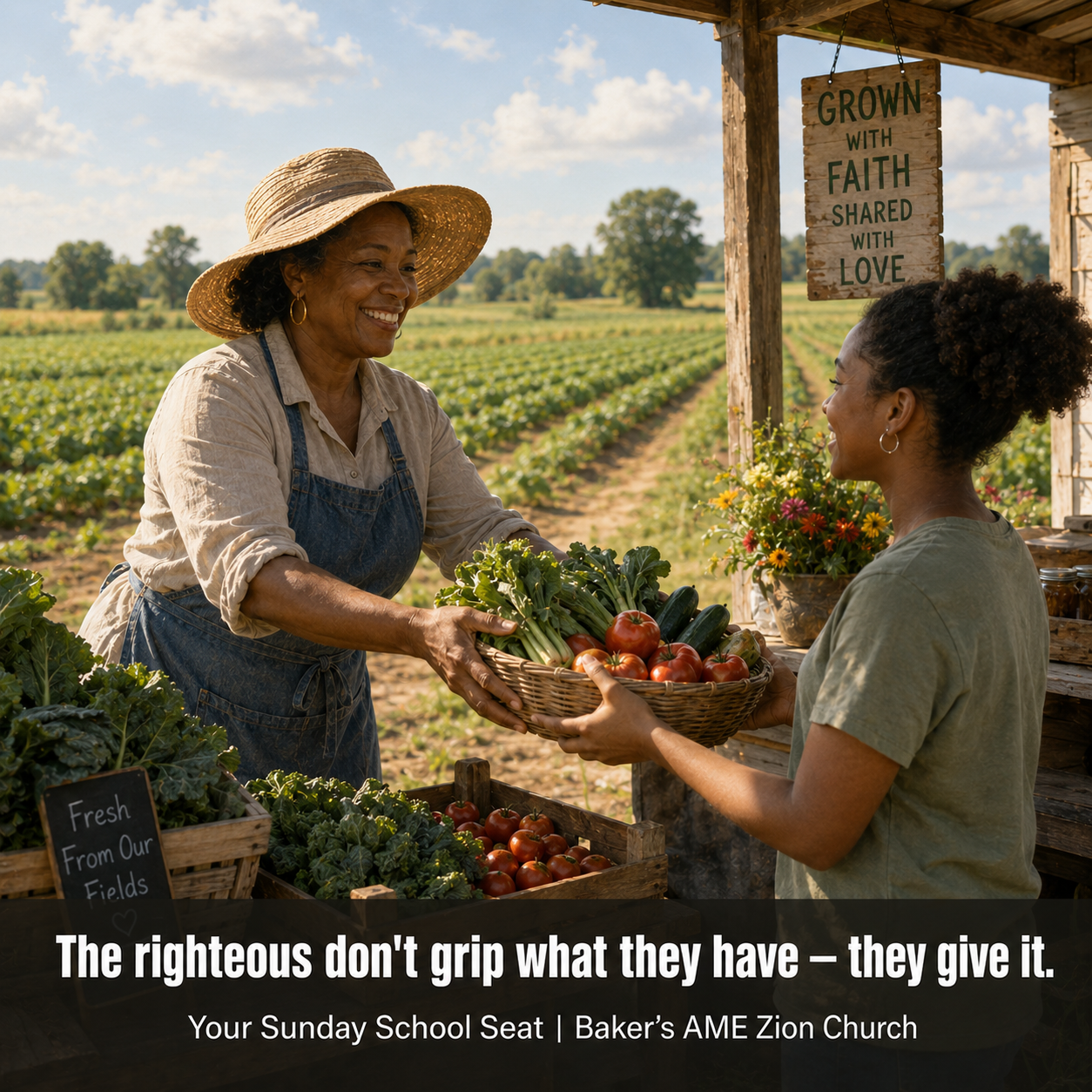
Stop counting what the dishonest have. This psalm says their whole pile is already evaporating.
Psalm 37:1-5, 18-22 — KJV
1 Fret not thyself because of evildoers, neither be thou envious against the workers of iniquity. 2 For they shall soon be cut down like the grass, and wither as the green herb. 3 Trust in the LORD, and do good; so shalt thou dwell in the land, and verily thou shalt be fed. 4 Delight thyself also in the LORD; and he shall give thee the desires of thine heart. 5 Commit thy way unto the LORD; trust also in him; and he shall bring it to pass. 18 The LORD knoweth the days of the upright: and their inheritance shall be for ever. 19 They shall not be ashamed in the evil time: and in the days of famine they shall be satisfied. 20 But the wicked shall perish, and the enemies of the LORD shall be as the fat of lambs: they shall consume; into smoke shall they consume away. 21 The wicked borroweth, and payeth not again: but the righteous sheweth mercy, and giveth. 22 For such as be blessed of him shall inherit the earth; and they that be cursed of him shall be cut off.
Psalm 37:1-5, 18-22 — WEB
1 Don't fret because of evildoers, neither be envious against those who work unrighteousness. 2 For they shall soon be cut down like the grass, and wither like the green herb. 3 Trust in Yahweh, and do good. Dwell in the land, and enjoy safe pasture. 4 Also delight yourself in Yahweh, and he will give you the desires of your heart. 5 Commit your way to Yahweh. Trust also in him, and he will do this: 18 Yahweh knows the days of the perfect. Their inheritance shall be forever. 19 They shall not be disappointed in the time of evil. In the days of famine they shall be satisfied. 20 But the wicked shall perish. The enemies of Yahweh shall be like the beauty of the fields. They will vanish—vanish like smoke. 21 The wicked borrow, and don't pay back, but the righteous give generously. 22 For such as are blessed by him shall inherit the land. Those who are cursed by him shall be cut off.
Explanation
Psalm 37 is wisdom poetry, written by someone old enough to have watched a full lifetime of the wicked prospering and the righteous struggling — and old enough to have finally seen how it ends. "I have been young, and now am old," he says later in the psalm, "yet have I not seen the righteous forsaken." The opening command, "fret not," isn't naive positivity. It's the hard-won conclusion of decades of watching. Don't let the dishonest man's full barn make you anxious or envious, because his prosperity is grass — green today, cut down by evening.
The psalm's practical wisdom is simple: trust, delight, commit, and be still. And its clearest contrast between wicked and righteous comes right at the end of our reading: "the wicked borroweth, and payeth not again: but the righteous sheweth mercy, and giveth." Two different relationships to what you have. One holds on and still comes up short. One gives freely and somehow has enough.
Zacchaeus lived on the wicked side of that line for most of his career — a tax collector skimming off the top, a man who took and didn't give back, at least not the way this psalm defines righteousness. But the moment grace reaches him, he flips completely to the other column: "the half of my goods I give to the poor." Overnight, a man of the "borroweth and payeth not again" school becomes exactly the generous giver Psalm 37:21 describes. That's not just a nice coincidence — it's what happens whenever someone stops fretting over what everyone else is grabbing and starts trusting God enough to open his hands instead.
This is worth sitting with honestly: envy of other people's shortcuts, other people's under-the-table hustle, other people's "figured out how to work the system" prosperity, is exhausting and, this psalm insists, misplaced. It's grass. It's smoke. Meanwhile, the quieter path — trust, delight, commit, give — looks unglamorous right up until you realize you're the one still standing decades later.
This week, notice where you're fretting over someone else's dishonest gain instead of tending your own honest ground. And notice, too, where you're gripping something you could be giving. The psalm's promise isn't that generosity makes you rich. It's that generosity is what trust in God actually looks like with your hands open.
Thought for the Day
The righteous don't grip what they have — they give it.
Reflection Question
What are you gripping that trust in God would let you give?
Prayer
Lord, I confess how easily I fret over what other people seem to get away with. Teach me to trust you instead of envying them. Loosen my grip on what I'm holding too tightly, and make me a generous giver instead of an anxious keeper. Amen.
This week we walk toward Sunday's lesson: Zacchaeus, The Publican.
Friday, July 17 — Love With Hands and Feet
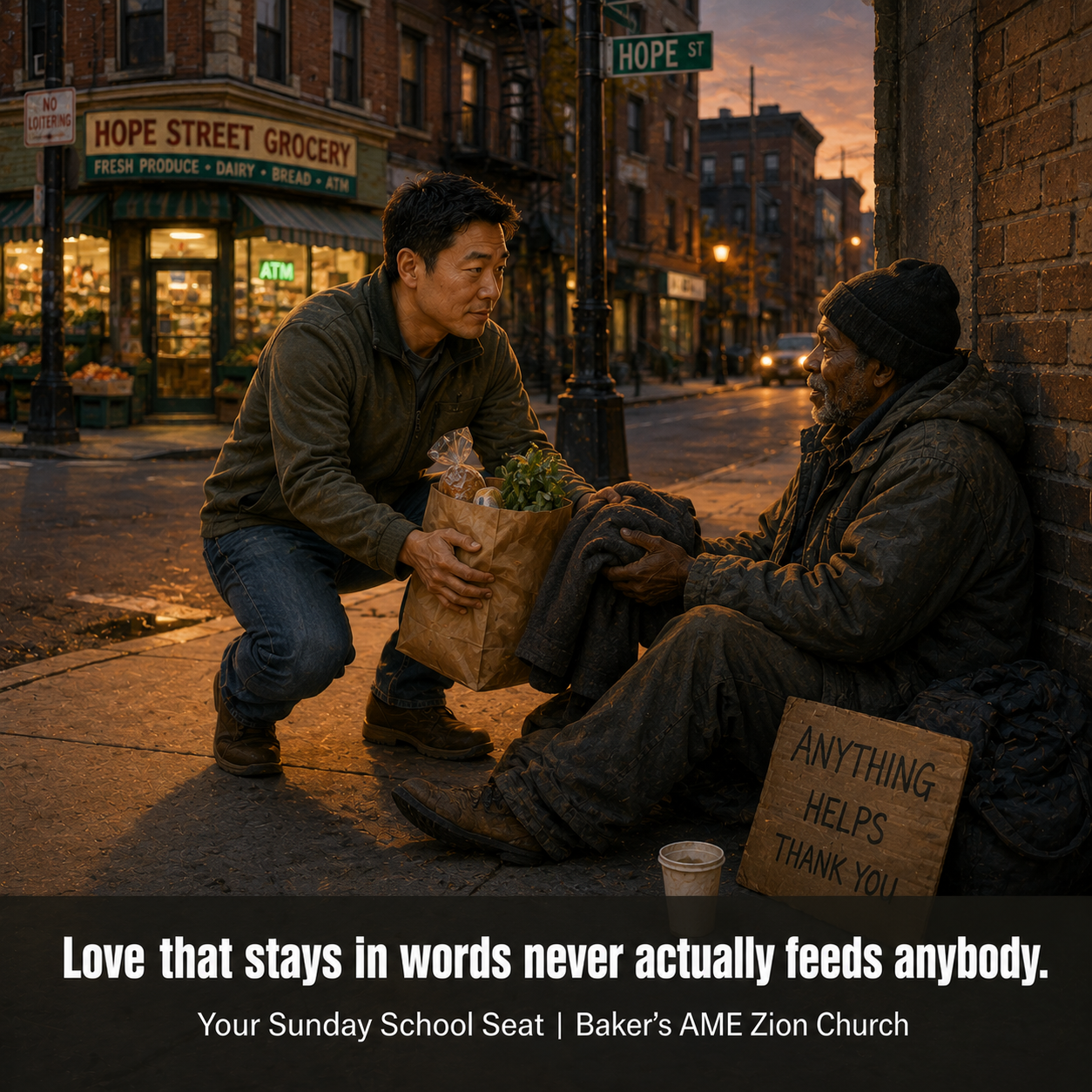
Anybody can say "I love you." John wants to know what your love has actually done lately.
1 John 3:14-18 — KJV
14 We know that we have passed from death unto life, because we love the brethren. He that loveth not his brother abideth in death. 15 Whosoever hateth his brother is a murderer: and ye know that no murderer hath eternal life abiding in him. 16 Hereby perceive we the love of God, because he laid down his life for us: and we ought to lay down our lives for the brethren. 17 But whoso hath this world's good, and seeth his brother have need, and shutteth up his bowels of compassion from him, how dwelleth the love of God in him? 18 My little children, let us not love in word, neither in tongue; but in deed and in truth.
1 John 3:14-18 — WEB
14 We know that we have passed out of death into life, because we love the brothers. He who doesn't love his brother remains in death. 15 Whoever hates his brother is a murderer, and you know that no murderer has eternal life remaining in him. 16 By this we know love, because he laid down his life for us. And we ought to lay down our lives for the brothers. 17 But whoever has the world's goods, and sees his brother in need, and closes his heart of compassion against him, how does God's love remain in him? 18 My little children, let's not love in word only, or with the tongue only, but in deed and truth.
Explanation
John writes this letter to a community wrestling with false teachers who claimed special spiritual knowledge while showing little concern for anyone around them. John's test for genuine faith is refreshingly unspiritual, in the best sense: love is proven in the direction of your wallet and your willingness to be inconvenienced, not in the sophistication of your beliefs. "We know that we have passed from death unto life, because we love the brethren" — assurance of salvation, tied directly to how you treat people.
Verse 17 gets specific and a little uncomfortable: if you have the world's goods, see a brother in need, and close your heart against him, how does God's love live in you? John doesn't ask whether you feel compassion. He asks whether your compassion opened your hand.
This is, again, Zacchaeus's whole story compressed into one verse. He had "this world's good" in abundance — wealth built, in part, on other people's needs going unmet. Salvation, when it reaches him, doesn't just change what he believes; it changes what his hands do the same afternoon. "The half of my goods I give to the poor." No committee meeting, no waiting for the "right time" — deed and truth, immediately, in front of witnesses. That's John's test passed in real time, days before John himself would have ever written it.
We live in a culture fluent in loving language and slower on loving action. We share the post about the cause. We say we'll pray about the need. We feel genuinely moved by a story of someone struggling. And then the moment passes, and our goods stay exactly where they were, and our schedule stays exactly as full as it was before we felt something. John isn't against feeling. He's against feeling that never becomes deed.
This week, pick one place where your compassion has stalled out at the feeling stage — a friend who's struggling, a family stretched thin, a need you've heard about more than once. Then do the unglamorous, practical thing: write the check, make the call, show up with the casserole or the ride to the appointment. Love in deed and truth is rarely dramatic. It looks like showing up with your hands full instead of your mouth.
Thought for the Day
Love that stays in words never actually feeds anybody.
Reflection Question
Where has your compassion stalled at feeling instead of doing?
Prayer
Father, forgive me for the times I've felt moved and done nothing. Show me the need in front of me right now, and give me the courage to love in deed and truth, not just in word. Let my hands prove what my heart says it believes. Amen.
This week we walk toward Sunday's lesson: Zacchaeus, The Publican.
Thursday, July 16 — Open Your Door Wide

You have no idea who's about to knock. Neither did the people who once fed an angel and never found out until later.
Hebrews 13:1-6 — KJV
1 Let brotherly love continue. 2 Be not forgetful to entertain strangers: for thereby some have entertained angels unawares. 3 Remember them that are in bonds, as bound with them; and them which suffer adversity, as being yourselves also in the body. 4 Marriage is honourable in all, and the bed undefiled: but whoremongers and adulterers God will judge. 5 Let your conversation be without covetousness; and be content with such things as ye have: for he hath said, I will never leave thee, nor forsake thee. 6 So that we may boldly say, The Lord is my helper, and I will not fear what man shall do unto me.
Hebrews 13:1-6 — WEB
1 Let brotherly love continue. 2 Don't forget to show hospitality to strangers, for in doing so, some have entertained angels without knowing it. 3 Remember those who are in bonds, as bound with them; and those who are ill-treated, since you are also in the body. 4 Let marriage be held in honor among all, and let the bed be undefiled: but God will judge the sexually immoral and adulterers. 5 Be free from the love of money, content with such things as you have, for he has said, "I will in no way leave you, neither will I in any way forsake you." 6 So that with good courage we say, "The Lord is my helper. I will not fear. What can man do to me?"
Explanation
Hebrews was written to Jewish Christians under real pressure — some had already lost property, some had loved ones in prison for their faith — and this closing chapter reads like practical instructions for how to keep loving each other while the pressure holds. Hospitality to strangers wasn't a nicety in the ancient world; travel was dangerous, inns were disreputable, and a stranger's welfare often depended entirely on whether a local household would open its door. The writer reminds them that Abraham entertained what turned out to be divine visitors at Mamre without knowing it at the time (Genesis 18) — so stay open-handed, because you never know who's really standing at your door.
Verse 5 then turns from strangers to money: be content, free from covetousness, because God himself has promised never to leave or forsake you. Hospitality and contentment are linked here on purpose. A heart clutching its own security has nothing left to offer a stranger.
Now look at Sunday's story in reverse. In Luke 19, the hospitality moves the other direction — the stranger, Jesus, invites himself into Zacchaeus's house. "Today I must abide at thy house." The whole town is scandalized that Jesus would lodge with a sinner, but Jesus does what Hebrews 13 commends: he doesn't let a person's reputation or wealth decide who's worth welcoming. And Zacchaeus, once welcomed, immediately becomes the kind of man Hebrews describes — letting go of covetousness, giving to the poor without being asked twice.
That's the real shape of biblical hospitality: it flows in both directions, and it's never really about the meal. It's about refusing to let comfort, suspicion, or self-protection close a door that God wants open.
Practically, this shows up in smaller ways than most of us expect. It's the new family at church nobody's introduced themselves to yet. It's the coworker eating lunch alone. It's the neighbor whose name you still don't know after three years on the same street. It's whether your home — and your time, and your calendar — has any room left in it for someone who isn't already family or friend.
Contentment makes room for hospitality. When you're not white-knuckling your money, your schedule, or your comfort, you have something left to offer the stranger. This week, look for one door — literal or otherwise — you've kept closed out of convenience, and open it.
Thought for the Day
You might be feeding an angel and never even know it.
Reflection Question
What door have you kept closed out of convenience, not necessity?
Prayer
Lord, thank you for never leaving or forsaking me — that promise is what frees me to be generous with others. Show me the stranger you want me to welcome this week, and loosen my grip on the comfort that keeps my door closed. Make me content enough to be hospitable. Amen.
This week we walk toward Sunday's lesson: Zacchaeus, The Publican.
Wednesday, July 15 — Blessed Are the Empty-Handed
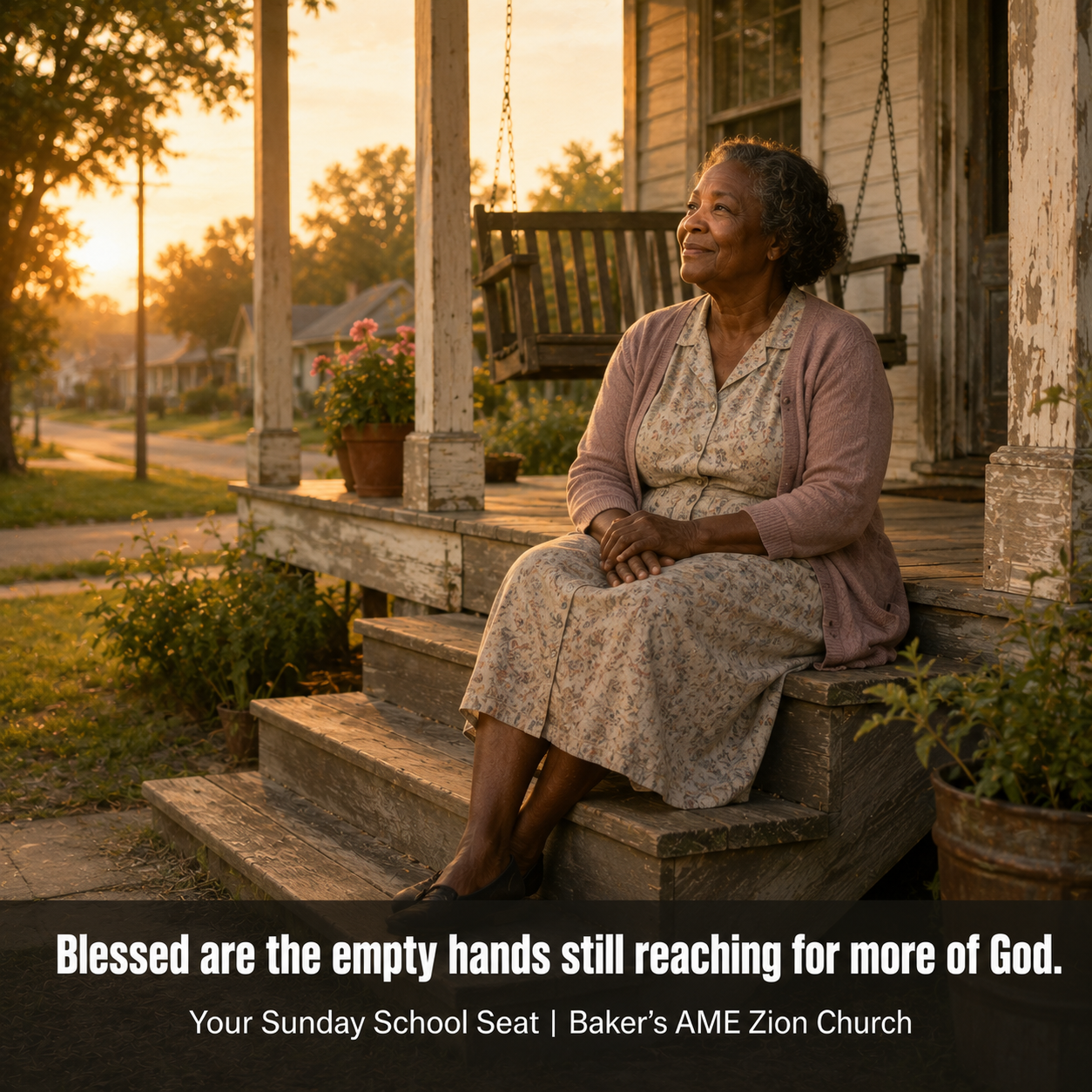
Jesus looks at the people with nothing and calls them blessed. Then he looks at the people with everything and says be careful.
Luke 6:20-26 — KJV
20 And he lifted up his eyes on his disciples, and said, Blessed be ye poor: for yours is the kingdom of God. 21 Blessed are ye that hunger now: for ye shall be filled. Blessed are ye that weep now: for ye shall laugh. 22 Blessed are ye, when men shall hate you, and when they shall separate you from their company, and shall reproach you, and cast out your name as evil, for the Son of man's sake. 23 Rejoice ye in that day, and leap for joy: for, behold, your reward is great in heaven: for in the like manner did their fathers unto the prophets. 24 But woe unto you that are rich! for ye have received your consolation. 25 Woe unto you that are full! for ye shall hunger. Woe unto you that laugh now! for ye shall mourn and weep. 26 Woe unto you, when all men shall speak well of you! for so did their fathers to the false prophets.
Luke 6:20-26 — WEB
20 He lifted up his eyes to his disciples, and said, "Blessed are you who are poor, God's Kingdom is yours. 21 Blessed are you who hunger now, for you will be filled. Blessed are you who weep now, for you will laugh. 22 Blessed are you when men shall hate you, and when they shall exclude and mock you, and throw out your name as evil, for the Son of Man's sake. 23 Rejoice in that day, and leap for joy, for behold, your reward is great in heaven, for their fathers did the same thing to the prophets. 24 "But woe to you who are rich! For you have received your consolation. 25 Woe to you, you who are full now, for you will be hungry. Woe to you who laugh now, for you will mourn and weep. 26 Woe, when men speak well of you, for their fathers did the same thing to the false prophets.
Explanation
Luke's version of the Beatitudes is shorter and sharper than Matthew's, and it's paired with something Matthew leaves out entirely: the woes. Luke isn't interested in spiritualizing poverty into "poor in spirit." He means people with empty cupboards, empty stomachs, and empty social standing. And he means people with full bank accounts too — full, comfortable, and applauded. Jesus isn't condemning having money. He's naming a spiritual danger: when your barn is full, it's easy to stop needing God, and when everybody speaks well of you, it's easy to stop needing the truth.
"Ye have received your consolation" is the key phrase in verse 24. It means the payment has already been made in full — nothing left owed. Comfort now, cushioned by wealth, can become the whole reward a person ever collects.
Now hold that next to a rich man in a tree. Zacchaeus was "the chief among the publicans, and he was rich" — the very description Luke 6:24 warns about. He had, by every earthly measure, already received his consolation. Big house, full purse, respected position among Rome's tax structure even while despised by his own people. But something in him was still climbing trees, still hungry for more than comfort could supply. Sunday's story is what happens when a "woe unto you that are rich" man refuses to let his wealth be the last word.
That's the hope tucked into this hard passage. The woes aren't a life sentence. They're a warning label, meant to be read while there's still time to change course — which is exactly what Zacchaeus does.
Most of us live somewhere between the blessed and the woeful, and this passage asks an honest question: what have you already let count as your reward? Maybe it's not money. Maybe it's the compliment you're chasing, the reputation you're protecting, the comfortable routine you won't disturb even though something in you knows it's costing you closeness with God. Full stomachs, full calendars, and full approval ratings can all quietly become "the consolation you've received" — the place you stopped reaching.
This week, notice where you've gotten comfortable enough to stop climbing. Zacchaeus had everything and still ran ahead of the crowd for one more look at Jesus. That kind of hunger, even in a full life, is exactly what verse 21 is blessing.
Thought for the Day
Blessed are the empty hands still reaching for more of God.
Reflection Question
What comfort have you let become your whole reward?
Prayer
Jesus, thank you for seeing and blessing the empty places in my life. Keep me from letting comfort become the end of my reaching. Whatever I have — much or little — give me a hunger for you that never settles for consolation instead of you. Amen.
This week we walk toward Sunday's lesson: Zacchaeus, The Publican.
Tuesday, July 14 — The Fast God Actually Wants
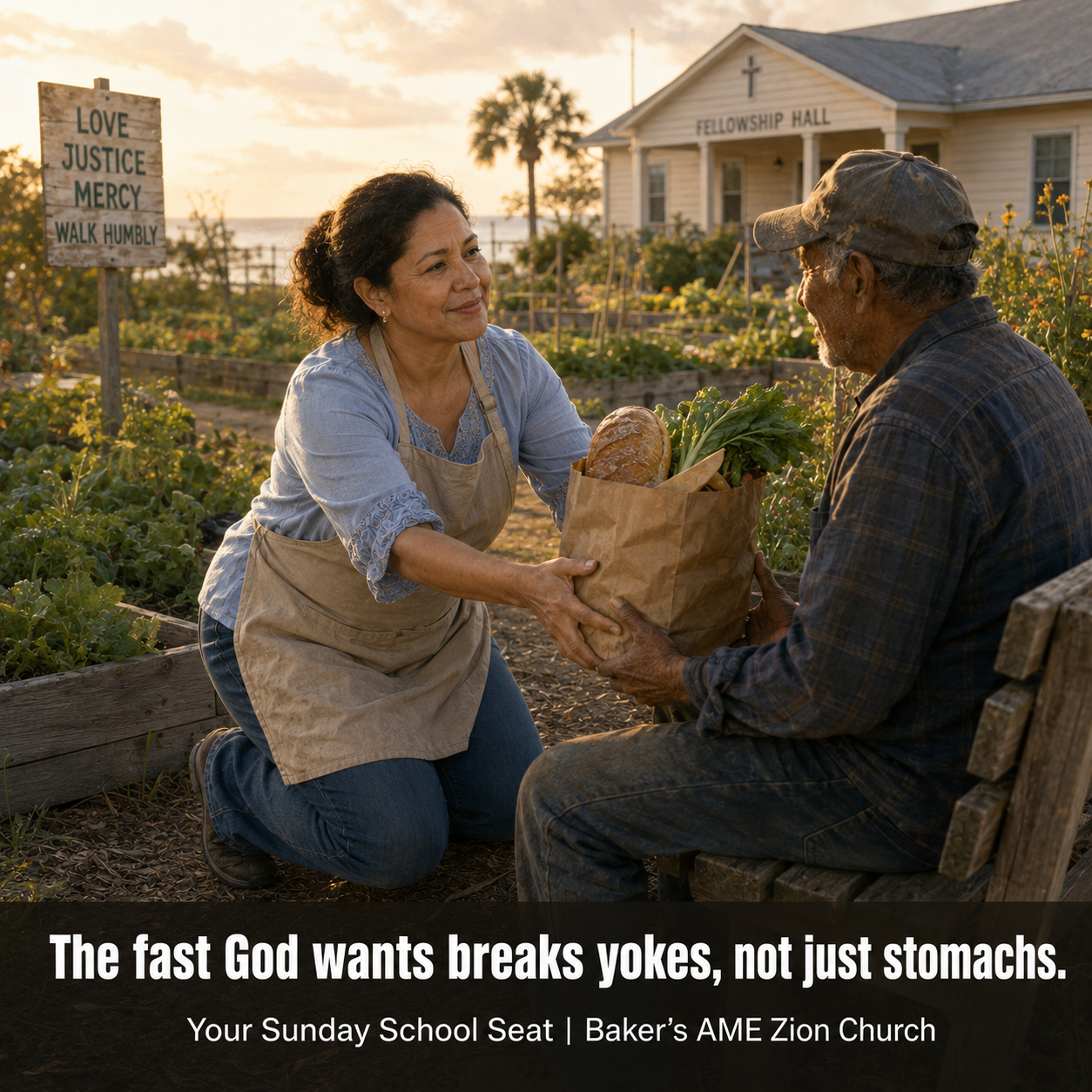
You can skip every meal this week and still miss what God is actually asking for.
Isaiah 58:3-7 — KJV
3 Wherefore have we fasted, say they, and thou seest not? wherefore have we afflicted our soul, and thou takest no knowledge? Behold, in the day of your fast ye find pleasure, and exact all your labours. 4 Behold, ye fast for strife and debate, and to smite with the fist of wickedness: ye shall not fast as ye do this day, to make your voice to be heard on high. 5 Is it such a fast that I have chosen? a day for a man to afflict his soul? is it to bow down his head as a bulrush, and to spread sackcloth and ashes under him? wilt thou call this a fast, and an acceptable day to the LORD? 6 Is not this the fast that I have chosen? to loose the bands of wickedness, to undo the heavy burdens, and to let the oppressed go free, and that ye break every yoke? 7 Is it not to deal thy bread to the hungry, and that thou bring the poor that are cast out to thy house? when thou seest the naked, that thou cover him; and that thou hide not thyself from thine own flesh?
Isaiah 58:3-7 — WEB
3 'Why have we fasted,' say they, 'and you don't see? Why have we afflicted our soul, and you don't notice?' "Behold, in the day of your fast you find pleasure, and oppress all your laborers. 4 Behold, you fast for strife and contention, and to strike with the fist of wickedness. You don't fast today so as to make your voice to be heard on high. 5 Is this the fast that I have chosen? A day for a man to humble his soul? Is it to bow down his head like a reed, and to spread sackcloth and ashes under himself? Will you call this a fast, and an acceptable day to Yahweh? 6 "Isn't this the fast that I have chosen: to release the bonds of wickedness, to undo the straps of the yoke, to let the oppressed go free, and that you break every yoke? 7 Isn't it to distribute your bread to the hungry, and that you bring the poor who are cast out to your house? When you see the naked, that you cover him; and that you not hide yourself from your own flesh?
Explanation
This passage comes from a community back from exile, rebuilding Jerusalem, doing all the right religious things — fasting, sackcloth, ashes — and confused about why heaven feels silent. God's answer through Isaiah is blunt: your fasting is real, but it's aimed at the wrong target. You're afflicting your bodies while your workers go unpaid and your neighbors go hungry. That's not devotion. That's performance with a side of oppression.
So God redefines the fast he actually wants: loosing the bonds of wickedness, breaking every yoke, sharing bread with the hungry, bringing the homeless poor into your own house, clothing the naked. Notice how physical all of it is. This isn't a call to feel more spiritual. It's a call to change what your hands are doing for the people around you.
That's exactly the wall Zacchaeus's whole career was built against. Tax collectors in first-century Judea were notorious for exacting more than was owed and pocketing the difference — legal oppression, dressed up in Rome's paperwork. He was, in Isaiah's language, tightening yokes for a living. When Jesus calls him down from that tree, Zacchaeus's response — "the half of my goods I give to the poor" — is Isaiah 58 finally being lived out by the very kind of man who'd been violating it for years. The true fast, arriving decades later, in a man's driveway.
We do a version of Isaiah's mistake constantly. We treat our devotion as a private transaction between us and God — read the verse, say the prayer, post the encouragement — while the actual justice question sits untouched: Am I underpaying anybody? Am I looking past someone who's cold or hungry because dealing with them is inconvenient? Do I keep my door, my check-book, and my calendar closed to needs I could actually meet?
This week, let your devotional time do more than move your soul. Let it move your hands. Maybe that's paying someone what you actually owe them, showing up for a neighbor who's stretched thin, or simply noticing the person your day has trained you to walk past. Isaiah isn't asking you to feel guiltier. He's asking you to loosen somebody's yoke by Friday.
Thought for the Day
The fast God wants breaks yokes, not just stomachs.
Reflection Question
Whose yoke could your hands help loosen this week?
Prayer
God, forgive me for the times my devotion stays private and never touches anyone else's burden. Show me the yoke I could help loosen today — the need right in front of me that I've learned to look past. Make my faith as practical as it is sincere. Amen.
This week we walk toward Sunday's lesson: Zacchaeus, The Publican.
Monday, July 13 — Restitution Is Love in Action
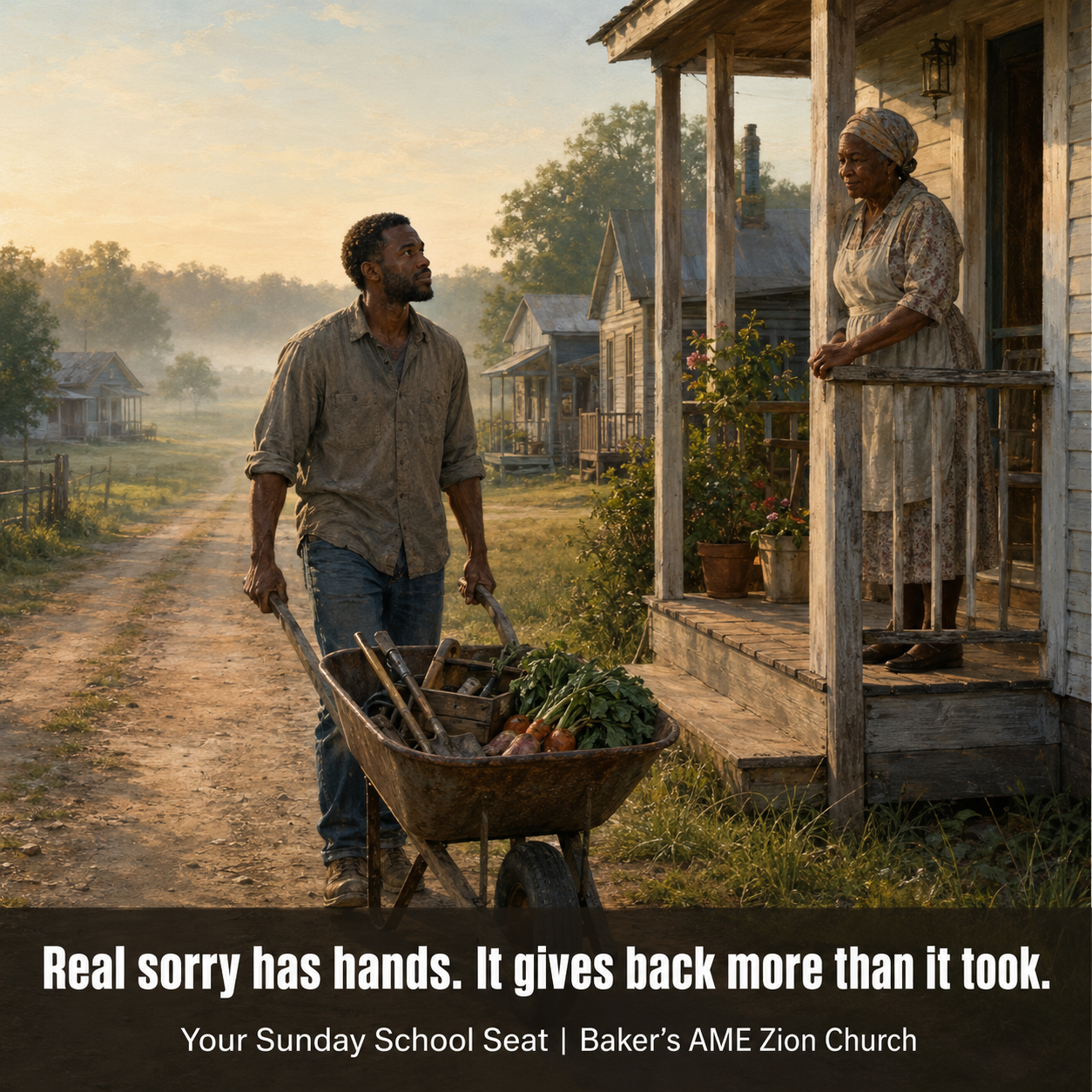
Somebody once told you "just say sorry and move on." This law says something different: sorry has to come with your hands full.
Exodus 22:1-6 — KJV
1 If a man shall steal an ox, or a sheep, and kill it, or sell it; he shall restore five oxen for an ox, and four sheep for a sheep. 2 If a thief be found breaking up, and be smitten that he die, there shall no blood be shed for him. 3 If the sun be risen upon him, there shall be blood shed for him; for he should make full restitution; if he have nothing, then he shall be sold for his theft. 4 If the theft be certainly found in his hand alive, whether it be ox, or ass, or sheep; he shall restore double. 5 If a man shall cause a field or vineyard to be eaten, and shall put in his beast, and shall feed in another man's field; of the best of his own field, and of the best of his own vineyard, shall he make restitution. 6 If fire break out, and catch in thorns, so that the stacks of corn, or the standing corn, or the field, be consumed therewith; he that kindled the fire shall surely make restitution.
Exodus 22:1-6 — WEB
1 "If a man steals an ox or a sheep, and kills it, or sells it; he shall pay five oxen for an ox, and four sheep for a sheep. 2 If the thief is found breaking in, and is struck so that he dies, there shall be no guilt of bloodshed for him. 3 If the sun has risen on him, guilt of bloodshed shall be for him; he shall make restitution. If he has nothing, then he shall be sold for his theft. 4 If the stolen property is found in his hand alive, whether it is ox, donkey, or sheep, he shall pay double. 5 "If a man causes a field or vineyard to be eaten, and lets his animal loose, and it grazes in another man's field, he shall make restitution from the best of his own field, and from the best of his own vineyard. 6 "If fire breaks out, and catches in thorns so that the shocks of grain, or the standing grain, or the field are consumed; he who kindled the fire shall surely make restitution.
Explanation
These verses come from the Book of the Covenant, the earliest block of case law in Exodus, given to a people who had just left Egypt with nothing and were learning, for the first time, how to live together as a free community. Ancient Near Eastern law codes like Hammurabi's dealt with theft too, but Israel's version is distinct in its insistence on restoration over punishment. The thief doesn't just get penalized — he has to actively restore what was broken, often at a multiplied cost. Five oxen for one. Double for what's still alive in hand. The math is not designed to bankrupt a person; it's designed to make the wronged party whole and to make the wrongdoer feel, in his own pocket, the seriousness of what he took.
That's the plain meaning here: sin against a neighbor isn't settled by an apology alone. It's settled when what was taken is returned, and then some. This is a law about tangible repair, not just moral regret.
Keep that thread in your hand this week, because it runs straight to Sunday. When we reach Zacchaeus in the sycamore tree, we'll hear a tax collector — a man who built his whole career on quiet, legal theft — stand up and say, "If I have taken any thing from any man by false accusation, I restore him fourfold." That number isn't random. Zacchaeus is applying this exact law to himself, unprompted, the moment he meets Jesus. Genuine repentance, all through Scripture, has hands and a wallet. It doesn't just feel bad. It gives back.
That's a hard word for modern life, where we're fluent in apologizing and rusty at repairing. We say "my bad" to a coworker whose project we torpedoed and never actually help fix it. We tell a spouse we're sorry for the missed years and never adjust the calendar. We ask forgiveness from a kid we disappointed and never show up differently next time. This passage won't let us stop at words.
Think of one relationship right now where you owe more than an apology — where actual restitution, actual repair, is overdue. It might be money. It might be time. It might be trust you have to rebuild brick by brick. Whatever it is, this is the week to stop rehearsing the apology and start making it right.
Thought for the Day
Real sorry has hands. It gives back more than it took.
Reflection Question
Where do you owe repair, not just regret?
Prayer
Lord, it's easier for me to say sorry than to make things right. Show me where I owe more than words this week. Give me the courage to repair what I've broken, even when it costs me. Thank you for a God who doesn't just forgive debt but teaches us how to settle it with love. Amen.
This week we walk toward Sunday's lesson: Zacchaeus, The Publican.
July 13-19, 2026 - Convergence Journey
This week, Your Sunday School Seat traces the distance between taking and giving — from Exodus 22's ancient restitution law, through Isaiah's call for a true fast, Luke's blessings and warnings, Hebrews's call to hospitality, 1 John's love proven in deed, and Psalm 37's generous giver — all the way to Sunday's lesson, "Zacchaeus, The Publican." It's the story of a rich, despised tax collector who climbs a tree just to see Jesus and comes down completely changed. Walk the week with us, and join us Sunday for the rest of the story.
Monday — Restitution Is Love in Action (Exodus 22:1-6)
Tuesday — The Fast God Actually Wants (Isaiah 58:3-7)
Wednesday — Blessed Are the Empty-Handed (Luke 6:20-26)
Thursday — Open Your Door Wide (Hebrews 13:1-6)
Friday — Love With Hands and Feet (1 John 3:14-18)
Saturday — Hold Loosely, Give Freely (Psalm 37:1-5, 18-22)
Sunday — Salvation Climbs Down From the Tree (Luke 19:1-10)
Your Sunday School Seat | Baker's AME Zion Church — We Save You a Seat
#YourSundaySchoolSeat #AMEZion #DailyDevotional #Faith #BlackChurch #Zacchaeus
Sunday, July 12 — Called to Feed Christ's Flock
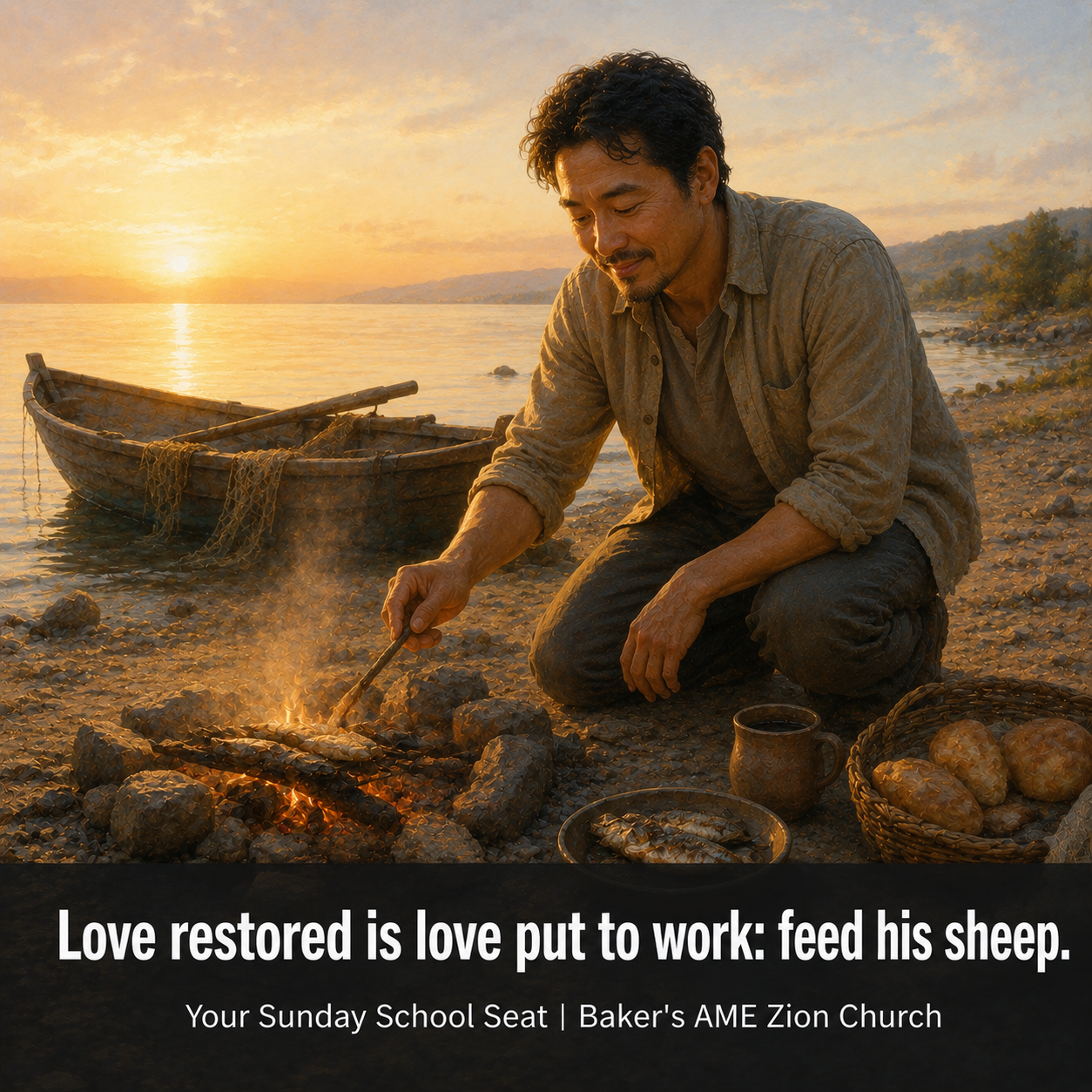
There's a second charcoal fire in the Gospels, and Jesus built it on purpose.
John 21:15-19 — KJV
15 So when they had dined, Jesus saith to Simon Peter, Simon, son of Jonas, lovest thou me more than these? He saith unto him, Yea, Lord; thou knowest that I love thee. He saith unto him, Feed my lambs. 16 He saith to him again the second time, Simon, son of Jonas, lovest thou me? He saith unto him, Yea, Lord; thou knowest that I love thee. He saith unto him, Feed my sheep. 17 He saith unto him the third time, Simon, son of Jonas, lovest thou me? Peter was grieved because he said unto him the third time, Lovest thou me? And he said unto him, Lord, thou knowest all things; thou knowest that I love thee. Jesus saith unto him, Feed my sheep. 18 Verily, verily, I say unto thee, When thou wast young, thou girdedst thyself, and walkedst whither thou wouldest: but when thou shalt be old, thou shalt stretch forth thy hands, and another shall gird thee, and carry thee whither thou wouldest not. 19 This spake he, signifying by what death he should glorify God. And when he had spoken this, he saith unto him, Follow me.
John 21:15-19 — WEB
15 So when they had eaten their breakfast, Jesus said to Simon Peter, "Simon, son of Jonah, do you love me more than these?" He said to him, "Yes, Lord; you know that I have affection for you." He said to him, "Feed my lambs." 16 He said to him again a second time, "Simon, son of Jonah, do you love me?" He said to him, "Yes, Lord; you know that I have affection for you." He said to him, "Tend my sheep." 17 He said to him the third time, "Simon, son of Jonah, do you have affection for me?" Peter was grieved because he asked him the third time, "Do you have affection for me?" He said to him, "Lord, you know everything. You know that I have affection for you." Jesus said to him, "Feed my sheep. 18 Most certainly I tell you, when you were young, you dressed yourself, and walked where you wanted to. But when you are old, you will stretch out your hands, and another will dress you, and carry you where you don't want to go." 19 Now he said this, signifying by what kind of death he would glorify God. When he had said this, he said to him, "Follow me."
Explanation
John gives us one small detail that changes everything: a charcoal fire. The only other charcoal fire in his Gospel is the one Peter stood beside while he denied Jesus three times. Now the risen Christ has built another one on the beach, cooked breakfast, and waited. Peter is about to be restored at a fire just like the one where he fell. Jesus doesn't avoid the scene of the wound. He returns to it and heals it.
Three times Peter had denied him. Three times Jesus now asks, "Simon, son of Jonas, lovest thou me?" It's not interrogation; it's restoration. One question for each denial, gently unwinding the failure thread by thread. By the third time Peter is grieved — the old wound is tender — but Jesus isn't reopening it to punish him. He's making sure it heals all the way through.
And notice what restoration looks like. Each time Peter answers, Jesus gives him a job: "Feed my lambs." "Feed my sheep." "Feed my sheep." Jesus doesn't restore Peter to a comfortable retirement. He restores him to work — to shepherding the very people Jesus loves. Love for Christ is proven not in feelings but in feeding. In showing up for his people. In care that costs something.
This is where our week lands, and where Sunday's lesson — "Simon Peter, From Weakness to Strength" — comes home. The man who crumbled in a courtyard is the same man Jesus now trusts with his flock. The strength was never Peter's nerve. It was the love of Christ reaching back into Peter's worst failure and calling him forward into purpose. Even the hard prophecy Jesus adds — that Peter will one day stretch out his hands and be led where he would not choose — is spoken as honor, not threat. The man who once saved his own skin will one day lay it down, and not deny his Lord again.
Then comes the same invitation Peter heard at the very beginning, before any of it: "Follow me." Two words. The whole journey, weakness to strength, fits between the first time Peter heard them and this one.
Jesus asks you the same question this morning. Not "have you been perfect?" Not "did you ever fail me?" Just — "do you love me?" And if the answer is yes, even a trembling yes, then there are lambs to feed and sheep to tend and a Savior still saying, "Follow me."
Thought for the Day
Love restored is love put to work: feed his sheep.
Reflection Question
Jesus asks you, too: do you love me? How will you feed his sheep this week?
Prayer
Lord Jesus, you meet me at the very fire where I failed, and you ask me only this: do you love me? My answer is yes — a trembling yes, but yes. Show me the lambs you want me to feed and the sheep you want me to tend. I hear you saying "follow me," and by your grace, I will. Amen.
Today is Sunday school. We save you a seat.
Saturday, July 11 — Crumbling under Pressure

The bold preacher of Monday is back by a fire — only this time he's swearing he never knew Jesus at all.
Mark 14:55-72 — KJV
55 And the chief priests and all the council sought for witness against Jesus to put him to death; and found none. 56 For many bare false witness against him, but their witness agreed not together. 57 And there arose certain, and bare false witness against him, saying, 58 We heard him say, I will destroy this temple that is made with hands, and within three days I will build another made without hands. 59 But neither so did their witness agree together. 60 And the high priest stood up in the midst, and asked Jesus, saying, Answerest thou nothing? what is it which these witness against thee? 61 But he held his peace, and answered nothing. Again the high priest asked him, and said unto him, Art thou the Christ, the Son of the Blessed? 62 And Jesus said, I am: and ye shall see the Son of man sitting on the right hand of power, and coming in the clouds of heaven. 63 Then the high priest rent his clothes, and saith, What need we any further witnesses? 64 Ye have heard the blasphemy: what think ye? And they all condemned him to be guilty of death. 65 And some began to spit on him, and to cover his face, and to buffet him, and to say unto him, Prophesy: and the servants did strike him with the palms of their hands. 66 And as Peter was beneath in the palace, there cometh one of the maids of the high priest: 67 And when she saw Peter warming himself, she looked upon him, and said, And thou also wast with Jesus of Nazareth. 68 But he denied, saying, I know not, neither understand I what thou sayest. And he went out into the porch; and the cock crew. 69 And a maid saw him again, and began to say to them that stood by, This is one of them. 70 And he denied it again. And a little after, they that stood by said again to Peter, Surely thou art one of them: for thou art a Galilaean, and thy speech agreeth thereto. 71 But he began to curse and to swear, saying, I know not this man of whom ye speak. 72 And the second time the cock crew. And Peter called to mind the word that Jesus said unto him, Before the cock crow twice, thou shalt deny me thrice. And when he thought thereon, he wept.
Mark 14:55-72 — WEB
55 Now the chief priests and the whole council sought witnesses against Jesus to put him to death, and found none. 56 For many gave false testimony against him, and their testimony didn't agree with each other. 57 Some stood up, and gave false testimony against him, saying, 58 "We heard him say, 'I will destroy this temple that is made with hands, and in three days I will build another made without hands.'" 59 Even so, their testimony did not agree. 60 The high priest stood up in the middle, and asked Jesus, "Have you no answer? What is it which these testify against you?" 61 But he stayed quiet, and answered nothing. Again the high priest asked him, "Are you the Christ, the Son of the Blessed?" 62 Jesus said, "I am. You will see the Son of Man sitting at the right hand of Power, and coming with the clouds of the sky." 63 The high priest tore his clothes, and said, "What further need have we of witnesses? 64 You have heard the blasphemy! What do you think?" They all condemned him to be worthy of death. 65 Some began to spit on him, and to cover his face, and to beat him with fists, and to tell him, "Prophesy!" The officers struck him with the palms of their hands. 66 As Peter was in the courtyard below, one of the maids of the high priest came, 67 and seeing Peter warming himself, she looked at him, and said, "You were also with the Nazarene, Jesus!" 68 But he denied it, saying, "I neither know, nor understand what you are saying." He went out on the porch, and the rooster crowed. 69 The maid saw him, and began again to tell those who stood by, "This is one of them." 70 But he again denied it. After a little while again those who stood by said to Peter, "You truly are one of them, for you are a Galilean, and your speech shows it." 71 But he began to curse, and to swear, "I don't know this man of whom you speak!" 72 The rooster crowed the second time. Peter remembered the word, how that Jesus said to him, "Before the rooster crows twice, you will deny me three times." When he thought about that, he wept.
Explanation
Here is the weakness in "from weakness to strength," and Mark tells it without flinching. While Jesus stands before the council giving the boldest answer of his life — "I am," owning everything, knowing it will cost him everything — Peter stands in the courtyard below, warming his hands at a fire, giving the weakest answers of his.
Mark sets the two scenes side by side on purpose. Upstairs, Jesus confesses the truth and is condemned for it. Downstairs, Peter denies the truth to save himself. Three times a voice points at him — a servant girl, then the same girl, then the bystanders. Three times Peter backs away, until he is cursing and swearing that he never knew the man he had promised to die for just hours before. Then the rooster crows the second time, the words of Jesus come flooding back, and the boldest of the disciples breaks down and weeps.
It's a devastating scene, and we need it, because most weeks don't feel like Pentecost. Most weeks feel like the courtyard. We mean to stand firm and we crumble — under pressure, under fear, under the simple desire not to be singled out. We stay quiet when we should speak. We laugh along when we should object. We protect ourselves and tell ourselves it didn't really count.
But pay attention to where Mark leaves Peter: not cursing, but weeping. The tears are the most hopeful thing in the passage. They mean the denial didn't kill what was real in him. A heart that breaks over its own failure is a heart still tender enough to be rebuilt. The story is not over, and somewhere in him Peter knows it isn't, even in his worst moment.
This is the truth the whole week has been building toward in Sunday's lesson. Strength, in God's economy, is not the absence of failure. It is what God does on the far side of it. If Peter's denial were the end of his story, we would never have heard his name again. Instead, his lowest night became the raw material for his most useful life.
So if you're carrying a courtyard moment — a time you folded, denied, went quiet, let someone down — don't mistake the weeping for the ending. Your worst failure is not the last word God gets to speak over you. Peter wept on Friday night. But Sunday was coming, and so was a charcoal fire on a beach where everything would be made new.
Thought for the Day
Your worst failure is not the last word God speaks.
Reflection Question
What failure are you still carrying that God is ready to redeem?
Prayer
Jesus, I know what it is to fold under pressure — to go quiet when I should have stood. Thank you that my failures don't kill what's real in me, and that weeping is not the end of the story. Catch the tears and use them. Rebuild what I've broken. Amen.
This week we walk toward Sunday's lesson: Simon Peter, From Weakness to Strength.
Friday, July 10 — Fear Not; God Is with You

"Fear not" is easy to print on a coffee mug and hard to feel at 3 a.m. So look at how God actually says it.
Isaiah 41:8-13 — KJV
8 But thou, Israel, art my servant, Jacob whom I have chosen, the seed of Abraham my friend. 9 Thou whom I have taken from the ends of the earth, and called thee from the chief men thereof, and said unto thee, Thou art my servant; I have chosen thee, and not cast thee away. 10 Fear thou not; for I am with thee: be not dismayed; for I am thy God: I will strengthen thee; yea, I will help thee; yea, I will uphold thee with the right hand of my righteousness. 11 Behold, all they that were incensed against thee shall be ashamed and confounded: they shall be as nothing; and they that strive with thee shall perish. 12 Thou shalt seek them, and shalt not find them, even them that contended with thee: they that war against thee shall be as nothing, and as a thing of nought. 13 For I the LORD thy God will hold thy right hand, saying unto thee, Fear not; I will help thee.
Isaiah 41:8-13 — WEB
8 "But you, Israel, my servant, Jacob whom I have chosen, the offspring of Abraham my friend, 9 You whom I have taken hold of from the ends of the earth, and called from its corners, and said to you, 'You are my servant, I have chosen you and have not cast you away.' 10 Don't you be afraid, for I am with you. Don't be dismayed, for I am your God. I will strengthen you. Yes, I will help you. Yes, I will uphold you with the right hand of my righteousness. 11 Behold, all those who are incensed against you will be disappointed and confounded. Those who strive with you will be like nothing, and shall perish. 12 You will seek them, and won't find them, even those who contend with you. Those who war against you will be as nothing, as a non-existent thing. 13 For I, Yahweh your God, will hold your right hand, saying to you, 'Don't be afraid. I will help you.'
Explanation
"Fear not" is one of the most repeated commands in Scripture, and also one of the hardest to obey, because fear rarely asks permission. You can't always talk yourself out of it. So it matters enormously how God frames the command here in Isaiah.
He doesn't say "fear not, because nothing bad will happen." He says "Fear thou not; for I am with thee." The reason for courage isn't the absence of danger. It's the presence of God. Israel heard these words as exiles — displaced, outnumbered, far from home, wondering if God had forgotten them. Into that very real fear God speaks not a pep talk but a promise: "I will strengthen thee; yea, I will help thee; yea, I will uphold thee with the right hand of my righteousness."
And then the image that ought to stay with you all day: "For I the LORD thy God will hold thy right hand, saying unto thee, Fear not; I will help thee." Picture it the way you'd take a frightened child by the hand crossing a busy street. The child is still small. The traffic is still real. But the hand changes everything.
This is our last weekday before Sunday's lesson, and it's the promise Peter most needed to learn. Peter's collapse — which we'll read tomorrow — came in a moment when he felt utterly alone in hostile territory. What he couldn't yet see is what Isaiah announces: God holds the hand of his servant even when the servant's grip fails. The strength that finally steadied Peter was never his own grip on God. It was God's grip on him.
That reframes fear for the rest of us, too. The goal of faith is not to become a person who never feels afraid. The goal is to feel the hand. To know, in the waiting room, in the layoff, in the 3 a.m. worry, that you are held by the right hand of a righteous God who has promised not to let go.
Notice who God is talking to: "thou whom I have taken from the ends of the earth... Thou art my servant; I have chosen thee, and not cast thee away." Before he says "fear not," he says "you're mine." The courage flows from the belonging. You are not facing tomorrow as an orphan trying to be brave. You are facing it as a chosen child whose Father has your hand in his. So — fear not. Not because the danger is gone, but because he is near.
Thought for the Day
Fear not — not because the danger's gone, but because God's near.
Reflection Question
What would change if you truly believed God was holding your hand today?
Prayer
Lord, when I'm afraid, remind me that the answer isn't a braver version of me — it's a nearer sense of you. Hold my right hand the way I'd hold a frightened child's. Help me remember that I am chosen and not cast away. I will not face tomorrow as an orphan. Amen.
This week we walk toward Sunday's lesson: Simon Peter, From Weakness to Strength.
Thursday, July 9 — Imperfect Understanding
Peter gives the exactly right answer about Jesus and then, in the very next breath, completely misses the point. We've all been there.
Mark 8:27-33 — KJV
27 And Jesus went out, and his disciples, into the towns of Caesarea Philippi: and by the way he asked his disciples, saying unto them, Whom do men say that I am? 28 And they answered, John the Baptist: but some say, Elias; and others, One of the prophets. 29 And he saith unto them, But whom say ye that I am? And Peter answereth and saith unto him, Thou art the Christ. 30 And he charged them that they should tell no man of him. 31 And he began to teach them, that the Son of man must suffer many things, and be rejected of the elders, and of the chief priests, and scribes, and be killed, and after three days rise again. 32 And he spake that saying openly. And Peter took him, and began to rebuke him. 33 But when he had turned about and looked on his disciples, he rebuked Peter, saying, Get thee behind me, Satan: for thou savourest not the things that be of God, but the things that be of men.
Mark 8:27-33 — WEB
27 Jesus went out, with his disciples, into the villages of Caesarea Philippi. On the way he asked his disciples, "Who do men say that I am?" 28 They told him, "John the Baptizer, and others say Elijah, but others: one of the prophets." 29 He said to them, "But who do you say that I am?" Peter answered, "You are the Christ." 30 He commanded them that they should tell no one about him. 31 He began to teach them that the Son of Man must suffer many things, and be rejected by the elders, the chief priests, and the scribes, and be killed, and after three days rise again. 32 He spoke to them openly. Peter took him, and began to rebuke him. 33 But he, turning around, and seeing his disciples, rebuked Peter, and said, "Get behind me, Satan! For you have in mind not the things of God, but the things of men."
Explanation
This is the hinge of the whole week. On a dusty road near Caesarea Philippi, Jesus asks the question every person eventually has to answer: "Whom do men say that I am?" The disciples relay the rumors — John the Baptist, Elijah, a prophet. Then Jesus makes it personal: "But whom say ye that I am?" And Peter, bless him, gets it exactly right: "Thou art the Christ."
It's the high point of Peter's faith so far. The right answer, spoken out loud, ahead of everyone else. If the story ended at verse 29, Peter would be the model student. But it doesn't end there, and that's the part we need.
Jesus immediately starts explaining what being the Christ actually means: suffering, rejection, death, and resurrection. And Peter — the same Peter who just nailed the confession — pulls Jesus aside to correct him. He rebukes the Messiah he just identified. Jesus' response is one of the sharpest in the Gospels: "Get thee behind me, Satan: for thou savourest not the things that be of God, but the things that be of men."
That's the title of today's reading: "Imperfect Understanding." Peter believed the right thing about Jesus and completely misunderstood what it would cost. He wanted a Christ of victory without a cross. And Sunday's lesson — "Simon Peter, From Weakness to Strength" — lives right here in the tension. Peter's confession is real strength. His resistance to the cross is real weakness. Both are true in the same man on the same afternoon.
We are more like Peter than we'd like to admit. It's possible to have your theology correct and your expectations all wrong. We can sing that Jesus is Lord on Sunday and quietly assume that following him should make life smoother, the bills lighter, the relationships easier. And when the road bends toward sacrifice instead of comfort, we do exactly what Peter did — we try to talk Jesus into a different plan.
The hard grace of this passage is that Jesus doesn't write Peter off. He corrects him, firmly, and keeps him close. "Get behind me" is not "get away from me." It's "get back in line, behind me, where a disciple belongs — following, not steering."
Maybe the most honest prayer this Thursday is to admit how much of our faith is built around the Jesus we'd prefer. The real one is headed to a cross, and he is still saying, "Follow me." Right understanding includes following him where we'd rather not go.
Thought for the Day
You can confess Christ rightly and still resist his way.
Reflection Question
Where are you following the Jesus you prefer instead of the real one?
Prayer
Lord Jesus, forgive me for the times I've confessed you with my mouth and resisted your way with my life. I've wanted you without the cross. Teach me to get behind you and follow, even when the road bends toward sacrifice. I trust that your way, however hard, is good. Amen.
This week we walk toward Sunday's lesson: Simon Peter, From Weakness to Strength.