
A daily walk through Scripture, preparing our hearts for Sunday.
Monday, September 14 — You Were Chosen on Purpose

Before Israel ever fought a single battle for the land, God sat them down and told them who they were. Everything that follows this week only makes sense once you know that first.
Deuteronomy 7:1-11 — KJV
1 When the LORD thy God shall bring thee into the land whither thou goest to possess it, and hath cast out many nations before thee, the Hittites, and the Girgashites, and the Amorites, and the Canaanites, and the Perizzites, and the Hivites, and the Jebusites, seven nations greater and mightier than thou; 2 And when the LORD thy God shall deliver them before thee; thou shalt smite them, and utterly destroy them; thou shalt make no covenant with them, nor shew mercy unto them: 3 Neither shalt thou make marriages with them; thy daughter thou shalt not give unto his son, nor his daughter shalt thou take unto thy son. 4 For they will turn away thy son from following me, that they may serve other gods: so will the anger of the LORD be kindled against you, and destroy thee suddenly. 5 But thus shall ye deal with them; ye shall destroy their altars, and break down their images, and cut down their groves, and burn their graven images with fire. 6 For thou art an holy people unto the LORD thy God: the LORD thy God hath chosen thee to be a special people unto himself, above all people that are upon the face of the earth. 7 The LORD did not set his love upon you, nor choose you, because ye were more in number than any people; for ye were the fewest of all people: 8 But because the LORD loved you, and because he would keep the oath which he had sworn unto your fathers, hath the LORD brought you out with a mighty hand, and redeemed you out of the house of bondmen, from the hand of Pharaoh king of Egypt. 9 Know therefore that the LORD thy God, he is God, the faithful God, which keepeth covenant and mercy with them that love him and keep his commandments to a thousand generations; 10 And repayeth them that hate him to their face, to destroy them: he will not be slack to him that hateth him, he will repay him to his face. 11 Thou shalt therefore keep the commandments, and the statutes, and the judgments, which I command thee this day, to do them.
Deuteronomy 7:1-11 — WEB
1 When Yahweh your God brings you into the land where you go to possess it, and casts out many nations before you—the Hittite, the Girgashite, the Amorite, the Canaanite, the Perizzite, the Hivite, and the Jebusite—seven nations greater and mightier than you; 2 and when Yahweh your God delivers them up before you, and you strike them, then you shall utterly destroy them. You shall make no covenant with them, nor show mercy to them. 3 You shall not make marriages with them. You shall not give your daughter to his son, nor shall you take his daughter for your son. 4 For that would turn away your sons from following me, that they may serve other gods. So Yahweh's anger would be kindled against you, and he would destroy you quickly. 5 But you shall deal with them like this: you shall break down their altars, dash their pillars in pieces, cut down their Asherah poles, and burn their engraved images with fire. 6 For you are a holy people to Yahweh your God. Yahweh your God has chosen you to be a people for his own possession, above all peoples who are on the face of the earth. 7 Yahweh didn't set his love on you nor choose you, because you were more in number than any people; for you were the fewest of all peoples; 8 but because Yahweh loves you, and because he desires to keep the oath which he swore to your fathers, Yahweh has brought you out with a mighty hand and redeemed you out of the house of bondage, from the hand of Pharaoh king of Egypt. 9 Know therefore that Yahweh your God himself is God, the faithful God, who keeps covenant and loving kindness with them who love him and keep his commandments to a thousand generations, 10 and repays those who hate him to their face, to destroy them. He will not be slack to him who hates him. He will repay him to his face. 11 You shall therefore keep the commandments, the statutes, and the ordinances which I command you today, to do them.
Explanation
This is a hard chapter, and it's honest to say so up front. Moses is preparing a young nation to enter a land already occupied by seven nations, and the commands are severe — no treaties, no intermarriage, tear down the altars. Modern readers rightly wince at the violence. But before we wrestle with the battles, notice where Moses starts. He doesn't open with strategy or weapons. He opens with identity. "You are a holy people to the LORD your God. The LORD your God has chosen you." Everything Israel is about to face is framed by who they already are.
And then comes the verse that unlocks the whole week. Why did God choose them? Not because they were impressive. "The LORD didn't set his love on you nor choose you because you were more in number... for you were the fewest of all peoples." He picked the smallest, the least likely, the former slaves. The only reason given is love and a promise: "because the LORD loved you, and because he would keep the oath which he swore to your fathers." That's grace with no résumé attached. God's love landed on them before they had done a single thing to earn it.
This is where our week begins its walk toward Sunday's lesson, "God's Complicated Promise." The promise of the land was real, but it came wrapped in commands and conflicts that unsettle us. Deuteronomy 7 refuses to let us skip to the fighting. It grounds the whole story in a God who is faithful — "the faithful God, who keeps covenant and loving kindness to a thousand generations." Israel's future didn't rest on their military skill. It rested on God's character.
For us, the application is close and personal. So much of our striving comes from a nagging fear that we have to earn our place — with God, at work, in the family, at church. Moses says the opposite. God set His love on you when you were the fewest, the smallest, the least. If you belong to Him, it isn't because you out-performed anyone. It's because He is faithful. Live today out of that settled identity instead of scrambling to prove it. You were chosen on purpose, by a God who keeps His word to a thousand generations.
Thought for the Day
God chose you not for your strength, but out of His love.
Reflection Question
Where are you still trying to earn a place that God has already given you by grace?
Prayer
Faithful God, thank You that You set Your love on me before I had anything to offer. When I forget who I am, remind me that I'm chosen — not for being great, but because You are good. Let me live today from that security instead of striving to prove myself. Keep me close to You, the God who keeps every promise. Amen.
This week we walk toward Sunday's lesson: God's Complicated Promise.
September 14 - 20, 2026 - God’s Complicated Promise
This week on Your Sunday School Seat, we walk into some of the hardest ground in the Bible — battles, armies, and conquered nations — and find one steady promise underneath it all: God fights for His people, and the victory was always His to give. From Israel chosen by grace in Deuteronomy, to Paul's contentment in a prison cell, to spiritual weapons that aren't of this world, to the night Jesus said "I have overcome the world," every day builds toward Sunday's lesson, "God's Complicated Promise," where God delivers His people and the land finally has rest from war. We hold the hard parts honestly and point to the cross, where the real battle was won. Watch, then come join us for Sunday school.
Monday — Live as God's Treasured Possession (Deuteronomy 7:1-11) Tuesday — God Will Love, Bless, and Multiply (Deuteronomy 7:12-26) Wednesday — Strengthened in Every Circumstance (Philippians 4:10-19) Thursday — Armed for Spiritual Warfare (2 Corinthians 10:1-5, 15-18) Friday — Christ Has Conquered the World (John 16:23-33) Saturday — God Fights for God's People (Joshua 10:40-11:5) Sunday — God Brings Victory (Joshua 11:6-9, 16-23)
Your Sunday School Seat | Baker's AME Zion Church — We Saved You a Seat
#YourSundaySchoolSeat #AMEZion #DailyDevotional #Faith #BlackChurch #GodBringsVictory
Sunday, September 13 — Stones That Tell the Story

All week we've watched God's people hold on, cross over, and rehearse what God has done. Today Joshua does something so simple it's easy to miss: he piles up twelve rocks so children who weren't born yet would have a reason to ask.
Joshua 4:14-24 — KJV
14 On that day the LORD magnified Joshua in the sight of all Israel; and they feared him, as they feared Moses, all the days of his life. 15 And the LORD spake unto Joshua, saying, 16 Command the priests that bear the ark of the testimony, that they come up out of Jordan. 17 Joshua therefore commanded the priests, saying, Come ye up out of Jordan. 18 And it came to pass, when the priests that bare the ark of the covenant of the LORD were come up out of the midst of Jordan, and the soles of the priests' feet were lifted up unto the dry land, that the waters of Jordan returned unto their place, and flowed over all his banks, as they did before. 19 And the people came up out of Jordan on the tenth day of the first month, and encamped in Gilgal, in the east border of Jericho. 20 And those twelve stones, which they took out of Jordan, did Joshua pitch in Gilgal. 21 And he spake unto the children of Israel, saying, When your children shall ask their fathers in time to come, saying, What mean these stones? 22 Then ye shall let your children know, saying, Israel came over this Jordan on dry land. 23 For the LORD your God dried up the waters of Jordan from before you, until ye were passed over, as the LORD your God did to the Red sea, which he dried up from before us, until we were gone over: 24 That all the people of the earth might know the hand of the LORD, that it is mighty: that ye might fear the LORD your God for ever.
Joshua 4:14-24 — WEB
14 On that day, Yahweh magnified Joshua in the sight of all Israel; and they feared him, as they feared Moses, all the days of his life. 15 Yahweh spoke to Joshua, saying, 16 "Command the priests who bear the ark of the covenant, that they come up out of the Jordan." 17 Joshua therefore commanded the priests, saying, "Come up out of the Jordan!" 18 When the priests who bore the ark of Yahweh's covenant had come up out of the middle of the Jordan, and the soles of the priests' feet had been lifted up to the dry ground, the waters of the Jordan returned to their place, and went over all its banks, as before. 19 The people came up out of the Jordan on the tenth day of the first month, and encamped in Gilgal, on the east border of Jericho. 20 Joshua set up those twelve stones, which they took out of the Jordan, in Gilgal. 21 He spoke to the children of Israel, saying, "When your children ask their fathers in time to come, saying, 'What do these stones mean?' 22 then you shall let your children know, saying, 'Israel came over this Jordan on dry land. 23 For Yahweh your God dried up the waters of the Jordan from before you until you had crossed over, as Yahweh your God did to the Red Sea, which he dried up from before us, until we had crossed over, 24 that all the peoples of the earth may know that Yahweh's hand is mighty, and that you may fear Yahweh your God forever.'"
Explanation
Here is where the week arrives. A new generation stands on the far bank of the Jordan. The ones who marched out of Egypt are buried in the wilderness; these are their children and grandchildren, and today they've walked into the promise on dry ground while priests stood in the riverbed holding the ark. The moment the priests step out, the river slams back over its banks. The door closes behind them. They are home.
And Joshua's very first order of business is memory. Twelve stones, one for each tribe, hauled up out of the riverbed and stacked at Gilgal. Not a monument to Israel's courage — they didn't do anything but walk. A marker of what God did. Then Joshua tells them exactly why it's there: When your children ask, "What do these stones mean?" He is planning for a question that won't be asked for twenty years. He is building a conversation starter for people not yet born.
Notice what the answer is supposed to include. Verse 23 reaches backward: God dried up this Jordan for you, just as He dried up the Red Sea for us. One generation's testimony gets stitched to the next one's. Grandparents' stories and grandchildren's stories become one story. That's this quarter's theme in a single verse — family legacies, remembering God's actions — and it's every thread of our week gathered into one pile of rocks. Paul said hold fast to what was handed down. Exodus gave us the sea. Numbers put the ark out front. John gave us the voice in the storm. The psalmist chose to remember. Jesus set a table so we wouldn't forget. Joshua stacks stones for the same holy reason.
So what are your stones? A worn Bible with somebody's handwriting in the margins. The story of how this church got built and who sacrificed to do it. The night the money came from nowhere. The healing nobody expected. Testimonies die in one generation if nobody says them out loud. Our children are not going to inherit our faith by osmosis — they inherit it because somebody sat them down and said, let me tell you what God did. Today, especially, honor the grandmothers and grandfathers whose stories have carried us this far. Then pick up your own stones and set them where the next generation will trip over them and ask.
Thought for the Day
Tell your children what God did. Don't let it die.
Reflection Question
What is one story of God's faithfulness in your life that your children or grandchildren have never heard you tell?
Prayer
Lord, You are the God who parts water and brings Your people home. Thank You for every crossing You've carried me through, and for the people who told me their stories before I had any of my own. Help me build markers instead of letting the memory fade. Give me the words when a child asks. And let my life be one of the stones that points somebody to You. Amen.
Today is Sunday school. We saved you a seat.
Saturday, September 12 — A Table That Remembers
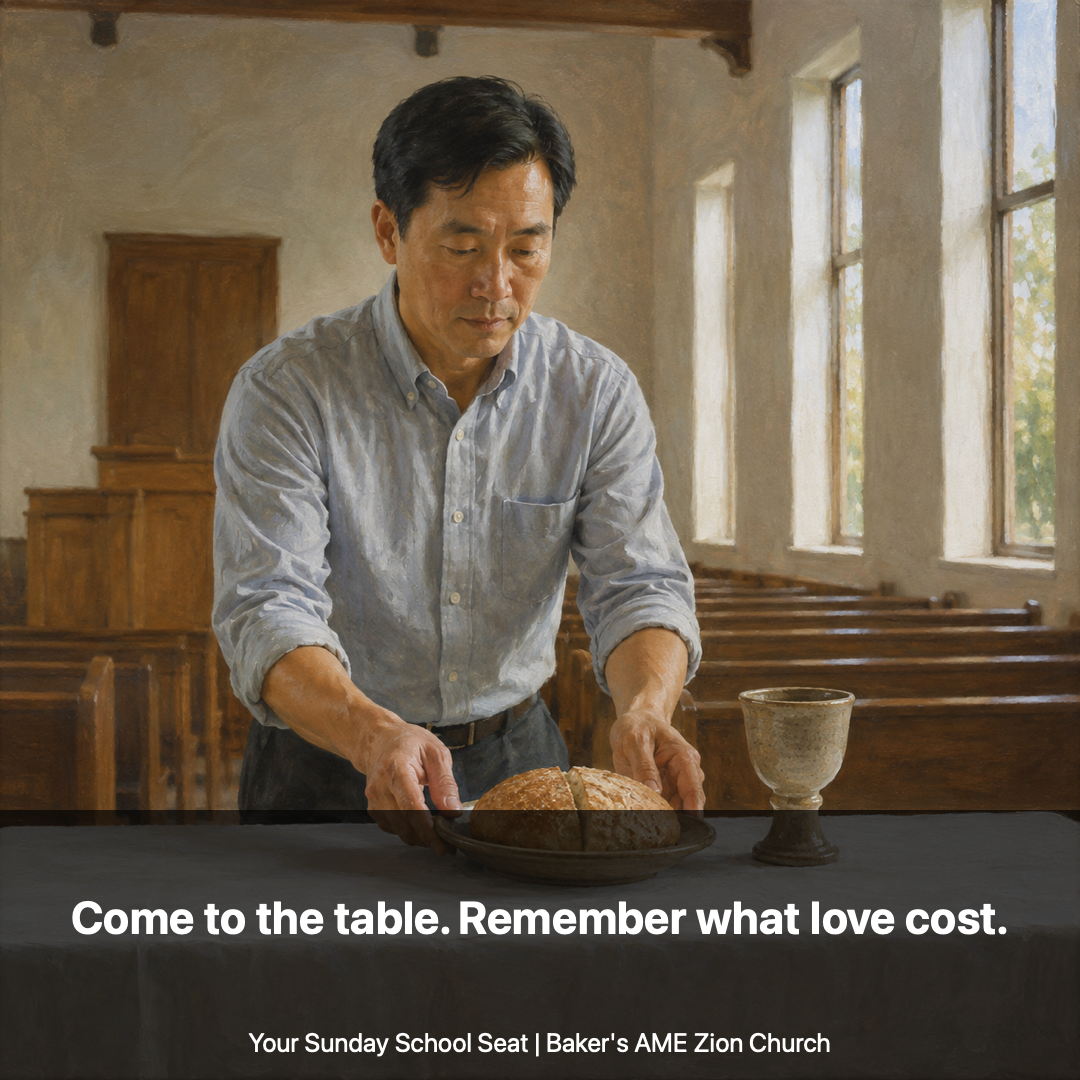
Of all the things Jesus could have left His church, He left a meal. Bread, a cup, and four words: do this in remembrance.
1 Corinthians 11:23-27 — KJV
23 For I have received of the Lord that which also I delivered unto you, That the Lord Jesus the same night in which he was betrayed took bread: 24 And when he had given thanks, he brake it, and said, Take, eat: this is my body, which is broken for you: this do in remembrance of me. 25 After the same manner also he took the cup, when he had supped, saying, This cup is the new testament in my blood: this do ye, as oft as ye drink it, in remembrance of me. 26 For as often as ye eat this bread, and drink this cup, ye do shew the Lord's death till he come. 27 Wherefore whosoever shall eat this bread, and drink this cup of the Lord, unworthily, shall be guilty of the body and blood of the Lord.
1 Corinthians 11:23-27 — WEB
23 For I received from the Lord that which also I delivered to you, that the Lord Jesus on the night in which he was betrayed took bread. 24 When he had given thanks, he broke it and said, "Take, eat. This is my body, which is broken for you. Do this in memory of me." 25 In the same way he also took the cup, after supper, saying, "This cup is the new covenant in my blood. Do this, as often as you drink, in memory of me." 26 For as often as you eat this bread and drink this cup, you proclaim the Lord's death until he comes. 27 Therefore whoever eats this bread or drinks the Lord's cup in a way unworthy of the Lord will be guilty of the body and the blood of the Lord.
Explanation
Paul is writing to a church that had turned communion into an embarrassment. The wealthy members were arriving early and eating their fill while working people, who couldn't leave their jobs, showed up to scraps. The meal meant to unite them had become one more place where the sorting happened. So Paul takes them all the way back to the upper room to remind them what the table actually is.
And listen to how he begins: I received from the Lord that which also I delivered to you. That is handing-down language — the very thing Paul told the Thessalonians to hold fast on Monday. The church has always been a chain of people passing something forward that they did not invent. This is one of the oldest paragraphs in the New Testament, older than the Gospels, already worn smooth from being repeated when Paul wrote it down.
Then the scene itself: on the night He was betrayed — not on a good night, on the worst one — Jesus gave thanks, broke bread, and told His friends to keep doing this so they wouldn't forget Him. Take. Eat. Broken for you. The cup is the new covenant in my blood. Every time we eat and drink, Paul says, we are preaching a sermon without words, proclaiming His death until He comes. It looks backward to a cross and forward to a return, and it holds us steady in the middle.
That's why this reading sits on the eve of Sunday. All week we've been gathering ways God's people keep memory alive — a tradition held fast, a sea that moved, an ark out front, a voice over the water, a psalm rehearsed in the dark. Tomorrow Joshua stacks twelve stones so children will ask what they mean. Today Jesus sets a table for the same reason. Some memories are too important to leave to chance, so God gives them a physical shape you can touch.
So as you get ready for Sunday, come to that table on purpose. Not out of habit, not while running down your grocery list. Paul's warning about eating unworthily isn't about whether you're good enough — nobody at that first table was. It's about paying attention to what you're holding. Slow down tomorrow. Taste the bread. Remember what love cost. And then go be the kind of church where nobody gets the scraps.
Thought for the Day
Come to the table. Remember what love cost.
Reflection Question
When you take communion tomorrow, what will you deliberately bring to mind — and who at your table needs to be included better?
Prayer
Lord Jesus, on the worst night of Your life You thought about us and left us a way to remember. Forgive me for the times I've come to Your table with my mind somewhere else. Slow me down tomorrow. Let the bread and the cup do their work in me. And make our church a place where the table is truly big enough for everyone. Amen.
This week we walk toward Sunday's lesson: Remember God's Actions.
Friday, September 11 — When Memory Becomes Medicine
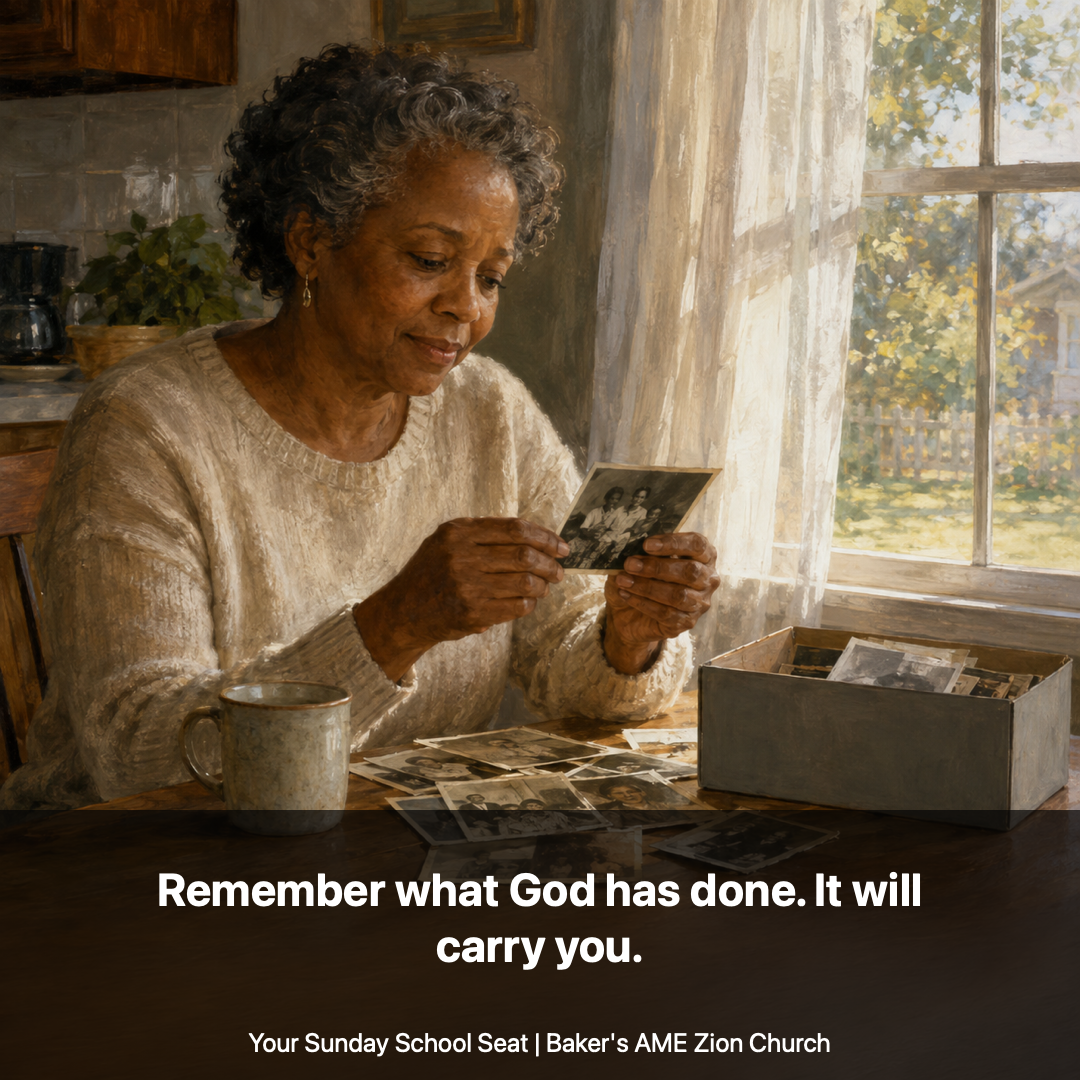
Asaph couldn't sleep. He'd been asking whether God had forgotten to be gracious. Then he made a decision that changed everything: he chose to remember.
Psalm 77:11-20 — KJV
11 I will remember the works of the LORD: surely I will remember thy wonders of old. 12 I will meditate also of all thy work, and talk of thy doings. 13 Thy way, O God, is in the sanctuary: who is so great a God as our God? 14 Thou art the God that doest wonders: thou hast declared thy strength among the people. 15 Thou hast with thine arm redeemed thy people, the sons of Jacob and Joseph. Selah. 16 The waters saw thee, O God, the waters saw thee; they were afraid: the depths also were troubled. 17 The clouds poured out water: the skies sent out a sound: thine arrows also went abroad. 18 The voice of thy thunder was in the heaven: the lightnings lightened the world: the earth trembled and shook. 19 Thy way is in the sea, and thy path in the great waters, and thy footsteps are not known. 20 Thou leddest thy people like a flock by the hand of Moses and Aaron.
Psalm 77:11-20 — WEB
11 I will remember Yah's deeds; for I will remember your wonders of old. 12 I will also meditate on all your work, and consider your doings. 13 Your way, God, is in the sanctuary. What god is great like God? 14 You are the God who does wonders. You have made your strength known among the peoples. 15 You have redeemed your people with your arm, the sons of Jacob and Joseph. Selah. 16 The waters saw you, God. The waters saw you, and they writhed. The depths also convulsed. 17 The clouds poured out water. The skies resounded with thunder. Your arrows also flashed around. 18 The voice of your thunder was in the whirlwind. The lightnings lit up the world. The earth trembled and shook. 19 Your way was through the sea, your paths through the great waters. Your footsteps were not known. 20 You led your people like a flock, by the hand of Moses and Aaron.
Explanation
To feel the weight of these verses you have to know what comes before them. In the first half of Psalm 77, Asaph is in genuine anguish — crying out at night, unable to be comforted, too troubled to speak. He asks the questions we're usually too polite to say out loud. Has the Lord rejected us for good? Has His mercy run out? Has God forgotten how to be gracious?
And then, at verse 11, the psalm pivots on a single act of the will: I will remember. Not "I feel better." Not "the circumstances improved." He simply turns his mind, on purpose, toward what God has already done. Then he does something that would sound almost stubborn if it weren't so wise — he starts reciting the Exodus. The waters saw You and writhed. The thunder rolled. You led Your people like a flock. He preaches Israel's oldest deliverance story to his own aching heart until his heart starts to believe it again.
Don't miss verse 19: Your way was through the sea, and Your footsteps were not known. God walked Israel straight through deep water and left no tracks behind. There is no map of how He did it. Which means memory is often all we have — and Asaph is telling us that memory is enough. This is the discipline our whole week is teaching. Monday we held on to what was handed down; Tuesday we watched the sea move; Wednesday the ark went first; Thursday Jesus walked the waves. Today the psalmist shows us what to do with all of it when life goes dark: rehearse it out loud.
On this particular Friday, a nation remembers a September morning twenty-five years past, and remembers the ones who ran toward the smoke. Some of us are carrying grief today with a name attached to it. Asaph doesn't tell you to stop grieving. He tells you where to put your mind while you do. Say it out loud — He healed that. He made a way that time. He kept me when I couldn't keep myself. Remembering is not nostalgia. It's medicine. And come Sunday, we'll see Joshua turn it into stone so nobody's children ever have to guess what God has done.
Thought for the Day
Remember what God has done. It will carry you.
Reflection Question
What specific thing has God done for you that you could say out loud today, in the middle of what's hard?
Prayer
Lord, some days I have more questions than answers, and I say them to You honestly. But I choose to remember. I remember Your wonders, Your faithfulness, the doors You opened and the ones You closed for my good. Steady my heart with what I already know about You. And where there is grief today, sit with us in it and lead us like a flock. Amen.
This week we walk toward Sunday's lesson: Remember God's Actions.
Thursday, September 10 — The Voice in the Storm
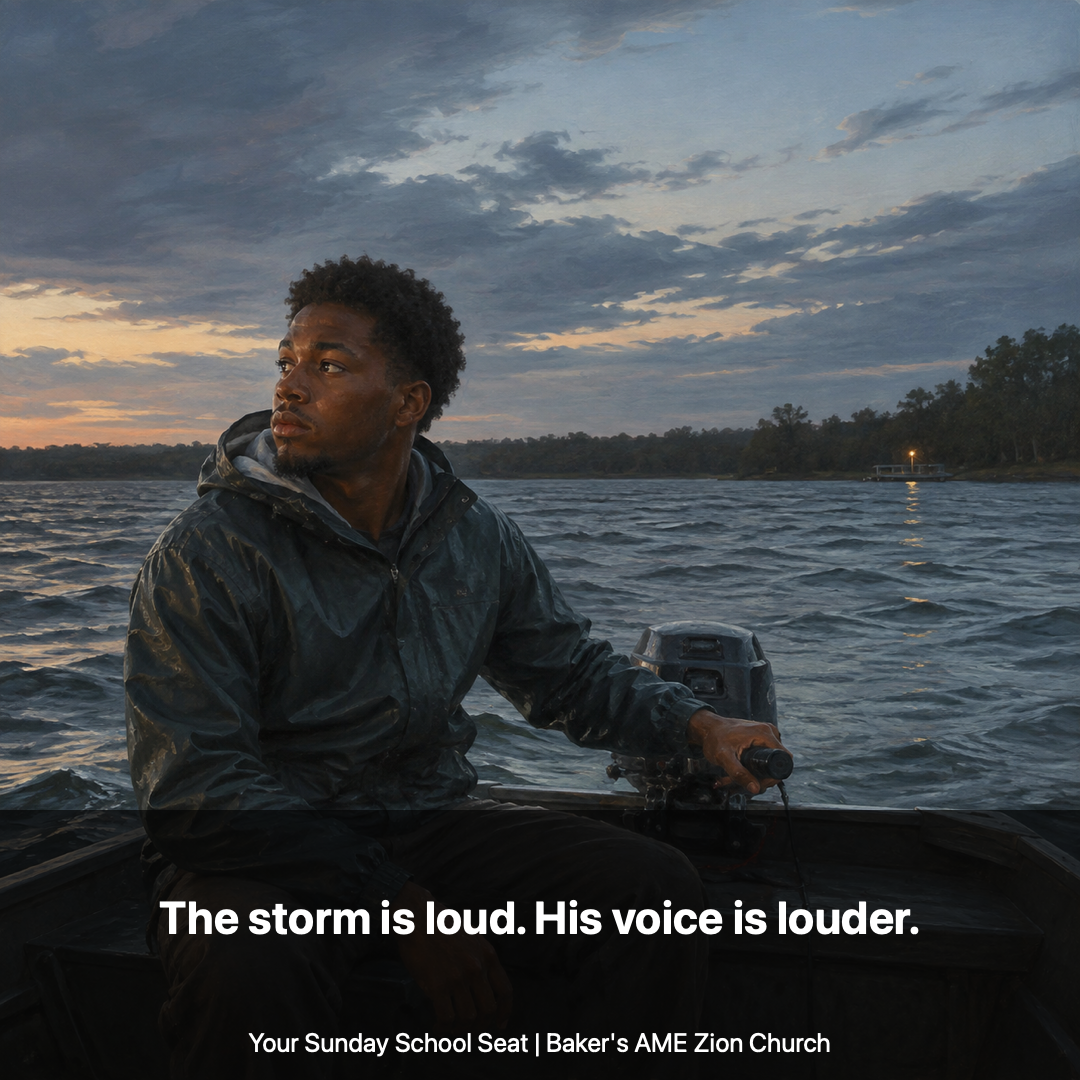
The disciples had just watched Jesus feed five thousand people. A few hours later they were rowing through the dark, soaked and scared, wondering where He'd gone.
John 6:15-21 — KJV
15 When Jesus therefore perceived that they would come and take him by force, to make him a king, he departed again into a mountain himself alone. 16 And when even was now come, his disciples went down unto the sea, 17 And entered into a ship, and went over the sea toward Capernaum. And it was now dark, and Jesus was not come to them. 18 And the sea arose by reason of a great wind that blew. 19 So when they had rowed about five and twenty or thirty furlongs, they see Jesus walking on the sea, and drawing nigh unto the ship: and they were afraid. 20 But he saith unto them, It is I; be not afraid. 21 Then they willingly received him into the ship: and immediately the ship was at the land whither they went.
John 6:15-21 — WEB
15 Jesus therefore, perceiving that they were about to come and take him by force to make him king, withdrew again to the mountain by himself. 16 When evening came, his disciples went down to the sea. 17 They entered into the boat, and were going over the sea to Capernaum. It was now dark, and Jesus had not come to them. 18 The sea was tossed by a great wind blowing. 19 When therefore they had rowed about twenty-five or thirty stadia, they saw Jesus walking on the sea and drawing near to the boat; and they were afraid. 20 But he said to them, "It is I. Don't be afraid." 21 They were willing therefore to receive him into the boat. Immediately the boat was at the land where they were going.
Explanation
The timing matters. This storm comes on the heels of the greatest afternoon of these men's lives. Bread multiplied in their own hands. Thousands fed. A crowd so worked up they were ready to crown Jesus king by force — which is exactly why He slips away up the mountain alone. And then the men who had just seen it all end up in the dark on rough water with the wind against them and no sign of Him anywhere.
John is unhurried about how bad it was. It was already dark. Jesus had not come. The sea was being tossed by a great wind. Anyone who has ever gone from a mountaintop straight into a hard week recognizes this boat. Faith does not inoculate you against the storm; sometimes it drops you right into one.
Then they see Him — walking on the very water that is beating their boat half to death — and John says they were afraid. Not comforted. Afraid. Sometimes God shows up in a form we don't recognize and the first thing we feel is terror. So Jesus speaks. In the Greek His words are simply ego eimi, "I am" — the name God gave Moses at the burning bush, spoken out on the waves. It is I. Don't be afraid. And the moment they were willing to take Him in, the boat was where it had been trying all night to go.
Look at what our week is quietly building. The God who forced the Red Sea back on Tuesday now strolls across a lake in the dark. The God whose ark went ahead on Wednesday now walks out to a boat that is behind schedule and taking on water. Sunday's stones at the Jordan exist to keep this exact truth in front of the next generation: our God handles deep water.
So for whatever tonight holds — the 3 a.m. worry, the child who won't call back, the bill you keep moving to the bottom of the stack — hear the voice before you look at the wind. He is not fazed by the thing that is drowning you. He is walking on top of it. And His first word is never a lecture. It's His own name and a hand out of the dark: It is I. Don't be afraid.
Thought for the Day
The storm is loud. His voice is louder.
Reflection Question
What fear has been the loudest voice in your life lately — and what would change if you let His voice answer it?
Prayer
Lord Jesus, I know what it is to row in the dark. Some nights the wind is against me and I can't see You anywhere. Thank You that You come walking on the very thing I'm afraid of. Quiet the noise long enough for me to hear You say it is You. Get in the boat with me, and bring me to shore. Amen.
This week we walk toward Sunday's lesson: Remember God's Actions.
Wednesday, September 9 — Somebody Has to Go First

Israel finally pulls up stakes and leaves the mountain — and before anyone takes a step, the ark of the covenant goes out three days ahead to find them a place to rest.
Numbers 10:29-36 — KJV
29 And Moses said unto Hobab, the son of Raguel the Midianite, Moses' father in law, We are journeying unto the place of which the LORD said, I will give it you: come thou with us, and we will do thee good: for the LORD hath spoken good concerning Israel. 30 And he said unto him, I will not go; but I will depart to mine own land, and to my kindred. 31 And he said, Leave us not, I pray thee; forasmuch as thou knowest how we are to encamp in the wilderness, and thou mayest be to us instead of eyes. 32 And it shall be, if thou go with us, yea, it shall be, that what goodness the LORD shall do unto us, the same will we do unto thee. 33 And they departed from the mount of the LORD three days' journey: and the ark of the covenant of the LORD went before them in the three days' journey, to search out a resting place for them. 34 And the cloud of the LORD was upon them by day, when they went out of the camp. 35 And it came to pass, when the ark set forward, that Moses said, Rise up, LORD, and let thine enemies be scattered; and let them that hate thee flee before thee. 36 And when it rested, he said, Return, O LORD, unto the many thousands of Israel.
Numbers 10:29-36 — WEB
29 Moses said to Hobab, the son of Reuel the Midianite, Moses' father-in-law, "We are journeying to the place of which Yahweh said, 'I will give it to you.' Come with us, and we will treat you well; for Yahweh has spoken good concerning Israel." 30 He said to him, "I will not go; but I will depart to my own land, and to my relatives." 31 Moses said, "Don't leave us, please; because you know how we are to encamp in the wilderness, and you can be our eyes. 32 It shall be, if you go with us, yes, it shall be, that whatever good Yahweh does to us, we will do the same to you." 33 They set forward from the Mount of Yahweh three days' journey. The ark of Yahweh's covenant went before them three days' journey, to seek out a resting place for them. 34 The cloud of Yahweh was over them by day, when they set forward from the camp. 35 When the ark went forward, Moses said, "Rise up, Yahweh, and let your enemies be scattered! Let those who hate you flee before you!" 36 When it rested, he said, "Return, Yahweh, to the ten thousands of the thousands of Israel."
Explanation
Sinai is behind them now. The law has been given, the tabernacle built, the camp organized, and it is finally time to move. Numbers records the departure in two pictures, and they sit side by side on purpose.
The first is the ark. The chest that carried the covenant went out three days ahead of the people to search out a resting place for them. Read that slowly. God did not merely point Israel toward the wilderness and wish them well; He went into it first and picked the campsite. The cloud stayed over them by day so nobody was walking blind. And every morning, when the ark lifted, Moses shouted a battle cry — "Rise up, LORD!" — and every evening when it settled, he prayed God back into the middle of the camp. Out front in the day, at home at night. That is the whole rhythm of walking with God, in two sentences.
The second picture is more human. Moses turns to Hobab, his wife's kin, and practically begs him to come along: you know this wilderness — you can be our eyes. It's a striking thing to say when you've got a pillar of cloud overhead. But Moses saw no contradiction, and neither should we. God leads. God also gives you people who know the terrain. The presence of divine guidance has never excused us from needing each other.
This is our week's thread again, one day further along. Monday we held on to what was handed down. Tuesday we watched God open a sea. Today the ark goes first. And on Sunday, at the Jordan, it will be the ark again — priests standing in the riverbed holding it while a whole nation walks past them into the promise. God has a habit of going ahead of His people, and remembering that habit is what makes the next step possible.
So take this into your Wednesday. Whatever you're walking into — the new job, the hard conversation, the appointment on Friday, the semester that already feels long — you are not the first one there. God has been in that room already. He is not scouting alongside you; He is scouting ahead of you, looking for a place where you can rest. And when you get there, don't do it alone. Ask somebody who knows the road to walk it with you. Pride will tell you that's weakness. Moses called it eyes.
Thought for the Day
God never sends you somewhere He hasn't already gone.
Reflection Question
Where do you need to trust that God has already gone ahead — and who could you ask to walk it with you?
Prayer
Lord, thank You that You go first. Before I ever get there, You have already been looking for a place where I can rest. Give me the faith to follow instead of running out ahead of You. And give me the humility to lean on the people You've put beside me, the ones who know this road better than I do. Rise up, Lord, and go before me today. Amen.
This week we walk toward Sunday's lesson: Remember God's Actions.
Tuesday, September 8 — The Sea That Had to Move

Israel stood at the water's edge with an army behind them and nowhere to go. What happened next became the story they told their children for a thousand years.
Exodus 14:21-31 — KJV
21 And Moses stretched out his hand over the sea; and the LORD caused the sea to go back by a strong east wind all that night, and made the sea dry land, and the waters were divided. 22 And the children of Israel went into the midst of the sea upon the dry ground: and the waters were a wall unto them on their right hand, and on their left. 23 And the Egyptians pursued, and went in after them to the midst of the sea, even all Pharaoh's horses, his chariots, and his horsemen. 24 And it came to pass, that in the morning watch the LORD looked unto the host of the Egyptians through the pillar of fire and of the cloud, and troubled the host of the Egyptians, 25 And took off their chariot wheels, that they drave them heavily: so that the Egyptians said, Let us flee from the face of Israel; for the LORD fighteth for them against the Egyptians. 26 And the LORD said unto Moses, Stretch out thine hand over the sea, that the waters may come again upon the Egyptians, upon their chariots, and upon their horsemen. 27 And Moses stretched forth his hand over the sea, and the sea returned to his strength when the morning appeared; and the Egyptians fled against it; and the LORD overthrew the Egyptians in the midst of the sea. 28 And the waters returned, and covered the chariots, and the horsemen, and all the host of Pharaoh that came into the sea after them; there remained not so much as one of them. 29 But the children of Israel walked upon dry land in the midst of the sea; and the waters were a wall unto them on their right hand, and on their left. 30 Thus the LORD saved Israel that day out of the hand of the Egyptians; and Israel saw the Egyptians dead upon the sea shore. 31 And Israel saw that great work which the LORD did upon the Egyptians: and the people feared the LORD, and believed the LORD, and his servant Moses.
Exodus 14:21-31 — WEB
21 Moses stretched out his hand over the sea, and Yahweh caused the sea to go back by a strong east wind all night, and made the sea dry land, and the waters were divided. 22 The children of Israel went into the middle of the sea on the dry ground; and the waters were a wall to them on their right hand and on their left. 23 The Egyptians pursued, and went in after them into the middle of the sea: all of Pharaoh's horses, his chariots, and his horsemen. 24 In the morning watch, Yahweh looked out on the Egyptian army through the pillar of fire and of cloud, and confused the Egyptian army. 25 He took off their chariot wheels, so that they drove them heavily; so that the Egyptians said, "Let's flee from the face of Israel, for Yahweh fights for them against the Egyptians!" 26 Yahweh said to Moses, "Stretch out your hand over the sea, that the waters may come again on the Egyptians, on their chariots, and on their horsemen." 27 Moses stretched out his hand over the sea, and the sea returned to its strength when the morning appeared; and the Egyptians fled against it. Yahweh overthrew the Egyptians in the middle of the sea. 28 The waters returned, and covered the chariots and the horsemen, even all Pharaoh's army that went in after them into the sea. There remained not so much as one of them. 29 But the children of Israel walked on dry land in the middle of the sea, and the waters were a wall to them on their right hand and on their left. 30 Thus Yahweh saved Israel that day out of the hand of the Egyptians; and Israel saw the Egyptians dead on the seashore. 31 Israel saw the great work which Yahweh did to the Egyptians, and the people feared Yahweh; and they believed in Yahweh and in his servant Moses.
Explanation
This is the hinge of the entire Old Testament. A nation of former slaves is pinned against the water with Pharaoh's chariots closing in — the fastest military technology in the ancient world bearing down on people carrying bedrolls and babies. There is no strategy here, no clever escape. There is only a God who decides that the sea is going to move.
Notice the detail Scripture doesn't skip: the wind blew all that night. The deliverance was real, and it still took hours. Israel spent a whole night in the dark listening to water pull back and wondering whether the ground would hold. God's rescue is not always instant, and the waiting is not evidence that nothing is happening. By the morning watch the picture is complete — the way is open, the chariot wheels are dragging, and even the Egyptians can see who is fighting this battle.
Then comes verse 31, which is really the point for our week. Israel saw the great work, and they feared and believed. This one night became the reference point for everything that followed. Psalmists sang about it. Prophets preached from it. And on Sunday, when Joshua stands at the Jordan and tells the people why he's stacking stones, he reaches all the way back to this morning: God dried up the Jordan just like He dried up the Red Sea. A whole generation who never saw this water get their own crossing to remember — and the older story is how they know what to call it.
For us, the sea is usually not water. It's the diagnosis, the eviction notice, the marriage that has run out of road, the child you can't reach. Behind you is everything you can't undo; in front of you is something you can't get through. Tuesday's word is not that God will always split it the way He split this one. It's that the God who did this is the same God standing with you at the edge. Deliverance may take a night. It may take longer. But the ground He opens is dry ground, and He has done it before. Remember that, and then tell somebody. Somebody's whole faith may one day rest on the story of what God did for you.
Thought for the Day
The God who opened the sea can open your way.
Reflection Question
What "sea" are you standing in front of right now — and what has God already brought you through that you've stopped telling?
Prayer
Lord, You are the God who makes a way where there is no way. I confess that when the water is in front of me I forget what You did behind me. Steady me through the long night when nothing looks like it's moving. Open the ground under my feet, and let me walk it with courage. And when I get to the other side, keep me from forgetting. Amen.
This week we walk toward Sunday's lesson: Remember God's Actions.
Monday, September 7 — Hold On to What Held You
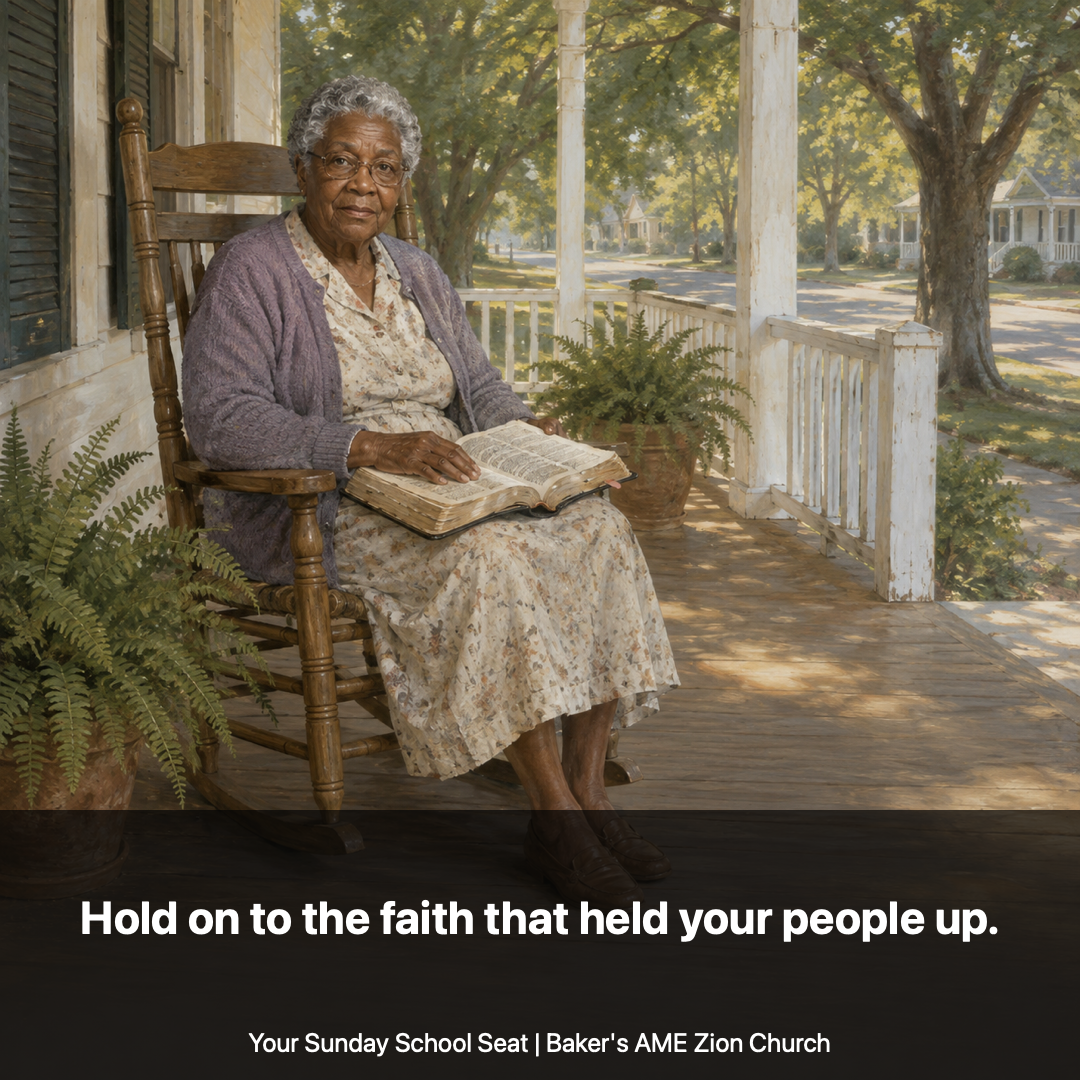
Most of us are standing on something we didn't build. A grandmother's prayers, a church that fed us, a faith handed down by people who had every reason to quit and didn't.
2 Thessalonians 2:13-17 — KJV
13 But we are bound to give thanks alway to God for you, brethren beloved of the Lord, because God hath from the beginning chosen you to salvation through sanctification of the Spirit and belief of the truth: 14 Whereunto he called you by our gospel, to the obtaining of the glory of our Lord Jesus Christ. 15 Therefore, brethren, stand fast, and hold the traditions which ye have been taught, whether by word, or our epistle. 16 Now our Lord Jesus Christ himself, and God, even our Father, which hath loved us, and hath given us everlasting consolation and good hope through grace, 17 Comfort your hearts, and stablish you in every good word and work.
2 Thessalonians 2:13-17 — WEB
13 But we are bound to always give thanks to God for you, brothers loved by the Lord, because God chose you from the beginning for salvation through sanctification of the Spirit and belief in the truth, 14 to which he called you through our Good News, for the obtaining of the glory of our Lord Jesus Christ. 15 So then, brothers, stand firm and hold the traditions which you were taught by us, whether by word or by letter. 16 Now our Lord Jesus Christ himself, and God our Father, who loved us and gave us eternal comfort and good hope through grace, 17 comfort your hearts and establish you in every good work and word.
Explanation
The church at Thessalonica was young and rattled. Somebody had gotten word to them — maybe a rumor, maybe a forged letter — claiming the day of the Lord had already come and gone and they had missed it. You can imagine the panic. Paul writes to steady them, and he does it the way a good elder does: he starts by reminding them who they are. God chose you. God called you. God is not finished with you. Only after that foundation is laid does he tell them what to do.
And what he tells them is short. Stand firm, and hold on to what you were taught. That word "traditions" makes some of us flinch, because we've seen tradition used as a club — this is how we've always done it, so sit down. But Paul isn't talking about the color of the carpet or the order of the announcements. He's talking about the handed-down truth of the gospel itself, the thing passed from one set of hands to the next like a lit candle in a dark hallway. Some of it came by preaching, some by letter. All of it came from somebody who cared enough to pass it on.
That's exactly where our week is headed. On Sunday we'll stand with Joshua at the Jordan River watching him stack twelve stones in the dirt so that generations who weren't there yet would have something to ask about. All week we're going to be tracing the same idea from different angles — what God has done, and what happens to a people who remember it. Monday's word is the first link in that chain: before you can hand anything down, you have to hold on to it.
So on a Labor Day morning, take stock of what's holding you up. Somebody taught you to pray. Somebody sang over you when you were too little to know the words. Somebody kept a church door open through lean years so it would still be open when you needed it. That inheritance is not sentimental — it's structural. And Paul's closing prayer says God intends to use it: that He would comfort your heart and steady you in every good word and work. Not just comfort. Steadiness. The kind that lets you be, for somebody younger, what somebody older was for you.
Thought for the Day
Hold on to the faith that held your people up.
Reflection Question
Who handed you your faith — and what specifically did they give you that you're still standing on?
Prayer
Lord, thank You for the people who carried this faith before I ever showed up. Thank You that You chose me and called me, and that none of this started with me. Help me hold fast to what I was taught instead of letting it slip quietly out of my hands. Comfort my heart today, and steady me in every good word and work. Amen.
This week we walk toward Sunday's lesson: Remember God's Actions.
Sunday, August 30 — She Opened Her Heart, Then Her Home
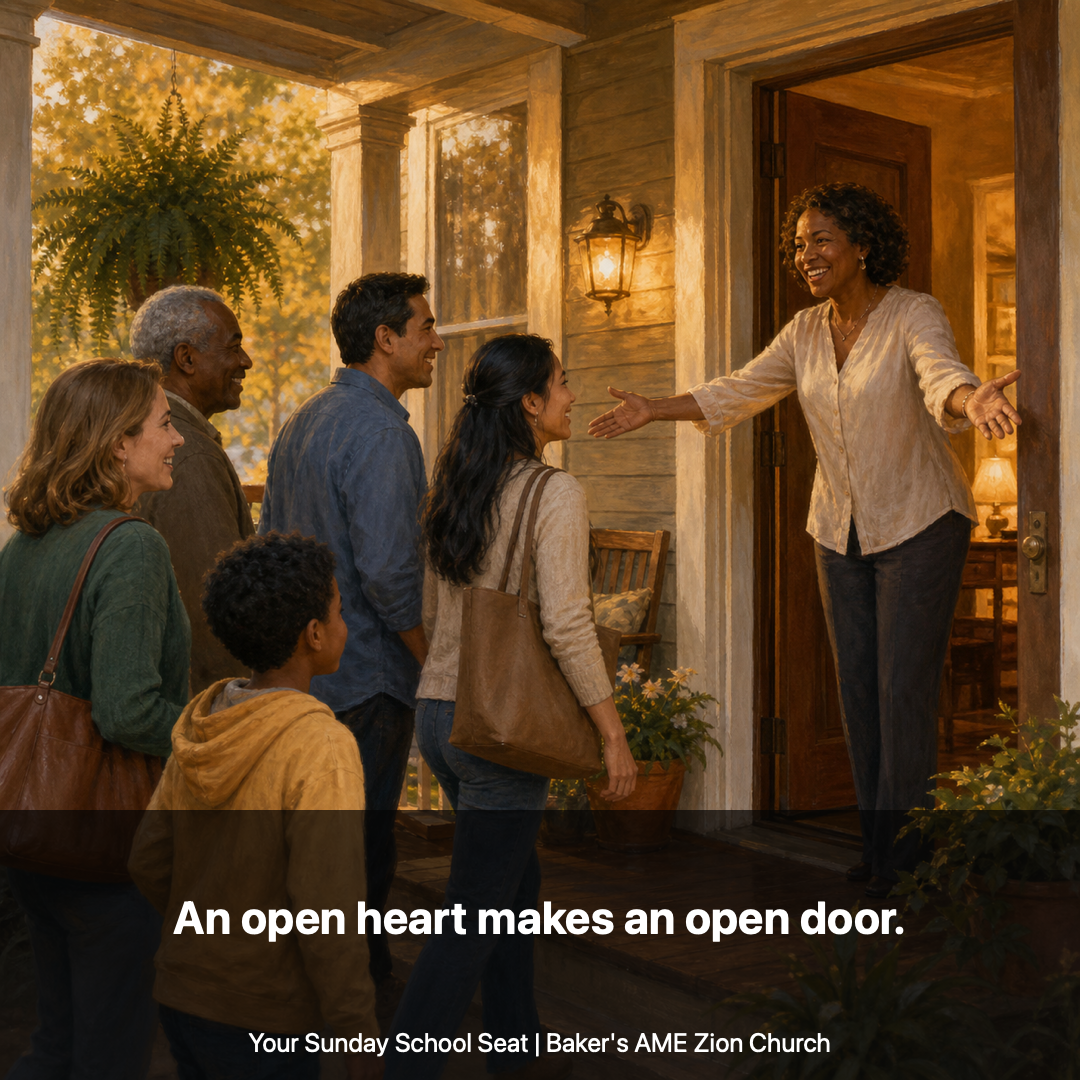
For six days we've watched faithful people make room, invest their gifts, and give with open hands. Today we meet the woman all of it was pointing toward — Lydia, who heard the gospel by a river and immediately threw her door wide open.
Acts 16:11-15, 40 — KJV
11 Therefore loosing from Troas, we came with a straight course to Samothracia, and the next day to Neapolis; 12 And from thence to Philippi, which is the chief city of that part of Macedonia, and a colony: and we were in that city abiding certain days. 13 And on the sabbath we went out of the city by a river side, where prayer was wont to be made; and we sat down, and spake unto the women which resorted thither. 14 And a certain woman named Lydia, a seller of purple, of the city of Thyatira, which worshipped God, heard us: whose heart the Lord opened, that she attended unto the things which were spoken of Paul. 15 And when she was baptized, and her household, she besought us, saying, If ye have judged me to be faithful to the Lord, come into my house, and abide there. And she constrained us. 40 And they went out of the prison, and entered into the house of Lydia: and when they had seen the brethren, they comforted them, and departed.
Acts 16:11-15, 40 — WEB
11 Setting sail therefore from Troas, we made a straight course to Samothrace, and the day following to Neapolis; 12 and from there to Philippi, which is a principal city of the district of Macedonia, a Roman colony. We were staying some days in this city. 13 On the Sabbath day we went outside of the city by a riverside, where we supposed there was a place of prayer, and we sat down and spoke to the women who had come together. 14 A certain woman named Lydia, a seller of purple, of the city of Thyatira, one who worshiped God, heard us. The Lord opened her heart to listen to the things which were spoken by Paul. 15 When she and her household were baptized, she begged us, saying, "If you have judged me to be faithful to the Lord, come into my house and stay." So she persuaded us. 40 They went out of the prison, and entered into Lydia's house. When they had seen the brothers, they encouraged them, then departed.
Explanation
Here is the destination our whole week has been walking toward. Paul and his companions arrive in Philippi, a proud Roman colony, and on the Sabbath they head outside the city to a riverside where people gathered to pray. There they meet Lydia — a businesswoman from Thyatira who dealt in purple cloth, a luxury trade, and who already "worshiped God." As Paul spoke, Luke tells us something beautiful and quiet: "The Lord opened her heart to listen." Her faith began not with her own effort but with God opening a door on the inside. And the moment He did, she opened every door she had.
Watch how fast it happens. She hears, she believes, she and her whole household are baptized, and then — almost in the same breath — she insists that Paul and the others come stay in her home. "If you have judged me to be faithful to the Lord, come into my house and stay." She won't take no for an answer; the text says "she persuaded us." An opened heart becomes an open home immediately. There's no gap between what she believes and what she does. Her hospitality is her faith made visible. And it lasts: by verse 40, after Paul and Silas have been beaten and jailed and finally released, where do they go? Back to Lydia's house, which has become the meeting place of the whole Philippian church. Her open door became a home base for the gospel in Europe.
Now look at the week she completes. Peter told us to be stewards who use hospitality without grudging — Lydia does. The Shunammite made a room for a man of God — Lydia makes room for a whole band of them. The Proverbs 31 woman ran a business and reached out her hand — Lydia is that woman, purple and all. The faithful servants invested what they were given — Lydia invests her home in the kingdom. Job held his wealth loosely and provided for others — Lydia holds her purple trade the same way. Every thread of the week gathers here, in one convert by a riverside who proved her faith by setting a table.
That's why our lesson is titled "All Are Welcome." Lydia was welcomed by God — an outsider, a woman, a foreigner in Philippi — and she turned around and welcomed everyone else. The church was born in her living room because she refused to keep her open heart to herself. This is the invitation waiting for every one of us: to let God open our hearts, and then to open our doors. Faith that stays inside is a talent still buried in the ground. Faith like Lydia's sets out the chairs, puts on the coffee, and says to a weary world, come in and stay. There's room here. And there's a seat waiting for you.
Thought for the Day
God opens hearts; open hearts open their doors.
Reflection Question
If God has opened your heart, who is He asking you to welcome through your door this week?
Prayer
Lord, do for me what You did for Lydia — open my heart to truly listen. And don't let it stop there. Turn my open heart into an open home, an open hand, an open life. Make me someone who welcomes others the way You welcomed me: freely, gladly, with no strings attached. Thank You that in Your house, all are welcome. Amen.
Today is Sunday school. We saved you a seat.
Saturday, August 29 — What You Do With What You Have
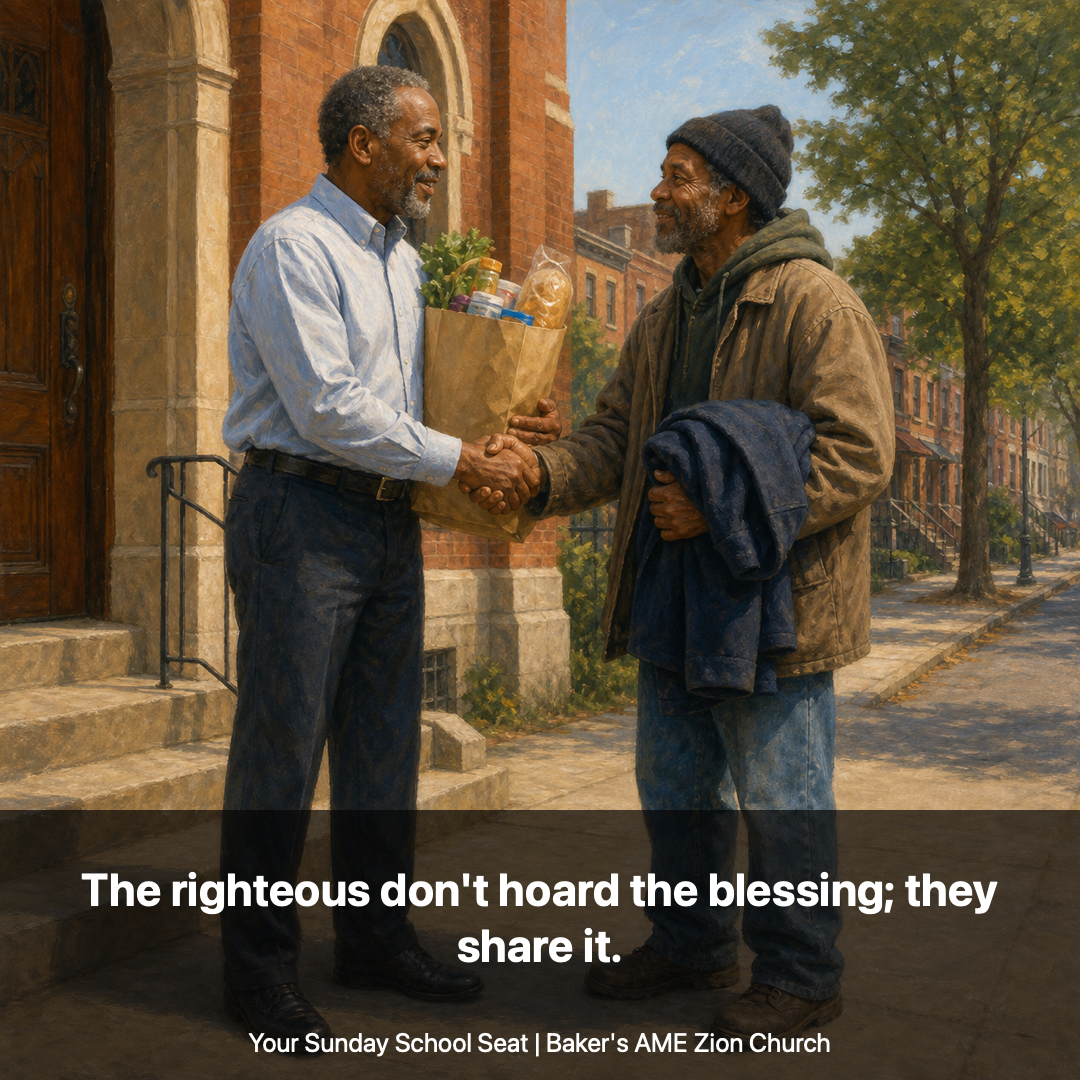
Job is defending his life before God, and his argument isn't about sacrifices or prayers. It's about how he treated the poor, the widow, and the fatherless — and about the wealth he refused to worship.
Job 31:16-28 — KJV
16 If I have withheld the poor from their desire, or have caused the eyes of the widow to fail; 17 Or have eaten my morsel myself alone, and the fatherless hath not eaten thereof; 18 (For from my youth he was brought up with me, as with a father, and I have guided her from my mother's womb;) 19 If I have seen any perish for want of clothing, or any poor without covering; 20 If his loins have not blessed me, and if he were not warmed with the fleece of my sheep; 21 If I have lifted up my hand against the fatherless, when I saw my help in the gate: 22 Then let mine arm fall from my shoulder blade, and mine arm be broken from the bone. 23 For destruction from God was a terror to me, and by reason of his highness I could not endure. 24 If I have made gold my hope, or have said to the fine gold, Thou art my confidence; 25 If I rejoiced because my wealth was great, and because mine hand had gotten much; 26 If I beheld the sun when it shined, or the moon walking in brightness; 27 And my heart hath been secretly enticed, or my mouth hath kissed my hand: 28 This also were an iniquity to be punished by the judge: for I should have denied the God that is above.
Job 31:16-28 — WEB
16 "If I have withheld the poor from their desire, or have caused the eyes of the widow to fail, 17 or have eaten my morsel alone, and the fatherless has not eaten of it 18 (no, from my youth he grew up with me as with a father, her have I guided from my mother's womb); 19 if I have seen any perish for want of clothing, or that the needy had no covering; 20 if his heart hasn't blessed me, if he hasn't been warmed with my sheep's fleece; 21 if I have lifted up my hand against the fatherless, because I saw my help in the gate, 22 then let my shoulder fall from the shoulder blade, and my arm be broken from the bone. 23 For calamity from God is a terror to me. Because of his majesty, I can do nothing. 24 "If I have made gold my hope, and have said to the fine gold, 'You are my confidence'; 25 If I have rejoiced because my wealth was great, and because my hand had gotten much; 26 if I have seen the sun when it shined, or the moon moving in splendor, 27 and my heart has been secretly enticed, and my hand threw a kiss from my mouth, 28 this also would be an iniquity to be punished by the judges, for I should have denied the God who is above.
Explanation
By this point in the book of Job, our man has lost nearly everything and endured round after round of accusation from his friends. Here he mounts his defense — not a list of religious rituals, but an accounting of how he lived among people who could do nothing for him. He points to the poor whose desires he did not withhold, the widow whose eyes he did not cause to fail, the fatherless he fed at his own table and raised almost as his own. Job's righteousness wasn't private and internal. It was measured at the level of a hungry stranger's plate and a cold man's blanket.
Then the passage takes a turn that connects it to everything we've read this week. Job says that if he had made gold his hope, if he had gloated over his wealth or trusted his fortune the way some people trust the sun and moon, that too would have been a sin — a quiet denial of "the God who is above." Here's a wealthy man insisting that the danger of riches isn't the having; it's the worshiping. He held his fortune with an open hand precisely because he refused to let it become his god. His provision flowed to others because it never became his idol.
That's the exact intersection our week has been driving toward. All week we've watched faithful people put their resources to work for others: Peter's stewards, the Shunammite's spare room, the Proverbs woman's open hand, the servants who invested their talents. Job adds the warning underneath all of it — the reason people bury their gifts and close their doors is usually that they've quietly started to trust their stuff more than their God. Tomorrow, Lydia will hold her purple-trade wealth the way Job describes: loosely, generously, as something to be spent on God's people rather than hoarded for herself.
So this Saturday, as the week's chores and errands and bills press in, Job hands us a mirror. Two questions, really. First: does anyone eat, stay warm, or stand a little taller because of what God has entrusted to you? And second, quieter and harder: what are you actually trusting? It's possible to be generous with your hands while your heart is slowly bowing to your bank balance. The righteous provide for others, Job says, and they can do it freely because their confidence was never in the gold to begin with. Give it away. And keep your heart free.
Thought for the Day
What we share proves what we really believe.
Reflection Question
Is there anything you've quietly begun to trust more than God — and how might loosening your grip bless someone else?
Prayer
Lord, You see straight through my hands to my heart. Keep me from the slow idolatry of trusting what I own. Make me generous to the poor, the widow, and the forgotten — not for show, but because my confidence rests in You alone. Let my open hand be honest proof of where my hope truly lies. Amen.
This week we walk toward Sunday's lesson: Lydia, Judged to Be Faithful.
Friday, August 28 — The Sin of Playing It Safe

We usually think of sin as doing something wrong. But the servant who got in trouble in this story didn't steal, cheat, or lose a dime. His sin was that he was too afraid to try.
Matthew 25:24-30 — KJV
24 Then he which had received the one talent came and said, Lord, I knew thee that thou art an hard man, reaping where thou hast not sown, and gathering where thou hast not strawed: 25 And I was afraid, and went and hid thy talent in the earth: lo, there thou hast that is thine. 26 His lord answered and said unto him, Thou wicked and slothful servant, thou knewest that I reap where I sowed not, and gather where I have not strawed: 27 Thou oughtest therefore to have put my money to the exchangers, and then at my coming I should have received mine own with usury. 28 Take therefore the talent from him, and give it unto him which hath ten talents. 29 For unto every one that hath shall be given, and he shall have abundance: but from him that hath not shall be taken away even that which he hath. 30 And cast ye the unprofitable servant into outer darkness: there shall be weeping and gnashing of teeth.
Matthew 25:24-30 — WEB
24 "He also who had received the one talent came and said, 'Lord, I knew you that you are a hard man, reaping where you did not sow, and gathering where you did not scatter. 25 I was afraid, and went away and hid your talent in the earth. Behold, you have what is yours.' 26 "But his lord answered him, 'You wicked and slothful servant. You knew that I reap where I didn't sow, and gather where I didn't scatter. 27 You ought therefore to have deposited my money with the bankers, and at my coming I should have received back my own with interest. 28 Take away therefore the talent from him and give it to him who has the ten talents. 29 For to everyone who has will be given, and he will have abundance, but from him who doesn't have, even that which he has will be taken away. 30 Throw out the unprofitable servant into the outer darkness, where there will be weeping and gnashing of teeth.'
Explanation
Today we meet the third servant, and his story is a warning. While the first two put their master's money to work, this one dug a hole and buried his single talent in the ground. When the master returns, the servant offers a defense that sounds almost pious: "I was afraid, so I kept it safe. Here it is — exactly what you gave me." He didn't lose anything. He gave back precisely what he received. And the master calls him "wicked and slothful."
That verdict stings until we understand it. The servant's real problem is revealed in his own words: "I knew you that you are a hard man." He had a distorted picture of his master — fearful, suspicious, expecting the worst — and that picture froze him. He treated a generous entrustment like a trap. Fear told him the safest thing was to do nothing, and doing nothing turned out to be the one unforgivable move. Even the bank, the master notes, would have earned a little interest. The sin here isn't failure. It's the refusal to risk anything at all.
This is the sharp edge of the week's message. The theme printed for today calls it plainly: "Blessed Are the Risk-takers." Faithfulness, we've been learning all week, means putting what God gives into motion — and motion always involves risk. The Shunammite risked her resources on a stranger. The Proverbs woman risked capital on a field. Sunday's Lydia will risk her reputation and her home by welcoming a group of traveling preachers who'd just stirred up trouble in town. Every one of them could have played it safe and buried their gift. None of them did. The buried talent is the one life the Bible holds up and says, don't let this be you.
So here's the honest question for a Friday, at the end of a working week: where is fear making you bury something God meant you to invest? Maybe it's a dream you've talked yourself out of, a conversation you keep avoiding, a gift you won't offer because you might look foolish, a step of generosity you won't take because you might come up short. Playing it safe feels responsible. Often it's just fear wearing a respectable coat. The good news is that our Master is nothing like the servant imagined — He's generous, patient, and eager to say "Well done." You don't have to be spectacular. You just have to stop burying what He gave you. Dig it up this weekend. Put it to work.
Thought for the Day
Fear buries what faith was meant to invest.
Reflection Question
What gift, dream, or act of generosity have you buried because you were afraid to risk it?
Prayer
Lord, forgive me for the times fear has looked like wisdom. I've buried gifts to keep them safe when You asked me to put them to work. Heal my picture of You — remind me that You are generous, not harsh. Give me the courage to take the risk of faith, trusting that You honor the servant who tries. Amen.
This week we walk toward Sunday's lesson: Lydia, Judged to Be Faithful.
Thursday, August 27 — Faithful With What You Were Given
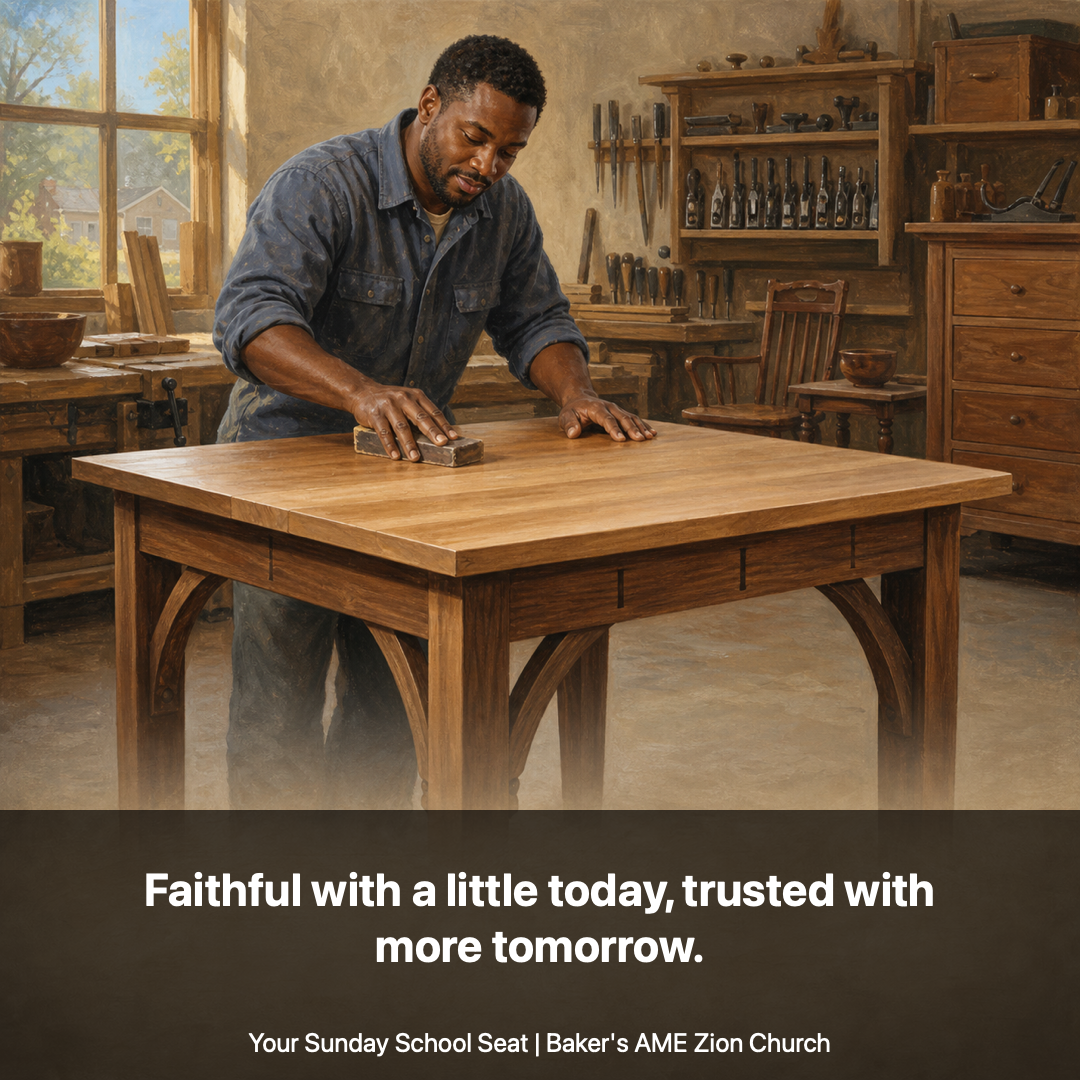
Two servants get the exact same words from their master: "Well done." One was handed five, the other only two. Turns out the amount was never the point.
Matthew 25:14-23 — KJV
14 For the kingdom of heaven is as a man travelling into a far country, who called his own servants, and delivered unto them his goods. 15 And unto one he gave five talents, to another two, and to another one; to every man according to his several ability; and straightway took his journey. 16 Then he that had received the five talents went and traded with the same, and made them other five talents. 17 And likewise he that had received two, he also gained other two. 18 But he that had received one went and digged in the earth, and hid his lord's money. 19 After a long time the lord of those servants cometh, and reckoneth with them. 20 And so he that had received five talents came and brought other five talents, saying, Lord, thou deliveredst unto me five talents: behold, I have gained beside them five talents more. 21 His lord said unto him, Well done, thou good and faithful servant: thou hast been faithful over a few things, I will make thee ruler over many things: enter thou into the joy of thy lord. 22 He also that had received two talents came and said, Lord, thou deliveredst unto me two talents: behold, I have gained two other talents beside them. 23 His lord said unto him, Well done, good and faithful servant; thou hast been faithful over a few things, I will make thee ruler over many things: enter thou into the joy of thy lord.
Matthew 25:14-23 — WEB
14 "For it is like a man going into another country, who called his own servants and entrusted his goods to them. 15 To one he gave five talents, to another two, to another one, to each according to his own ability. Then he went on his journey. 16 Immediately he who received the five talents went and traded with them, and made another five talents. 17 In the same way, he also who got the two gained another two. 18 But he who received the one talent went away and dug in the earth and hid his lord's money. 19 "Now after a long time the lord of those servants came, and settled accounts with them. 20 He who received the five talents came and brought another five talents, saying, 'Lord, you delivered to me five talents. Behold, I have gained another five talents besides them.' 21 "His lord said to him, 'Well done, good and faithful servant. You have been faithful over a few things, I will set you over many things. Enter into the joy of your lord.' 22 "He also who got the two talents came and said, 'Lord, you delivered to me two talents. Behold, I have gained another two talents besides them.' 23 "His lord said to him, 'Well done, good and faithful servant. You have been faithful over a few things. I will set you over many things. Enter into the joy of your lord.'
Explanation
Jesus tells a story about a wealthy man leaving on a long journey. Before he goes, he entrusts his estate to three servants — five "talents" to one, two to another, one to the last, "each according to his own ability." A talent wasn't a skill in the modern sense; it was a staggering sum of money, years of wages. The point is that the master handed over real value and real responsibility, then left the servants free to act. Today's reading follows the first two. Both went out, put the money to work, and doubled it. And both heard the same seven words that everyone longs to hear: "Well done, good and faithful servant."
Notice what the master does not say. He doesn't tell the five-talent servant, "You did more, so you're my favorite." The commendation is identical, because the standard was never the size of the return — it was faithfulness with whatever was entrusted. The man who turned two into four gets the same welcome as the man who turned five into ten. God grades on faithfulness, not on comparison. That should be deeply freeing to anyone who has ever looked at someone else's five talents and quietly concluded their own two weren't worth investing.
This ties tightly into the week we've been building. Monday, Peter called us stewards of God's grace. Wednesday, the Proverbs woman put her resources to work. Today, Jesus makes the principle unmistakable: what God gives, He expects us to use — and He rewards the using, not the amount. Sunday's Lydia will do precisely this. She takes what she has — a home, a business, a willing spirit — and invests it in the kingdom by hosting the church in Philippi. She's a "good and faithful servant" who didn't bury a thing.
For your Thursday, this cuts through a lot of noise. Comparison is the great thief of faithfulness. We look at someone with more time, more money, more talent, more platform, and we tell ourselves that until we have five, our two don't count. Jesus disagrees. The measure of your life is not how your five compares to someone else's, but whether you put your two to work. The single mom praying with her kids at bedtime, the retiree teaching one boy to read, the worker doing an honest job with quiet integrity — these are the servants who will hear "Well done." Stop measuring your portion against your neighbor's. Start investing the portion God actually put in your hands.
Thought for the Day
God isn't asking for perfect. He's asking for faithful.
Reflection Question
Where have you let comparison keep you from investing what God has already given you?
Prayer
Master, You have entrusted me with more than I realize. Forgive me for the times I measured my portion against someone else's and used it as an excuse to do nothing. Help me invest what's in my hands with courage and joy. And let my life, small as it may seem, one day hear Your "Well done." Amen.
This week we walk toward Sunday's lesson: Lydia, Judged to Be Faithful.
Wednesday, August 26 — Faith With Its Sleeves Rolled Up
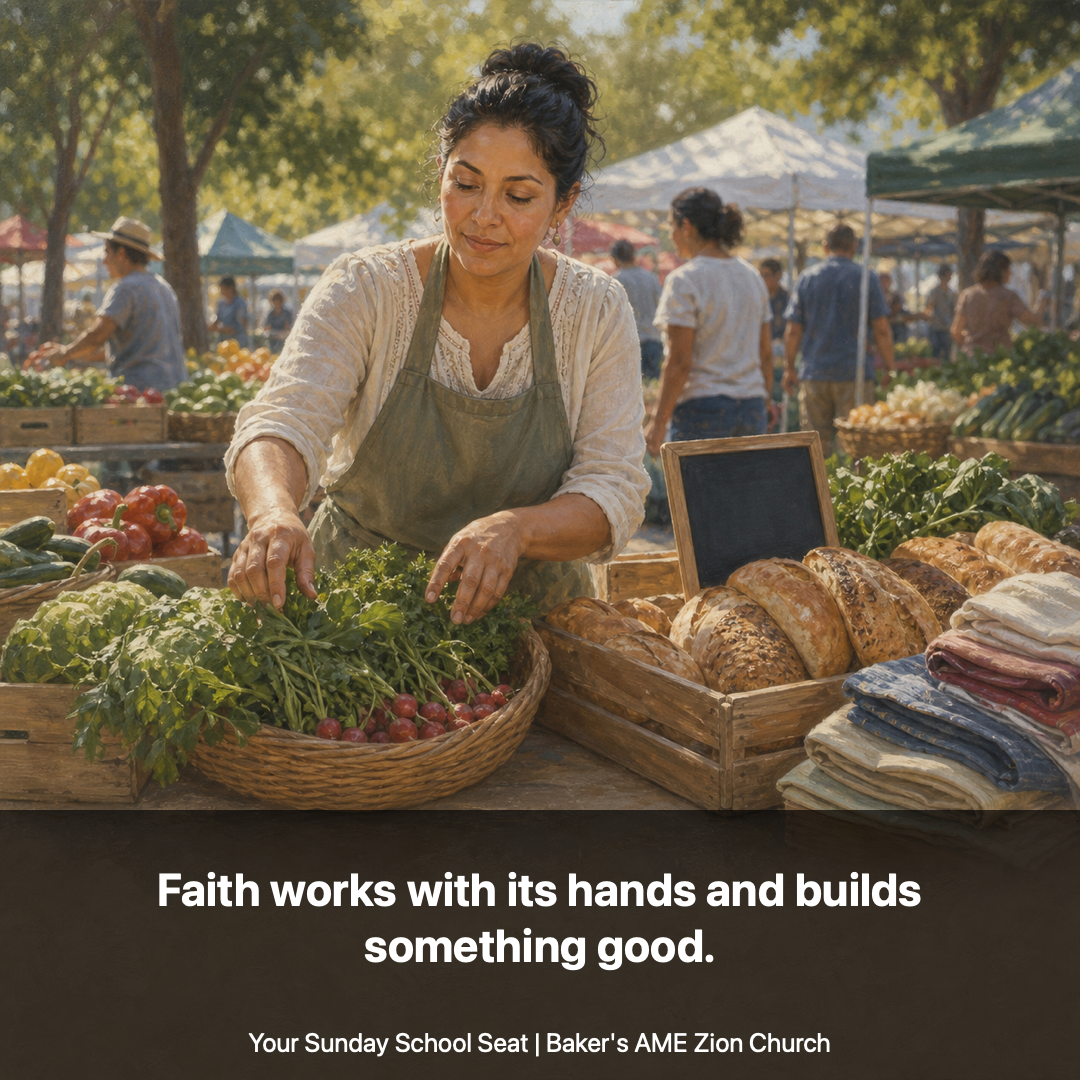
We sometimes picture the "godly woman" as quiet and folded-handed. Proverbs 31 pictures her running a business, buying real estate, and staying up past midnight — with one hand always stretched out to the poor.
Proverbs 31:10-22 — KJV
10 Who can find a virtuous woman? for her price is far above rubies. 11 The heart of her husband doth safely trust in her, so that he shall have no need of spoil. 12 She will do him good and not evil all the days of her life. 13 She seeketh wool, and flax, and worketh willingly with her hands. 14 She is like the merchants' ships; she bringeth her food from afar. 15 She riseth also while it is yet night, and giveth meat to her household, and a portion to her maidens. 16 She considereth a field, and buyeth it: with the fruit of her hands she planteth a vineyard. 17 She girdeth her loins with strength, and strengtheneth her arms. 18 She perceiveth that her merchandise is good: her candle goeth not out by night. 19 She layeth her hands to the spindle, and her hands hold the distaff. 20 She stretcheth out her hand to the poor; yea, she reacheth forth her hands to the needy. 21 She is not afraid of the snow for her household: for all her household are clothed with scarlet. 22 She maketh herself coverings of tapestry; her clothing is silk and purple.
Proverbs 31:10-22 — WEB
10 Who can find a worthy woman? For her value is far above rubies. 11 The heart of her husband trusts in her. He shall have no lack of gain. 12 She does him good, and not harm, all the days of her life. 13 She seeks wool and flax, and works eagerly with her hands. 14 She is like the merchant ships. She brings her bread from afar. 15 She rises also while it is yet night, gives food to her household, and portions for her servant girls. 16 She considers a field, and buys it. With the fruit of her hands, she plants a vineyard. 17 She arms her waist with strength, and makes her arms strong. 18 She perceives that her merchandise is profitable. Her lamp doesn't go out by night. 19 She lays her hands to the distaff, and her hands hold the spindle. 20 She opens her arms to the poor; yes, she extends her hands to the needy. 21 She is not afraid of the snow for her household, for all her household are clothed with scarlet. 22 She makes for herself carpets of tapestry. Her clothing is fine linen and purple.
Explanation
This famous poem closes the book of Proverbs, and it's easy to misread it as a checklist that makes ordinary women feel like they're failing. Read it again slowly and you'll notice it isn't a to-do list — it's a portrait of what wisdom looks like when it moves into a real life and gets to work. The woman here is nobody's decoration. She sources materials, manages a household, evaluates a field and buys it, plants a vineyard with her own profits, and keeps her lamp burning late because there's work worth finishing. She's strong — the text says she "arms her waist with strength." This is faith with calluses.
But here's the verse that keeps the whole thing from becoming a hymn to hustle. Right in the middle of all that industry — verse 20 — "She opens her arms to the poor; yes, she extends her hands to the needy." The same hands that work the spindle and sign the deed reach out to people who can't pay her back. Her competence and her compassion aren't in competition. Her success funds her generosity. She's capable so that she can be openhanded. That's the point Proverbs is making, and it's the point our whole week keeps circling.
You can see why this reading sits where it does. On Sunday we meet Lydia, "a seller of purple" — a first-century entrepreneur running a business in luxury textiles, the very "purple" this Proverbs woman wears. Lydia is Proverbs 31 walking around in the New Testament: a working woman with resources, who used what she built to welcome and provide for others. The daily readings are quietly assembling a picture of the faithful person as someone who works hard and gives freely, and Lydia is where the picture comes into focus.
For those of us clocking in tomorrow, this is a bracing word. Your job is not a distraction from your faith. Your competence at work, your head for numbers, your steady management of a home, your late nights getting it right — these can be holy. The measure isn't whether you're ambitious. It's whether your open hand keeps pace with your working hand. Do the poor benefit from your success? Does anyone eat because you're good at what you do? A capable life that never reaches outward is just a well-run island. But a capable life with an open hand — that's a woman worth far more than rubies, and a man too. Work hard this week. Then reach out.
Thought for the Day
Faithful hands work hard and still reach out to the poor.
Reflection Question
How could the skill or success God has given you become a blessing to someone in need?
Prayer
Lord, thank You for the work of my hands and the strength to do it. Keep me from the lie that says my faith and my labor live in separate rooms. Let my competence serve Your purposes, and never let my working hand outrun my open one. Make me capable and generous in the same breath. Amen.
This week we walk toward Sunday's lesson: Lydia, Judged to Be Faithful.
Tuesday, August 25 — The God Who Notices Open Doors

There's a woman in Shunem whose name we never learn, but God never forgot what she did with a spare room and a plate of food. Small kindnesses have a way of getting God's attention.
2 Kings 4:8-17 — KJV
8 And it fell on a day, that Elisha passed to Shunem, where was a great woman; and she constrained him to eat bread. And so it was, that as oft as he passed by, he turned in thither to eat bread. 9 And she said unto her husband, Behold now, I perceive that this is an holy man of God, which passeth by us continually. 10 Let us make a little chamber, I pray thee, on the wall; and let us set for him there a bed, and a table, and a stool, and a candlestick: and it shall be, when he cometh to us, that he shall turn in thither. 11 And it fell on a day, that he came thither, and he turned into the chamber, and lay there. 12 And he said to Gehazi his servant, Call this Shunammite. And when he had called her, she stood before him. 13 And he said unto him, Say now unto her, Behold, thou hast been careful for us with all this care; what is to be done for thee? wouldest thou be spoken for to the king, or to the captain of the host? And she answered, I dwell among mine own people. 14 And he said, What then is to be done for her? And Gehazi answered, Verily she hath no child, and her husband is old. 15 And he said, Call her. And when he had called her, she stood in the door. 16 And he said, About this season, according to the time of life, thou shalt embrace a son. And she said, Nay, my lord, thou man of God, do not lie unto thine handmaid. 17 And the woman conceived, and bare a son at that season that Elisha had said unto her, according to the time of life.
2 Kings 4:8-17 — WEB
8 One day Elisha went to Shunem, where there was a prominent woman; and she persuaded him to eat bread. So it was, that as often as he passed by, he turned in there to eat bread. 9 She said to her husband, "See now, I perceive that this is a holy man of God who passes by us continually. 10 Please let's make a little room on the wall. Let's set a bed, a table, a chair, and a lamp stand for him there. When he comes to us, he can stay there." 11 One day he came there, and he turned into the room and lay there. 12 He said to Gehazi his servant, "Call this Shunammite." When he had called her, she stood before him. 13 He said to him, "Say now to her, 'Behold, you have cared for us with all this care. What is to be done for you? Would you like to be spoken for to the king, or to the captain of the army?'" She answered, "I dwell among my own people." 14 He said, "What then is to be done for her?" Gehazi answered, "Most certainly she has no son, and her husband is old." 15 He said, "Call her." When he had called her, she stood in the doorway. 16 He said, "At this season, when the time comes around, you will embrace a son." She said, "No, my lord, you man of God, do not lie to your servant." 17 The woman conceived, and bore a son at that season, when the time came around, as Elisha had said to her.
Explanation
The Shunammite woman had means — the text calls her "great" or "prominent" — and she used them the way faithful people use whatever they have: to make room for someone else. She noticed the prophet Elisha passing through, fed him, and then went a step further. She talked her husband into building a small rooftop room, furnished it plainly with a bed, a table, a chair, and a lamp, and kept it ready. No fanfare. Just a door that was always open to a servant of God.
What's striking is what she didn't want in return. When Elisha offers to pull strings for her with the king or the army commander, she waves it off: "I dwell among my own people." She wasn't being hospitable to get ahead. She had everything she thought she needed and was content. Her kindness came with no invoice attached. And that, it turns out, is exactly the kind of generosity heaven leans toward. It's Elisha's servant who spots the one ache she never mentioned — she had no child, and her husband was old. God saw the need she never voiced and answered it with a son.
This is the thread running through our whole week. Yesterday Peter told us to "use hospitality one to another without grudging." Today we watch what that looks like in a real house with real furniture. And it points straight to Sunday, when Lydia will open her home to Paul the same way — no strings, no calculation, just room made for the people of God. The Shunammite and Lydia are separated by centuries and an ocean, but they're doing the identical holy thing: turning private space into a place where God's work can rest.
For us, the lesson lands close to home. Most of us can't fix the world, but almost all of us can make a little room. A seat at the table. A guest bed made up. A porch light left on. A standing invitation to the person who eats alone. We tend to think God is impressed by big, public acts of faith. This story says He's watching the ordinary generosity nobody applauds — the extra plate, the tidy spare room, the quiet "you're always welcome here." God sees hospitality. And in His own timing, He rewards it in ways we'd never have thought to ask for.
Thought for the Day
Make room for others; God makes room for you.
Reflection Question
Is there a "spare room" in your life — space, time, or resources — you could open to someone this week?
Prayer
Father, thank You for noticing the quiet kindnesses no one else sees. Make me like the woman of Shunem — content, unhurried, and quick to make room. Free me from keeping score, so I can give without expecting anything back. And surprise me, Lord, with the ways You reward an open door. Amen.
This week we walk toward Sunday's lesson: Lydia, Judged to Be Faithful.
Monday, August 24 — Every Gift Was Meant to Be Given
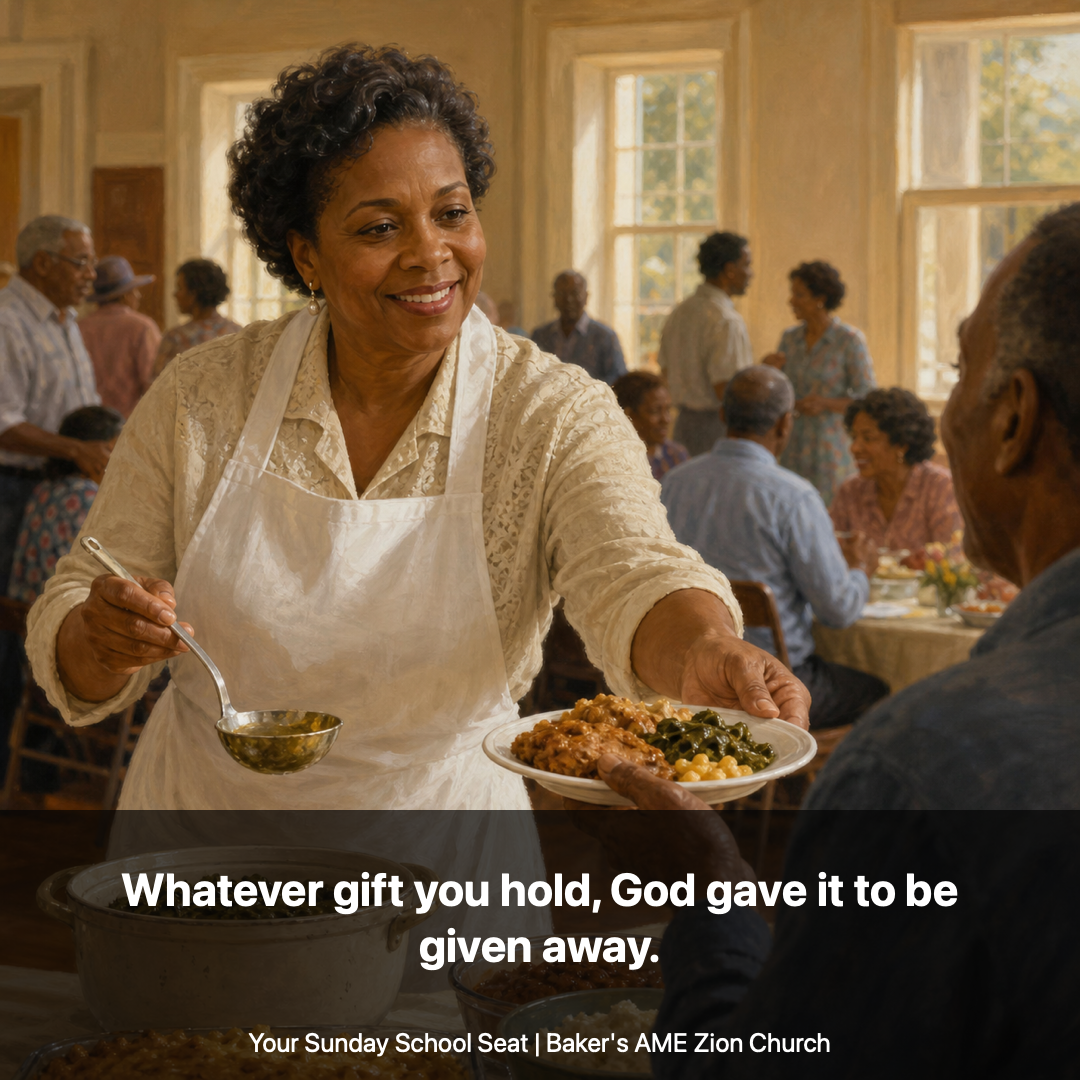
Somewhere in your day today you'll use a gift you didn't earn and rarely think about — a steady set of hands, a way with words, a knack for making people feel at ease. Peter says none of it was ever really yours to keep.
1 Peter 4:7-11 — KJV
7 But the end of all things is at hand: be ye therefore sober, and watch unto prayer. 8 And above all things have fervent charity among yourselves: for charity shall cover the multitude of sins. 9 Use hospitality one to another without grudging. 10 As every man hath received the gift, even so minister the same one to another, as good stewards of the manifold grace of God. 11 If any man speak, let him speak as the oracles of God; if any man minister, let him do it as of the ability which God giveth: that God in all things may be glorified through Jesus Christ, to whom be praise and dominion for ever and ever. Amen.
1 Peter 4:7-11 — WEB
7 But the end of all things is near. Therefore be of sound mind, self-controlled, and sober in prayer. 8 And above all things be earnest in your love among yourselves, for love covers a multitude of sins. 9 Be hospitable to one another without grumbling. 10 As each has received a gift, employ it in serving one another, as good managers of the grace of God in its various forms. 11 If anyone speaks, let it be as it were the very words of God. If anyone serves, let it be as of the strength which God supplies, that in all things God may be glorified through Jesus Christ, to whom belong the glory and the dominion forever and ever. Amen.
Explanation
Peter wrote these words to scattered believers living under pressure, people who had every reason to hunker down and protect what little they had. He tells them the opposite. Because "the end of all things is near," he says, live wide open — pray with a clear head, love each other hard, and keep the guest room ready. Crisis, in Peter's mind, isn't a reason to close the door. It's a reason to fling it wider.
The heart of the passage is verse 10: "As each has received a gift, employ it in serving one another, as good managers of the grace of God." That word "managers" — or "stewards" in the King James — is the key. A steward never owns the estate; a steward runs it well on behalf of the owner. Peter is saying that whatever you're good at, whatever grace God dropped into your life, came with your name on the delivery label but not on the deed. It was handed to you so it could be handed on. He splits it into two everyday categories: those who speak and those who serve. If you talk, talk like your words matter to God. If you work, work with the strength He supplies. Either way the goal is the same — "that in all things God may be glorified."
This is where the week begins its walk toward Sunday. On Sunday we'll meet Lydia, a businesswoman in Philippi who heard the gospel by a riverside and immediately opened her home to Paul and his companions. She is Peter's theology in a person: a woman who took what God had given her — a house, a trade, an open heart — and put it to work serving others. Before we get to her Sunday, Peter wants us to understand what she understood. Faithfulness isn't mostly about what we believe on the inside. It shows up in what we do with what's in our hands.
So the question for a Monday is refreshingly practical. Not "Am I gifted enough?" but "Am I spending what I've got?" The cook who feeds the grieving family, the neighbor who jump-starts the dead battery, the grandmother who prays over the phone at 6 a.m. — these aren't small people doing small things. They're stewards, managing the grace of God in its various forms. Today, spend a gift instead of hoarding it, and watch how quickly a plain Monday starts to glorify God.
Thought for the Day
Whatever gift you hold, God gave it to be given away.
Reflection Question
What is one gift you tend to hold back — and who around you needs it this week?
Prayer
Lord, thank You for the gifts I didn't earn and too often overlook. Help me see them for what they are — grace to be managed, not treasure to be buried. Give me the strength You promised, so that when I speak I honor You and when I serve I point to You. Make my hands generous today. Amen.
This week we walk toward Sunday's lesson: Lydia, Judged to Be Faithful.
August 24-30, 2026 - Lydia, Judged to Be Faithful
Good morning, and welcome back to Your Sunday School Seat. Pour yourself a cup of coffee and settle in, because this week has a story to tell — and it all builds toward a woman named Lydia and one simple truth: all are welcome.
Here's the thread that runs through all seven days. Faithfulness isn't just something we feel on the inside. It's something we do with our hands and our homes. It opens up. It makes room. It takes what God gives and turns it toward other people. Watch how the week walks us there, one day at a time.
We start on Monday in First Peter, chapter four. Peter is writing to people under pressure, and instead of telling them to hunker down, he tells them to open up. Whatever gift you've got, he says, you're just the manager of it — a steward of the grace of God. It was handed to you so it could be handed on. That's where the week begins: every gift was meant to be given.
Tuesday takes us to Second Kings and a woman in the town of Shunem. She notices the prophet Elisha passing through, feeds him, and builds a little room on her roof so he'll always have a place to rest. She asks for nothing in return. And God, who sees the kindness nobody applauds, blesses her with the one thing her heart most wanted. The lesson? Make room for others, and God makes room for you.
Wednesday, we open Proverbs 31, and we meet a woman who shatters our stereotypes. She's running a business, buying a field, planting a vineyard, working late into the night. But right in the middle of all that hustle, verse twenty says she opens her arms to the poor. Her success and her generosity aren't fighting each other. She's capable so that she can be openhanded.
Thursday and Friday give us two halves of the same story — Jesus' parable of the talents. On Thursday, two servants take what their master entrusted to them and put it to work. Different amounts, but the same reward: "Well done, good and faithful servant." God isn't grading on the size of the return. He's looking for faithfulness. Then Friday shows us the third servant, the one who was so afraid he buried his talent in the ground. He didn't lose anything — and that was exactly the problem. Fear buries what faith was meant to invest. Playing it safe was the one thing the master couldn't accept.
Saturday, we sit with Job. He's lost nearly everything, and when he defends his life, he doesn't point to his religious rituals. He points to how he treated the poor, the widow, and the fatherless — and to the fact that he never let his wealth become his god. The righteous provide for others, Job shows us, and they can give freely because their confidence was never in the gold to begin with. What we share proves what we really believe.
And then comes Sunday, and everything gathers into one person. By a riverside outside Philippi, Paul meets Lydia — a businesswoman who sold purple cloth, a woman who already worshiped God. As Paul spoke, Luke tells us the Lord opened her heart. And the moment God opened her heart on the inside, Lydia opened every door she had. She's baptized with her whole household, and immediately she insists Paul and his friends stay in her home. She won't take no for an answer. Her open heart becomes an open home — and that home becomes the birthplace of the church in Philippi.
Do you see how the whole week was walking toward her? Peter's steward, the Shunammite's spare room, the Proverbs woman's open hand, the servants who invested, Job's loose grip on his wealth — all of it lives in Lydia. She was welcomed by God, an outsider by a river, and she turned around and welcomed everyone else. That's why Sunday's lesson is called "Lydia, Judged to Be Faithful," and why the topic is simply this: all are welcome.
So here's the invitation this week leaves with you. Let God open your heart — and then open your door. Faith that stays inside is just a talent buried in the ground. But faith like Lydia's sets out the chairs, puts on the coffee, and tells a tired world, come in and stay. There's room here.
And there's a seat with your name on it. Come join us for Sunday school. We saved you a seat.
Sunday, August 23 — Continue In What You Have Learned
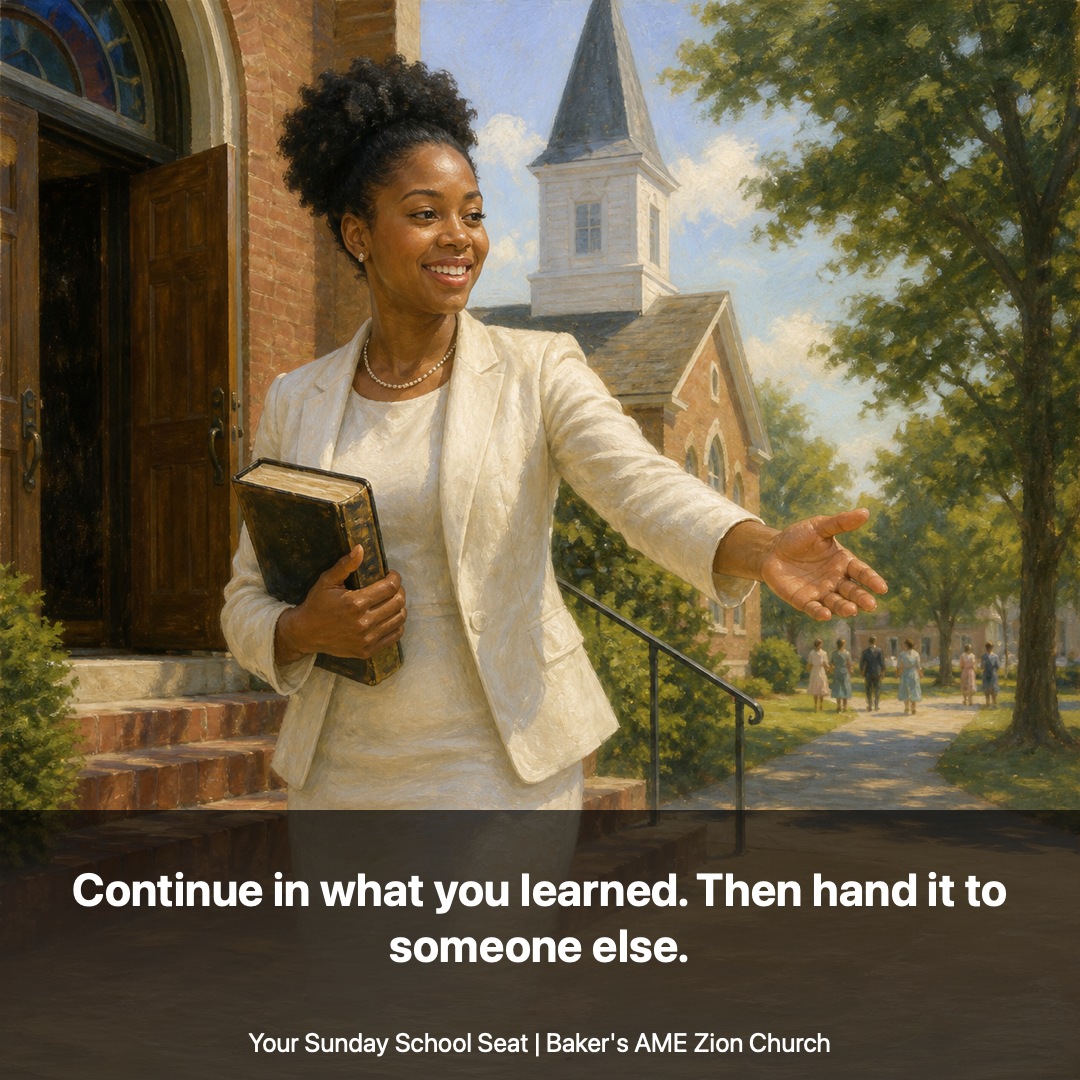
The faith that will carry you through the hard years is usually the faith you learned before you understood it.
2 Timothy 3:10-11, 14-16 — KJV
10 But thou hast fully known my doctrine, manner of life, purpose, faith, longsuffering, charity, patience, 11 Persecutions, afflictions, which came unto me at Antioch, at Iconium, at Lystra; what persecutions I endured: but out of them all the Lord delivered me. 14 But continue thou in the things which thou hast learned and hast been assured of, knowing of whom thou hast learned them; 15 And that from a child thou hast known the holy scriptures, which are able to make thee wise unto salvation through faith which is in Christ Jesus. 16 All scripture is given by inspiration of God, and is profitable for doctrine, for reproof, for correction, for instruction in righteousness:
2 Timothy 3:10-11, 14-16 — WEB
10 But you followed my teaching, conduct, purpose, faith, patience, love, steadfastness, 11 persecutions, and sufferings: those things that happened to me at Antioch, Iconium, and Lystra. I endured those persecutions. The Lord delivered me out of them all. 14 But you remain in the things which you have learned and have been assured of, knowing from whom you have learned them. 15 From infancy, you have known the sacred writings which are able to make you wise for salvation through faith which is in Christ Jesus. 16 Every Scripture is God-breathed and profitable for teaching, for reproof, for correction, and for instruction in righteousness,
Explanation
Here we are at Sunday, and Paul gives Timothy his marching orders in a single word. Continue. Or as the WEB puts it, remain. In a chapter where Paul has just warned that difficult times are coming and that many will drift, his charge to Timothy is not to reinvent himself but to stay put in what he already knows to be true. Continue in the things which you have learned and have been assured of, knowing from whom you learned them.
That last phrase is the whole point of our week. Knowing from whom you learned them. Timothy's faith was not an abstract idea he picked up from a stranger. He learned it from people he trusted, from Lois and Eunice at home, and from Paul on the road. When the pressure came, part of what held him steady was the memory of the credible lives behind the message. It is harder to walk away from truth when you watched it lived out by people who loved you.
Then Paul reaches all the way back to the beginning. From infancy you have known the sacred writings which are able to make you wise for salvation. From a child. This is home training in its purest form. Before Timothy could reason or argue, Scripture was already being poured into him. His mother and grandmother did not wait until he was old enough to decide for himself. They gave him the word of God as a birthright. And Paul says those childhood Scriptures were able to make him wise unto salvation. What was planted in the nursery bore fruit in the mission field.
Paul crowns it with the great statement about Scripture itself. All Scripture is God-breathed and profitable for teaching, for reproof, for correction, and for instruction in righteousness. The book that shaped Timothy at home was not merely good advice. It was the living word of God, useful for every season of the journey. That is why it could hold him when everything else shook.
So the week comes full circle. We began with a protégé of promise and end with a charge to continue. The influence of a faithful home does not just start a person's journey. It gives them something to hold onto when the road gets hard. Whatever you learned from the faithful people in your life, and whatever the Scriptures planted in you early, do not drift from it now. Continue. Remain. Then hand it to someone else.
Today is Sunday school. We come to remember where our faith came from, and to make sure it keeps going.
Thought for the Day
Continue in what you learned. Then hand it to someone else.
Reflection Question
What is one truth you learned early that you need to firmly recommit to continuing in today?
Prayer
Lord, thank You for the truth that was planted in me before I could understand it. When times are hard and many drift, help me continue, help me remain. Thank You for Your word that makes me wise for salvation and equips me for every good work. Keep me faithful to what I have learned, and let it not stop with me. Amen.
Today is Sunday school. We save you a seat.
Saturday, August 22 — Thankful For An Established Faith

Behind almost every strong believer stands a praying grandmother or a faithful mother whose name the world never learned.
2 Timothy 1:1-16 — KJV
1 Paul, an apostle of Jesus Christ by the will of God, according to the promise of life which is in Christ Jesus, 2 To Timothy, my dearly beloved son: Grace, mercy, and peace, from God the Father and Christ Jesus our Lord. 3 I thank God, whom I serve from my forefathers with pure conscience, that without ceasing I have remembrance of thee in my prayers night and day; 4 Greatly desiring to see thee, being mindful of thy tears, that I may be filled with joy; 5 When I call to remembrance the unfeigned faith that is in thee, which dwelt first in thy grandmother Lois, and thy mother Eunice; and I am persuaded that in thee also. 6 Wherefore I put thee in remembrance that thou stir up the gift of God, which is in thee by the putting on of my hands. 7 For God hath not given us the spirit of fear; but of power, and of love, and of a sound mind. 8 Be not thou therefore ashamed of the testimony of our Lord, nor of me his prisoner: but be thou partaker of the afflictions of the gospel according to the power of God; 9 Who hath saved us, and called us with an holy calling, not according to our works, but according to his own purpose and grace, which was given us in Christ Jesus before the world began, 10 But is now made manifest by the appearing of our Saviour Jesus Christ, who hath abolished death, and hath brought life and immortality to light through the gospel: 11 Whereunto I am appointed a preacher, and an apostle, and a teacher of the Gentiles. 12 For the which cause I also suffer these things: nevertheless I am not ashamed: for I know whom I have believed, and am persuaded that he is able to keep that which I have committed unto him against that day. 13 Hold fast the form of sound words, which thou hast heard of me, in faith and love which is in Christ Jesus. 14 That good thing which was committed unto thee keep by the Holy Ghost which dwelleth in us. 15 This thou knowest, that all they which are in Asia be turned away from me; of whom are Phygellus and Hermogenes. 16 The Lord give mercy unto the house of Onesiphorus; for he oft refreshed me, and was not ashamed of my chain:
2 Timothy 1:1-16 — WEB
1 Paul, an apostle of Jesus Christ through the will of God, according to the promise of the life which is in Christ Jesus, 2 to Timothy, my beloved child: Grace, mercy, and peace, from God the Father and Christ Jesus our Lord. 3 I thank God, whom I serve as my forefathers did, with a pure conscience. How unceasing is my memory of you in my petitions, night and day 4 longing to see you, remembering your tears, that I may be filled with joy; 5 having been reminded of the unfeigned faith that is in you, which lived first in your grandmother Lois, and your mother Eunice, and, I am persuaded, in you also. 6 For this cause, I remind you that you should stir up the gift of God which is in you through the laying on of my hands. 7 For God didn't give us a spirit of fear, but of power, love, and self-control. 8 Therefore don't be ashamed of the testimony of our Lord, nor of me his prisoner; but endure hardship for the Good News according to the power of God, 9 who saved us and called us with a holy calling, not according to our works, but according to his own purpose and grace, which was given to us in Christ Jesus before times eternal, 10 but has now been revealed by the appearing of our Savior, Christ Jesus, who abolished death, and brought life and immortality to light through the Good News. 11 For this, I was appointed as a preacher, an apostle, and a teacher of the Gentiles. 12 For this cause I also suffer these things. Yet I am not ashamed, for I know him whom I have believed, and I am persuaded that he is able to guard that which I have committed to him against that day. 13 Hold the pattern of sound words which you have heard from me, in faith and love which is in Christ Jesus. 14 That good thing which was committed to you, guard through the Holy Spirit who dwells in us. 15 This you know, that all who are in Asia turned away from me; of whom are Phygelus and Hermogenes. 16 May the Lord grant mercy to the house of Onesiphorus, for he often refreshed me, and was not ashamed of my chain,
Explanation
This is the chapter our whole week has been leaning toward. Paul, near the end of his life and writing from prison, pens a deeply personal letter to Timothy, and in it he finally names the women behind the man. I am reminded of the sincere faith that is in you, which lived first in your grandmother Lois, and your mother Eunice, and, I am persuaded, in you also. Three generations, one faith, handed down hand to hand. This is home training given names and faces.
Paul calls it unfeigned, or sincere, faith. It was not for show. Lois and Eunice were not performing religion. They believed, and their believing shaped the atmosphere Timothy grew up breathing. By the time Paul met him, the foundation was already poured. That is why Paul can tell Timothy to stir up the gift of God that is in you, like fanning a fire that is already lit. You do not stir up something that was never there. The home had put the coals in place.
Then comes verse seven, one of the most quoted lines in all of Scripture. God did not give us a spirit of fear, but of power, love, and a sound mind. Timothy seems to have been a timid young man, easily discouraged, and Paul reminds him that timidity is not his inheritance. The same faith that was established in him also carried power, love, and self-discipline. When you have been rooted in something real, you can face hardship without being ruled by fear.
Paul is honest that faithfulness costs something. He is in chains. He mentions that people in Asia have abandoned him. Then, almost in the same breath, he stops to thank God for Onesiphorus, a friend who was not ashamed of his chains and often refreshed him. Even a giant like Paul needed people who showed up. Faith is established at home and then sustained by a community that refuses to walk away when things get hard.
For those of us who had a Lois or a Eunice, today is a day for gratitude. Somebody prayed for us before we could pray for ourselves. Somebody's sincere faith set the table we now eat from. And for those who did not have that, the invitation is to become the first link, the Lois or Eunice whose faith some future believer will one day thank God for.
Tomorrow is Sunday. We gather to talk about the home that shaped Timothy and the faith that outlived the ones who planted it. Come thankful.
Thought for the Day
Somebody's sincere faith set the table you now eat from.
Reflection Question
Whose faith established yours, and have you ever thanked God out loud for them by name?
Prayer
Father, thank You for the Loises and Eunices in my life, the ones whose sincere faith shaped mine before I understood it. Stir up the gift You have placed in me. Remind me that You gave me power, love, and a sound mind, not fear. And where no one handed faith to me, let me be the one who starts the chain. Amen.
This week we walk toward Sunday's lesson: Timothy, The Influence of Home Training.
Friday, August 21 — Make God Known To The Next Generation

The things we never talk about at home are the things our children will never learn from us.
Deuteronomy 4:9-13 — KJV
9 Only take heed to thyself, and keep thy soul diligently, lest thou forget the things which thine eyes have seen, and lest they depart from thy heart all the days of thy life: but teach them thy sons, and thy sons' sons; 10 Specially the day that thou stoodest before the LORD thy God in Horeb, when the LORD said unto me, Gather me the people together, and I will make them hear my words, that they may learn to fear me all the days that they shall live upon the earth, and that they may teach their children. 11 And ye came near and stood under the mountain; and the mountain burned with fire unto the midst of heaven, with darkness, clouds, and thick darkness. 12 And the LORD spake unto you out of the midst of the fire: ye heard the voice of the words, but saw no similitude; only ye heard a voice. 13 And he declared unto you his covenant, which he commanded you to perform, even ten commandments; and he wrote them upon two tables of stone.
Deuteronomy 4:9-13 — WEB
9 Only be careful, and keep your soul diligently, lest you forget the things which your eyes saw, and lest they depart from your heart all the days of your life; but make them known to your children and your children's children— 10 the day that you stood before Yahweh your God in Horeb, when Yahweh said to me, "Assemble the people to me, and I will make them hear my words, that they may learn to fear me all the days that they live on the earth, and that they may teach their children." 11 You came near and stood under the mountain. The mountain burned with fire to the heart of the sky, with darkness, cloud, and thick darkness. 12 Yahweh spoke to you out of the middle of the fire: you heard the voice of words, but you saw no form; you only heard a voice. 13 He declared to you his covenant, which he commanded you to perform, even the ten commandments. He wrote them on two stone tablets.
Explanation
Moses is an old man giving one of his last speeches to a people about to enter a land he will not see. And what does he burn to tell them? Do not forget, and do not let your children forget. Keep your soul diligently, lest you forget the things your eyes have seen, but make them known to your children and your children's children. This is the biblical blueprint for passing faith down the generations, and it is the beating heart of this whole week.
Moses points them back to Horeb, the mountain where God met the whole nation in fire and voice. It was the defining moment of their lives, the day they heard God speak. Moses knows how memory works. What was overwhelming to one generation becomes a faint rumor to the next unless someone deliberately tells the story. Faith is always one generation from being forgotten. It is not passed down in the bloodstream. It has to be handed over on purpose.
Notice the method God commands. Not a monument, not a museum, but teaching, parents telling children who then tell their own children. God's plan for keeping His name alive on the earth was ordinary families talking about Him at home. That is precisely what happened with Timothy. Generations later and a whole culture away, a grandmother named Lois and a mother named Eunice were still doing what Moses commanded here. They made God known to the next generation, and the world got an apostle's right-hand man because of it.
This lands on us with real weight. Many of us assume the church, the school, or the youth program will handle our children's faith. Those are gifts, but they were never meant to replace the kitchen table. If the adults in a home never speak of God, never pray out loud, never tell the story of what He has done for them, children will grow up fluent in everything except faith. What we treasure, we talk about. What we go silent on, we surrender.
The encouraging side is that this is doable for ordinary people. You do not need a seminary degree to tell a child what God has done in your life. You just need to not forget, and to not stay quiet. Tell the story of the prayer God answered. Name the season He carried you through. Say His name at your own table.
Make God known to your children and your children's children. That single instruction, obeyed by unremarkable families, is how faith reaches the next hundred years.
Thought for the Day
Faith is always one generation from forgotten. Keep telling the story.
Reflection Question
What is one thing God has done in your life that a younger person in your family has never heard you say out loud?
Prayer
Lord, help me not to forget what You have done, and help me not to stay silent about it. Give me the courage to speak Your name at my own table and to tell the next generation the story of Your faithfulness. Make me a link in the chain that carries faith forward. Do not let it stop with me. Amen.
This week we walk toward Sunday's lesson: Timothy, The Influence of Home Training.