

A daily walk through Scripture, preparing our hearts for Sunday.
Friday, October 2 — Love Is the Whole Law
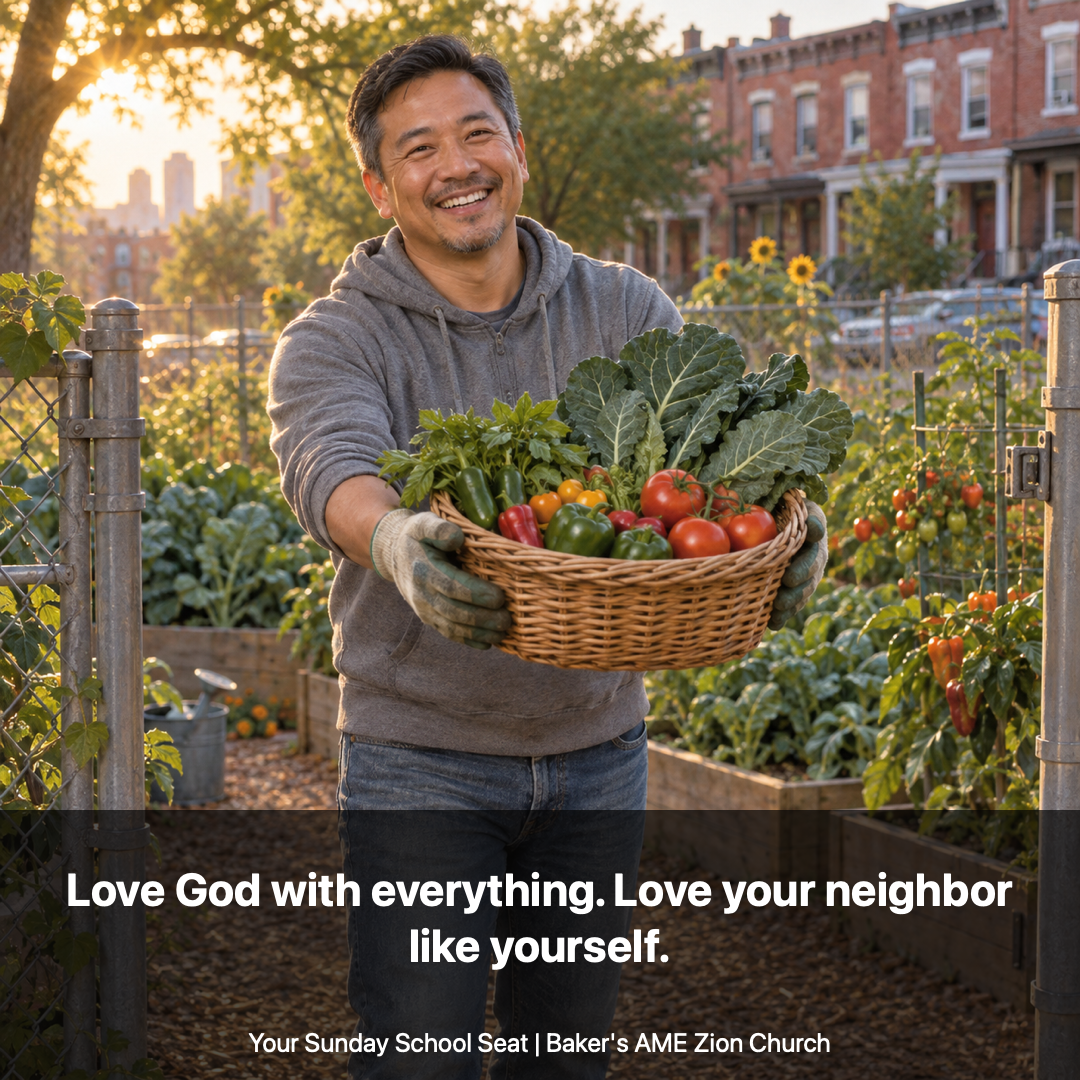
Some questions aren't really questions. They're traps with a question mark on the end.
Matthew 22:34-40 — KJV
34 But when the Pharisees had heard that he had put the Sadducees to silence, they were gathered together. 35 Then one of them, which was a lawyer, asked him a question, tempting him, and saying, 36 Master, which is the great commandment in the law? 37 Jesus said unto him, Thou shalt love the Lord thy God with all thy heart, and with all thy soul, and with all thy mind. 38 This is the first and great commandment. 39 And the second is like unto it, Thou shalt love thy neighbour as thyself. 40 On these two commandments hang all the law and the prophets.
Matthew 22:34-40 — WEB
34 But the Pharisees, when they heard that he had silenced the Sadducees, gathered themselves together. 35 One of them, a lawyer, asked him a question, testing him. 36 “Teacher, which is the greatest commandment in the law?” 37 Jesus said to him, “‘You shall love the Lord your God with all your heart, with all your soul, and with all your mind.’ 38 This is the first and great commandment. 39 A second likewise is this, ‘You shall love your neighbor as yourself.’ 40 The whole law and the prophets depend on these two commandments.”
Explanation
This scene takes place in the temple courts during the last week of Jesus' life. One group after another has come at Him with loaded questions — about paying taxes to Caesar, about the resurrection — hoping He'll say something that gets Him in trouble with the crowd or the authorities. He has just silenced the Sadducees. Now the Pharisees regroup and send in a lawyer, an expert in the law of Moses. Teachers of the day counted hundreds of commandments in the law, and arguing over which ones weighed the most was a favorite debate. Pick one, and somebody would say you were neglecting the rest.
Jesus doesn't take the bait, and He doesn't invent anything new. He quotes the Shema from Deuteronomy 6 — words devout Jews prayed every morning and evening: love the Lord your God with all your heart, all your soul, and all your mind. Your emotions, your very life, your thinking — everything. Then, without being asked, He adds a second commandment from Leviticus 19: love your neighbor as yourself. He says the second is "like unto it" — the same weight, the same kind. You cannot pull them apart.
Then comes the line that changes how we read the whole Bible: "On these two commandments hang all the law and the prophets." Picture a door hanging on two hinges. Take away the hinges and the door is just a heavy board on the floor. Every rule, every prophetic warning, every instruction about worship and justice and money swings on love for God and love for people.
That ties right back to Monday. Joshua's farewell ended with "take good heed therefore unto yourselves, that ye love the LORD your God." God's covenant was never mainly a rulebook. It was a relationship. And Sunday's "Radical Commitment to God's Way" is not about being the strictest person in the building. It is about love that goes all the way down to the root and then shows up in how we treat people.
The historic Black church has always understood that you cannot claim to love God while ignoring your neighbor. That's why our churches have run schools, food pantries, voter drives, and burial societies. Faith that doesn't reach the street isn't finished yet.
So bring it home. Loving God with all your mind includes what you read, what you watch, and how you think about the people you disagree with. Your neighbor is the coworker who gets on your nerves, the man at the bus stop, the family down the street who flies a different flag than you do. And "as yourself" means some of us need to learn to be kind to the person in the mirror, too.
When life gets complicated, try two questions: Does this love God? Does this love my neighbor?
Thought for the Day
Love God with everything. Love your neighbor like yourself.
Reflection Question
Which is harder for you right now — loving God with your whole mind, or loving the neighbor right in front of you?
Prayer
God of love, You have made the way simple, even when we make it complicated. Teach us to love You with our whole heart, soul, and mind. Open our eyes to the neighbors we walk past every day, and give us the courage to love them well. Let everything we do this weekend hang on these two commands. Amen.
This week we walk toward Sunday's lesson: Radical Commitment to God's Way.
Thursday, October 1 — Hands on the Plow
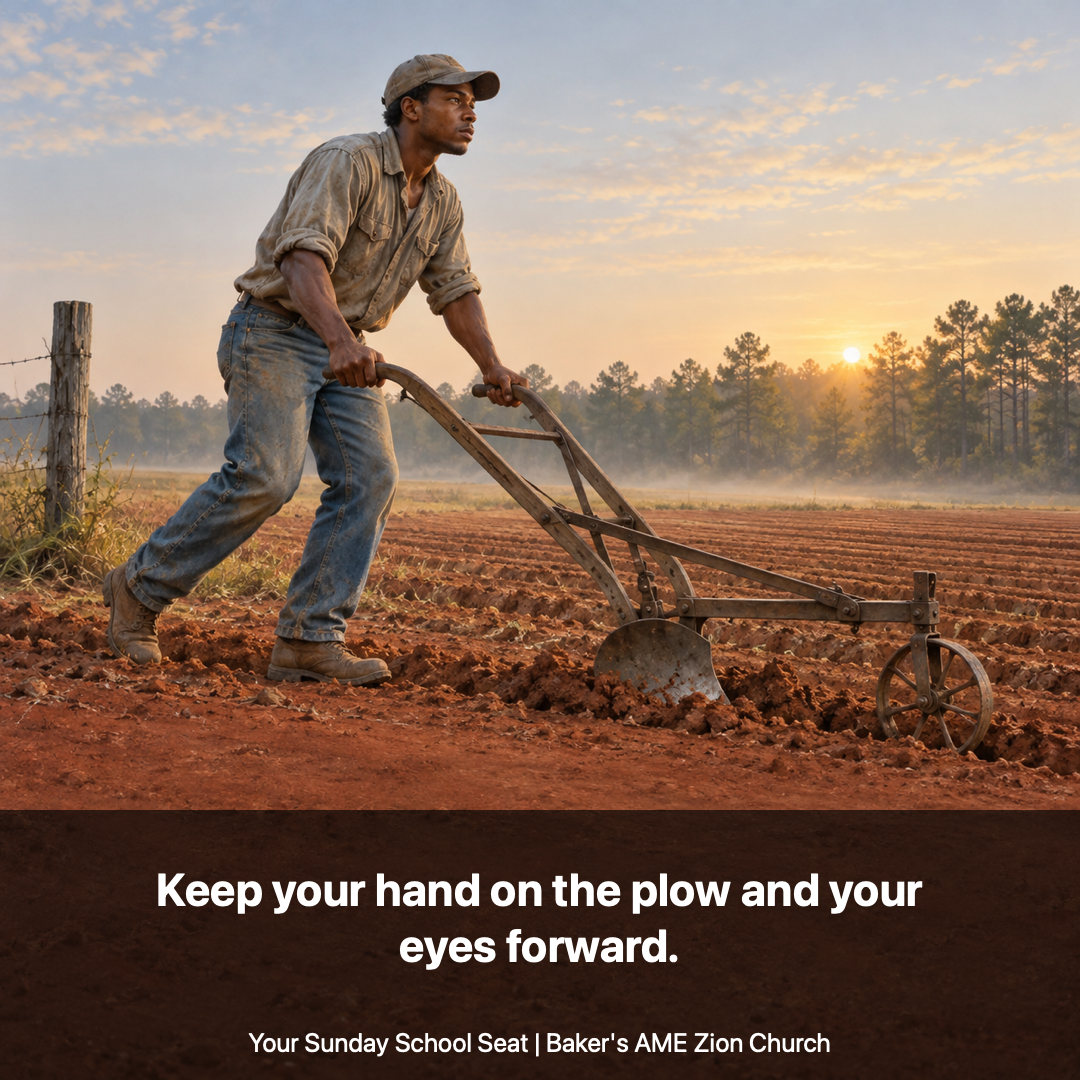
Anybody who's ever cut a lawn and glanced back over their shoulder knows what happens next. The line goes crooked.
Luke 9:57-62 — KJV
57 And it came to pass, that, as they went in the way, a certain man said unto him, Lord, I will follow thee whithersoever thou goest. 58 And Jesus said unto him, Foxes have holes, and birds of the air have nests; but the Son of man hath not where to lay his head. 59 And he said unto another, Follow me. But he said, Lord, suffer me first to go and bury my father. 60 Jesus said unto him, Let the dead bury their dead: but go thou and preach the kingdom of God. 61 And another also said, Lord, I will follow thee; but let me first go bid them farewell, which are at home at my house. 62 And Jesus said unto him, No man, having put his hand to the plough, and looking back, is fit for the kingdom of God.
Luke 9:57-62 — WEB
57 As they went on the way, a certain man said to him, “I want to follow you wherever you go, Lord.” 58 Jesus said to him, “The foxes have holes, and the birds of the sky have nests, but the Son of Man has no place to lay his head.” 59 He said to another, “Follow me!” But he said, “Lord, allow me first to go and bury my father.” 60 But Jesus said to him, “Leave the dead to bury their own dead, but you go and announce God’s Kingdom.” 61 Another also said, “I want to follow you, Lord, but first allow me to say good-bye to those who are at my house.” 62 But Jesus said to him, “No one, having put his hand to the plow, and looking back, is fit for God’s Kingdom.”
Explanation
A few verses earlier, Luke tells us that Jesus "stedfastly set his face to go to Jerusalem." From this point on, He is walking toward the cross, and everything in the Gospel moves with that same forward lean. On the road, three would-be followers step up. Jesus' answers sound sharp to modern ears, but each one is aimed at something real.
The first man is all enthusiasm: "Lord, I will follow thee whithersoever thou goest." Jesus answers with a reality check. Foxes have dens, birds have nests, but the Son of Man has nowhere to lay His head. Following Him doesn't come with a guaranteed bed. Count the cost before you sign.
The second man Jesus calls directly: "Follow me." The man answers, "Lord, suffer me first to go and bury my father." That sounds reasonable — and burying a parent was a sacred duty. But the phrase may mean "let me wait until my father has passed and my obligations at home are finished," which could be years. Jesus' reply, "Let the dead bury their dead," is deliberate overstatement to make a point about urgency: the kingdom will not wait on "someday."
The third man says, "Let me first go bid them farewell." His request echoes Elisha, who asked Elijah if he could kiss his parents goodbye before following him — and who then burned his plow so there was nothing to go back to. Jesus takes the image further: no one who puts his hand to the plow and keeps looking back is fit for the kingdom. A farmer walking behind a plow fixes his eyes on a point at the far end of the field. Look over your shoulder and the furrow wanders.
Notice the word the last two men share: "first." "Me first." Each one wanted to follow Jesus — second.
That is the bridge to Sunday. Joshua will tell Israel to put away the gods their fathers served "on the other side of the flood" and in Egypt. In other words, stop looking back. Radical commitment is a decision with no escape hatch. The old song puts it plainly: I have decided to follow Jesus — no turning back.
Jesus is not against funerals or family. He is against "later." Most of us have a "Lord, but first." First get the kids through school. First get the promotion. First get my life together, then I'll get serious about God. And some of us are looking back in a different way — at an old relationship, an old habit, an old grudge, an old version of ourselves we keep checking on.
If you have looked back, you are in good company; Peter did too, and Jesus restored him. But today is a new furrow. Put your hand to it, pick a point up ahead, and keep walking.
Thought for the Day
Keep your hand on the plow and your eyes forward.
Reflection Question
What is the "Lord, but first" you keep putting between yourself and following Jesus fully?
Prayer
Jesus, You set Your face toward Jerusalem for me and never turned back. Forgive me for all my "but firsts." Loosen my grip on the things behind me, and steady my hands on the work in front of me. Keep my eyes fixed on You, all the way to the end of the row. Amen.
This week we walk toward Sunday's lesson: Radical Commitment to God's Way.
Wednesday, September 30 — Honest Confession, Real Obedience
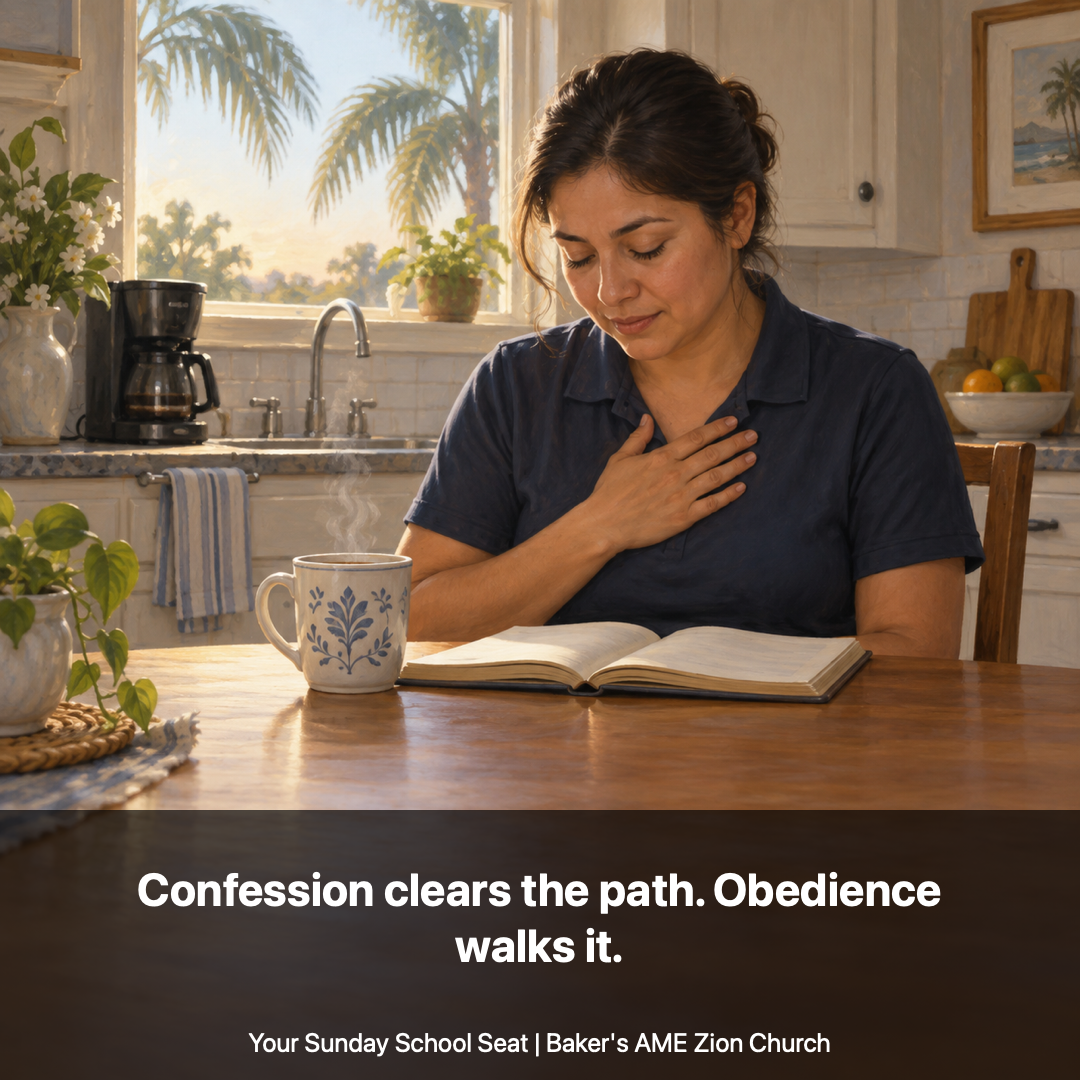
Most of us have a version of ourselves we show at church and another one that shows up in traffic. John writes to people who are tired of pretending there's no difference.
1 John 1:8–2:5 — KJV
1:8 If we say that we have no sin, we deceive ourselves, and the truth is not in us. 9 If we confess our sins, he is faithful and just to forgive us our sins, and to cleanse us from all unrighteousness. 10 If we say that we have not sinned, we make him a liar, and his word is not in us. 2:1 My little children, these things write I unto you, that ye sin not. And if any man sin, we have an advocate with the Father, Jesus Christ the righteous: 2 And he is the propitiation for our sins: and not for ours only, but also for the sins of the whole world. 3 And hereby we do know that we know him, if we keep his commandments. 4 He that saith, I know him, and keepeth not his commandments, is a liar, and the truth is not in him. 5 But whoso keepeth his word, in him verily is the love of God perfected: hereby know we that we are in him.
1 John 1:8–2:5 — WEB
1:8 If we say that we have no sin, we deceive ourselves, and the truth is not in us. 9 If we confess our sins, he is faithful and righteous to forgive us the sins, and to cleanse us from all unrighteousness. 10 If we say that we haven’t sinned, we make him a liar, and his word is not in us. 2:1 My little children, I write these things to you so that you may not sin. If anyone sins, we have a Counselor with the Father, Jesus Christ, the righteous. 2 And he is the atoning sacrifice for our sins, and not for ours only, but also for the whole world. 3 This is how we know that we know him: if we keep his commandments. 4 One who says, “I know him,” and doesn’t keep his commandments, is a liar, and the truth isn’t in him. 5 But God’s love has most certainly been perfected in whoever keeps his word. This is how we know that we are in him:
Explanation
First John was written late in the first century by an elder writing like a father to congregations that had just been through a painful split. Some who left claimed a higher spiritual knowledge and seemed to believe that what you did with your body and your days did not really matter, as long as you had the right inner light. John answers with two plain tests for anyone who says they know God: are you honest about your sin, and do you keep His commandments?
He starts with honesty. Three times he writes "if we say." If we say we have no sin, we fool ourselves. If we say we have not sinned, we call God a liar. But between those two sentences is one of the most hopeful promises in scripture: if we confess our sins, He is faithful and just to forgive. "Just" is a surprising word there. Forgiveness is not God looking the other way. It is fair, because the debt has been paid. John says we have an advocate — someone who stands beside us in court — Jesus Christ the righteous. And His sacrifice is big enough not just for our sins, but for the whole world.
Then John turns, and he doesn't let grace become an excuse. "Hereby we do know that we know him, if we keep his commandments." Anybody can say "I know Him." The proof is in the living. Whoever keeps His word, John says, is the one in whom God's love is "perfected" — brought to full completion.
John holds both truths at once, and we need both. Without confession, obedience turns into pretending — the polished church face. Without obedience, confession turns into a revolving door — say sorry on Sunday, repeat on Monday. Grace is not permission, and obedience is not payment. Obedience is what love looks like when it gets up and goes to work.
This connects directly to Sunday. When Israel says "we will serve the LORD," Joshua pushes back: "Ye cannot." He is right — none of us can in our own strength. John shows us how people like us live a committed life anyway: honest confession, an Advocate who pleads our case, and obedience that grows out of being loved.
Confession is not a stained-glass word. It is just telling the truth. "I snapped at my kids this morning." "I shaded that expense report." "I have been holding a grudge against my sister for three years." In a culture of filtered photos and curated feeds, that kind of honesty is itself a refusal to conform. And then obedience is simply the next right thing, done on a Wednesday afternoon when nobody is watching.
Thought for the Day
Confession clears the path. Obedience walks it.
Reflection Question
What is one thing you've been calling "not that bad" that you need to simply confess to God today?
Prayer
Lord Jesus, thank You for standing beside me as my Advocate when I have nothing to say for myself. I confess the things I have hidden, excused, and renamed. Forgive me, cleanse me, and then teach me to walk in Your word today. Let Your love be made complete in the way I live. Amen.
This week we walk toward Sunday's lesson: Radical Commitment to God's Way.
Tuesday, September 29 — Remember Who Brought You Here
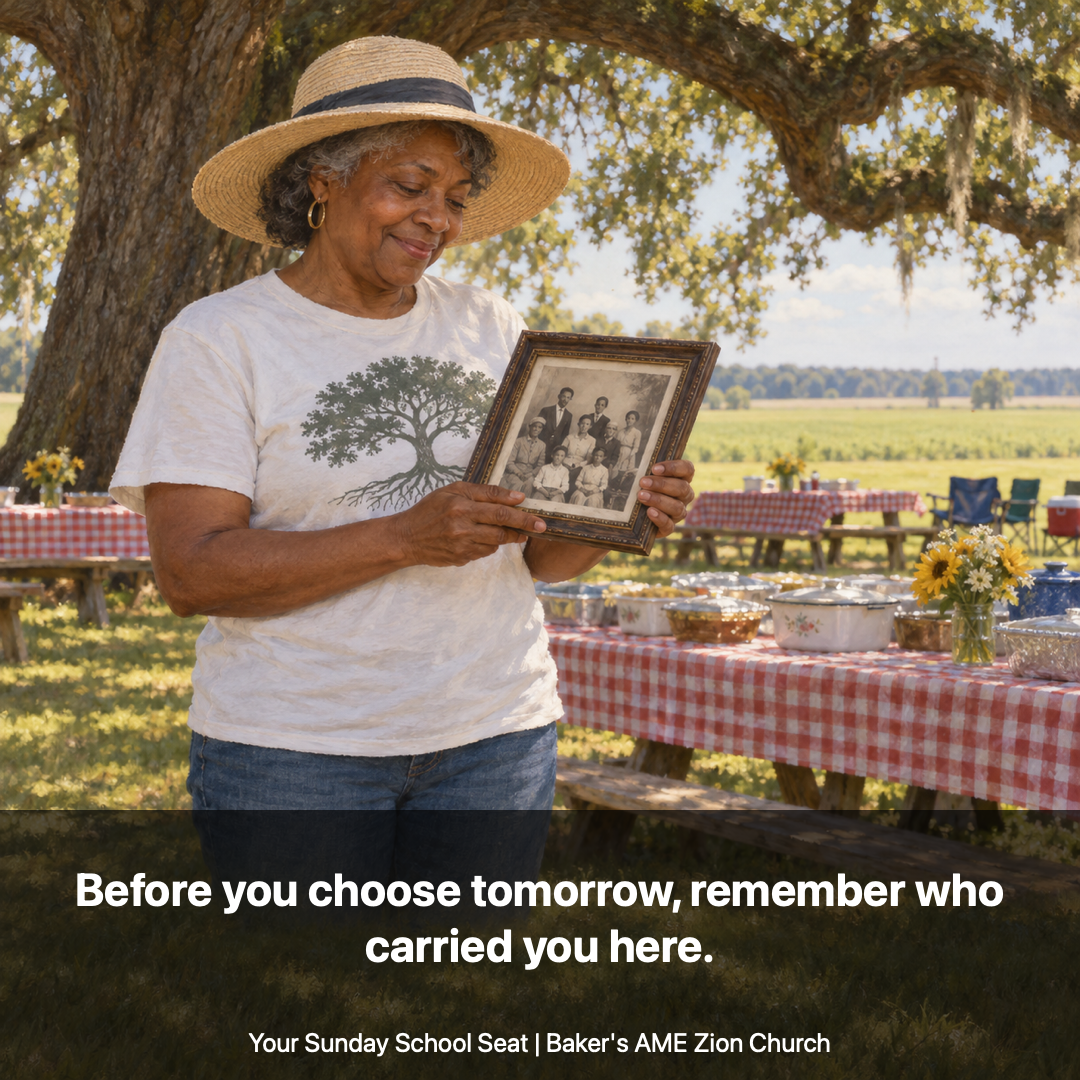
Every family has that one elder who stands up at the reunion and tells the story of where we came from. Nobody rolls their eyes for long, because the story explains everything.
Joshua 24:1-13 — KJV
1 And Joshua gathered all the tribes of Israel to Shechem, and called for the elders of Israel, and for their heads, and for their judges, and for their officers; and they presented themselves before God. 2 And Joshua said unto all the people, Thus saith the LORD God of Israel, Your fathers dwelt on the other side of the flood in old time, even Terah, the father of Abraham, and the father of Nachor: and they served other gods. 3 And I took your father Abraham from the other side of the flood, and led him throughout all the land of Canaan, and multiplied his seed, and gave him Isaac. 4 And I gave unto Isaac Jacob and Esau: and I gave unto Esau mount Seir, to possess it; but Jacob and his children went down into Egypt. 5 I sent Moses also and Aaron, and I plagued Egypt, according to that which I did among them: and afterward I brought you out. 6 And I brought your fathers out of Egypt: and ye came unto the sea; and the Egyptians pursued after your fathers with chariots and horsemen unto the Red sea. 7 And when they cried unto the LORD, he put darkness between you and the Egyptians, and brought the sea upon them, and covered them; and your eyes have seen what I have done in Egypt: and ye dwelt in the wilderness a long season. 8 And I brought you into the land of the Amorites, which dwelt on the other side Jordan; and they fought with you: and I gave them into your hand, that ye might possess their land; and I destroyed them from before you. 9 Then Balak the son of Zippor, king of Moab, arose and warred against Israel, and sent and called Balaam the son of Beor to curse you: 10 But I would not hearken unto Balaam; therefore he blessed you still: so I delivered you out of his hand. 11 And ye went over Jordan, and came unto Jericho: and the men of Jericho fought against you, the Amorites, and the Perizzites, and the Canaanites, and the Hittites, and the Girgashites, the Hivites, and the Jebusites; and I delivered them into your hand. 12 And I sent the hornet before you, which drave them out from before you, even the two kings of the Amorites; but not with thy sword, nor with thy bow. 13 And I have given you a land for which ye did not labour, and cities which ye built not, and ye dwell in them; of the vineyards and oliveyards which ye planted not do ye eat.
Joshua 24:1-13 — WEB
1 Joshua gathered all the tribes of Israel to Shechem, and called for the elders of Israel, for their heads, for their judges, and for their officers; and they presented themselves before God. 2 Joshua said to all the people, “Yahweh, the God of Israel, says, ‘Your fathers lived of old time beyond the River, even Terah, the father of Abraham, and the father of Nahor. They served other gods. 3 I took your father Abraham from beyond the River, and led him throughout all the land of Canaan, and multiplied his offspring, and gave him Isaac. 4 I gave to Isaac Jacob and Esau: and I gave to Esau Mount Seir, to possess it. Jacob and his children went down into Egypt. 5 “‘I sent Moses and Aaron, and I plagued Egypt, according to that which I did among them: and afterward I brought you out. 6 I brought your fathers out of Egypt: and you came to the sea. The Egyptians pursued your fathers with chariots and with horsemen to the Red Sea. 7 When they cried out to Yahweh, he put darkness between you and the Egyptians, and brought the sea on them, and covered them; and your eyes saw what I did in Egypt. You lived in the wilderness many days. 8 “‘I brought you into the land of the Amorites, that lived beyond the Jordan. They fought with you, and I gave them into your hand. You possessed their land, and I destroyed them from before you. 9 Then Balak the son of Zippor, king of Moab, arose and fought against Israel. He sent and called Balaam the son of Beor to curse you, 10 but I would not listen to Balaam; therefore he blessed you still. So I delivered you out of his hand. 11 “‘You went over the Jordan, and came to Jericho. The men of Jericho fought against you, the Amorite, the Perizzite, the Canaanite, the Hittite, the Girgashite, the Hivite, and the Jebusite; and I delivered them into your hand. 12 I sent the hornet before you, which drove them out from before you, even the two kings of the Amorites; not with your sword, nor with your bow. 13 I gave you a land on which you had not labored, and cities which you didn’t build, and you live in them. You eat of vineyards and olive groves which you didn’t plant.’
Explanation
Joshua gathers all the tribes one last time, and the location matters. Shechem is where Abraham built his first altar after arriving in Canaan. It is where Jacob once buried his household's idols under an oak. Joshua brings the nation back to the place where the family story in this land began, and he leads them through a covenant renewal. Ancient agreements between a great king and his people often opened this way: first a history of what the king had already done, then the terms. Before God asks anything of Israel, He reminds them who He has been.
Read the passage again and count the verbs. "I took." "I gave." "I sent." "I brought." "I delivered." Joshua speaks in God's own voice, and God is the actor in almost every sentence. The story does not begin with Israel's goodness, either. It begins with an uncomfortable fact: "your fathers dwelt on the other side of the flood" — beyond the Euphrates — "and they served other gods." Abraham's family were idol worshipers when God called him. From there the story runs through Isaac and Jacob, through Egypt and the sea, through the wilderness, through Balaam — hired to curse Israel and made to bless them instead — through Jericho, and to the hornet that drove enemies out "not with thy sword, nor with thy bow."
Then verse 13 lands like a quiet punch: a land you did not labor for, cities you did not build, vineyards and olive groves you did not plant. Everything they are sitting on is a gift.
This matters for Sunday. Tomorrow's readings will talk about obedience, and Sunday Joshua will ask the people to choose. But first he makes them remember. Real commitment grows out of gratitude, not guilt. People who have forgotten what God did for them will eventually decide they did it themselves — and people who believe they did it themselves see no reason not to live like everyone else.
The Black church has always understood this. We tell the story. Our own denomination began in 1796, when Black Methodists in New York decided they would worship God with dignity rather than from the back of someone else's church. Many of us worship in buildings our grandparents paid for one dinner plate and one pledge card at a time. We dwell in cities we did not build.
So try this at your kitchen table tonight. Write your own version of Joshua 24. "I brought you through that layoff. I gave you that child. I sent that friend when you were at the bottom. I kept you when the doctor's report came back." Put God as the subject of every sentence. Then read it out loud. It is very hard to drift away from a God you remember clearly.
Thought for the Day
Before you choose tomorrow, remember who carried you here.
Reflection Question
If you wrote your own "I brought you out" list, what would be the first three lines?
Prayer
Father, before You ever asked anything of us, You gave. You carried our families through seas and wildernesses we can barely imagine. Forgive us for the days we act like we built our lives on our own. Help us remember clearly, so that our "yes" to You comes from a grateful heart. Amen.
This week we walk toward Sunday's lesson: Radical Commitment to God's Way.
September 28 - October 4: Radical Commitment to God’s Way
This week we stand with Israel at a turning point. The wandering years are over, the land is settled, and an aging Joshua gathers the people to ask one question: whom will you serve? Across seven readings — from Joshua's farewell to John's call to honest obedience, from Jesus' words about the plow to the psalmist's eyes fixed on God — we see what it means to hold on to God when the world around us pulls another way. It all builds to Sunday's lesson, "Radical Commitment to God's Way." Watch, walk through the week with us, and join us for Sunday school.
Monday — Hold Fast to the Lord (Joshua 23:1-11)
Tuesday — Reaffirming the Covenant (Joshua 24:1-13)
Wednesday — Obey Christ's commandments (1 John 1:8–2:5)
Thursday — No Turning Back (Luke 9:57-62)
Friday — The Greatest Commandments (Matthew 22:34-40)
Saturday — God, Redeem Your People (Psalm 25:12-22)
Sunday — We Will Serve the Lord (Joshua 24:18-27)
Your Sunday School Seat | Baker's AME Zion Church — We Saved You a Seat
#YourSundaySchoolSeat #AMEZion #DailyDevotional #Faith #BlackChurch #WeWillServeTheLord
Monday, September 28 — Hold On Like You Mean It
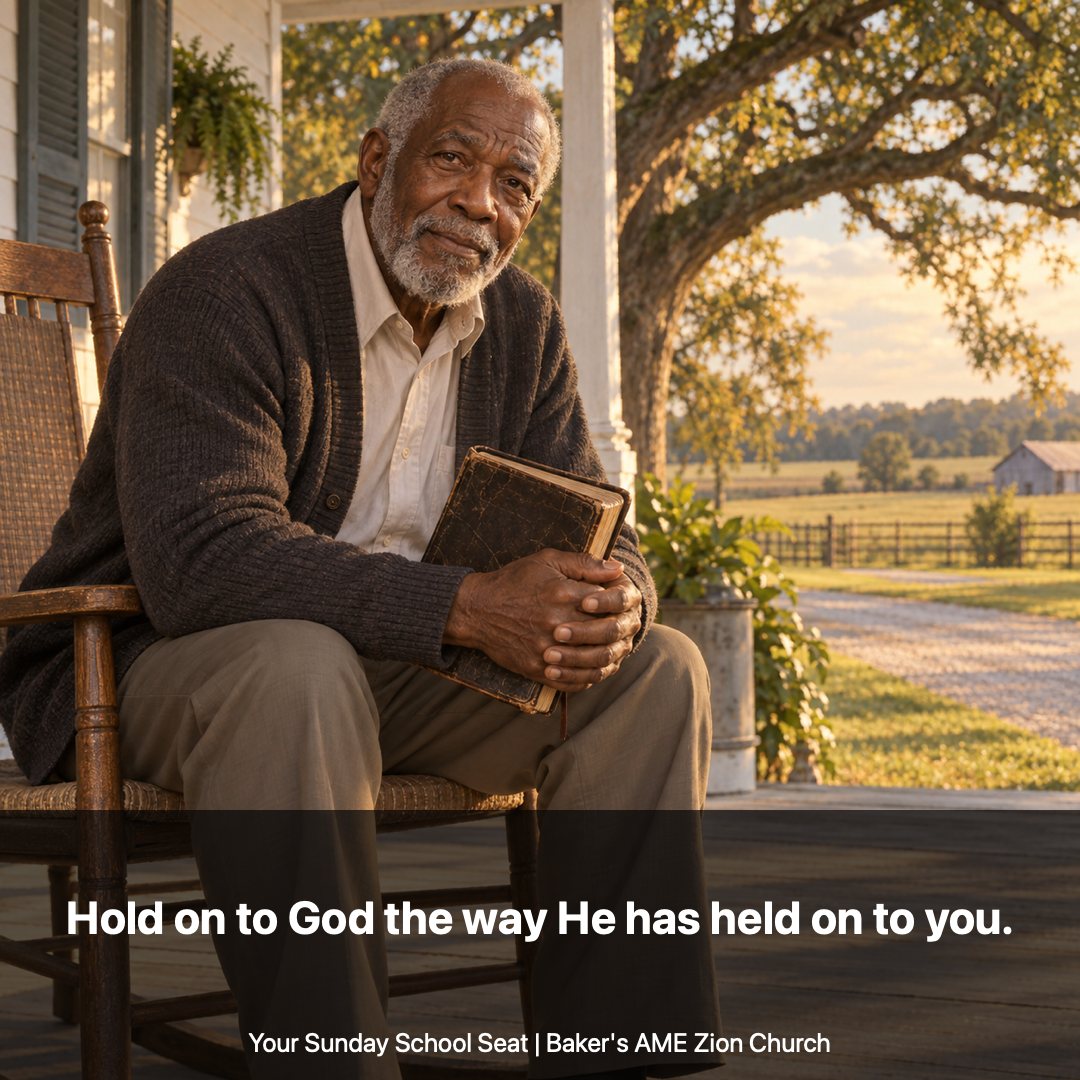
There's a certain kind of talk an old man gives when he knows he may not get to give it again. He skips the small talk and says only what matters.
Joshua 23:1-11 — KJV
1 And it came to pass a long time after that the LORD had given rest unto Israel from all their enemies round about, that Joshua waxed old and stricken in age. 2 And Joshua called for all Israel, and for their elders, and for their heads, and for their judges, and for their officers, and said unto them, I am old and stricken in age: 3 And ye have seen all that the LORD your God hath done unto all these nations because of you; for the LORD your God is he that hath fought for you. 4 Behold, I have divided unto you by lot these nations that remain, to be an inheritance for your tribes, from Jordan, with all the nations that I have cut off, even unto the great sea westward. 5 And the LORD your God, he shall expel them from before you, and drive them from out of your sight; and ye shall possess their land, as the LORD your God hath promised unto you. 6 Be ye therefore very courageous to keep and to do all that is written in the book of the law of Moses, that ye turn not aside therefrom to the right hand or to the left; 7 That ye come not among these nations, these that remain among you; neither make mention of the name of their gods, nor cause to swear by them, neither serve them, nor bow yourselves unto them: 8 But cleave unto the LORD your God, as ye have done unto this day. 9 For the LORD hath driven out from before you great nations and strong: but as for you, no man hath been able to stand before you unto this day. 10 One man of you shall chase a thousand: for the LORD your God, he it is that fighteth for you, as he hath promised you. 11 Take good heed therefore unto yourselves, that ye love the LORD your God.
Joshua 23:1-11 — WEB
1 After many days, when Yahweh had given rest to Israel from their enemies all around, and Joshua was old and well advanced in years, 2 Joshua called for all Israel, for their elders and for their heads, and for their judges and for their officers, and said to them, “I am old and well advanced in years. 3 You have seen all that Yahweh your God has done to all these nations because of you; for it is Yahweh your God who has fought for you. 4 Behold, I have allotted to you these nations that remain, to be an inheritance for your tribes, from the Jordan, with all the nations that I have cut off, even to the great sea toward the going down of the sun. 5 Yahweh your God will thrust them out from before you, and drive them from out of your sight. You shall possess their land, as Yahweh your God spoke to you. 6 “Therefore be very courageous to keep and to do all that is written in the book of the law of Moses, that you not turn away from it to the right hand or to the left; 7 that you not come among these nations, these that remain among you; neither make mention of the name of their gods, nor cause to swear by them, neither serve them, nor bow down yourselves to them; 8 but hold fast to Yahweh your God, as you have done to this day. 9 “For Yahweh has driven great and strong nations out from before you. But as for you, no man has stood before you to this day. 10 One man of you shall chase a thousand; for it is Yahweh your God who fights for you, as he spoke to you. 11 Take good heed therefore to yourselves, that you love Yahweh your God.
Explanation
Joshua 23 comes near the very end of the book that carries his name. The Jordan crossing is decades behind him. The walls of Jericho are an old story. The tribes have received their land, and the fighting has mostly quieted down. The text says twice in two verses that Joshua is "old and stricken in age," as if he wants everyone to understand this is not a routine meeting. He calls in the elders, the heads, the judges, and the officers — the people who will lead after he is gone — and he gives them his farewell charge. This is the season our unit calls the move from nomadic tribes to settled people. The tents are folded. The houses are built.
What stands out is what Joshua does not say. He doesn't recount his victories or remind anyone of his leadership. He points past himself: "the LORD your God is he that hath fought for you." Then he gives three instructions. Be very courageous to keep what is written, and don't drift to the right hand or the left. Don't blend in with the nations still living around you — don't even get comfortable saying the names of their gods. And cleave to the LORD your God. That word "cleave" is the same word Genesis uses when a man cleaves to his wife. It is not casual attachment. It is grip.
Notice when this warning comes. Not in the wilderness, when Israel woke up every morning to manna and had no choice but to depend on God. It comes when life is finally working. Settled life has its own temptations. When the battles are over, you relax, and comfort is usually where the drift begins. The nations that remained in the land were not mainly a military threat anymore. They were a cultural one — their gods of rain and harvest, their easy assumption that this is just how everybody lives.
That is exactly where Sunday's lesson is headed. "Radical Commitment to God's Way" asks whether our faith can stay distinct when the world around us offers a more comfortable way. Joshua's "not to the right hand or to the left" is the first draft of the word we will hear all week: do not conform.
Our drift rarely looks like rebellion. It looks like a full fall calendar, a promotion that eats our Sundays, a phone we check before we pray, a habit of saying "everybody does it." Holding fast means noticing the small detours before they become the road. And it means remembering verse 10: one of you shall chase a thousand — not because you are strong, but because God fights for you. So hold on. Not with white-knuckled fear, but the way you hold the handrail on the church steps when it's raining — because you know what keeps you standing.
Thought for the Day
Hold on to God the way He has held on to you.
Reflection Question
Where has comfort quietly loosened your grip on God, and what would holding fast look like this week?
Prayer
Lord, You have fought battles for us that we did not even know we were in. Forgive us for the times comfort made us forget You. Teach us to cleave to You on the good days as tightly as we did on the hard ones. Keep our feet from turning to the right or the left. In Jesus' name, Amen.
This week we walk toward Sunday's lesson: Radical Commitment to God's Way.
Sunday, September 27 — The One Name God Called Out
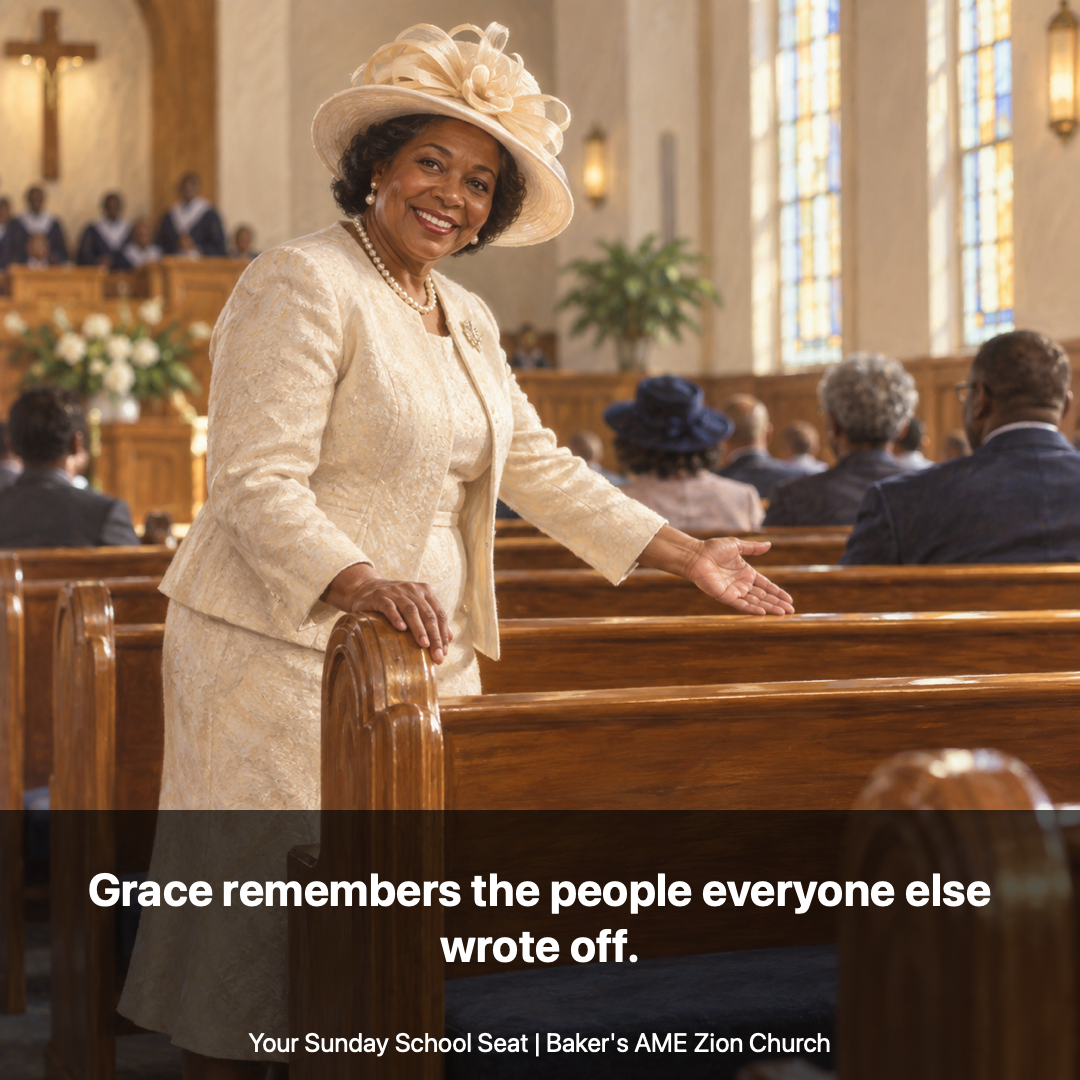
A whole city comes down, and in the middle of the wreckage God stops to name one woman and keep one promise.
Joshua 6:6-17 — KJV
6 And Joshua the son of Nun called the priests, and said unto them, Take up the ark of the covenant, and let seven priests bear seven trumpets of rams' horns before the ark of the LORD. 7 And he said unto the people, Pass on, and compass the city, and let him that is armed pass on before the ark of the LORD. 8 And it came to pass, when Joshua had spoken unto the people, that the seven priests bearing the seven trumpets of rams' horns passed on before the LORD, and blew with the trumpets: and the ark of the covenant of the LORD followed them. 9 And the armed men went before the priests that blew with the trumpets, and the rereward came after the ark, the priests going on, and blowing with the trumpets. 10 And Joshua had commanded the people, saying, Ye shall not shout, nor make any noise with your voice, neither shall any word proceed out of your mouth, until the day I bid you shout; then shall ye shout. 11 So the ark of the LORD compassed the city, going about it once: and they came into the camp, and lodged in the camp. 12 And Joshua rose early in the morning, and the priests took up the ark of the LORD. 13 And seven priests bearing seven trumpets of rams' horns before the ark of the LORD went on continually, and blew with the trumpets: and the armed men went before them; but the rereward came after the ark of the LORD, the priests going on, and blowing with the trumpets. 14 And the second day they compassed the city once, and returned into the camp: so they did six days. 15 And it came to pass on the seventh day, that they rose early about the dawning of the day, and compassed the city after the same manner seven times: only on that day they compassed the city seven times. 16 And it came to pass at the seventh time, when the priests blew with the trumpets, Joshua said unto the people, Shout; for the LORD hath given you the city. 17 And the city shall be accursed, even it, and all that are therein, to the LORD: only Rahab the harlot shall live, she and all that are with her in the house, because she hid the messengers that we sent.
Joshua 6:6-17 — WEB
6 Joshua the son of Nun called the priests, and said to them, "Take up the ark of the covenant, and let seven priests bear seven trumpets of rams' horns before Yahweh's ark." 7 They said to the people, "Advance! March around the city, and let the armed men pass on before Yahweh's ark." 8 It was so, that when Joshua had spoken to the people, the seven priests bearing the seven trumpets of rams' horns before Yahweh advanced and blew the trumpets, and the ark of Yahweh's covenant followed them. 9 The armed men went before the priests who blew the trumpets, and the ark went after them. The trumpets sounded as they went. 10 Joshua commanded the people, saying, "You shall not shout, nor let your voice be heard, neither shall any word proceed out of your mouth, until the day I tell you to shout. Then you shall shout." 11 So he caused Yahweh's ark to go around the city, going about it once. Then they came into the camp, and stayed in the camp. 12 Joshua rose early in the morning, and the priests took up Yahweh's ark. 13 The seven priests bearing the seven trumpets of rams' horns in front of Yahweh's ark went on continually, and blew the trumpets. The armed men went in front of them. The rear guard came after Yahweh's ark. The trumpets sounded as they went. 14 The second day they marched around the city once, and returned into the camp. They did this six days. 15 On the seventh day, they rose early at the dawning of the day, and marched around the city in the same way seven times. Only on this day they marched around the city seven times. 16 At the seventh time, when the priests blew the trumpets, Joshua said to the people, "Shout, for Yahweh has given you the city! 17 The city shall be devoted, even it and all that is in it, to Yahweh. Only Rahab the prostitute shall live, she and all who are with her in the house, because she hid the messengers that we sent.
Explanation
Six days of marching in silence around a city that does not move. That is most of this passage. No shouting, no strategy meetings, no visible progress — just a slow circle, priests and trumpets and an ark, while the people inside the walls watch and presumably laugh. Then on the seventh day they go around seven times, and Joshua finally gives permission to shout.
This is one of the strangest military operations in scripture, and that is the point. Israel does not take Jericho. God gives it. The instructions are built so that nobody walking away from that field could credit their own tactics. Verse 16 says it plainly: Shout; for the LORD hath given you the city.
But the verse that should stop us is 17. In the middle of the hardest sentence in the chapter — the whole city devoted, everything in it — there is one exception, and it is a name. Only Rahab the harlot shall live, she and all that are with her in the house, because she hid the messengers that we sent.
Read what God remembered. Not her résumé. Not a reformed life she had not had time to build yet. He remembered one night, one act of shelter, one scared woman who chose His people when it was dangerous to. Two spies made her a promise on a rooftop, and when the walls came down, that promise held. Her whole household — the father, the mother, the brothers, the sisters she had negotiated for — walked out of that city alive. She asked for mercy for her family, and she got every bit of it.
That is the compassion this week has been walking toward. It is not sentimental. It is specific. God knew her name, knew her reputation, knew exactly what she had done and who she had been, and He kept the promise anyway. Hebrews will later put her in the roll call of the faithful. James will name her alongside Abraham. Matthew will put her in the family tree of Jesus Christ Himself. The woman Jericho pushed to the wall ends up in the genealogy of the Savior.
So hear this wherever you are sitting today. If you have been carrying a past you assume God has not forgotten, you are right — He has not. He remembers the whole thing, and He is still calling your name out of the wreckage. If you have been marching around something for six days with no sign of movement, keep marching; the seventh day is not your job to arrange. And if you are the one who has been deciding who deserves a place at this table, look again at verse 17 and notice who God insisted on saving.
Rahab did not clean herself up and then get rescued. She was rescued, and then she got a whole new life — and a whole new family.
Thought for the Day
Grace remembers the people everyone else wrote off.
Reflection Question
What part of your past do you assume disqualifies you, and what would change if you believed God already knows and still calls your name?
Prayer
Lord, You remembered Rahab by name in the middle of everything falling down. Remember me. Where I have been marching without seeing anything move, give me the strength for one more day. Where I have written somebody off, change my heart. Thank You that the story ends with an outsider inside Your family. Amen.
Today is Sunday school. We saved you a seat.
Saturday, September 26 — She Believed Before She Belonged

She had no Bible, no covenant, and no church home. She had heard one story about God, and she built her whole life on it.
Joshua 2:8-14 — KJV
8 And before they were laid down, she came up unto them upon the roof; 9 And she said unto the men, I know that the LORD hath given you the land, and that your terror is fallen upon us, and that all the inhabitants of the land faint because of you. 10 For we have heard how the LORD dried up the water of the Red sea for you, when ye came out of Egypt; and what ye did unto the two kings of the Amorites, that were on the other side Jordan, Sihon and Og, whom ye utterly destroyed. 11 And as soon as we had heard these things, our hearts did melt, neither did there remain any more courage in any man, because of you: for the LORD your God, he is God in heaven above, and in earth beneath. 12 Now therefore, I pray you, swear unto me by the LORD, since I have shewed you kindness, that ye will also shew kindness unto my father's house, and give me a true token: 13 And that ye will save alive my father, and my mother, and my brethren, and my sisters, and all that they have, and deliver our lives from death. 14 And the men answered her, Our life for yours, if ye utter not this our business. And it shall be, when the LORD hath given us the land, that we will deal kindly and truly with thee.
Joshua 2:8-14 — WEB
8 Before they had lain down, she came up to them on the roof. 9 She said to the men, "I know that Yahweh has given you the land, and that the fear of you has fallen upon us, and that all the inhabitants of the land melt away before you. 10 For we have heard how Yahweh dried up the water of the Red Sea before you, when you came out of Egypt; and what you did to the two kings of the Amorites, who were beyond the Jordan, to Sihon and to Og, whom you utterly destroyed. 11 As soon as we had heard it, our hearts melted, and there wasn't any more spirit in any man, because of you: for Yahweh your God, he is God in heaven above, and on earth beneath. 12 Now therefore, please swear to me by Yahweh, since I have dealt kindly with you, that you also will deal kindly with my father's house, and give me a true sign; 13 and that you will save alive my father, my mother, my brothers, and my sisters, and all that they have, and will deliver our lives from death." 14 The men said to her, "Our life for yours, if you don't talk about this business of ours; and it shall be, when Yahweh gives us the land, that we will deal kindly and truly with you."
Explanation
The soldiers are gone. The gate is shut. And before the two men can even lie down, Rahab climbs up to the roof to say what she has been holding all evening.
What comes out of her mouth is one of the clearest confessions of faith in the Old Testament, and it comes from the least likely person in the book. I know that the LORD hath given you the land. Not I suspect. Not people are saying. I know. Then she tells them why. Forty years ago a sea opened. More recently two Amorite kings fell. Jericho heard about it, and Jericho has been afraid ever since.
Here is what makes her different. Everyone in that city heard the same reports. Verse 11 says the whole city's heart melted. But fear is not faith. The rest of Jericho heard about the God who split the sea and responded by bolting the gates. Rahab heard the same thing and concluded something nobody else in her city was willing to say out loud: the LORD your God, he is God in heaven above, and in earth beneath. Not one god among the others. The God. Over everything. She crossed from being afraid of Him to belonging to Him, and she did it alone.
Then she asks for two things, and they tell you what kind of person she really is. She asks for mercy — deal kindly with my father's house — and she asks for a sign she can hold onto. And notice she does not ask only for herself. Her father, her mother, her brothers, her sisters, all that they have. The woman her city pushed to the wall is standing on a rooftop negotiating for her whole family's survival.
She had nothing that we would call qualifications. No covenant. No scroll. No upbringing in the faith. No one to disciple her. She had a rumor about something God did before she was old enough to remember it, and she staked her life on it anyway. She believed before she belonged.
Some of us need to hear that this morning, because we have been waiting to feel qualified. We think real faith belongs to people who grew up in the church, who know the books of the Bible in order, who have a clean story to tell. Rahab had none of it. What she had was the courage to say what she believed out loud to the only two people who could do anything about it.
And some of us know somebody like her right now — somebody on the outside of church life who has been quietly watching, half-convinced, with a past they assume disqualifies them. They are usually waiting for one person to tell them they would be welcome.
Tomorrow we find out what God did with Rahab's confession. Tonight, she is just a woman on a roof, telling the truth about God with no guarantee that it will save her.
Thought for the Day
You don't need a clean past to have a bold faith.
Reflection Question
What do you actually believe about God that you have never said out loud to anyone?
Prayer
God of heaven above and earth beneath, thank You that You receive faith from people the world has already judged. Where I feel unqualified, remind me that Rahab was too. Give me courage to say plainly what I believe about You, and to tell somebody who is watching from the outside that there is room for them. Amen.
This week we walk toward Sunday's lesson: God's Compassion for Rahab.
Friday, September 25 — No Favorites, No Exceptions
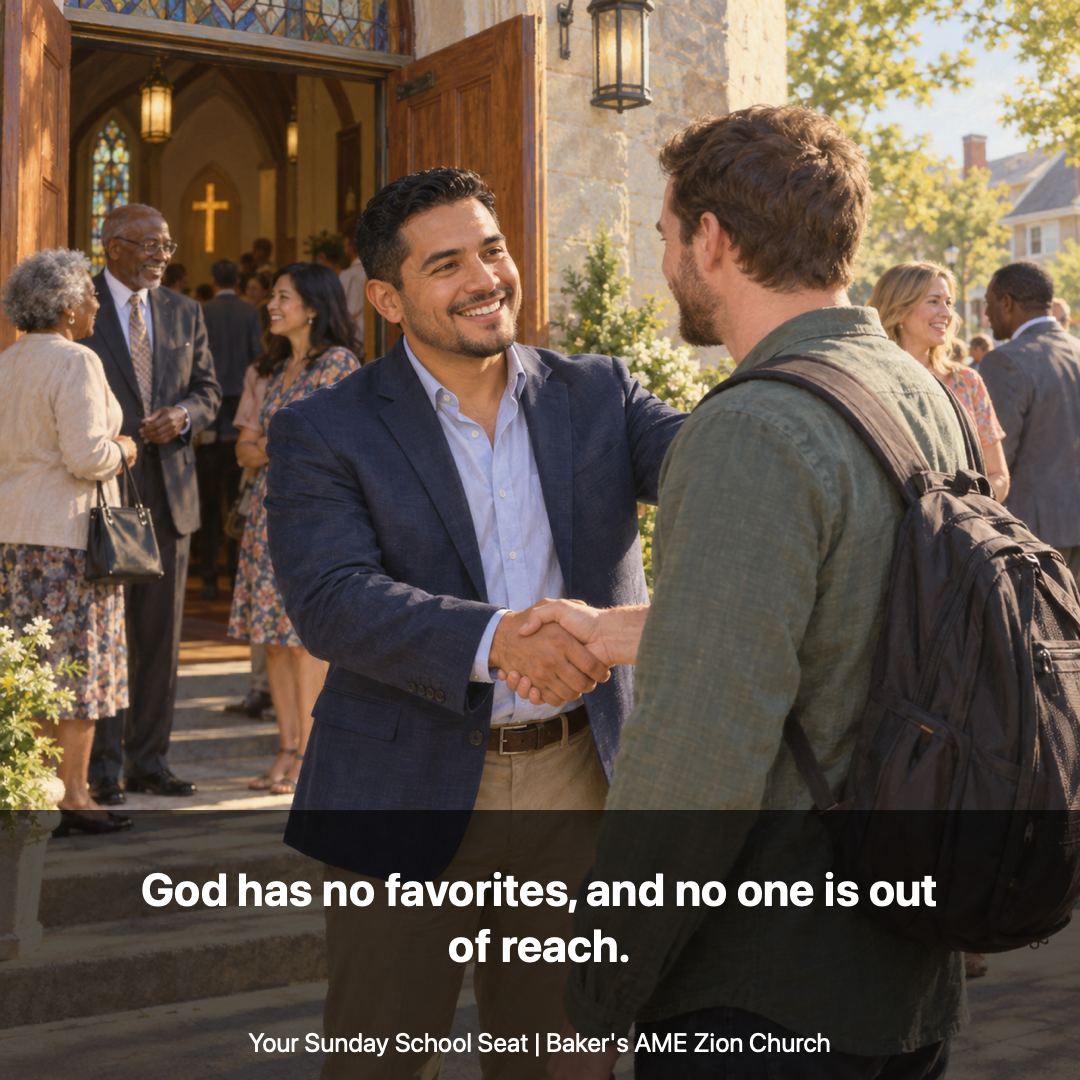
Peter had to have his mind changed about who God loves. Most of us do.
Acts 10:34-48 — KJV
34 Then Peter opened his mouth, and said, Of a truth I perceive that God is no respecter of persons: 35 But in every nation he that feareth him, and worketh righteousness, is accepted with him. 36 The word which God sent unto the children of Israel, preaching peace by Jesus Christ: (he is Lord of all:) 37 That word, I say, ye know, which was published throughout all Judaea, and began from Galilee, after the baptism which John preached; 38 How God anointed Jesus of Nazareth with the Holy Ghost and with power: who went about doing good, and healing all that were oppressed of the devil; for God was with him. 39 And we are witnesses of all things which he did both in the land of the Jews, and in Jerusalem; whom they slew and hanged on a tree: 40 Him God raised up the third day, and shewed him openly; 41 Not to all the people, but unto witnesses chosen before of God, even to us, who did eat and drink with him after he rose from the dead. 42 And he commanded us to preach unto the people, and to testify that it is he which was ordained of God to be the Judge of quick and dead. 43 To him give all the prophets witness, that through his name whosoever believeth in him shall receive remission of sins. 44 While Peter yet spake these words, the Holy Ghost fell on all them which heard the word. 45 And they of the circumcision which believed were astonished, as many as came with Peter, because that on the Gentiles also was poured out the gift of the Holy Ghost. 46 For they heard them speak with tongues, and magnify God. Then answered Peter, 47 Can any man forbid water, that these should not be baptized, which have received the Holy Ghost as well as we? 48 And he commanded them to be baptized in the name of the Lord. Then prayed they him to tarry certain days.
Acts 10:34-48 — WEB
34 Peter opened his mouth and said, "Truly I perceive that God doesn't show favoritism; 35 but in every nation he who fears him and works righteousness is acceptable to him. 36 The word which he sent to the children of Israel, preaching good news of peace by Jesus Christ—he is Lord of all— 37 you yourselves know what happened, which was proclaimed throughout all Judea, beginning from Galilee, after the baptism which John preached; 38 even Jesus of Nazareth, how God anointed him with the Holy Spirit and with power, who went about doing good and healing all who were oppressed by the devil, for God was with him. 39 We are witnesses of everything he did both in the country of the Jews, and in Jerusalem; whom they also killed, hanging him on a tree. 40 God raised him up the third day, and gave him to be revealed, 41 not to all the people, but to witnesses who were chosen before by God, to us, who ate and drank with him after he rose from the dead. 42 He commanded us to preach to the people and to testify that this is he who is appointed by God as the Judge of the living and the dead. 43 All the prophets testify about him, that through his name everyone who believes in him will receive remission of sins." 44 While Peter was still speaking these words, the Holy Spirit fell on all those who heard the word. 45 They of the circumcision who believed were amazed, as many as came with Peter, because the gift of the Holy Spirit was also poured out on the Gentiles. 46 For they heard them speaking in other languages and magnifying God. Then Peter answered, 47 "Can anyone forbid these people from being baptized with water? They have received the Holy Spirit just like us." 48 He commanded them to be baptized in the name of Jesus Christ. Then they asked him to stay some days.
Explanation
To appreciate what Peter says in verse 34, you have to know what it cost him to get there. He is standing in the house of Cornelius, a Roman centurion — an officer of the occupying army, a Gentile, a man Peter had been taught his whole life not to eat with. Peter did not arrive at this doorstep because he grew more open-minded. He arrived because God gave him a vision three times and then told him to go anyway.
And then he says it: Of a truth I perceive that God is no respecter of persons. The older phrase is worth keeping. A "respecter of persons" is someone who looks at the face and decides accordingly — the family name, the skin, the address, the accent, the record. Peter is confessing that he had been doing exactly that, and that God does not.
Watch what happens next, because the timing is the sermon. Peter is still talking when the Holy Spirit falls on the whole room. He does not get to finish. There is no membership process, no probation period, no vetting committee. God acts before the church has finished deciding whether these people qualify. And the believers who came with Peter are described as astonished — not delighted, astonished — because what they were watching broke a category they had held their entire lives.
Peter's response is the right one, and it is really a question with only one possible answer: Can any man forbid water?God has already moved. Who are we to stand in the doorway?
This is where the whole week comes into focus. Rahab in Jericho and Cornelius in Caesarea are the same story separated by centuries. In both, God reaches past the boundary line His own people had drawn and welcomes someone from the outside — and in both, the people on the inside have to catch up to what God has already done.
We have our own version of that doorway, and we should be honest about it. There are people we have quietly decided are not the right fit for our church, our circle, our table. Somebody with a record. Somebody whose past is public. Somebody whose politics or accent or income makes us uneasy. Somebody whose family everybody in town has an opinion about. The AME Zion church knows this history from the inside — our tradition exists in part because people were told where they could and could not sit. We of all people should be slow to hand anyone else that experience.
God still shows no partiality. The only question left is whether we will be standing in the doorway when He walks somebody through it, or holding it open.
Thought for the Day
God has no favorites, and no one is out of reach.
Reflection Question
Who have you quietly decided would not fit in your church, and what would it take to welcome them?
Prayer
Lord, You do not look at faces the way I do. Search out the places where I have decided in advance who belongs, and tear those lines up. Make our church a place where people walk in and find a seat waiting, not a test to pass. Move me out of the doorway. Amen.
This week we walk toward Sunday's lesson: God's Compassion for Rahab.
Thursday, September 24 — Faith Before the Proof

Faith is not certainty about the outcome. It is a decision you make while the outcome is still hidden.
Hebrews 11:1-2, 29-31 — KJV
1 Now faith is the substance of things hoped for, the evidence of things not seen. 2 For by it the elders obtained a good report. 29 By faith they passed through the Red sea as by dry land: which the Egyptians assaying to do were drowned. 30 By faith the walls of Jericho fell down, after they were compassed about seven days. 31 By faith the harlot Rahab perished not with them that believed not, when she had received the spies with peace.
Hebrews 11:1-2, 29-31 — WEB
1 Now faith is assurance of things hoped for, proof of things not seen. 2 For by this, the elders obtained testimony. 29 By faith, they passed through the Red Sea as on dry land. When the Egyptians tried to do so, they were swallowed up. 30 By faith, the walls of Jericho fell down, after they had been encircled for seven days. 31 By faith, Rahab the prostitute, didn't perish with those who were disobedient, having received the spies in peace.
Explanation
Hebrews was written to believers who were tired. The excitement had worn off, the pressure had not, and some of them were quietly considering going back to what was safer. So the writer does something pastoral and strategic: he takes them on a long walk through their own family history, naming person after person who kept going when going kept costing them something.
He starts with a definition. Faith is the substance of things hoped for, the evidence of things not seen. Read that slowly. Faith is not a feeling that everything will work out. It is not optimism with a Bible verse attached. It is the settled decision to act on what God has said before you can see it, to treat God's word as solid ground while you are still standing on nothing else.
Then he lists examples, and our three land back-to-back in a way that is almost certainly intentional. Verse 29: the Red Sea, where a people walked into a seabed on nothing but a promise. Verse 30: Jericho's walls, which came down after a week of marching in silence around a city that was not moving — seven days of looking foolish before anything happened. Verse 31: Rahab, who did not perish with the disobedient, because she received the spies in peace.
Look at who she is standing beside. Abraham. Moses. Sarah. Joseph. The whole roll call of the faith. And there is a Canaanite woman with a reputation, listed by name, with no asterisk and no apology. Hebrews does not scrub her past out of the record. It leaves her name and her trade in the same sentence as her faith, because the point is not that she was respectable. The point is that she believed God when the people with far better résumés around her did not.
Notice, too, what Hebrews says she got right. She received the spies in peace. All the faith she had available to her that night was a willingness to welcome. She had no covenant, no scroll, no priest, no history with this God — only a rumor about a sea that parted and a growing conviction that the God behind it was the real one. She acted on the little light she had, and it was enough.
That matters if your faith feels thin right now. Some of us are waiting to feel certain before we obey, and certainty is not coming. Some of us are seven days into marching around a wall that has not budged, wondering whether we heard God at all. Hebrews says the elders obtained a good report not because they had unusual clarity but because they kept walking in the dark.
Sunday we will see the walls come down and Rahab walk out alive. Today is the part of the story before any of that is visible — the part where you have to decide what you will do with the little you know.
Thought for the Day
Faith is trusting God before you can see the outcome.
Reflection Question
Where are you waiting to feel certain before you obey what God has already made clear?
Prayer
Faithful God, I want proof and You have offered me Your word. Help me act on what You have said while I am still waiting to see it. When the wall does not move on day six, keep me marching. Thank You that You count small faith that acts over big faith that only talks. Amen.
This week we walk toward Sunday's lesson: God's Compassion for Rahab.
Wednesday, September 23 — Blessed So It Doesn't Stop With You

We ask God to bless us and usually stop the sentence right there. Psalm 67 finishes it.
Psalm 67 — KJV
1 God be merciful unto us, and bless us; and cause his face to shine upon us; Selah. 2 That thy way may be known upon earth, thy saving health among all nations. 3 Let the people praise thee, O God; let all the people praise thee. 4 O let the nations be glad and sing for joy: for thou shalt judge the people righteously, and govern the nations upon earth. Selah. 5 Let the people praise thee, O God; let all the people praise thee. 6 Then shall the earth yield her increase; and God, even our own God, shall bless us. 7 God shall bless us; and all the ends of the earth shall fear him.
Psalm 67 — WEB
1 May God be merciful to us, bless us, and cause his face to shine on us. Selah. 2 That your way may be known on earth, and your salvation among all nations, 3 let the peoples praise you, God. Let all the peoples praise you. 4 Oh let the nations be glad and sing for joy, for you will judge the peoples with equity, and govern the nations on earth. Selah. 5 Let the peoples praise you, God. Let all the peoples praise you. 6 The earth has yielded its increase. God, even our own God, will bless us. 7 God will bless us. All the ends of the earth shall fear him.
Explanation
Psalm 67 is a harvest song. Israel sang it when the crops came in, and it opens with words any Israelite would have recognized from the old blessing Aaron spoke over the people: God be merciful unto us, and bless us; and cause his face to shine upon us. Familiar territory. Comfortable. The kind of prayer we know how to pray.
Then comes verse two, and the whole psalm turns on one small word: that. Bless us — that Your way may be known upon earth, Your saving health among all nations. The blessing is not the destination. It is the delivery vehicle. God pours something into this people so that it will run through them and out to everybody else.
From there the psalm can barely contain itself. Twice it repeats the same line, and the repetition is the point: let all the peoples praise you. Not our people. All of them. The nations are invited to be glad and sing for joy, because the God of Israel governs the whole earth with equity. That is a startling thing for a small nation surrounded by larger, hostile ones to sing out loud. It is also exactly the theology that makes sense of Rahab.
Because here is what this psalm does to the week. On Monday we met a Canaanite woman — one of the nations, an outsider by every marker Israel used. Sunday's lesson is about God's compassion for her. Psalm 67 tells us that was never an exception or a loophole. God being good to Israel was always aimed at the day when a woman in Jericho would hear about what He did at the Red Sea and decide He was worth risking her life on. The mission was in the blessing from the beginning.
And it turns the mirror on us. Most of our prayer life stops at verse one. Bless my family. Bless my job. Bless my health, my house, my children, my checking account. None of that is wrong — the psalm prays it too. But the psalm will not let us stop there, and neither should we. What has God put in your hands lately? A raise, a healthy year, a skill, an open door, a stretch of peace after a hard season? Psalm 67 asks the follow-up question we usually skip: who is it for?
The harvest imagery makes it concrete. A field does not eat what it grows. The earth yields her increase and then hands it over. The blessing moves. When it stops moving, it spoils.
So take stock today. Somebody near you is one kind word, one introduction, one paid bill, one shared meal away from seeing that God is real. You may be holding exactly what they need, and you may have been calling it "mine" this whole time.
Thought for the Day
God's blessing was never meant to stop with you.
Reflection Question
What has God given you lately that somebody else was supposed to benefit from?
Prayer
Gracious God, thank You for a kindness I did not earn and cannot repay. Keep me from hoarding it. Make my home, my table, and my paycheck a place where Your goodness keeps moving outward. Let somebody know You are real this week because of something You gave me. Amen.
This week we walk toward Sunday's lesson: God's Compassion for Rahab.
Tuesday, September 22 — Faith You Can Actually See
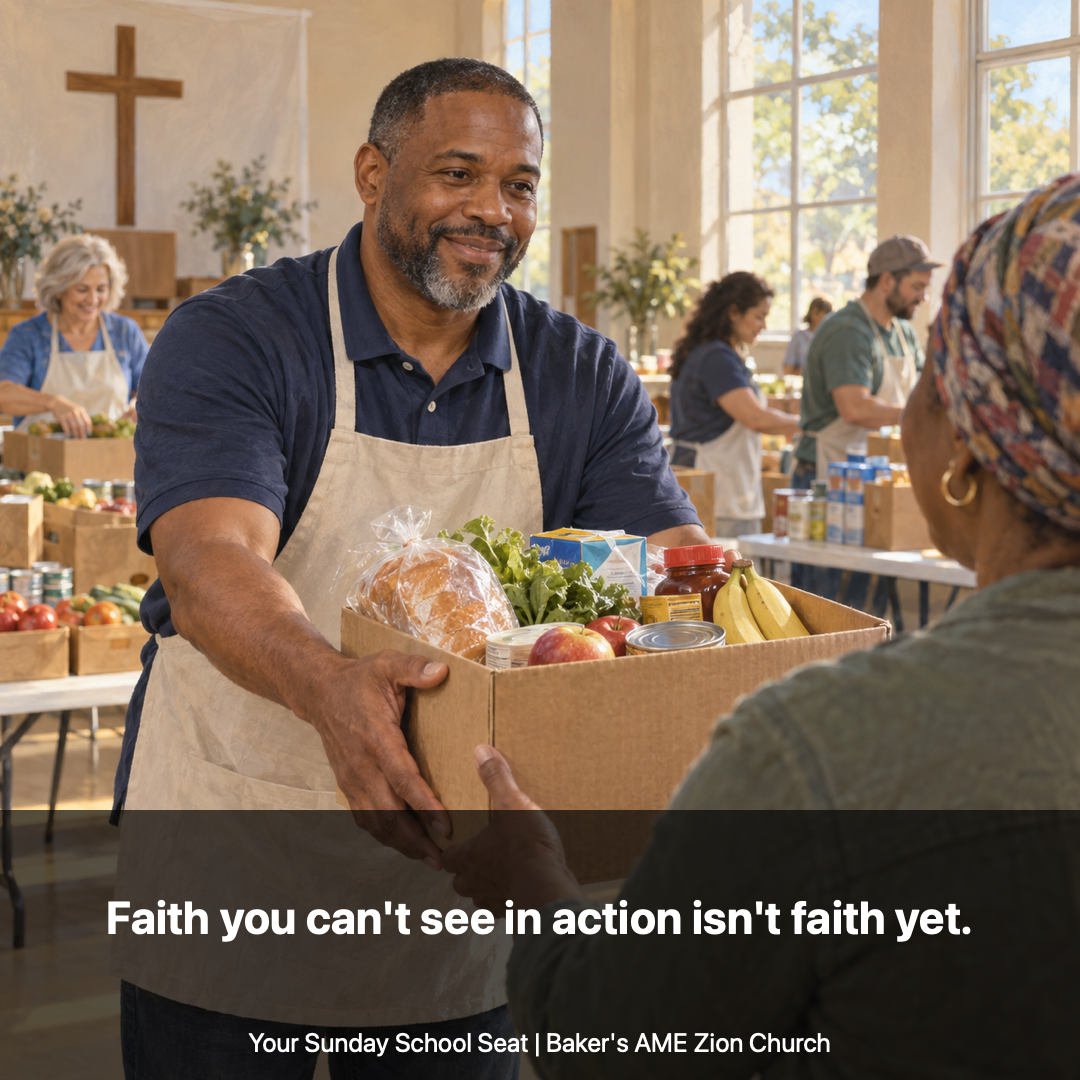
Everybody says they believe. James wants to know what your believing has cost you lately.
James 2:18-26 — KJV
18 Yea, a man may say, Thou hast faith, and I have works: shew me thy faith without thy works, and I will shew thee my faith by my works. 19 Thou believest that there is one God; thou doest well: the devils also believe, and tremble. 20 But wilt thou know, O vain man, that faith without works is dead? 21 Was not Abraham our father justified by works, when he had offered Isaac his son upon the altar? 22 Seest thou how faith wrought with his works, and by works was faith made perfect? 23 And the scripture was fulfilled which saith, Abraham believed God, and it was imputed unto him for righteousness: and he was called the Friend of God. 24 Ye see then how that by works a man is justified, and not by faith only. 25 Likewise also was not Rahab the harlot justified by works, when she had received the messengers, and had sent them out another way? 26 For as the body without the spirit is dead, so faith without works is dead also.
James 2:18-26 — WEB
18 Yes, a man will say, "You have faith, and I have works." Show me your faith without works, and I by my works will show you my faith. 19 You believe that God is one. You do well. The demons also believe, and shudder. 20 But do you want to know, vain man, that faith apart from works is dead? 21 Wasn't Abraham our father justified by works, in that he offered up Isaac his son on the altar? 22 You see that faith worked with his works, and by works faith was perfected; 23 and the Scripture was fulfilled which says, "Abraham believed God, and it was accounted to him as righteousness"; and he was called the friend of God. 24 You see then that by works, a man is justified, and not only by faith. 25 In the same way, wasn't Rahab the prostitute also justified by works, in that she received the messengers, and sent them out another way? 26 For as the body apart from the spirit is dead, even so faith apart from works is dead.
Explanation
James is writing to scattered believers who had learned the language of faith and were getting comfortable in it. They could say the right things. They could sit in the right room. And James, who does not have much patience for religious performance, asks a question that still lands: show me. Show me the faith you keep talking about, with the talking removed. What is left?
Then he throws in a line that ought to stop us cold. "The demons also believe, and shudder." Correct theology is not the finish line. You can believe every true thing about God and still be nowhere near Him. Belief that never moves your hands, your calendar, or your bank account is belief that has already died and just has not been buried yet.
To make the point, James reaches for two examples, and the pairing is deliberate. First Abraham — the patriarch, the father of the nation, the man at the top of every Jewish family tree. Then Rahab — a Canaanite woman with a reputation, from a city God's people were about to level. James puts them in the same paragraph, on the same footing, justified by the same kind of living faith. He does not apologize for the pairing. He does not put Abraham in one category and Rahab in a lesser one.
And notice what he calls Rahab's "work." It was not a sacrifice on a mountain or a lifetime of religious discipline. It was one night of hospitality and one act of protection. She received the messengers and sent them out another way. That is it. That is the work God counted.
Which should quiet two kinds of anxiety at once. If you have been measuring your faith by how much you know, James says knowledge is not the measure. If you have been measuring it by how impressive your service looks compared to everyone else's, Rahab says it does not have to be impressive. It has to be real, and it usually costs something.
So what does that look like on a Tuesday? It looks like actually making the phone call instead of saying you will pray about it. Driving the person to the appointment. Paying the light bill for a family that will never be able to pay you back. Telling the truth in the meeting when staying quiet would be easier and cheaper. Taking the casserole. Sitting in the hospital waiting room. None of it makes the bulletin. All of it is the body and spirit staying together.
Sunday's lesson is God's compassion for Rahab, and this is the hinge. Rahab did not talk her way into the story of God's people. She acted her way in, on one dark night, at real risk, before she had any guarantee it would work out.
Thought for the Day
Faith you can't see in action isn't faith yet.
Reflection Question
What is one thing your faith has been telling you to do that your schedule keeps overruling?
Prayer
God, I am good at believing and slow at moving. Take the faith I claim on Sunday and put it in my hands on Tuesday. Show me one person this week I can actually help, and keep me from talking myself out of it. Let my life show what my mouth keeps saying. Amen.
This week we walk toward Sunday's lesson: God's Compassion for Rahab.
Monday, September 21 — The Door She Decided to Open

Two strangers walk into a dangerous city, and the only person willing to take them in is the last person anybody would have picked. That is usually how God works.
Joshua 2:1-7 — KJV
1 And Joshua the son of Nun sent out of Shittim two men to spy secretly, saying, Go view the land, even Jericho. And they went, and came into an harlot's house, named Rahab, and lodged there. 2 And it was told the king of Jericho, saying, Behold, there came men in hither to night of the children of Israel to search out the country. 3 And the king of Jericho sent unto Rahab, saying, Bring forth the men that are come to thee, which are entered into thine house: for they be come to search out all the country. 4 And the woman took the two men, and hid them, and said thus, There came men unto me, but I wist not whence they were: 5 And it came to pass about the time of shutting of the gate, when it was dark, that the men went out: whither the men went I wot not: pursue after them quickly; for ye shall overtake them. 6 But she had brought them up to the roof of the house, and hid them with the stalks of flax, which she had laid in order upon the roof. 7 And the men pursued after them the way to Jordan unto the fords: and as soon as they which pursued after them were gone out, they shut the gate.
Joshua 2:1-7 — WEB
1 Joshua the son of Nun secretly sent two men out of Shittim as spies, saying, "Go, view the land, including Jericho." They went and came into the house of a prostitute whose name was Rahab, and slept there. 2 The king of Jericho was told, "Behold, men of the children of Israel came in here tonight to spy out the land." 3 Jericho's king sent to Rahab, saying, "Bring out the men who have come to you, who have entered into your house; for they have come to spy out all the land." 4 The woman took the two men and hid them. Then she said, "Yes, the men came to me, but I didn't know where they came from. 5 About the time of the shutting of the gate, when it was dark, the men went out. Where the men went, I don't know. Pursue them quickly. You may catch up with them." 6 But she had brought them up to the roof, and hidden them under the stalks of flax which she had laid in order on the roof. 7 The men pursued them along the way to the fords of the Jordan River. As soon as those who pursued them had gone out, they shut the gate.
Explanation
Israel is camped at Shittim, on the east side of the Jordan, looking across the water at everything God promised them forty years earlier. Joshua does what any careful leader would do before a hard move: he sends two men ahead to see what they are walking into. Jericho is a walled city, and the men are foreigners in a place already nervous about the crowd gathering across the river. They need somewhere to disappear. They end up in the house of a Canaanite woman named Rahab.
Scripture does not soften who she is. It names her trade in the first sentence. It does not explain her away or clean her up before letting her into the story. And her house, the text tells us later, sits in the city wall itself — the very edge of a city that had already pushed her to the edge. She is an outsider inside her own hometown.
Then the king's men come knocking, and Rahab has about ten seconds to decide. She hides the spies under stalks of flax drying on her roof, sends the search party running toward the Jordan, and shuts the gate behind them. That is not a small thing. If she is caught, she does not get a trial. She is risking everything she has on two men she met that evening, because of something she has heard about their God.
This is where the week begins, and it is worth sitting with before Sunday. The lesson we are walking toward is God's compassion for Rahab, and the first thing to notice is that the compassion runs both directions. Before God ever spares Rahab, Rahab shelters God's people. The rescue of Israel's mission ran straight through a household that no respectable person in Jericho would have claimed.
We are good at deciding who counts. We do it at work, at school, in the pew. We look at somebody's record, their reputation, the rumors that trail them, and we quietly move them to the column marked not our kind of people. Then God walks right past our columns. He sends the future of an entire nation to knock on the door of the woman we had written off.
So the practical question this Monday is simple and uncomfortable. Who is standing at the edge of your life right now — the new family in the back row nobody has spoken to, the coworker eating lunch alone, the cousin who needs a couch for a few weeks, the neighbor whose story you think you already know? Hospitality is not a personality trait. It is a decision, usually made fast, usually at some cost. Rahab made hers in the dark, with soldiers at the door, and God built a whole chapter of redemption on it.
Thought for the Day
God's rescue often starts at a door somebody decided to open.
Reflection Question
Who is standing at the edge of your life right now, waiting to see whether you will open the door?
Prayer
Lord, You keep showing up in the people I did not expect and did not choose. Forgive me for the quiet lists I keep of who belongs and who does not. Give me the nerve to open a door this week even when it costs me something. And when I am the stranger, send me a Rahab. Amen.
This week we walk toward Sunday's lesson: God's Compassion for Rahab.
September 21 -27, 2026: God's Compassion for Rahab
This week we follow one of the most surprising rescues in scripture. Two spies walk into Jericho and find shelter in the house of Rahab — a Canaanite woman living at the edge of her own city, the last person anybody would have picked. Across seven readings, from Joshua to James to Psalm 67 to Acts, we watch God keep reaching past the boundary lines His own people drew, and we watch a woman with no covenant and no credentials believe before she ever belonged. It all builds toward Sunday's lesson, God's Compassion for Rahab, where a whole city comes down and God stops to call out one name and keep one promise. Watch the week's overview, then come study it with us in Sunday school.
Monday — Welcoming Strangers (Joshua 2:1-7)
Tuesday — Faith without Works Is Dead (James 2:18-26)
Wednesday — May the Nations Know God's Salvation (Psalm 67)
Thursday — Faith to Live By (Hebrews 11:1-2, 29-31)
Friday — God Shows No Partiality (Acts 10:34-48)
Saturday — Rahab's Faith in Israel's God (Joshua 2:8-14)
Sunday — Rahab Is Spared (Joshua 6:6-17)
Your Sunday School Seat | Baker's AME Zion Church — We Saved You a Seat
#YourSundaySchoolSeat #AMEZion #DailyDevotional #Faith #BlackChurch #Rahab
Sunday, September 20 — Do Not Be Afraid
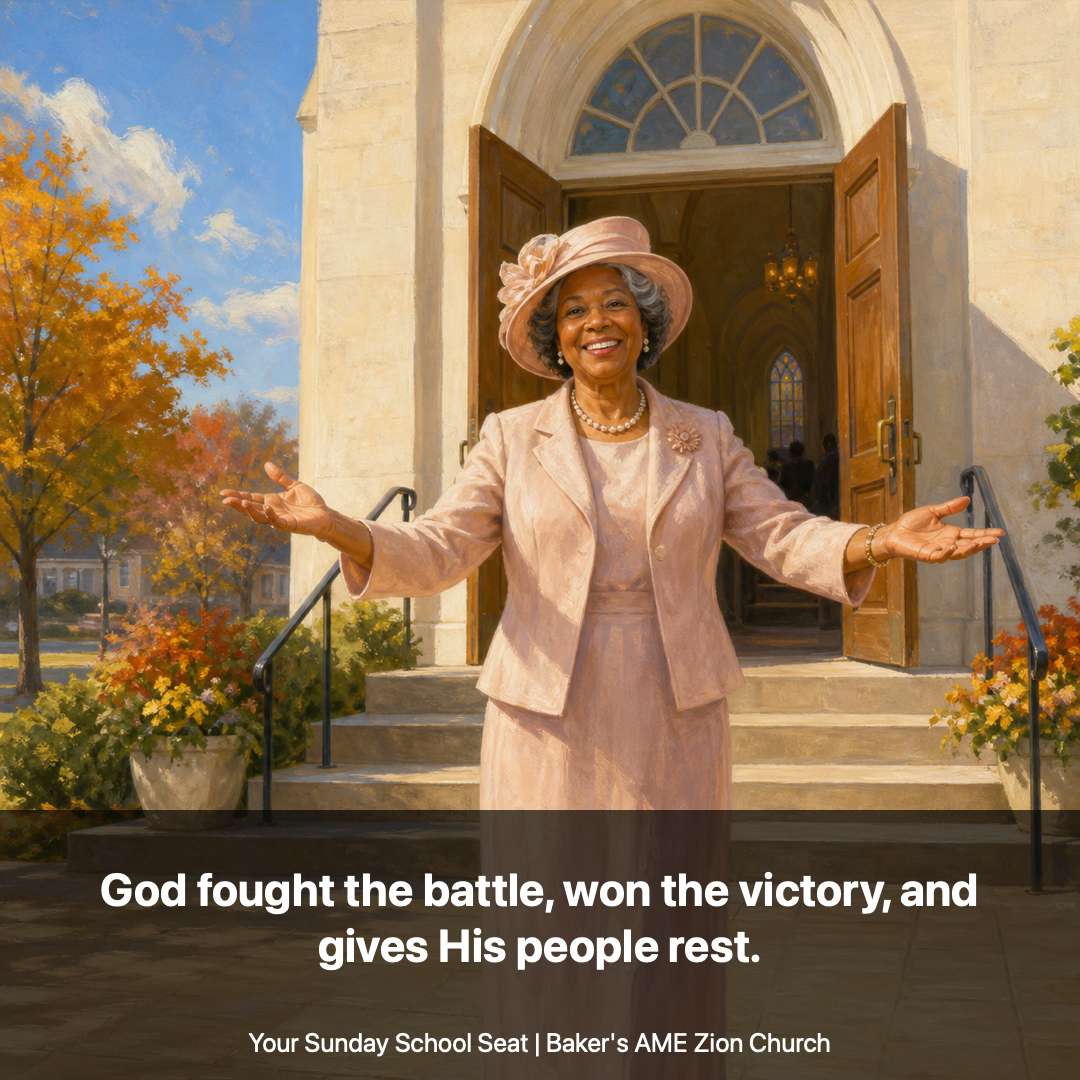
For six days we've walked toward one promise, complicated and costly — that God would give His people victory. Today the promise is kept, and it opens with the three words God has been saying to His people all along: do not be afraid.
Joshua 11:6-9, 16-23 — KJV
6 And the LORD said unto Joshua, Be not afraid because of them: for to morrow about this time will I deliver them up all slain before Israel: thou shalt hough their horses, and burn their chariots with fire. 7 So Joshua came, and all the people of war with him, against them by the waters of Merom suddenly; and they fell upon them. 8 And the LORD delivered them into the hand of Israel, who smote them, and chased them unto great Zidon, and unto Misrephothmaim, and unto the valley of Mizpeh eastward; and they smote them, until they left them none remaining. 9 And Joshua did unto them as the LORD bade him: he houghed their horses, and burnt their chariots with fire. 16 So Joshua took all that land, the hills, and all the south country, and all the land of Goshen, and the valley, and the plain, and the mountain of Israel, and the valley of the same; 17 Even from the mount Halak, that goeth up to Seir, even unto Baalgad in the valley of Lebanon under mount Hermon: and all their kings he took, and smote them, and slew them. 18 Joshua made war a long time with all those kings. 19 There was not a city that made peace with the children of Israel, save the Hivites the inhabitants of Gibeon: all other they took in battle. 20 For it was of the LORD to harden their hearts, that they should come against Israel in battle, that he might destroy them utterly, and that they might have no favour, but that he might destroy them, as the LORD commanded Moses. 21 And at that time came Joshua, and cut off the Anakims from the mountains, from Hebron, from Debir, from Anab, and from all the mountains of Judah, and from all the mountains of Israel: Joshua destroyed them utterly with their cities. 22 There was none of the Anakims left in the land of the children of Israel: only in Gaza, in Gath, and in Ashdod, there remained. 23 So Joshua took the whole land, according to all that the LORD said unto Moses; and Joshua gave it for an inheritance unto Israel according to their divisions by their tribes. And the land rested from war.
Joshua 11:6-9, 16-23 — WEB
6 Yahweh said to Joshua, "Don't be afraid because of them; for tomorrow at this time, I will deliver them up all slain before Israel. You shall hamstring their horses and burn their chariots with fire." 7 So Joshua came suddenly, with all the warriors, against them by the waters of Merom, and attacked them. 8 Yahweh delivered them into the hand of Israel, and they struck them, and chased them to great Sidon, and to Misrephoth Maim, and to the valley of Mizpah eastward. They struck them until they left them no one remaining. 9 Joshua did to them as Yahweh told him. He hamstrung their horses and burned their chariots with fire. 16 So Joshua captured all that land, the hill country, all the South, all the land of Goshen, the lowland, the Arabah, the hill country of Israel, and the lowland of the same; 17 from Mount Halak, that goes up to Seir, even to Baal Gad in the valley of Lebanon under Mount Hermon. He took all their kings, struck them, and put them to death. 18 Joshua made war a long time with all those kings. 19 There was not a city that made peace with the children of Israel, except the Hivites, the inhabitants of Gibeon. They took all in battle. 20 For it was of Yahweh to harden their hearts, to come against Israel in battle, that he might utterly destroy them, that they might have no favor, but that he might destroy them, as Yahweh commanded Moses. 21 Joshua came at that time, and cut off the Anakim from the hill country, from Hebron, from Debir, from Anab, and from all the hill country of Judah, and from all the hill country of Israel: Joshua utterly destroyed them with their cities. 22 There were none of the Anakim left in the land of the children of Israel. Only in Gaza, in Gath, and in Ashdod, some remained. 23 So Joshua took the whole land, according to all that Yahweh spoke to Moses; and Joshua gave it for an inheritance to Israel according to their divisions by their tribes. Then the land had rest from war.
Explanation
Here is where the whole week has been heading, and it opens exactly as it should. Facing that vast coalition with its horses and chariots, God says to Joshua, "Don't be afraid." It's the same word He gave through Moses in Deuteronomy 7, the same reassurance the disciples needed from Jesus in John 16. From first to last, God's word to His people staring down something bigger than themselves has been consistent: do not be afraid, for I am the one who delivers.
And He does. Yesterday's terrifying army is undone in a single verse: "Yahweh delivered them into the hand of Israel." Joshua hamstrings the horses and burns the chariots — deliberately destroying the very things Israel didn't have and might have been tempted to trust in going forward. The theme is simply "God Brings Victory," and the passage ends on one of the most beautiful phrases in the Old Testament: "Then the land had rest from war." After the long campaign, after the fear and the fighting, there is rest. The promise, complicated and hard-won, is finally kept.
We shouldn't rush past how complicated it is. This chapter includes utter destruction and even the sobering note that God "hardened their hearts." These are not easy verses, and faithful believers have long sat with them rather than tidied them up. But the lesson title, "God's Complicated Promise," invites exactly that honesty. The promise of a homeland for a landless people came through a history full of violence and hard providence — and yet the throughline is God's faithfulness to a people who could never have secured a home on their own.
Now bring the whole week together. Monday: you are chosen by grace, not merit. Tuesday: don't measure the obstacle, measure your God. Wednesday: Christ strengthens you in every circumstance. Thursday: our real warfare is spiritual, fought with God's weapons. Friday: Jesus has already overcome the world. Saturday: God fights for His people. And today: God brings the victory and gives His people rest. Joshua's conquest was a shadow; the substance came on Friday, at the cross, where Jesus won the war that mattered most and opened the way into a rest no army could ever seize.
That's the promise waiting for you. Not that life will be free of battles — it won't be. But that the God who told Joshua "do not be afraid" is fighting for you, has already overcome the world, and is leading you toward a rest that will last. The land had rest from war. In Christ, so will you.
Thought for the Day
God fought the battle, won the victory, and gives His people rest.
Reflection Question
Where do you most need to hear "do not be afraid" today — and to trust God for the rest He promises?
Prayer
Faithful God, all week You have said the same thing: do not be afraid, for I am the one who delivers. Thank You that the victory is Yours, won for me finally in Christ. Quiet my fears, and lead me into the rest You promise Your people. Where I am still fighting, remind me the outcome is already secure. I trust You to bring me home. Amen.
Today is Sunday school. We saved you a seat.
Saturday, September 19 — When God Does the Fighting
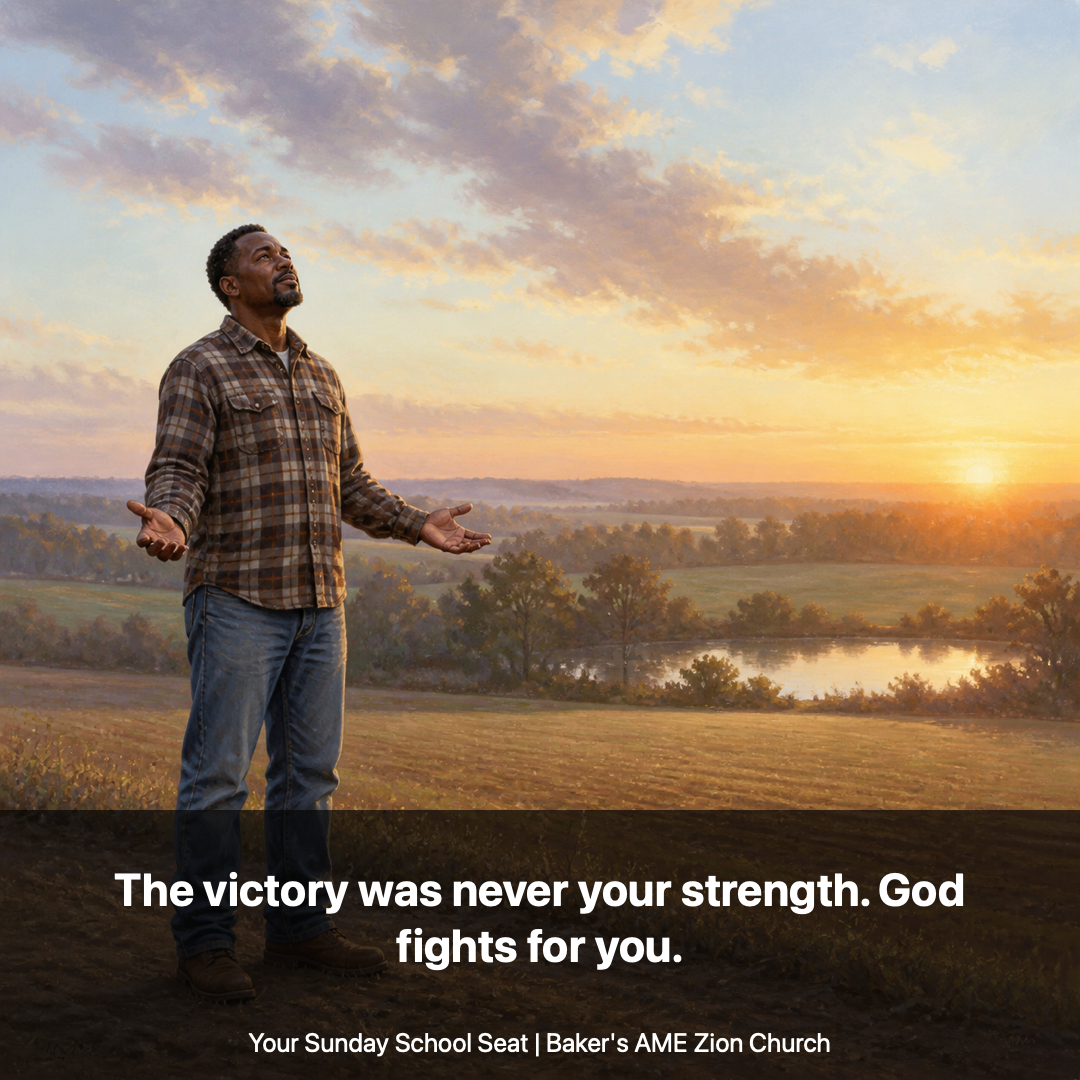
There's a line in this passage that changes everything around it. After all the marching and battles, Scripture pauses to tell us who was really doing the fighting — and it wasn't Joshua.
Joshua 10:40-11:5 — KJV
40 So Joshua smote all the country of the hills, and of the south, and of the vale, and of the springs, and all their kings: he left none remaining, but utterly destroyed all that breathed, as the LORD God of Israel commanded. 41 And Joshua smote them from Kadeshbarnea even unto Gaza, and all the country of Goshen, even unto Gibeon. 42 And all these kings and their land did Joshua take at one time, because the LORD God of Israel fought for Israel. 43 And Joshua returned, and all Israel with him, unto the camp to Gilgal. 1 And it came to pass, when Jabin king of Hazor had heard those things, that he sent to Jobab king of Madon, and to the king of Shimron, and to the king of Achshaph, 2 And to the kings that were on the north of the mountains, and of the plains south of Chinneroth, and in the valley, and in the borders of Dor on the west, 3 And to the Canaanite on the east and on the west, and to the Amorite, and the Hittite, and the Perizzite, and the Jebusite in the mountains, and to the Hivite under Hermon in the land of Mizpeh. 4 And they went out, they and all their hosts with them, much people, even as the sand that is upon the sea shore in multitude, with horses and chariots very many. 5 And when all these kings were met together, they came and pitched together at the waters of Merom, to fight against Israel.
Joshua 10:40-11:5 — WEB
40 So Joshua struck all the land, the hill country, the South, the lowland, the slopes, and all their kings. He left no one remaining, but he utterly destroyed all that breathed, as Yahweh, the God of Israel, commanded. 41 Joshua struck them from Kadesh Barnea even to Gaza, and all the country of Goshen, even to Gibeon. 42 Joshua took all these kings and their land at one time because Yahweh, the God of Israel, fought for Israel. 43 Joshua returned, and all Israel with him, to the camp to Gilgal. 1 When Jabin king of Hazor heard of it, he sent to Jobab king of Madon, to the king of Shimron, to the king of Achshaph, 2 and to the kings who were on the north, in the hill country, in the Arabah south of Chinneroth, in the lowland, and in the heights of Dor on the west, 3 to the Canaanite on the east and on the west, the Amorite, the Hittite, the Perizzite, the Jebusite in the hill country, and the Hivite under Hermon in the land of Mizpah. 4 They went out, they and all their armies with them, many people, even as the sand that is on the seashore in multitude, with very many horses and chariots. 5 All these kings met together; and they came and encamped together at the waters of Merom, to fight with Israel.
Explanation
We should be honest about what we're reading. This is a summary of conquest, and the phrase "utterly destroyed all that breathed" is jarring to modern ears, as it should be. Bible readers have wrestled with these passages for centuries, and it's right to hold them soberly rather than cheer. But even inside this hard text, Scripture drops a key that unlocks its real meaning. Verse 42 explains how a former band of slaves overcame fortified cities and trained armies: "because the LORD God of Israel fought for Israel." The victories were never a monument to Israel's might. They were the work of God keeping a promise.
That's the daily theme in five words: "God Fights for God's People." Look at the odds stacked against them in chapter 11. King Jabin rallies a coalition — kings from the north, the hill country, the valleys, the coast — a combined army "as the sand on the seashore in multitude, with very many horses and chariots." Israel had no chariots. By every earthly measure, this was over before it began. The writer piles up the enemy's advantages on purpose, so that when the victory comes tomorrow, no one can mistake where it came from.
This connects straight back to Tuesday, when Israel worried, "These nations are more than I; how can I dispossess them?" Here they are — more numerous, better armed, gathered for war. And the answer is the same as it always was: it was never about Israel's strength. It was about God's faithfulness. The same truth Paul preached on Thursday holds: the real power in any battle worth fighting doesn't come from human resources.
For us, this is a Saturday-sized encouragement. Most of us are looking at some coalition of troubles that feels like sand on the seashore — bills and health and family and worry, all gathered against us at once. The temptation is to size up our own strength and despair, because honestly, we don't have chariots either. But the gospel keeps insisting that the outcome of our battles doesn't rest on our resources. God fights for His people. Your job today isn't to be strong enough. It's to stay faithful and let God be God. Show up, do the next right thing, and trust the One who has never lost. Tomorrow we'll see how completely He delivers — but the secret is already out in verse 42.
Thought for the Day
The victory was never your strength. God fights for you.
Reflection Question
What battle are you trying to win in your own strength that you need to hand back to God?
Prayer
Lord, I look at what's gathered against me and I feel small and outnumbered. Remind me that the victory has never depended on my strength. You fought for Your people then, and You fight for me now. Help me stay faithful and stop trying to carry what only You can win. I trust You to go before me. Amen.
This week we walk toward Sunday's lesson: God's Complicated Promise.
Friday, September 18 — He Already Won

Some nights the news, the diagnosis, or the silence in the house can make you feel like the world is winning. Jesus told His friends the truth on the hardest night of His life: the world has already lost.
John 16:23-33 — KJV
23 And in that day ye shall ask me nothing. Verily, verily, I say unto you, Whatsoever ye shall ask the Father in my name, he will give it you. 24 Hitherto have ye asked nothing in my name: ask, and ye shall receive, that your joy may be full. 25 These things have I spoken unto you in proverbs: but the time cometh, when I shall no more speak unto you in proverbs, but I shall shew you plainly of the Father. 26 At that day ye shall ask in my name: and I say not unto you, that I will pray the Father for you: 27 For the Father himself loveth you, because ye have loved me, and have believed that I came out from God. 28 I came forth from the Father, and am come into the world: again, I leave the world, and go to the Father. 29 His disciples said unto him, Lo, now speakest thou plainly, and speakest no proverb. 30 Now are we sure that thou knowest all things, and needest not that any man should ask thee: by this we believe that thou camest forth from God. 31 Jesus answered them, Do ye now believe? 32 Behold, the hour cometh, yea, is now come, that ye shall be scattered, every man to his own, and shall leave me alone: and yet I am not alone, because the Father is with me. 33 These things I have spoken unto you, that in me ye might have peace. In the world ye shall have tribulation: but be of good cheer; I have overcome the world.
John 16:23-33 — WEB
23 "In that day you will ask me no questions. Most certainly I tell you, whatever you may ask of the Father in my name, he will give it to you. 24 Until now, you have asked nothing in my name. Ask, and you will receive, that your joy may be made full. 25 I have spoken these things to you in figures of speech. But the time is coming when I will no more speak to you in figures of speech, but will tell you plainly about the Father. 26 In that day you will ask in my name; and I don't say to you that I will pray to the Father for you, 27 for the Father himself loves you, because you have loved me, and have believed that I came from God. 28 I came from the Father, and have come into the world. Again, I leave the world, and go to the Father." 29 His disciples said to him, "Behold, now you are speaking plainly, and using no figures of speech. 30 Now we know that you know all things, and don't need for anyone to question you. By this we believe that you came from God." 31 Jesus answered them, "Do you now believe? 32 Behold, the time is coming, yes, and has now come, that you will be scattered, everyone to his own place, and you will leave me alone. Yet I am not alone, because the Father is with me. 33 I have told you these things, that in me you may have peace. In the world you have trouble; but cheer up! I have overcome the world."
Explanation
This is the end of Jesus' last long conversation with His disciples before the cross. In a few hours He'll be arrested; by tomorrow He'll be dead. And on that night — knowing all of it — He talks to them about prayer, joy, and peace. He tells them a new kind of access is opening up: "Whatever you may ask of the Father in my name, he will give it to you... Ask, and you will receive, that your joy may be made full." Because of what Jesus is about to do, the door to the Father swings wide open, and it's a door of love: "the Father himself loves you."
Then Jesus gets painfully honest. He tells them they're about to scatter and leave Him alone. He doesn't pretend the night will be easy or that their faith will be heroic. And yet, even abandoned, He says, "I am not alone, because the Father is with me." That's the same steadiness Paul described on Wednesday — a peace that doesn't depend on the circumstances cooperating.
Everything lands on that last verse, one of the great sentences of the Bible: "In the world you have trouble; but cheer up! I have overcome the world." Notice Jesus doesn't say you might have trouble, or that trouble will skip the faithful. He guarantees it — "you have trouble." The Christian life was never sold as a trouble-free deal. But He sets that hard promise next to a greater one: "I have overcome the world." Past tense, spoken before the cross, as good as done.
This is the turning point of our whole week, and it's why the daily theme is "Christ Has Conquered the World." Deuteronomy promised God would fight Israel's battles. Paul said our real warfare is spiritual, fought with divine weapons. Now Jesus reveals who actually wins the war — and He wins it not with an army but by laying down His life. Tomorrow and Sunday we'll watch Joshua's earthly victories, but Friday tells us where the real, final victory was secured: at the cross of Christ.
So for the weekend ahead, hold both halves of verse 33 together. Don't be surprised by the trouble; Jesus told you it was coming. But don't be defeated by it either. The outcome of the war is already settled. You're not fighting for victory — you're living from a victory Christ already won. Whatever you're facing tonight, you can be of good cheer, because He has overcome the world.
Thought for the Day
In the world, trouble. In Christ, a victory already won.
Reflection Question
What trouble are you facing that changes when you remember Christ has already overcome the world?
Prayer
Lord Jesus, on Your hardest night You spoke peace over Your friends, and You speak it over me now. I do have trouble in this world — You told me I would. But You have overcome it. Help me stop fighting for a victory You've already won, and start living from it. Fill my joy, open my prayers, and steady me with Your peace. Amen.
This week we walk toward Sunday's lesson: God's Complicated Promise.
Thursday, September 17 — Fighting the Right Battle

We aim our anger at people all the time — the driver, the coworker, the relative, the stranger online. Paul says most of the time we're firing at the wrong target with the wrong weapons.
2 Corinthians 10:1-5, 15-18 — KJV
1 Now I Paul myself beseech you by the meekness and gentleness of Christ, who in presence am base among you, but being absent am bold toward you: 2 But I beseech you, that I may not be bold when I am present with that confidence, wherewith I think to be bold against some, which think of us as if we walked according to the flesh. 3 For though we walk in the flesh, we do not war after the flesh: 4 (For the weapons of our warfare are not carnal, but mighty through God to the pulling down of strong holds;) 5 Casting down imaginations, and every high thing that exalteth itself against the knowledge of God, and bringing into captivity every thought to the obedience of Christ; 15 Not boasting of things without our measure, that is, of other men's labours; but having hope, when your faith is increased, that we shall be enlarged by you according to our rule abundantly, 16 To preach the gospel in the regions beyond you, and not to boast in another man's line of things made ready to our hand. 17 But he that glorieth, let him glory in the Lord. 18 For not he that commendeth himself is approved, but whom the Lord commendeth.
2 Corinthians 10:1-5, 15-18 — WEB
1 Now I Paul, myself, entreat you by the humility and gentleness of Christ, I who in your presence am lowly among you, but being absent am bold toward you. 2 Yes, I beg you that I may not, when present, show courage with the confidence with which I intend to be bold against some, who consider us to be walking according to the flesh. 3 For though we walk in the flesh, we don't wage war according to the flesh; 4 for the weapons of our warfare are not of the flesh, but mighty before God to the throwing down of strongholds, 5 throwing down imaginations and every high thing that is exalted against the knowledge of God, and bringing every thought into captivity to the obedience of Christ, 15 not boasting beyond proper limits in other men's labors, but having hope that as your faith grows, we will be abundantly enlarged by you in our sphere of influence, 16 so as to preach the Good News even to the parts beyond you, not to boast in what someone else has already done. 17 But "he who boasts, let him boast in the Lord." 18 For it isn't he who commends himself who is approved, but whom the Lord commends.
Explanation
Paul is under attack. Critics in Corinth said he was timid in person and only brave in his letters, and that he operated "according to the flesh" — by worldly scheming. His response reframes the whole conflict. "Though we walk in the flesh, we don't wage war according to the flesh; for the weapons of our warfare are not of the flesh, but mighty before God to the throwing down of strongholds." Paul agrees there's a battle. He just insists it's a different kind of battle than his critics think, fought with different weapons.
This is the reading that reinterprets the entire week. Monday and Tuesday gave us literal warfare — swords, armies, walled cities. Saturday and Sunday will return to it with Joshua. But right here at the center, Paul lifts the whole theme onto a higher plane. The real "nations" that oppose God's people aren't flesh-and-blood enemies; they're "strongholds" — entrenched ways of thinking, arguments, and "every high thing that is exalted against the knowledge of God." The daily theme calls it "Armed for Spiritual Warfare," and Paul's most striking image is verse 5: "bringing every thought into captivity to the obedience of Christ." The battlefield is the mind.
Think about what that means practically. The stronghold might be a lie you've believed since childhood — that you're worthless, unlovable, too far gone. It might be a resentment you rehearse until it hardens into bitterness, or a fear that runs your decisions from the shadows. You can't bulldoze those things with willpower, and you certainly can't fix them by lashing out at the people around you. Paul says they come down another way — through truth, through prayer, through taking each runaway thought and marching it into obedience to Christ. That's spiritual warfare, and it's quieter and harder than a shouting match.
Notice, too, how Paul refuses to boast about himself. Twice he says the credit belongs elsewhere: "He who boasts, let him boast in the Lord... It isn't he who commends himself who is approved, but whom the Lord commends." Even our victories aren't trophies for our egos. This ties back to Monday — we were chosen by grace, not merit — and forward to Sunday, where the land is won not by Israel's greatness but by God fighting for them.
So today, before you go to war with a person, ask what the real stronghold is. The coworker isn't your enemy; the pride or fear underneath the friction might be. Fight the right battle, with the right weapons. Take that anxious, angry, accusing thought captive, and hand it over to Christ.
Thought for the Day
Take every runaway thought captive and hand it to Christ.
Reflection Question
What thought or stronghold keeps winning in your mind — and what would it look like to surrender it to Christ?
Prayer
Lord, so often I fight the wrong battles with the wrong weapons — sharp words, wounded pride, quiet grudges. Show me the real strongholds in my mind. Give me weapons that actually work: Your truth, Your Spirit, honest prayer. Help me take every anxious and angry thought captive and lay it at Your feet. And let any victory be to Your glory, not mine. Amen.
This week we walk toward Sunday's lesson: God's Complicated Promise.
Wednesday, September 16 — The Secret of Being Steady
Some people fall apart when life gets hard and get proud when life gets easy. Paul says he learned a better way — a steadiness that holds up in a prison cell and a palace alike.
Philippians 4:10-19 — KJV
10 But I rejoiced in the Lord greatly, that now at the last your care of me hath flourished again; wherein ye were also careful, but ye lacked opportunity. 11 Not that I speak in respect of want: for I have learned, in whatsoever state I am, therewith to be content. 12 I know both how to be abased, and I know how to abound: every where and in all things I am instructed both to be full and to be hungry, both to abound and to suffer need. 13 I can do all things through Christ which strengtheneth me. 14 Notwithstanding ye have well done, that ye did communicate with my affliction. 15 Now ye Philippians know also, that in the beginning of the gospel, when I departed from Macedonia, no church communicated with me as concerning giving and receiving, but ye only. 16 For even in Thessalonica ye sent once and again unto my necessity. 17 Not because I desire a gift: but I desire fruit that may abound to your account. 18 But I have all, and abound: I am full, having received of Epaphroditus the things which were sent from you, an odour of a sweet smell, a sacrifice acceptable, wellpleasing to God. 19 But my God shall supply all your need according to his riches in glory by Christ Jesus.
Philippians 4:10-19 — WEB
10 But I rejoice in the Lord greatly, that now at length you have revived your thought for me; in which you did indeed take thought, but you lacked opportunity. 11 Not that I speak because of lack, for I have learned in whatever state I am, to be content in it. 12 I know how to be humbled, and I know also how to abound. In everything and in all things I have learned the secret both to be filled and to be hungry, both to abound and to be in need. 13 I can do all things through Christ, who strengthens me. 14 However you did well that you shared in my affliction. 15 You yourselves also know, you Philippians, that in the beginning of the Good News, when I departed from Macedonia, no assembly shared with me in the matter of giving and receiving but you only. 16 For even in Thessalonica you sent once and again to my need. 17 Not that I seek for the gift, but I seek for the fruit that increases to your account. 18 But I have all things and abound. I am filled, having received from Epaphroditus the things that came from you, a sweet-smelling fragrance, an acceptable and well-pleasing sacrifice to God. 19 My God will supply every need of yours according to his riches in glory in Christ Jesus.
Explanation
Midweek, the readings turn a corner. The first two days had us walking with Israel toward a promised land; now Paul writes from a Roman prison, and the battlefield moves inside the human heart. He's thanking the Philippians for a financial gift, but he slips in a testimony that has steadied believers for two thousand years: "I have learned, in whatever state I am, to be content."
Read that word "learned" carefully. Contentment didn't come naturally to Paul any more than it does to us. He learned it — through hunger and plenty, through applause and abandonment, through shipwrecks and jail cells. He "learned the secret both to be filled and to be hungry, both to abound and to be in need." Notice both sides make the list. Abundance can wreck a soul as surely as lack can; plenty of people who survived hard times quietly lost their way once things got comfortable. Paul found a steadiness that didn't rise and fall with his circumstances.
Where did that steadiness come from? Verse 13, one of the most quoted and most misunderstood lines in the Bible: "I can do all things through Christ which strengtheneth me." Paul isn't talking about winning games or landing promotions. In context, "all things" means all these things — being full and being empty, having much and having little. The strength Christ gives isn't a guarantee that life gets easier. It's the power to stay faithful and joyful no matter which way the wind blows.
This is exactly why the reading sits in the middle of a week about God's people facing bigger nations. Israel's battle was outside them; ours is often inside. Can I trust God when the account is low? Can I stay humble when it's full? The daily theme names it well: "Strengthened in Every Circumstance." And Paul ends with the promise that carries the whole thing: "My God will supply every need of yours according to his riches in glory in Christ Jesus." Not every want — every need, out of God's endless supply.
For our ordinary Wednesday, this is freedom. You don't have to wait for your circumstances to settle down before your soul does. Contentment is learned in the middle of the mess, one dependent day at a time, by a person who keeps drawing strength from Christ. Whatever your bank balance, health, or workload looks like today, the same Christ who held Paul in prison is holding you. Lean into Him, and be steady.
Thought for the Day
Christ's strength holds you steady in plenty and in need.
Reflection Question
Is contentment harder for you in seasons of lack or in seasons of plenty — and why?
Prayer
Lord, teach me the secret Paul learned — to be content whether my hands are full or empty. Keep me from letting my joy rise and fall with my circumstances. When I'm stretched thin, be my strength; when I'm comfortable, keep me humble and grateful. Thank You that You supply every need out of Your riches. Steady my heart in You today. Amen.
This week we walk toward Sunday's lesson: God's Complicated Promise.
Tuesday, September 15 — The God Who Multiplies Faithfulness
We're quick to believe God can forgive us. We're slower to believe He actually wants to bless us. Moses spends a whole passage insisting that obedience and blessing are tied together in the heart of a loving God.
Deuteronomy 7:12-26 — KJV
12 Wherefore it shall come to pass, if ye hearken to these judgments, and keep, and do them, that the LORD thy God shall keep unto thee the covenant and the mercy which he sware unto thy fathers: 13 And he will love thee, and bless thee, and multiply thee: he will also bless the fruit of thy womb, and the fruit of thy land, thy corn, and thy wine, and thine oil, the increase of thy kine, and the flocks of thy sheep, in the land which he sware unto thy fathers to give thee. 14 Thou shalt be blessed above all people: there shall not be male or female barren among you, or among your cattle. 15 And the LORD will take away from thee all sickness, and will put none of the evil diseases of Egypt, which thou knowest, upon thee; but will lay them upon all them that hate thee. 16 And thou shalt consume all the people which the LORD thy God shall deliver thee; thine eye shall have no pity upon them: neither shalt thou serve their gods; for that will be a snare unto thee. 17 If thou shalt say in thine heart, These nations are more than I; how can I dispossess them? 18 Thou shalt not be afraid of them: but shalt well remember what the LORD thy God did unto Pharaoh, and unto all Egypt; 19 The great temptations which thine eyes saw, and the signs, and the wonders, and the mighty hand, and the stretched out arm, whereby the LORD thy God brought thee out: so shall the LORD thy God do unto all the people of whom thou art afraid. 20 Moreover the LORD thy God will send the hornet among them, until they that are left, and hide themselves from thee, be destroyed. 21 Thou shalt not be affrighted at them: for the LORD thy God is among you, a mighty God and terrible. 22 And the LORD thy God will put out those nations before thee by little and little: thou mayest not consume them at once, lest the beasts of the field increase upon thee. 23 But the LORD thy God shall deliver them unto thee, and shall destroy them with a mighty destruction, until they be destroyed. 24 And he shall deliver their kings into thine hand, and thou shalt destroy their name from under heaven: there shall no man be able to stand before thee, until thou have destroyed them. 25 The graven images of their gods shall ye burn with fire: thou shalt not desire the silver or gold that is on them, nor take it unto thee, lest thou be snared therein: for it is an abomination to the LORD thy God. 26 Neither shalt thou bring an abomination into thine house, lest thou be a cursed thing like it: but thou shalt utterly detest it, and thou shalt utterly abhor it; for it is a cursed thing.
Deuteronomy 7:12-26 — WEB
12 It shall happen, because you listen to these ordinances and keep and do them, that Yahweh your God will keep with you the covenant and the loving kindness which he swore to your fathers. 13 He will love you, bless you, and multiply you. He will also bless the fruit of your body and the fruit of your ground, your grain and your new wine and your oil, the increase of your livestock and the young of your flock, in the land which he swore to your fathers to give you. 14 You will be blessed above all peoples. There won't be male or female barren among you, or among your livestock. 15 Yahweh will take away from you all sickness; and he will put none of the evil diseases of Egypt, which you know, on you, but will lay them on all those who hate you. 16 You shall consume all the peoples whom Yahweh your God shall deliver to you. Your eye shall not pity them. You shall not serve their gods; for that would be a snare to you. 17 If you shall say in your heart, "These nations are more than I; how can I dispossess them?" 18 you shall not be afraid of them. You shall remember well what Yahweh your God did to Pharaoh and to all Egypt: 19 the great trials which your eyes saw, the signs, the wonders, the mighty hand, and the outstretched arm, by which Yahweh your God brought you out. So shall Yahweh your God do to all the peoples of whom you are afraid. 20 Moreover Yahweh your God will send the hornet among them, until those who are left, and hide themselves, perish from before you. 21 You shall not be scared of them; for Yahweh your God is among you, a great and awesome God. 22 Yahweh your God will cast out those nations before you little by little. You may not consume them at once, lest the animals of the field increase on you. 23 But Yahweh your God will deliver them up before you, and will confuse them with a great confusion, until they are destroyed. 24 He will deliver their kings into your hand, and you shall make their name perish from under the sky. No one will be able to stand before you until you have destroyed them. 25 You shall burn the engraved images of their gods with fire. You shall not covet the silver or the gold that is on them, nor take it for yourself, lest you be snared in it; for it is an abomination to Yahweh your God. 26 You shall not bring an abomination into your house and become a devoted thing like it. You shall utterly detest it. You shall utterly abhor it; for it is a devoted thing.
Explanation
Yesterday Moses told Israel who they were: chosen, loved, holy. Today he tells them what happens when a chosen people actually walks with God. The word that dominates the opening verses is generous — He "will love you, bless you, and multiply you." God ties His blessing to their faithfulness, not because He's stingy, but because He knows that a people who forget Him will drift into the very idolatry that destroys them. The commands here are stern, but the heart behind them is a Father protecting His children from what will ruin them.
Then Moses does something pastoral. He anticipates the exact fear that would rise in their chests: "If you say in your heart, 'These nations are more than I; how can I dispossess them?'" He names their anxiety out loud. And his answer isn't a pep talk about their own abilities. It's a memory: "Remember well what the LORD your God did to Pharaoh and to all Egypt." Don't measure the size of the obstacle. Measure the size of the God who already brought you out of slavery. The same hand that split the sea is the hand going before you now.
There's also a quietly realistic promise tucked in verse 22: God will drive out the nations "little by little," not all at once, so the land wouldn't fall into ruin before they could tend it. God's timing often feels slower than we'd like, but His pace is mercy, not neglect. He knows what we can handle and what would overwhelm us. The gradual victory is still a real victory.
This is the second step toward Sunday's "complicated promise." The promise came with fear attached — the enemies really were bigger. And God's answer to fear, all week long, will be the same: I have done this before, and I am with you now. For us, the enemies aren't Canaanite armies. They're the diagnosis, the overdue bill, the addiction, the strained marriage, the fear that our small faith isn't enough. And God still says, remember what I've already carried you through. He is a God who multiplies faithfulness — small obedience, over time, into something abundant. You may only be able to take the next step. Take it. He clears the land little by little, and He is with you the whole way.
Thought for the Day
Don't measure the obstacle. Measure the God who brought you out.
Reflection Question
What "nation" feels too big for you right now — and how has God already proven Himself in your past?
Prayer
Lord, I confess how quickly I size up my problems and forget Your power. Remind me today of what You've already brought me through. When the road ahead looks too big, steady my heart with Your presence. Thank You that You bless faithfulness and clear the way little by little. I'll take the next step, trusting You for the rest. Amen.
This week we walk toward Sunday's lesson: God's Complicated Promise.