

A daily walk through Scripture, preparing our hearts for Sunday.
Wednesday, May 20 — When the Streets Fill with Play
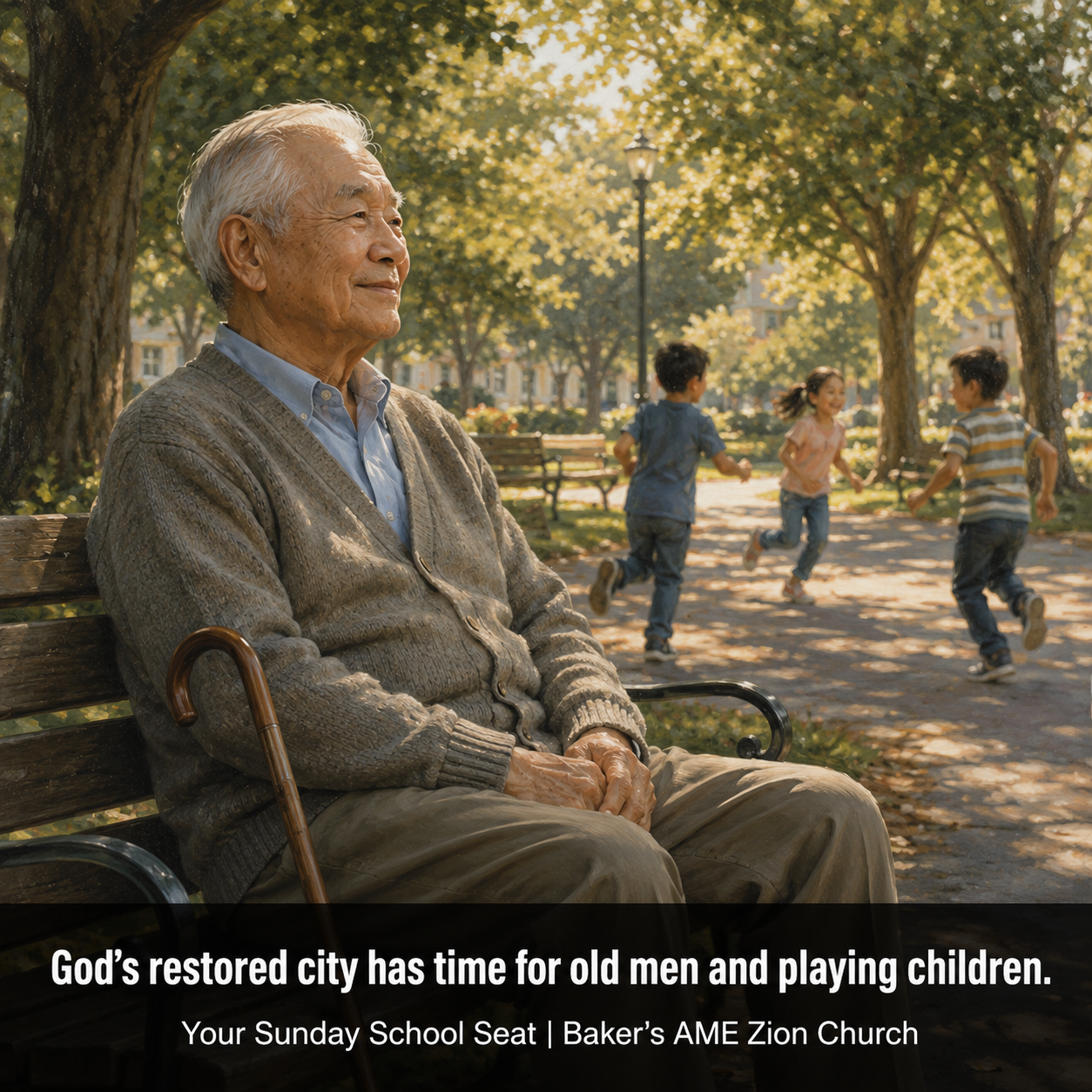
Zechariah is preaching to a community sitting in rubble — and God's vision of restoration isn't a temple or a treasury. It's old people on benches and kids playing in the street.
Zechariah 8:1-5 — KJV 1 Again the word of the LORD of hosts came to me, saying, 2 Thus saith the LORD of hosts; I was jealous for Zion with great jealousy, and I was jealous for her with great fury. 3 Thus saith the LORD; I am returned unto Zion, and will dwell in the midst of Jerusalem: and Jerusalem shall be called a city of truth; and the mountain of the LORD of hosts the holy mountain. 4 Thus saith the LORD of hosts; There shall yet old men and old women dwell in the streets of Jerusalem, and every man with his staff in his hand for very age. 5 And the streets of the city shall be full of boys and girls playing in the streets thereof.
Zechariah 8:1-5 — WEB 1 The word of Yahweh of Armies came to me. 2 Yahweh of Armies says: "I am jealous for Zion with great jealousy, and I am jealous for her with great wrath." 3 Yahweh says: "I have returned to Zion, and will dwell in the middle of Jerusalem. Jerusalem shall be called 'The City of Truth;' and the mountain of Yahweh of Armies, 'The Holy Mountain.'" 4 Yahweh of Armies says: "Old men and old women will again dwell in the streets of Jerusalem, every man with his staff in his hand for the multitude of days. 5 The streets of the city will be full of boys and girls playing in its streets."
Explanation
Zechariah is prophesying to a community trying to come back from the bottom. The exiles have returned to Jerusalem. The temple is half-rebuilt and the work has stalled. The walls are still in pieces. The economy is fragile. The older folks remember what the city used to look like, and the younger ones have only ever known it broken. People are tired. Discouraged. Wondering if it was worth coming home at all.
And into this exhaustion, God speaks. He says: I'm coming back. And here's what restoration is going to look like.
Now you might expect God to describe a restored temple. Or a powerful king. Or armies, or wealth, or political power. He doesn't. The picture God paints of a redeemed Jerusalem is small and tender and astonishing: old men and old women sitting safely in the streets, leaning on their canes, swapping stories. And kids — boys and girls — playing in those same streets. Not afraid. Not hidden. Just playing.
That's the picture. That's what the Lord of Hosts says shalom looks like.
Think about what those two images have in common. Old people in the street and children at play are both signs of safety. They are both signs of time enjoyed. Neither group is producing economic output in this picture. Neither is fighting a war. Neither is rushing somewhere. They are simply being, in a place that is no longer afraid. That, the prophet says, is the city God dwells in.
This is huge for us as we think about the Christian view of recreation. The kingdom of God is not just rescue from sin — though it is that. It's not just heaven later — though it is that too. It's also streets safe enough for play. It's an old man on a bench with his cane. It's a little girl chasing a ball without looking over her shoulder. The Hebrew word shalom doesn't just mean the absence of war. It means the kind of peace where children can play in the road.
Here's the question for us. If God's vision of restoration includes recreation — rest, play, leisure, gathering — then how should that shape the lives we build now? How we run our households? How we treat our elders? How we structure our weeks?
A city where no one has time to play is not yet a city God is finished with.
Thought for the Day God's restored city has time for old men and playing children.
Reflection Question Where, in your life or community, is there no longer time to play — and what would it take to recover that?
Prayer Lord of Hosts, you who measure flourishing in laughter and not in productivity, teach us to long for the city you described. Where elders are honored with rest. Where children play without fear. Where streets are safe. Make our homes small previews of that city. And give us the courage to slow down enough to let your shalom catch up with us. Amen.
This week we walk toward Sunday's lesson: The Christian View of Recreation.
Tuesday, May 19 — God Made Me to Laugh
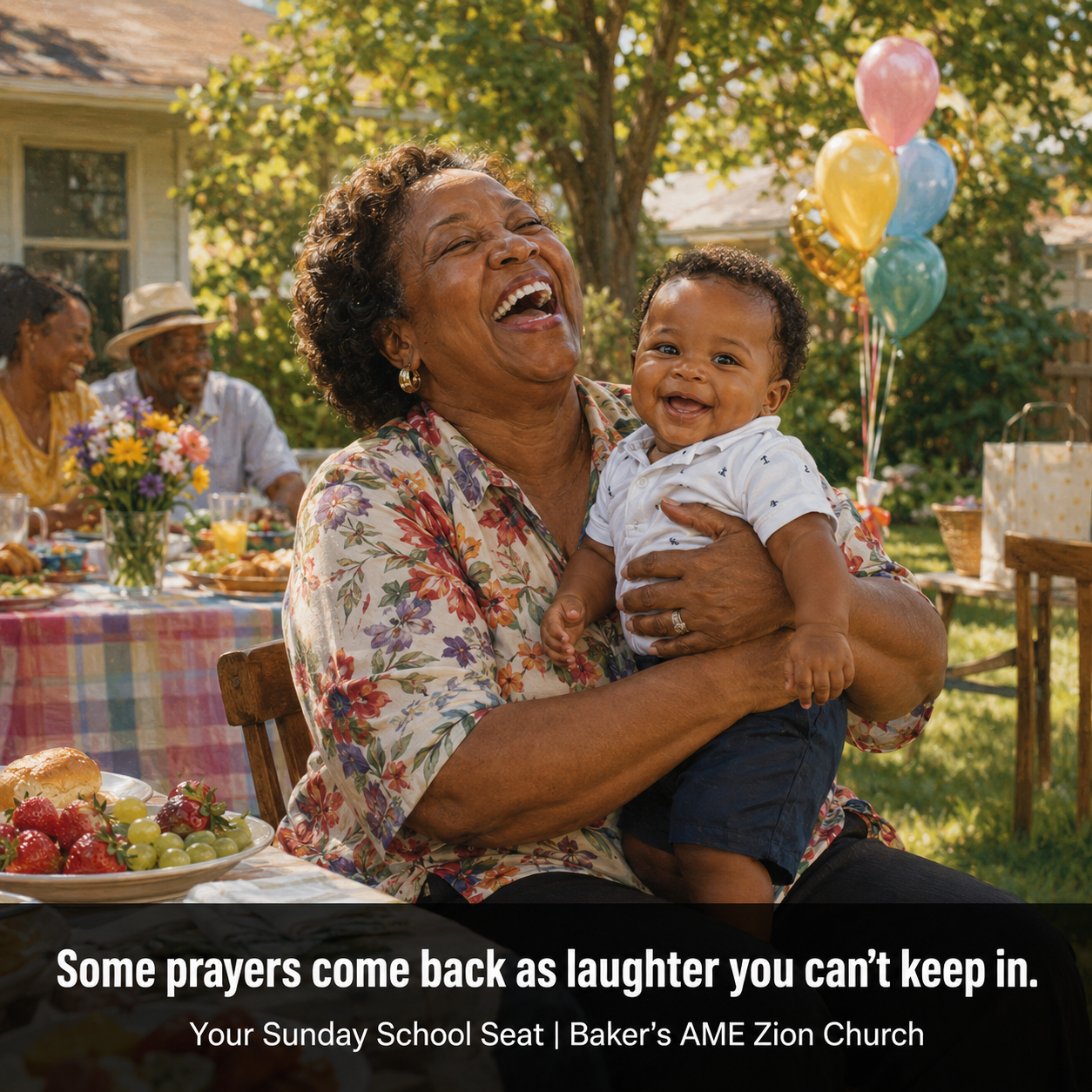
Sarah laughed. First out of disbelief, then out of sheer joy. Sometimes God's promises arrive late enough that you'd given up — and that's exactly when they break you wide open.
Genesis 21:1-8 — KJV 1 And the LORD visited Sarah as he had said, and the LORD did unto Sarah as he had spoken. 2 For Sarah conceived, and bare Abraham a son in his old age, at the set time of which God had spoken to him. 3 And Abraham called the name of his son that was born unto him, whom Sarah bare to him, Isaac. 4 And Abraham circumcised his son Isaac being eight days old, as God had commanded him. 5 And Abraham was an hundred years old, when his son Isaac was born unto him. 6 And Sarah said, God hath made me to laugh, so that all that hear will laugh with me. 7 And she said, Who would have said unto Abraham, that Sarah should have given children suck? for I have born him a son in his old age. 8 And the child grew, and was weaned: and Abraham made a great feast the same day that Isaac was weaned.
Genesis 21:1-8 — WEB 1 Yahweh visited Sarah as he had said, and Yahweh did to Sarah as he had spoken. 2 Sarah conceived, and bore Abraham a son in his old age, at the set time of which God had spoken to him. 3 Abraham called his son who was born to him, whom Sarah bore to him, Isaac. 4 Abraham circumcised his son Isaac when he was eight days old, as God had commanded him. 5 Abraham was one hundred years old when his son Isaac was born to him. 6 Sarah said, "God has made me laugh. Everyone who hears will laugh with me." 7 She said, "Who would have said to Abraham that Sarah would nurse children? For I have borne him a son in his old age." 8 The child grew and was weaned. Abraham made a great feast on the day that Isaac was weaned.
Explanation
The name Isaac means "he laughs." Sarah picked it. And there's something striking about the fact that this woman — who once laughed in disbelief when she overheard the Lord telling Abraham she'd have a son in her old age — chose laughter as the permanent name of the answer to her prayer.
Sarah was about ninety. Abraham was a hundred. They had been waiting on this child for somewhere around twenty-five years. They had tried to make it happen on their own — that's what the Hagar story is about, a few chapters earlier — and they had failed in painful ways. And then, when they had nothing left but their wrinkles and their grief, God showed up. And he kept his word.
Notice what Abraham does next: he throws a feast. A great feast, the text says. Not a small thing. Not a quiet, dignified moment. A feast. The kind of celebration that involves cooking for days, inviting the whole community, laughter spilling out of the tents into the desert evening. They didn't whisper their gratitude. They threw a party.
This week's theme is the Christian view of recreation, and here's something we don't always notice: throughout scripture, God's people mark the milestones of grace with celebration. Weaning a child. Bringing in a harvest. Surviving a war. Watching a son or daughter walk through a door we didn't think they'd reach. The right response to grace, biblically speaking, is often a feast.
If you were raised in a stoic household, this can feel foreign. We're more comfortable with grim endurance than open joy. We say things like, "I'm just grateful," in the same flat tone we use to read traffic reports. But Sarah's laughter has a different quality. It's loud. It's contagious. It says: I cannot believe this is happening. I cannot keep this in.
What has God done for you that you haven't celebrated yet? Maybe it's the kid who finally came home. Maybe it's the diagnosis that turned out better than expected. Maybe it's the marriage you thought wouldn't make it through last year. Maybe it's just that you woke up one more time.
Sarah named the answer to her prayer "he laughs." That's a theology, in a single word. Recreation, in the deepest sense, is what we do when grace is so good we can't sit still.
Thought for the Day Some prayers come back as laughter you can't keep in.
Reflection Question What unspoken answer to prayer have you not yet stopped to celebrate?
Prayer Father, you remember the things we've forgotten to thank you for. The mercies we treated as small. The doors that opened that we walked through without looking back. Today, give us Sarah's laugh — the kind that startles us with how good you've been. And teach us to mark your faithfulness with feasts, not just thank-yous. Amen.
This week we walk toward Sunday's lesson: The Christian View of Recreation.
Monday, May 18 — Jesus Came to the Party
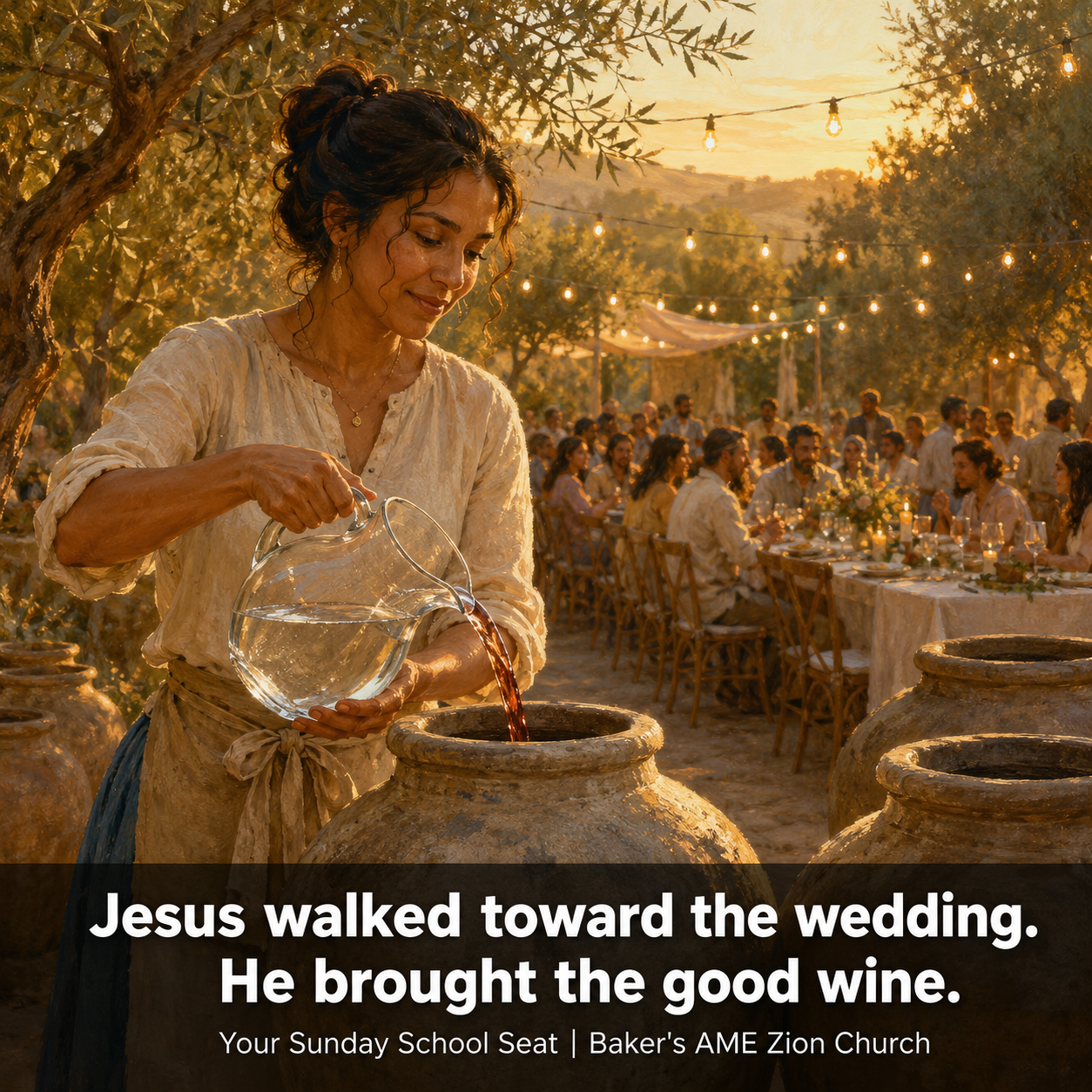
There's a reason the first miracle in John's Gospel happens at a wedding reception and not on a mountaintop. Stay with me — this matters more than you'd think.
John 2:1-11 — KJV 1 And the third day there was a marriage in Cana of Galilee; and the mother of Jesus was there: 2 And both Jesus was called, and his disciples, to the marriage. 3 And when they wanted wine, the mother of Jesus saith unto him, They have no wine. 4 Jesus saith unto her, Woman, what have I to do with thee? mine hour is not yet come. 5 His mother saith unto the servants, Whatsoever he saith unto you, do it. 6 And there were set there six waterpots of stone, after the manner of the purifying of the Jews, containing two or three firkins apiece. 7 Jesus saith unto them, Fill the waterpots with water. And they filled them up to the brim. 8 And he saith unto them, Draw out now, and bear unto the governor of the feast. And they bare it. 9 When the ruler of the feast had tasted the water that was made wine, and knew not whence it was: (but the servants which drew the water knew;) the governor of the feast called the bridegroom, 10 And saith unto him, Every man at the beginning doth set forth good wine; and when men have well drunk, then that which is worse: but thou hast kept the good wine until now. 11 This beginning of miracles did Jesus in Cana of Galilee, and manifested forth his glory; and his disciples believed on him.
John 2:1-11 — WEB 1 The third day, there was a wedding in Cana of Galilee. Jesus' mother was there. 2 Jesus also was invited, with his disciples, to the wedding. 3 When the wine ran out, Jesus' mother said to him, "They have no wine." 4 Jesus said to her, "Woman, what does that have to do with you and me? My hour has not yet come." 5 His mother said to the servants, "Whatever he says to you, do it." 6 Now there were six water pots of stone set there after the Jews' way of purifying, containing two or three metretes apiece. 7 Jesus said to them, "Fill the water pots with water." So they filled them up to the brim. 8 He said to them, "Now draw some out, and take it to the ruler of the feast." So they took it. 9 When the ruler of the feast tasted the water now become wine, and didn't know where it came from (but the servants who had drawn the water knew), the ruler of the feast called the bridegroom 10 and said to him, "Everyone serves the good wine first, and when the guests have drunk freely, then that which is worse. You have kept the good wine until now!" 11 This beginning of his signs Jesus did in Cana of Galilee, and revealed his glory; and his disciples believed in him.
Explanation
The first miracle. People remember that. But notice where it happens. Not in the temple. Not on a mountainside. Not in some dramatic moment of healing or resurrection. The first miracle Jesus performs in John's Gospel happens at a wedding reception.
That should tell us something.
Weddings in first-century Galilee weren't an afternoon affair. They were week-long celebrations. Family came in from miles around. Neighbors pitched in. There was music, dancing, eating, drinking, laughter. The whole village shut down to celebrate. And it was at one of these — somewhere in the middle of the third day — that the wine ran out. In that culture, that was a disaster. Hospitality was sacred. The host would have been humiliated; the family's honor wounded. The party was about to grind to a halt.
And Jesus's mother turns to him and says, "They have no wine."
Notice what Jesus doesn't do. He doesn't lecture anyone. He doesn't pull out a scroll and say, "Well, perhaps this is a good moment to reflect on the dangers of overindulgence." He doesn't suggest the celebration has run its course. He saves the party. He turns six stone jars of water — about 150 gallons — into wine so good the master of the banquet can't believe they served the cheap stuff first.
Here's what I want us to notice this week as we move toward Sunday's lesson on the Christian view of recreation: Jesus didn't just tolerate the celebration. He extended it. He honored it. He blessed it.
We've inherited, somewhere along the way, a strange idea that the holier we get, the more solemn we become. That joy is suspicious. That a good time is something we apologize for. But the first public act of God's Son in John's account is to keep a wedding feast going.
The God who flung galaxies into space and shaped the human heart for love also made wedding feasts and laughter and the kind of music that pulls you out of your chair. Recreation isn't something we squeeze in around the edges of a serious Christian life. It's part of how we were designed to live.
If your week has been heavy — if you've been carrying a lot — hear this: the same Jesus who walked toward the cross also walked toward the wedding. And he showed up smiling. He brought the good wine.
Maybe today, you can let yourself enjoy something small. A meal. A laugh. A walk. A song. Not because you've earned it. But because joy is part of the Kingdom too.
Thought for the Day Jesus walked toward the wedding. He brought the good wine.
Reflection Question What's one ordinary joy you've been treating as a guilty pleasure that God might actually be inviting you into?
Prayer Lord, thank you that you didn't come into this world too holy for laughter. Thank you that you blessed a wedding, multiplied the wine, and kept the celebration going. Loosen the tightness in our shoulders today. Help us receive joy as the gift you intended it to be. Amen.
This week we walk toward Sunday's lesson: The Christian View of Recreation.
Sunday, May 17 — The Sermon on Contentment
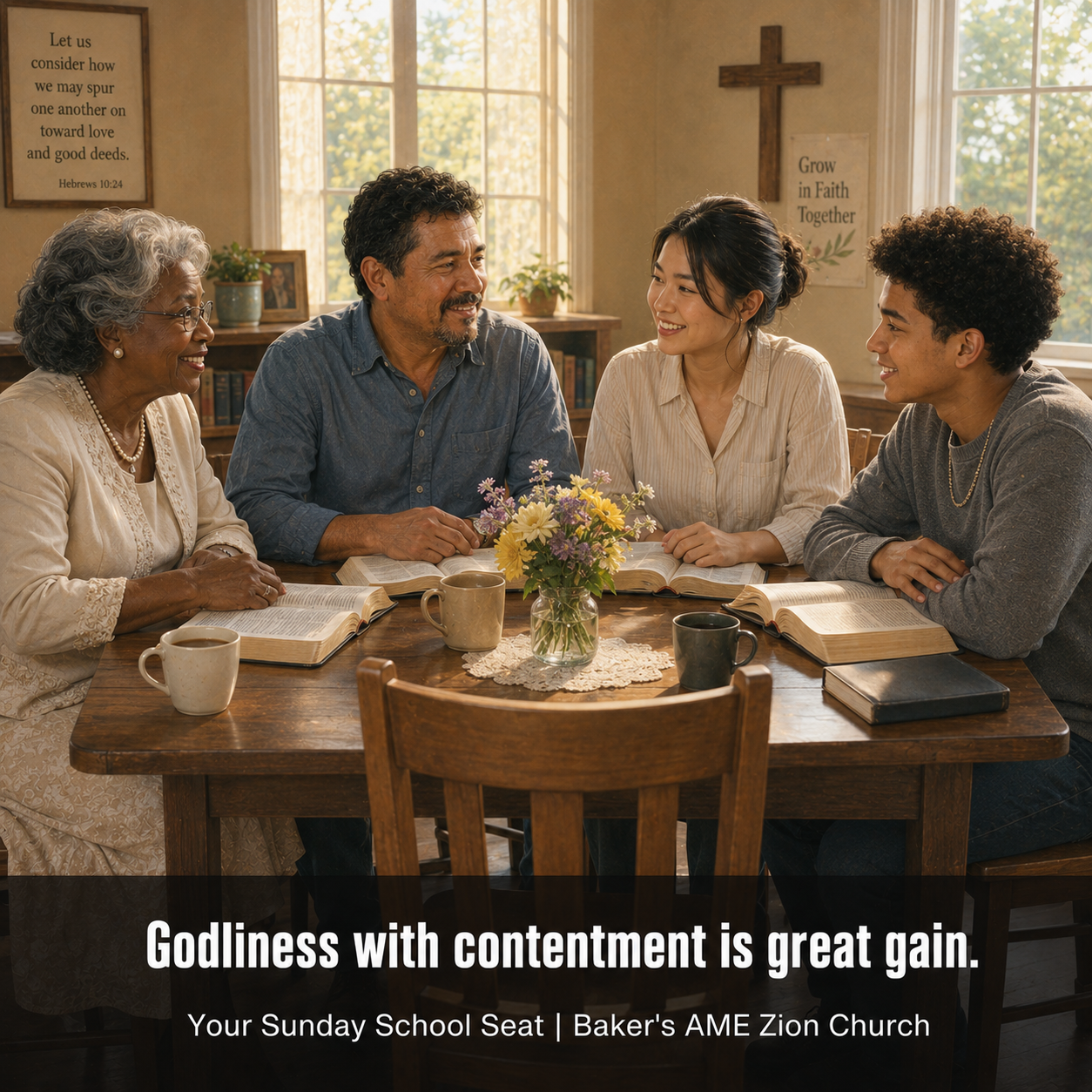
All week we've been walking toward this Sunday — and Paul's words to Timothy bring it home. Industry, money, work, possessions. None of it is the point. All of it is a tool.
1 Timothy 6:6-8, 17-19 — KJV 6 But godliness with contentment is great gain. 7 For we brought nothing into this world, and it is certain we can carry nothing out. 8 And having food and raiment let us be therewith content. 17 Charge them that are rich in this world, that they be not highminded, nor trust in uncertain riches, but in the living God, who giveth us richly all things to enjoy; 18 That they do good, that they be rich in good works, ready to distribute, willing to communicate; 19 Laying up in store for themselves a good foundation against the time to come, that they may lay hold on eternal life.
1 Timothy 6:6-8, 17-19 — WEB 6 But godliness with contentment is great gain. 7 For we brought nothing into the world, and we certainly can't carry anything out. 8 But having food and clothing, we will be content with that. 17 Charge those who are rich in this present age that they not be high-minded, nor have their hope set on the uncertainty of riches, but on the living God, who richly provides us with everything to enjoy; 18 that they do good, that they be rich in good works, that they be ready to distribute, willing to share; 19 laying up in store for themselves a good foundation against the time to come, that they may lay hold of eternal life.
Paul wrote 1 Timothy to a young pastor leading the church in Ephesus — a wealthy port city full of merchants, traders, and temple money. Timothy was navigating false teachers who treated godliness like a means to financial gain. Paul corrects them with a turn of phrase that has been quoted ever since: godliness with contentment is great gain. The riches you can carry are not the riches you can keep.
Verses 6-8 strip life down to the essentials. We brought nothing into this world. We're not taking anything out either. If we have food and clothing, that should be enough. It's a sentence that doesn't preach well in a consumer culture, but it lands like cold water — clarifying. We will spend much of our lives chasing things we cannot keep. Paul is gently asking us to come up for air.
Then Paul turns to those who are rich in this present age — and notice he doesn't tell them to liquidate everything. He gives them a different kind of charge. Don't be high-minded. Don't trust uncertain riches. Trust the living God, who richly gives us all things to enjoy. Do good. Be rich in good works. Be ready to give. Be willing to share. Lay up for yourselves a foundation for the life that is truly life.
So here is the culmination of "The Christian Spirit in Industry." We've spent the week walking through diligence (Proverbs), grace in labor (Matthew), prophetic warning (Amos), wages and patience (James), doing all in Jesus' name (Colossians), and gleaning generosity (Deuteronomy). And Paul ties the whole basket together this morning. The Christian spirit in industry isn't simply about how we work, what we earn, or how much we give. It is about who we are becoming in the doing.
A contented soul is rare in any economy. A generous one is rarer still. Paul says these are the people who have laid hold of life that is truly life — not the upgraded life of more possessions, but the deeper life of Christ.
This morning we put on our coats and head to the building together. Some of us are tired from the week. Some of us are carrying questions. Some of us are bringing joy. Whatever we bring, the table is set. The lesson is ready. And we have saved you a seat.
Thought for the Day Godliness with contentment is great gain.
Reflection What in your life are you holding too tightly that God is asking you to enjoy and share?
Prayer Father, You have given us so much. Forgive us for the moments we've measured our lives by what we own instead of who we are in You. Teach us contentment — the deep, free kind that doesn't depend on circumstance. Make us generous. Make us grateful. And as we step into worship this morning, settle our hearts to receive what You have for us. Amen.
Today is Sunday school. We save you a seat.
Saturday, May 16 — Leave Some for the Stranger
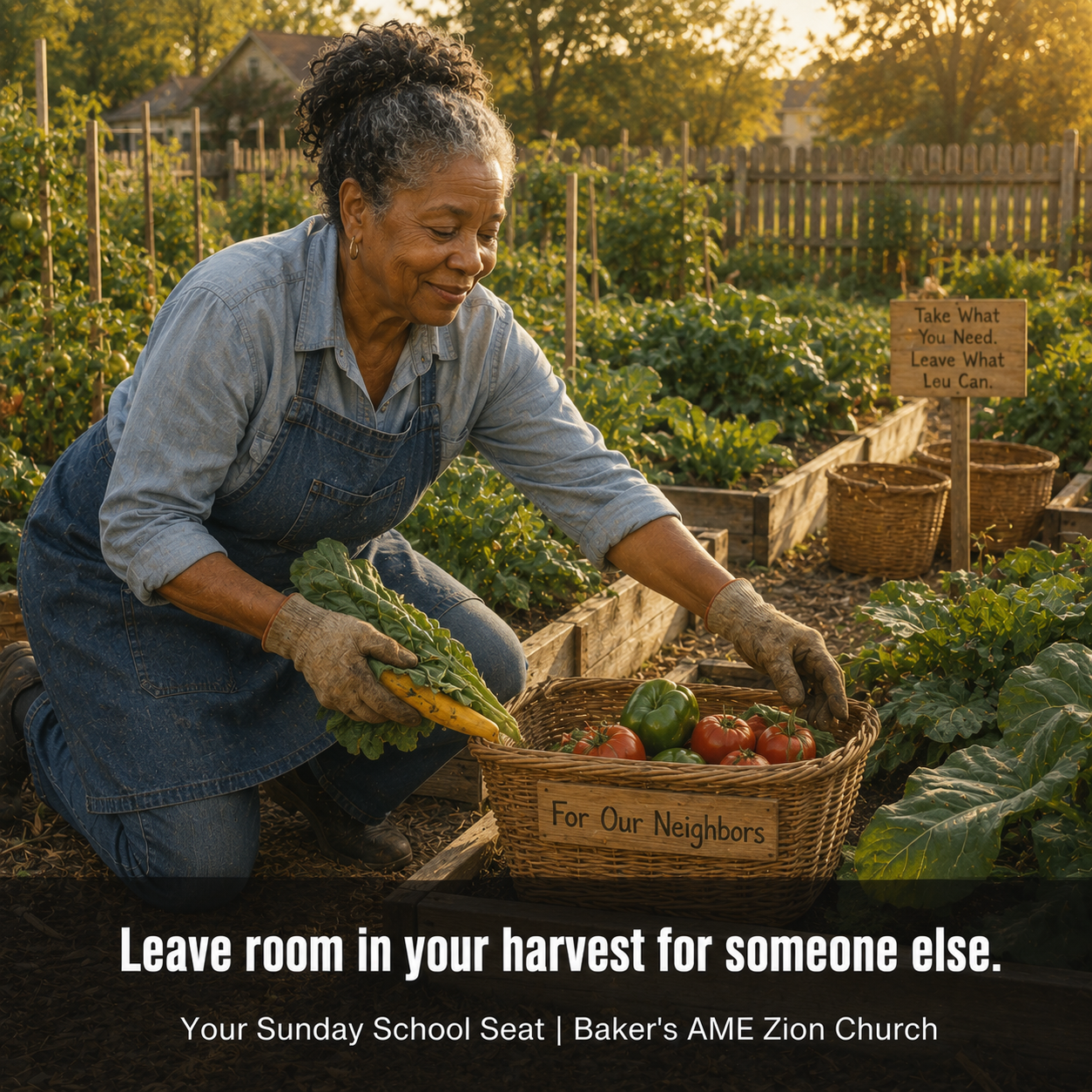
God's law has a generosity built into it that most modern economics doesn't. Don't strip the field bare. Leave something for the people who don't have a field.
Deuteronomy 24:14-21 — KJV 14 Thou shalt not oppress an hired servant that is poor and needy, whether he be of thy brethren, or of thy strangers that are in thy land within thy gates: 15 At his day thou shalt give him his hire, neither shall the sun go down upon it; for he is poor, and setteth his heart upon it: lest he cry against thee unto the LORD, and it be sin unto thee. 16 The fathers shall not be put to death for the children, neither shall the children be put to death for the fathers: every man shall be put to death for his own sin. 17 Thou shalt not pervert the judgment of the stranger, nor of the fatherless; nor take a widow's raiment to pledge: 18 But thou shalt remember that thou wast a bondman in Egypt, and the LORD thy God redeemed thee thence: therefore I command thee to do this thing. 19 When thou cuttest down thine harvest in thy field, and hast forgot a sheaf in the field, thou shalt not go again to fetch it: it shall be for the stranger, for the fatherless, and for the widow: that the LORD thy God may bless thee in all the work of thine hands. 20 When thou beatest thine olive tree, thou shalt not go over the boughs again: it shall be for the stranger, for the fatherless, and for the widow. 21 When thou gatherest the grapes of thy vineyard, thou shalt not glean it afterward: it shall be for the stranger, for the fatherless, and for the widow.
Deuteronomy 24:14-21 — WEB 14 You shall not oppress a hired servant who is poor and needy, whether he is one of your brothers, or one of the foreigners who are in your land within your gates. 15 In his day you shall give him his wages, neither shall the sun go down on it; for he is poor and sets his heart on it; lest he cry against you to Yahweh, and it be sin to you. 16 The fathers shall not be put to death for the children, neither shall the children be put to death for the fathers. Every man shall be put to death for his own sin. 17 You shall not deprive the foreigner or the fatherless of justice, nor take a widow's clothing in pledge; 18 but you shall remember that you were a slave in Egypt, and Yahweh your God redeemed you there. Therefore I command you to do this thing. 19 When you reap your harvest in your field, and have forgotten a sheaf in the field, you shall not go again to get it. It shall be for the foreigner, for the fatherless, and for the widow; that Yahweh your God may bless you in all the work of your hands. 20 When you beat your olive tree, you shall not go over the boughs again. It shall be for the foreigner, for the fatherless, and for the widow. 21 When you harvest your vineyard, you shall not glean it after yourselves. It shall be for the foreigner, for the fatherless, and for the widow.
Deuteronomy was Moses' final sermon to a generation of Israelites preparing to enter the promised land. Most of the people he was speaking to were the children and grandchildren of slaves. They had grown up hearing how God brought their families out of Egypt with a strong hand. Now they were about to plant fields, raise livestock, and become an economy of their own. And before they crossed the Jordan, Moses gave them laws to make sure they didn't forget what slavery felt like.
Chapter 24, verses 14-21, lays out a practical ethic. Don't oppress a hired worker — whether that worker is one of your own or a foreigner living in your gates. Pay him his wages the same day, before sundown, because he's poor and depending on it. Don't pervert justice for the foreigner or the orphan. Don't take a widow's last piece of clothing as collateral. And here's the kicker: when you reap your fields, leave a sheaf behind. When you beat your olive tree, don't go back over the branches. When you harvest your vineyard, don't pick it twice. Leave it for the foreigner, the orphan, and the widow.
Built into the ancient farmer's economy was an intentional inefficiency — a holy waste that wasn't waste at all. Maximizing wasn't the highest virtue. Mercy was. And the reason given is haunting and beautiful: remember that you were a slave in Egypt, and the Lord your God redeemed you.
The ethic of "The Christian Spirit in Industry" isn't a New Testament invention. It is woven all the way back through Moses. God has always cared about how the worker is paid, how the foreigner is treated, how the widow is fed, and what we do at the edges of our own success. The corners of the field belong to those who don't have one.
In our economy, the corners look different. They look like the person who cleans your building. The single mom on your block. The stranger who just moved in. The unhoused man at the intersection. The worker who can't afford the rent in the neighborhood she serves. We are not asked to fix everything. But we are asked not to glean every last grape of our own lives without looking up.
The Lord your God redeemed you. Don't forget it.
Thought for the Day Leave room in your harvest for someone else.
Reflection What "corner of your field" — your time, money, attention — could you leave for someone this week?
Prayer God of every generation, You have been generous with us, and You remember the stranger and the worker when we forget. Make us a people who do not strip our fields bare. Where we have margin — of time, money, energy — let us leave some for those who have less. Help us remember we were redeemed. Help us live like it. Amen.
This week we walk toward Sunday's lesson: The Christian Spirit in Industry.
Friday, May 15 — Whatever You Do
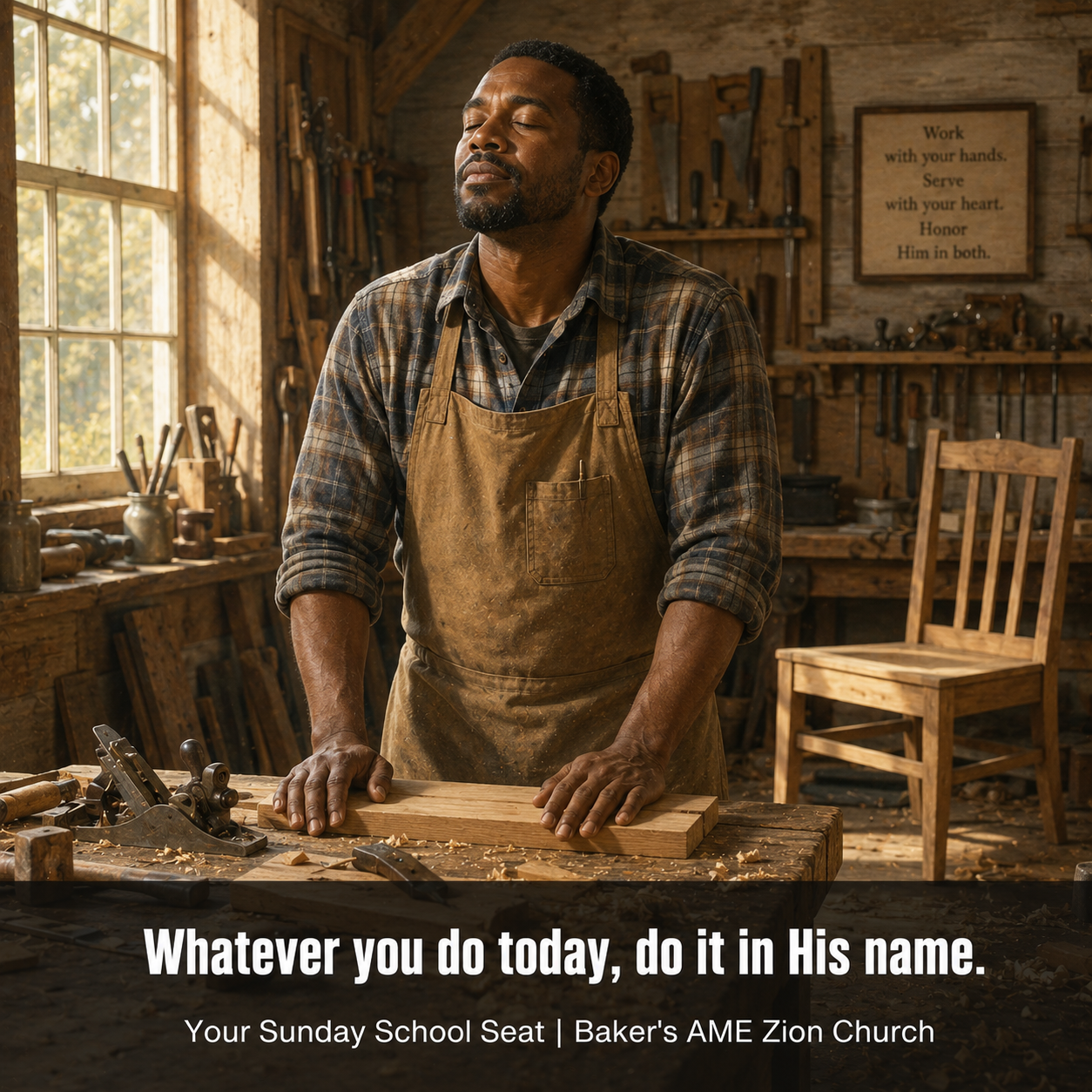
Most of us aren't going to be famous Christians. We're going to be ordinary ones — at the desk, at the register, at the school pickup line. Paul says that's exactly the point.
Colossians 3:12-17 — KJV 12 Put on therefore, as the elect of God, holy and beloved, bowels of mercies, kindness, humbleness of mind, meekness, longsuffering; 13 Forbearing one another, and forgiving one another, if any man have a quarrel against any: even as Christ forgave you, so also do ye. 14 And above all these things put on charity, which is the bond of perfectness. 15 And let the peace of God rule in your hearts, to the which also ye are called in one body; and be ye thankful. 16 Let the word of Christ dwell in you richly in all wisdom; teaching and admonishing one another in psalms and hymns and spiritual songs, singing with grace in your hearts to the Lord. 17 And whatsoever ye do in word or deed, do all in the name of the Lord Jesus, giving thanks to God and the Father by him.
Colossians 3:12-17 — WEB 12 Put on therefore, as God's chosen ones, holy and beloved, a heart of compassion, kindness, lowliness, humility, and perseverance; 13 bearing with one another, and forgiving each other, if any man has a complaint against any; even as Christ forgave you, so you also do. 14 Above all these things, walk in love, which is the bond of perfection. 15 And let the peace of God rule in your hearts, to which also you were called in one body, and be thankful. 16 Let the word of Christ dwell in you richly; in all wisdom teaching and admonishing one another with psalms, hymns, and spiritual songs, singing with grace in your heart to the Lord. 17 Whatever you do, in word or in deed, do all in the name of the Lord Jesus, giving thanks to God the Father, through him.
Colossians was written by Paul (likely from prison) to a small church in Colossae, a town in modern-day Turkey he had never visited. False teaching had crept in, and Paul writes to anchor them in Christ — and then in chapter 3, he gets practical. Verses 12-17 are some of the most concrete instructions in the New Testament about how Christians ought to act in everyday relationships.
Paul says: put on. Like clothing. Every morning. Compassion. Kindness. Humility. Gentleness. Patience. Bear with each other when you're getting on each other's nerves. Forgive grievances the way Christ forgave you — which means more often than is comfortable, and more freely than makes sense. Above all, put on love. It is the belt that holds the whole outfit together. Let the peace of Christ rule in your hearts. Let the word of Christ live in you. Teach. Sing. Be thankful.
Then comes verse 17 — the line that holds the whole industrial week together: "And whatever you do, in word or deed, do all in the name of the Lord Jesus, giving thanks to God the Father through him."
Whatever. You. Do.
Not just preaching. Not just praying. Not just the Sunday parts of life. The Monday parts. The Tuesday morning meetings. The Wednesday lunch break. The Thursday inspection. The Friday afternoon when you'd rather just go home. The diaper changes. The driving. The dishes. The data entry. The customer service. The construction site. The classroom. The hospital floor. The kitchen.
Sunday's lesson is "The Christian Spirit in Industry," and Paul is laying out what that spirit actually looks like in a body. It isn't a halo. It's a posture. It's how you treat your coworker when you've already explained that thing twice. It's how you talk to the cashier on a hard day. It's how you handle the customer who is being unfair. It's the integrity you carry into the meeting where no one is checking. It's the kindness you bring home after a thankless shift. It's the gratitude you stitch into ordinary moments before they slip past.
Some weeks the world will not notice. But heaven does. And whatever you do — whatever — you do in His name.
Thought for the Day Whatever you do today, do it in His name.
Reflection What ordinary task today can you carry into the name of Jesus?
Prayer Lord Jesus, take all of it — the meaningful work and the mundane, the praised and the unseen. Clothe me in the patience and kindness I do not naturally have. Help me forgive freely and love deeply. Whatever I do today, in word or deed, let it be done in Your name. Amen.
This week we walk toward Sunday's lesson: The Christian Spirit in Industry.
Thursday, May 14 — The Wages That Cry Out
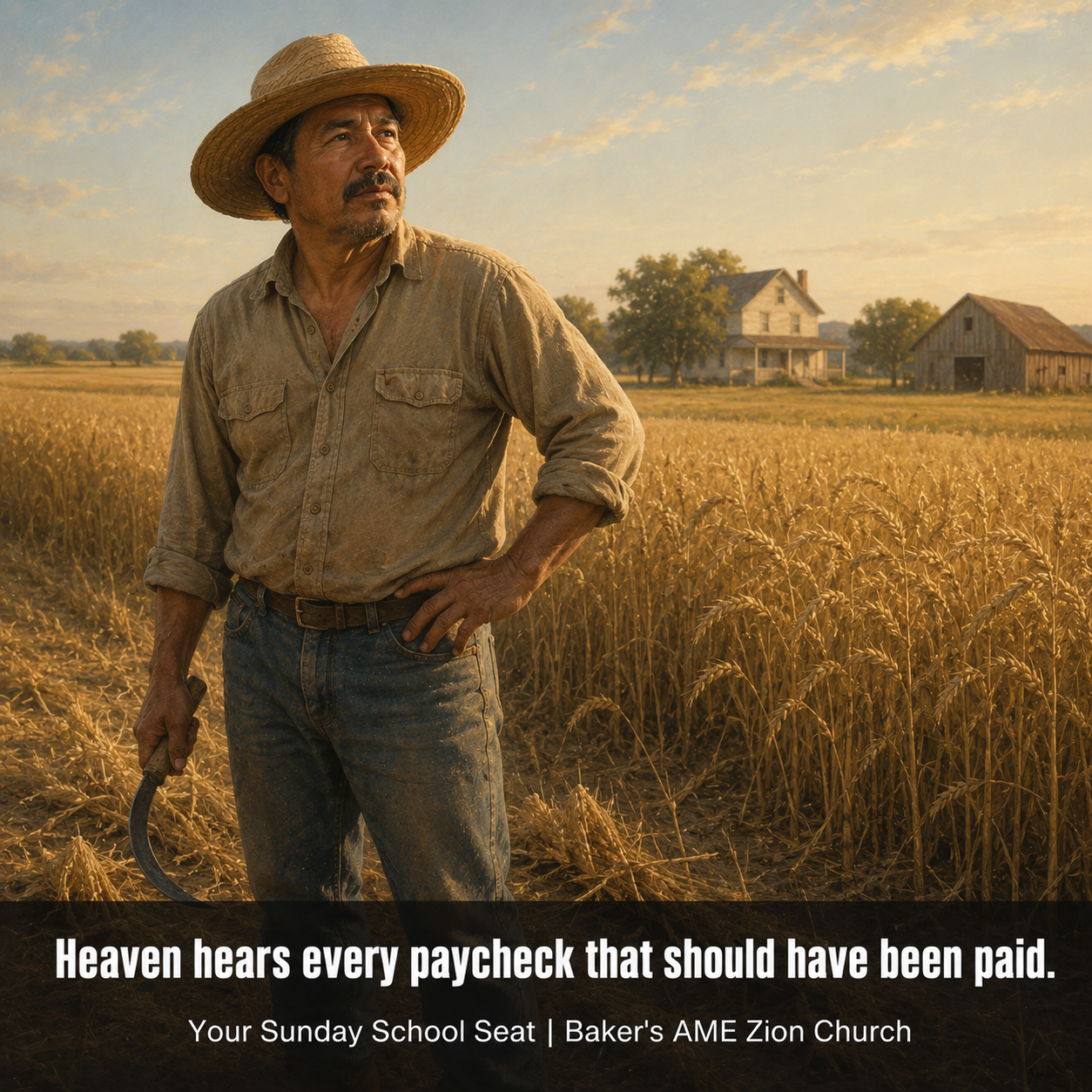
James doesn't soften his words for the rich. And the part that should make us all stop is verse 4 — the unpaid wages of workers crying out to God.
James 5:1-11 — KJV 1 Go to now, ye rich men, weep and howl for your miseries that shall come upon you. 2 Your riches are corrupted, and your garments are motheaten. 3 Your gold and silver is cankered; and the rust of them shall be a witness against you, and shall eat your flesh as it were fire. Ye have heaped treasure together for the last days. 4 Behold, the hire of the labourers who have reaped down your fields, which is of you kept back by fraud, crieth: and the cries of them which have reaped are entered into the ears of the Lord of sabaoth. 5 Ye have lived in pleasure on the earth, and been wanton; ye have nourished your hearts, as in a day of slaughter. 6 Ye have condemned and killed the just; and he doth not resist you. 7 Be patient therefore, brethren, unto the coming of the Lord. Behold, the husbandman waiteth for the precious fruit of the earth, and hath long patience for it, until he receive the early and latter rain. 8 Be ye also patient; stablish your hearts: for the coming of the Lord draweth nigh. 9 Grudge not one against another, brethren, lest ye be condemned: behold, the judge standeth before the door. 10 Take, my brethren, the prophets, who have spoken in the name of the Lord, for an example of suffering affliction, and of patience. 11 Behold, we count them happy which endure. Ye have heard of the patience of Job, and have seen the end of the Lord; that the Lord is very pitiful, and of tender mercy.
James 5:1-11 — WEB 1 Come now, you rich, weep and howl for your miseries that are coming on you. 2 Your riches are corrupted and your garments are moth-eaten. 3 Your gold and your silver are corroded, and their corrosion will be for a testimony against you and will eat your flesh like fire. You have laid up your treasure in the last days. 4 Behold, the wages of the laborers who mowed your fields, which you have kept back by fraud, cry out, and the cries of those who reaped have entered into the ears of the Lord of Armies. 5 You have lived in luxury on the earth, and taken your pleasure. You have nourished your hearts as in a day of slaughter. 6 You have condemned and you have murdered the righteous one. He doesn't resist you. 7 Be patient therefore, brothers, until the coming of the Lord. Behold, the farmer waits for the precious fruit of the earth, being patient over it, until it receives the early and late rain. 8 You also be patient. Establish your hearts, for the coming of the Lord is at hand. 9 Don't grumble, brothers, against one another, so that you won't be judged. Behold, the judge stands at the door. 10 Take, brothers, for an example of suffering and of perseverance, the prophets who spoke in the name of the Lord. 11 Behold, we call them blessed who endured. You have heard of the perseverance of Job, and have seen the Lord in the outcome, and how the Lord is full of compassion and mercy.
James, traditionally believed to be the brother of Jesus and a leader of the Jerusalem church, wrote to scattered Jewish believers struggling under economic pressure. The early church included poor day laborers who had been cheated, widows with no protection, and small farmers losing their land. James writes with the bluntness of a prophet and the warmth of a pastor.
He opens chapter 5 with a thunderclap. Weep and howl, you rich, for your miseries are coming. Your hoarded wealth is rotting. Your fine garments are moth-eaten. Your gold and silver are corroding — and the corrosion itself will testify against you in the day of judgment. Then comes the line that should land on every employer, every business owner, every manager and supervisor and homeowner who hires help: the wages of the workers who reaped your fields, which you have kept back by fraud, are crying out — and the cries have entered the ears of the Lord of armies.
In other words: the paychecks you held back, the hours you shaved off the timesheet, the contractor you "forgot" to pay, the worker you exploited because you knew they couldn't fight back — God hears all of it. The cries don't disappear. They reach heaven.
James pivots in verse 7 from warning to encouragement. To the workers, the cheated, the patient ones still waiting on justice, he says: be patient like the farmer waiting for the rain. Strengthen your hearts. The Lord is near. Don't grumble against each other in the meantime. Look at the prophets who suffered and stayed faithful. Look at Job, whose endurance we still talk about. The Lord is full of compassion and mercy.
Sunday is closing in on us, and "The Christian Spirit in Industry" is sharpening into something costly. James will not let us read this passage as if it's only about other people. He's asking us — what does our money say about us? What do our employees say about us? What do the people who clean our offices, drive our deliveries, pick our food, and care for our children say about us when they go home?
There is good news in the patience James promises. But it does not let any of us off the hook for how we treat the worker.
Thought for the Day Heaven hears every paycheck that should have been paid.
Reflection Is there a worker, a debt, or a wage you've owed someone that needs to be made right?
Prayer Lord, You are the God who hears the cry of the worker. Search me. Show me where I have been careless or unjust with what I owe — money, time, recognition, fairness. Give me the courage to make it right. And give me patience when I am the one waiting on what was promised to me. Amen.
This week we walk toward Sunday's lesson: The Christian Spirit in Industry.
Wednesday, May 13 — When the Marketplace Forgets the Poor
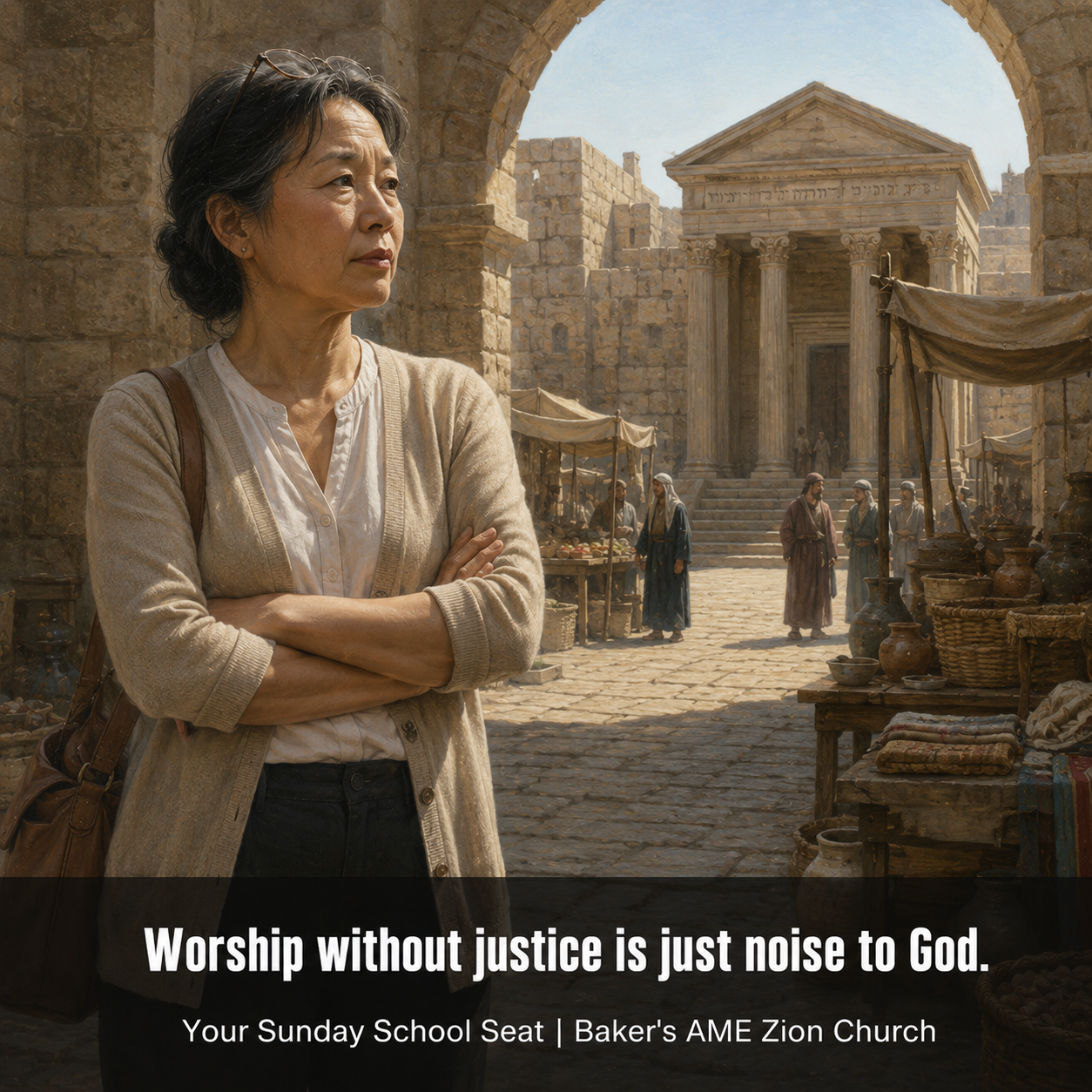
Amos was not the kind of prophet anyone wanted at the dinner table. He told the truth about money, and the powerful never wanted to hear it.
Amos 5:6-15 — KJV 6 Seek the LORD, and ye shall live; lest he break out like fire in the house of Joseph, and devour it, and there be none to quench it in Bethel. 7 Ye who turn judgment to wormwood, and leave off righteousness in the earth, 8 Seek him that maketh the seven stars and Orion, and turneth the shadow of death into the morning, and maketh the day dark with night: that calleth for the waters of the sea, and poureth them out upon the face of the earth: The LORD is his name: 9 That strengtheneth the spoiled against the strong, so that the spoiled shall come against the fortress. 10 They hate him that rebuketh in the gate, and they abhor him that speaketh uprightly. 11 Forasmuch therefore as your treading is upon the poor, and ye take from him burdens of wheat: ye have built houses of hewn stone, but ye shall not dwell in them; ye have planted pleasant vineyards, but ye shall not drink wine of them. 12 For I know your manifold transgressions and your mighty sins: they afflict the just, they take a bribe, and they turn aside the poor in the gate from their right. 13 Therefore the prudent shall keep silence in that time; for it is an evil time. 14 Seek good, and not evil, that ye may live: and so the LORD, the God of hosts, shall be with you, as ye have spoken. 15 Hate the evil, and love the good, and establish judgment in the gate: it may be that the LORD God of hosts will be gracious unto the remnant of Joseph.
Amos 5:6-15 — WEB 6 Seek Yahweh, and you will live; lest he break out like fire in the house of Joseph, and it devour, and there be no one to quench it in Bethel. 7 You who turn justice to wormwood, and cast down righteousness to the earth: 8 seek him who made the Pleiades and Orion, and turns the shadow of death into the morning, and makes the day dark with night; who calls for the waters of the sea, and pours them out on the surface of the earth, Yahweh is his name, 9 who brings sudden destruction on the strong, so that destruction comes on the fortress. 10 They hate him who reproves in the gate, and they abhor him who speaks blamelessly. 11 Therefore, because you trample on the poor, and take taxes from him of wheat: You have built houses of cut stone, but you will not dwell in them. You have planted pleasant vineyards, but you shall not drink their wine. 12 For I know how many your offenses, and how great are your sins— you who afflict the just, who take a bribe, and who turn away the needy in the courts. 13 Therefore a prudent person keeps silent in such a time, for it is an evil time. 14 Seek good, and not evil, that you may live; and so Yahweh, the God of Armies, will be with you, as you say. 15 Hate evil, love good, and establish justice in the courts. It may be that Yahweh, the God of Armies, will be gracious to the remnant of Joseph.
Amos was a working man — a herdsman from Tekoa, a small town south of Jerusalem — who showed up in the northern kingdom of Israel during the reign of Jeroboam II. The economy was booming. The temples were full. Religious life looked alive. But underneath the surface, the poor were being crushed. The rich were buying up land, exploiting labor, rigging the courts, and feeling holy about it.
Amos shows up with a message no one ordered. Seek the Lord and live, he says, or fire is coming. He calls out the powerful for turning justice into wormwood — bitter, poisonous — and casting righteousness to the ground. Then he reminds them who the Lord is: the One who made the Pleiades and Orion, who turns death's shadow into morning, who calls the seas to flood the earth. The God you ignore in the courts is the God who hung the constellations.
Then Amos drops the indictment. They hate the man who speaks honestly in the gate — the gate being the place where business deals were made and disputes were settled. They've trampled the poor and taxed them out of their grain. They've built fine stone houses and planted lush vineyards, but Amos warns: you won't live in those houses. You won't drink that wine. God sees the bribes. God sees how the poor are turned away from justice in the courts. And the prudent stay quiet, because telling the truth has become dangerous.
The midweek pause of "The Christian Spirit in Industry" requires this hard look. We live inside an economy too — one with payday loans, wage theft, gentrification, and quiet exploitation that hides behind professional language. Amos is not talking about people who happen to be wealthy. He's talking about a system that treats human beings as inventory. And he's saying that worship without justice is not worship. It's noise.
But Amos doesn't just diagnose. He invites. Seek good and not evil. Hate evil, love good, establish justice in the courts. There is still room for grace, even in a corrupted marketplace. The God of armies hasn't given up on the remnant of Joseph — and He hasn't given up on us either.
The question isn't whether God notices injustice. He does. The question is whether we will let Him reshape how we participate.
Thought for the Day Worship without justice is just noise to God.
Reflection Where might Christ be calling you to refuse the easy silence and speak honestly?
Prayer God of justice, You see what we sometimes prefer not to see. Forgive us for the comfortable silences. Give us courage where we have been quiet, integrity where we have cut corners, and love where we have looked away. Make us people who seek good in the marketplace, not just in the sanctuary. Amen.
This week we walk toward Sunday's lesson: The Christian Spirit in Industry.
Tuesday, May 12 — When Grace Isn't Fair
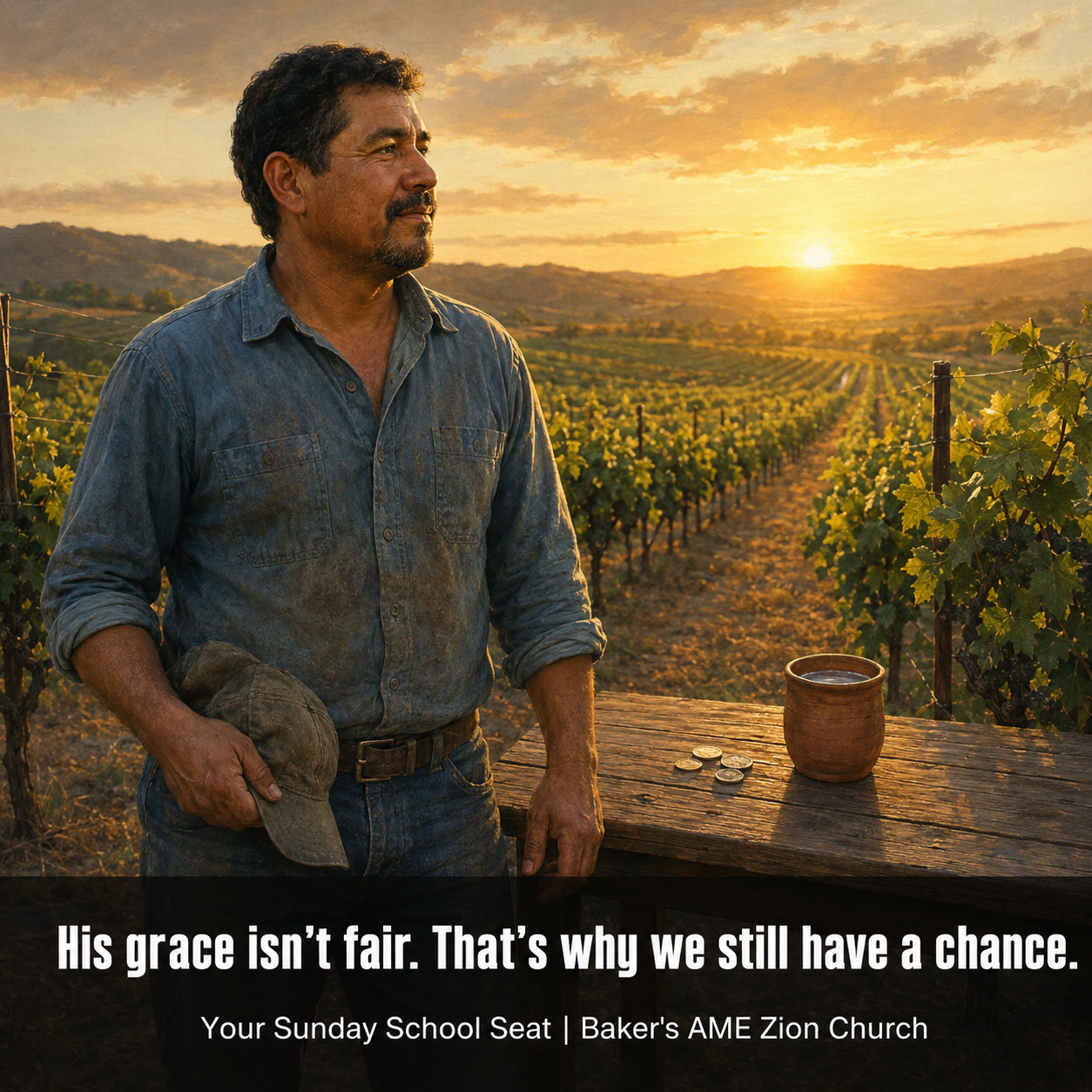
We grew up being told life isn't fair. Then we read Jesus' parables and realize grace isn't either — and that's actually the good news.
Matthew 20:1-16 — KJV 1 For the kingdom of heaven is like unto a man that is an householder, which went out early in the morning to hire labourers into his vineyard. 2 And when he had agreed with the labourers for a penny a day, he sent them into his vineyard. 3 And he went out about the third hour, and saw others standing idle in the marketplace, 4 And said unto them; Go ye also into the vineyard, and whatsoever is right I will give you. And they went their way. 5 Again he went out about the sixth and ninth hour, and did likewise. 6 And about the eleventh hour he went out, and found others standing idle, and saith unto them, Why stand ye here all the day idle? 7 They say unto him, Because no man hath hired us. He saith unto them, Go ye also into the vineyard; and whatsoever is right, that shall ye receive. 8 So when even was come, the lord of the vineyard saith unto his steward, Call the labourers, and give them their hire, beginning from the last unto the first. 9 And when they came that were hired about the eleventh hour, they received every man a penny. 10 But when the first came, they supposed that they should have received more; and they likewise received every man a penny. 11 And when they had received it, they murmured against the goodman of the house, 12 Saying, These last have wrought but one hour, and thou hast made them equal unto us, which have borne the burden and heat of the day. 13 But he answered one of them, and said, Friend, I do thee no wrong: didst not thou agree with me for a penny? 14 Take that thine is, and go thy way: I will give unto this last, even as unto thee. 15 Is it not lawful for me to do what I will with mine own? Is thine eye evil, because I am good? 16 So the last shall be first, and the first last: for many be called, but few chosen.
Matthew 20:1-16 — WEB 1 "For the Kingdom of Heaven is like a man who was the master of a household, who went out early in the morning to hire laborers for his vineyard. 2 When he had agreed with the laborers for a denarius a day, he sent them into his vineyard. 3 He went out about the third hour, and saw others standing idle in the marketplace. 4 He said to them, 'You also go into the vineyard, and whatever is right I will give you.' So they went their way. 5 Again he went out about the sixth and the ninth hour, and did likewise. 6 About the eleventh hour he went out, and found others standing idle. He said to them, 'Why do you stand here all day idle?' 7 They said to him, 'Because no one has hired us.' He said to them, 'You also go into the vineyard, and you will receive whatever is right.' 8 When evening had come, the lord of the vineyard said to his manager, 'Call the laborers and pay them their wages, beginning from the last to the first.' 9 When those who were hired at about the eleventh hour came, they each received a denarius. 10 When the first came, they supposed that they would receive more; and they likewise each received a denarius. 11 When they received it, they murmured against the master of the household, 12 saying, 'These last have spent one hour, and you have made them equal to us who have borne the burden of the day and the scorching heat!' 13 "But he answered one of them, 'Friend, I am doing you no wrong. Didn't you agree with me for a denarius? 14 Take that which is yours, and go your way. It is my desire to give to this last just as much as to you. 15 Isn't it lawful for me to do what I want to with what I own? Or is your eye evil, because I am good?' 16 So the last will be first, and the first last; for many are called, but few chosen."
Jesus tells this parable in Matthew 20 right after a hard conversation with Peter about who's first in the kingdom. The disciples have been doing the math of discipleship — what do we get for following you? — and Jesus answers with a story.
A landowner goes out at dawn to hire workers for his vineyard. Standard wage: a denarius — a single day's pay, just enough to feed a family. He goes back at nine in the morning, again at noon, again at three, again even at five o'clock — one hour before quitting time. He hires every laborer he finds. When evening comes, he pays everyone the same. The ones who worked all day are furious. The ones who barely worked an hour go home with full pockets.
The parable rubs us the wrong way for a reason. It's supposed to. The all-day workers aren't villains — they have a point. They worked through the heat, and the latecomers walked in with cool foreheads. Anybody would feel some kind of way about that. But the master answers gently: I'm not cheating you. We agreed on a denarius. You got a denarius. Why is your eye evil because I am generous?
This is where Sunday's theme of Christian spirit in industry takes a sharp turn. We can do the work all day and still miss the kingdom if our hearts curdle into resentment. The vineyard owner — God — runs his economy by grace, not strict accounting. He gives what He chooses to give. Every worker leaves with what they need. No one leaves cheated. But envy can ruin even an honest day's wage.
Maybe you've been the all-day worker. The one who's been faithful for decades. Tithing. Serving. Showing up before the doors open. And someone walks in last week, mess and all, and they get all the celebration. It stings. Jesus knows it stings. He's not dismissing the labor — He's stretching the heart.
Or maybe you're the eleventh-hour worker. Maybe you came late to faith, late to recovery, late to owning your life, late to forgiveness. The denarius is still yours. The Father doesn't hand out partial portions to people who showed up after lunch.
The kingdom doesn't run on punch clocks. It runs on a generosity we didn't earn and can't outpace.
Thought for the Day His grace isn't fair. That's why we still have a chance.
Reflection Are you working faithfully — or working with one eye on what others are getting?
Prayer Father, thank You for being more generous than I deserve. Search my heart for the places where envy has crept into my service. Loosen my grip on what's "fair." Help me trust that Your goodness toward someone else is never a subtraction from Your goodness toward me. Make me grateful in the vineyard today. Amen.
This week we walk toward Sunday's lesson: The Christian Spirit in Industry.
Monday, May 11 — The Quiet Power of Showing Up

Some mornings the alarm hits like a bag of bricks. Before the coffee finishes brewing, the day already feels like too much.
Proverbs 10:1-5, 15-16 — KJV 1 The proverbs of Solomon. A wise son maketh a glad father: but a foolish son is the heaviness of his mother. 2 Treasures of wickedness profit nothing: but righteousness delivereth from death. 3 The LORD will not suffer the soul of the righteous to famish: but he casteth away the substance of the wicked. 4 He becometh poor that dealeth with a slack hand: but the hand of the diligent maketh rich. 5 He that gathereth in summer is a wise son: but he that sleepeth in harvest is a son that causeth shame. 15 The rich man's wealth is his strong city: the destruction of the poor is their poverty. 16 The labour of the righteous tendeth to life: the fruit of the wicked to sin.
Proverbs 10:1-5, 15-16 — WEB 1 The proverbs of Solomon. A wise son makes a glad father; but a foolish son brings grief to his mother. 2 Treasures of wickedness profit nothing, but righteousness delivers from death. 3 Yahweh will not allow the soul of the righteous to go hungry, but he thrusts away the desire of the wicked. 4 He becomes poor who works with a lazy hand, but the hand of the diligent brings wealth. 5 He who gathers in summer is a wise son, but he who sleeps during the harvest is a son who causes shame. 15 The rich man's wealth is his strong city. The destruction of the poor is their poverty. 16 The labor of the righteous leads to life. The increase of the wicked leads to sin.
Proverbs is a collection of wisdom sayings gathered largely under Solomon's name, composed for everyday life rather than temple ritual. These were the rules for living well — the kind of insight a parent slips to a child as they head out the door. Verses 1-5 and 15-16 of chapter 10 sit in the section that contrasts the wise and the foolish, the diligent and the slack, sentence by sentence. Hebrew poetry pairs these opposites so the contrast lands like a one-two punch.
The passage is practical. A wise son makes a parent glad. A foolish one breaks his mother's heart. Wickedness piles up treasure that won't save you. Righteousness will. The Lord won't let the soul of the righteous starve. Lazy hands lead to poverty. Diligent hands lead to provision. The one who shows up in summer is wise. The one who sleeps through harvest causes shame. The labor of the righteous tends toward life. The fruit of the wicked tends toward sin.
This is where the week begins — at the workbench, the kitchen counter, the steering wheel of the early commute. Sunday's lesson is "The Christian Spirit in Industry," and Proverbs is laying the groundwork. Long before we get to the prophets calling out injustice or Paul writing about doing everything in Jesus' name, Solomon is telling us something simpler: God notices how you show up. Not just at church. At work. At the second shift. At the family business. At the homework table with your kid. At the project no one asked you about.
Diligence isn't glamorous. It looks like answering one more email. Sweeping one more aisle. Driving one more route. Washing one more load. Reading one more bedtime story. The world doesn't put a parade together for it. But Proverbs says it tends toward life — that the steady, faithful work of an honest person quietly builds something the lazy and the dishonest cannot. Wealth isn't condemned here, but neither is it worshiped. The rich have their strong city. The poor still have the Lord. And the laborer who does honest work is on holy ground whether or not anyone applauds.
Some of us are tired this morning. The work feels invisible. But God sees it. He always has.
Thought for the Day God notices how you show up — even today.
Reflection Where in your daily work do you most need God to remind you that He sees you?
Prayer Lord, You know the work I'm walking into today. The parts that feel heavy, the parts that feel hidden. Steady my hands and my heart. Help me bring honesty, patience, and care to whatever You set in front of me. Thank You for seeing what no one else does. Amen.
This week we walk toward Sunday's lesson: The Christian Spirit in Industry.
Sunday, May 10 — If You Won't Work, Don't Eat
Paul writes a letter that ends with one of the bluntest verses in the New Testament. And every word still applies.
2 Thessalonians 3:6-12 — KJV
Now we command you, brethren, in the name of our Lord Jesus Christ, that ye withdraw yourselves from every brother that walketh disorderly, and not after the tradition which he received of us. For yourselves know how ye ought to follow us: for we behaved not ourselves disorderly among you; neither did we eat any man's bread for nought; but wrought with labour and travail night and day, that we might not be chargeable to any of you: not because we have not power, but to make ourselves an ensample unto you to follow us. For even when we were with you, this we commanded you, that if any would not work, neither should he eat. For we hear that there are some which walk among you disorderly, working not at all, but are busybodies. Now them that are such we command and exhort by our Lord Jesus Christ, that with quietness they work, and eat their own bread.
2 Thessalonians 3:6-12 — WEB
Now we command you, brothers, in the name of our Lord Jesus Christ, that you withdraw yourselves from every brother who walks in rebellion, and not after the tradition which they received from us. For you know how you ought to imitate us. For we didn't behave ourselves rebelliously among you, neither did we eat bread from anyone's hand without paying for it, but in labor and travail worked night and day, that we might not burden any of you; not because we don't have the right, but to make ourselves an example to you, that you should imitate us. For even when we were with you, we commanded you this: "If anyone is not willing to work, don't let him eat." For we hear of some who walk among you in rebellion, who don't work at all, but are busybodies. Now those who are that way, we command and exhort in the Lord Jesus Christ, that they work with quietness and eat their own bread.
Explanation
We have arrived at the lesson the whole week was pointing toward. Useful work as Christian duty. And Paul is not in the mood for soft language.
A little context. The church at Thessalonica was a young, struggling congregation. Some of the believers had become convinced that Jesus was returning so soon there was no point in working. They had quit their jobs. They were hanging around the church, sponging off other believers, and making themselves nuisances in everyone else's business. Paul calls them what they were. Busybodies. People who would not work but had plenty of time to comment on everyone else who did.
His instruction to the church is sharp. If anyone is not willing to work, don't let him eat. Read that verse carefully. It does not say "if anyone cannot work." It does not say "if anyone has fallen on hard times." The Bible is full of generosity for those genuinely in need. This verse is talking about people who are able-bodied and unwilling. People who could work and refuse to. Paul says: do not subsidize that. It is not love. It is enabling.
But Paul does not stop there. He turns and looks at himself. He reminds the church that when he and his team were among them, they earned their own bread. They worked night and day. They could have demanded support — Paul actually had the right to be supported as an apostle — but they chose not to. They wanted to model what Christian work looks like. They wanted to leave a pattern.
Put all of this together with the week we have just walked. Work was God's first gift to humanity, planted in Eden before the curse. Work is to be committed to the Lord, not held in our own white-knuckled grip. Work is part of the dignity of being human, crowned by God with glory and honor. Work has to be punctuated by Sabbath, or it will eat you. Work is healing, not crushing. Work is so we have something to give, not just so we have something to keep. And finally, work is a Christian duty, owed to God and to neighbor.
This is a pastoral word for our church and our culture. We live in a time when work is often a status symbol, a source of identity, a treadmill, or a thing avoided. The Bible holds up a different picture. Work is honest. Work is quiet. Work is faithful. Work feeds your family and feeds your neighbor. Work keeps you out of other people's business and in your own callings. Work is one of the ways you say thank you to the God who made you a worker in his image.
Whether you are a teacher, a janitor, a CEO, a stay-at-home parent, a retiree volunteering at the food pantry, a student, or someone between jobs trying hard to find one, this lesson is for you. Quietness. Faithfulness. Useful labor. Generosity with what your hands produce. That is the rhythm of a Christian life.
May we walk it together this week, and the next, and the one after that.
Thought for the day: Work quietly. Eat what you have earned. Share the rest. That is the whole sermon.
Reflection question: Has my work this past week been a witness to the gospel — quiet, faithful, generous — or has it been something else? What is one change I can make starting tomorrow?
Prayer
Father, you have walked us through your Word this week and shown us that work is your idea, not the world's. Thank you for hands to use, for minds to think, for energy you renew each morning. Bless the workers among us today. Bless the mothers whose work often goes unnoticed and unpaid. Bless those without work who long for it. Make us a church of quiet, faithful, generous laborers, in the name of the One who said his Father is still working. Amen.
Today is Sunday school. We save you a seat.
Saturday, May 9 — These Hands
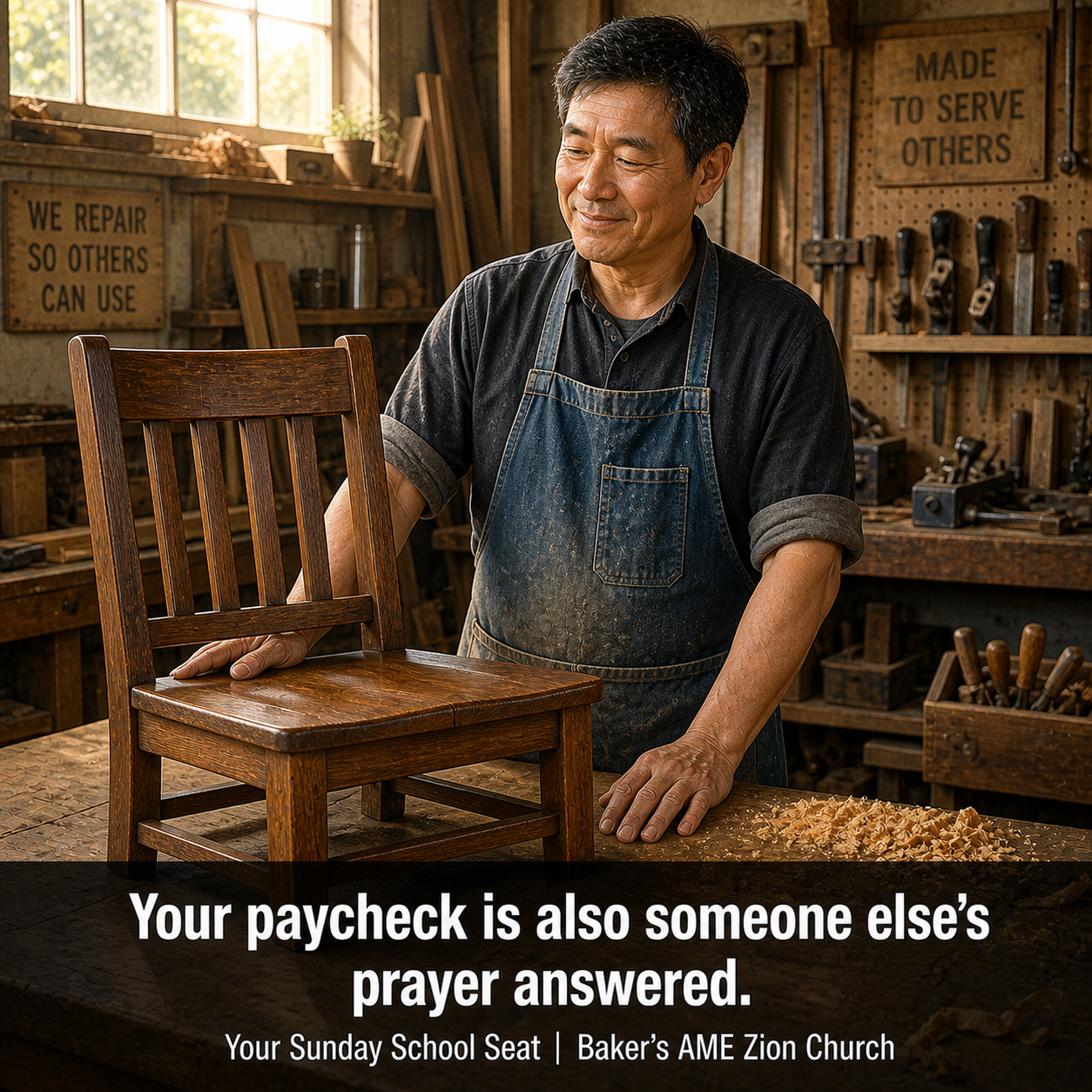
Paul holds up his own hands and says, look. These paid for everything I needed. I never asked you for a dime.
Acts 20:31-35 — KJV
Therefore watch, and remember, that by the space of three years I ceased not to warn every one night and day with tears. And now, brethren, I commend you to God, and to the word of his grace, which is able to build you up, and to give you an inheritance among all them which are sanctified. I have coveted no man's silver, or gold, or apparel. Yea, ye yourselves know, that these hands have ministered unto my necessities, and to them that were with me. I have shewed you all things, how that so labouring ye ought to support the weak, and to remember the words of the Lord Jesus, how he said, It is more blessed to give than to receive.
Acts 20:31-35 — WEB
Therefore watch, remembering that for a period of three years I didn't cease to admonish everyone night and day with tears. Now, brothers, I entrust you to God and to the word of his grace, which is able to build up and to give you the inheritance among all those who are sanctified. I coveted no one's silver, gold, or clothing. You yourselves know that these hands served my necessities, and those who were with me. In all things I gave you an example, that so laboring you ought to help the weak, and to remember the words of the Lord Jesus, that he himself said, "It is more blessed to give than to receive."
Explanation
This is one of the most personal moments in the entire book of Acts. Paul is on his way to Jerusalem, where he believes he will be arrested. He stops in Miletus and sends for the elders of the church at Ephesus, a church he had poured three years of his life into. He knows he will probably never see them again. This is his goodbye speech.
What does he choose to talk about in his last conversation with people he loved? He talks about his hands.
Paul was a tentmaker. He made a living by working with leather and rough cloth, hour after hour, year after year, building tents and patching them. He did this on top of preaching, planting churches, writing letters that would shape the Christian faith for two thousand years. He was, by any measure, one of the most spiritually significant figures in human history. And he refused to let that excuse him from working with his hands.
Notice what he does in verse 34. He raises his hands. You can almost see the gesture. These hands. These rough, calloused, scarred hands. These hands paid the bills. These hands kept me from being a burden on you. These hands also fed the people traveling with me. He is showing them his hands as a sermon.
Paul's logic is worth sitting with. He says it would have been within his rights to receive support from the church. He had a power, an authority, to be funded for his ministry. He chose not to exercise it. Why? So that he could be an example. So that the gospel he preached could not be reduced to a hustle. So that he could practice what Jesus preached: it is more blessed to give than to receive.
This is the second-to-last note in our week, and it is the one that brings us right up to the doorstep of Sunday's lesson. Useful work is not just about earning a paycheck. It is also about generosity. The two are tied together in Paul's mind. He worked, partly so that he would have something to give. He had no patience for Christians who freeloaded off the church. He had less patience for Christians who treated their work as if it were just for themselves.
Look at your own hands today. Maybe they are working hands like Paul's. Maybe they are tired hands, swollen hands, hands that don't look the way they used to. Maybe they are young hands that have not yet learned what hard work feels like. Whatever your hands look like, ask the question Paul is asking. Are these hands serving the weak? Are these hands giving as well as taking? Are these hands witnessing to the Christ who said it is more blessed to give than to receive?
The work of our hands is not just for us. It is so we have something to share. That is the gospel of useful work, and it has been the gospel since Paul stretched out his calloused hands one last time in Miletus and said, look at these.
Thought for the day: Work hard enough to have something to give. Then give it.
Reflection question: If someone watched only your hands for a week — not your words — what would they say your life is about? Earning, or also giving?
Prayer
Father, you gave us hands so that we could love you and love each other. Forgive us when we use our work only to take care of ourselves. Make our hands generous hands. Whatever you put in them this week, let some of it flow back out toward people who need it. Amen.
This week we walk toward Sunday's lesson: Useful Work as Christian Duty.
Friday, May 8 — My Father Is Working
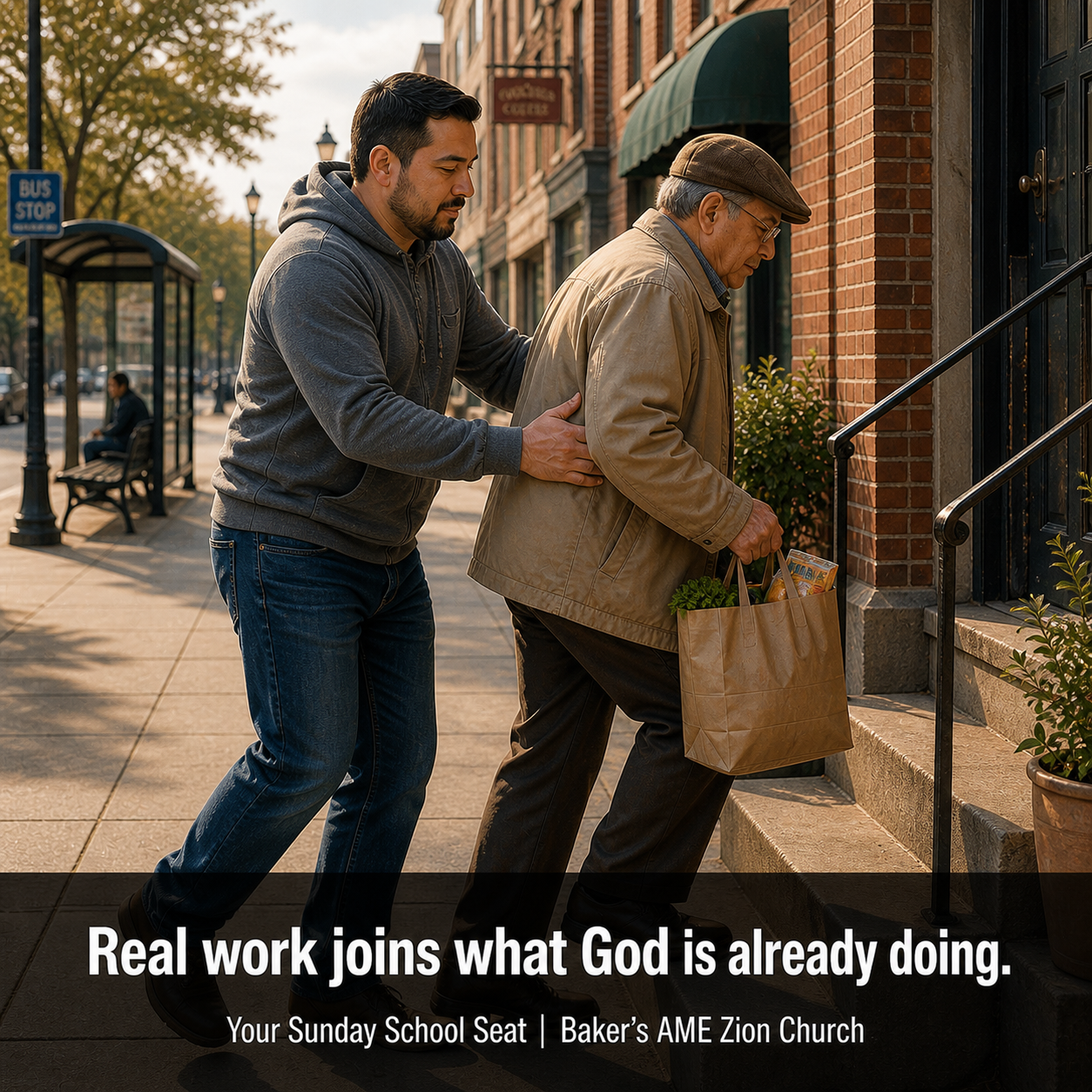
Jesus heals a man on the wrong day, and the religious leaders lose their minds. Then Jesus says something so big it takes the rest of the chapter to unpack.
John 5:8-11, 16-17 — KJV
Jesus saith unto him, Rise, take up thy bed, and walk. And immediately the man was made whole, and took up his bed, and walked: and on the same day was the sabbath. The Jews therefore said unto him that was cured, It is the sabbath day: it is not lawful for thee to carry thy bed. He answered them, He that made me whole, the same said unto me, Take up thy bed, and walk. ... And therefore did the Jews persecute Jesus, and sought to slay him, because he had done these things on the sabbath day. But Jesus answered them, My Father worketh hitherto, and I work.
John 5:8-11, 16-17 — WEB
Jesus said to him, "Arise, take up your mat, and walk." Immediately, the man was made well, and took up his mat and walked. Now that day was a Sabbath. So the Jews said to him who was cured, "It is the Sabbath. It is not lawful for you to carry the mat." He answered them, "He who made me well, the same said to me, 'Take up your mat, and walk.'" ... For this cause the Jews persecuted Jesus, and sought to kill him, because he did these things on the Sabbath. But Jesus answered them, "My Father is still working, so I am working, too."
Explanation
Yesterday we learned about Sabbath rest. Today we have to wrestle with what happens when keeping the Sabbath gets weaponized.
The setting is the pool of Bethesda in Jerusalem. There is a man there who has been sick for thirty-eight years. Thirty-eight. Long enough that hope had to have died in him a hundred times. Jesus walks up, asks if he wants to be made well, and tells him to get up. The man does. Jesus heals him with a word. It is one of the most beautiful moments in John's Gospel.
And then the trouble starts.
It happens to be the Sabbath. The religious leaders see this man carrying his mat home — a small, joyful act after thirty-eight years of being unable to walk — and the first words out of their mouths are about the rules. Not "praise God you can walk." Not "tell us what happened." Just: it is not lawful for you to carry your mat. They have taken the gift of Sabbath, the gift God gave for human flourishing, and turned it into a cage.
Jesus's response is one of the most theologically loaded sentences in the Gospels. My Father worketh hitherto, and I work. He is saying that the God of Sabbath does not, in fact, sit idle while the world groans. God is at work all the time, holding the universe together, healing the sick, drawing people to himself. The Sabbath was never a vacation from God's love. And Jesus, fully sharing the Father's nature, is not violating the Sabbath by healing a man on it. He is fulfilling what the Sabbath was always for.
There is a crucial lesson here for our week of thinking about useful work. Religion can take a holy thing and turn it into a stick to beat people with. The Sabbath in the hands of the Pharisees became a way to crush the very people God was trying to lift up. The same can happen with the doctrine of Christian work. We can take the truth that work matters and turn it into a club, judging people by how busy they look, by what kind of job they hold, by whether they "produce." That is not what God meant by useful work. God's idea of work is the work that heals. The work that lifts. The work that frees a man from a mat he has been lying on for thirty-eight years.
Ask yourself who you are most like in this story. Are you the man on the mat, finally hearing Jesus tell you to get up and walk? Are you the legalist, more concerned with the rules than with the miracle in front of you? Or are you Jesus, willing to be misunderstood and even hated in order to do the good thing in front of you?
The Father is working. The Son is working. We are invited into that work. But we are invited into the kind of work that heals, not the kind that crushes.
Thought for the day: When religion gets in the way of healing, religion is wrong.
Reflection question: Is there a place in your life where you have used "doing the right thing" to ignore a person right in front of you who needed help? What would it cost you to put the rule down and pick up the person?
Prayer
Lord Jesus, you healed people who needed healing, even when it cost you. Save us from the kind of religion that knows the rules and forgets the people. Make our work a healing work this week. Where someone has been on a mat for too long, give us the courage to speak a word that lifts them up. Amen.
This week we walk toward Sunday's lesson: Useful Work as Christian Duty.
Thursday, May 7 — Even God Stopped
If God himself rests, what makes you think you can run forever?
Exodus 31:12-17 — KJV
And the LORD spake unto Moses, saying, Speak thou also unto the children of Israel, saying, Verily my sabbaths ye shall keep: for it is a sign between me and you throughout your generations; that ye may know that I am the LORD that doth sanctify you. Ye shall keep the sabbath therefore; for it is holy unto you: every one that defileth it shall surely be put to death: for whosoever doeth any work therein, that soul shall be cut off from among his people. Six days may work be done; but in the seventh is the sabbath of rest, holy to the LORD: whosoever doeth any work in the sabbath day, he shall surely be put to death. Wherefore the children of Israel shall keep the sabbath, to observe the sabbath throughout their generations, for a perpetual covenant. It is a sign between me and the children of Israel for ever: for in six days the LORD made heaven and earth, and on the seventh day he rested, and was refreshed.
Exodus 31:12-17 — WEB
The LORD spoke to Moses, saying, "Speak also to the children of Israel, saying, 'Most certainly you shall keep my Sabbaths, for it is a sign between me and you throughout your generations, that you may know that I am the LORD who sanctifies you. You shall keep the Sabbath therefore, for it is holy to you. Everyone who profanes it shall surely be put to death; for whoever does any work therein, that soul shall be cut off from among his people. Six days shall work be done, but on the seventh day is a Sabbath of solemn rest, holy to the LORD. Whoever does any work on the Sabbath day shall surely be put to death. Therefore the children of Israel shall keep the Sabbath, to observe the Sabbath throughout their generations, for a perpetual covenant. It is a sign between me and the children of Israel forever; for in six days the LORD made heaven and earth, and on the seventh day he rested, and was refreshed.'"
Explanation
This week we have been talking about the goodness of work. Today we have to talk about the goodness of stopping.
Exodus 31 lands at a curious moment. God has just finished giving Moses long, careful instructions about how to build the tabernacle — the most important construction project Israel has ever undertaken. Skilled artisans are gearing up. Gold is being weighed. Cloth is being dyed. The whole people are about to throw themselves into a holy job. And right before they begin, God hits the brakes and says: keep my sabbaths.
Not later. Not when the work is done. Not as soon as we have a free moment. Now, before you even start. Make sure you stop.
For Israel, the Sabbath was not a suggestion. The penalties in this passage are sobering, and they tell us how seriously God takes the rhythm of rest. The point is not that God enjoys threatening people. The point is that humans, left to themselves, will work until they ruin themselves and everyone connected to them. We are very good at building things. We are not as good at putting the tools down.
The most striking line in the passage is the very last one. In six days the LORD made heaven and earth, and on the seventh day he rested, and was refreshed. The Hebrew word translated "refreshed" literally means something like "took a deep breath." God himself, in the language of this passage, exhaled. Picture it. The God of the universe, after the work of creation, takes a moment to breathe. If he takes that moment, what makes us think we are exempt?
This passage is the seam in our week. Useful work is a Christian duty. So is the rest that protects it. The two are not opposites. They are partners. A workhorse that never stops dies young. A field that is never fallow grows nothing. A soul that never sabbaths becomes brittle, anxious, and quietly bitter, no matter how many sermons it hears.
Look at your own life. Are you working all the way through your week? Do you keep your phone in your hand even on what is supposedly your day off? Do you measure your worth by how much you got done? You are not alone. Most of us are addicted to motion. The Sabbath is God's gentle, steady protest against that addiction. He carved a day into the week where you are allowed to be a human and not a machine. Where worship is more important than productivity. Where rest is sanctified time, not wasted time.
You do not honor God by exhausting yourself. You honor God by working faithfully and then putting the work down so you can come and worship the One who made you in the first place.
Thought for the day: God built rest into the calendar. Don't outwork the Maker.
Reflection question: When was the last full day you took genuine rest — not chores, not catching up, not doom-scrolling — and what does it say that the answer didn't come easily?
Prayer
God of the seventh day, you yourself stopped. Forgive us for treating rest like a weakness. Teach us to work hard at what you have given us, and to lay it down at the right time. Refresh us with your presence the way you refreshed yourself at creation. Bring us into Sunday with our hearts ready to worship and not just to keep going. Amen.
This week we walk toward Sunday's lesson: Useful Work as Christian Duty.
Wednesday, May 6 — Look Up

Step outside tonight. Find a piece of sky between the streetlights. Take a good long look. Then read this psalm again.
Psalm 8 — KJV
To the chief Musician upon Gittith, A Psalm of David.
O LORD our Lord, how excellent is thy name in all the earth! who hast set thy glory above the heavens. Out of the mouth of babes and sucklings hast thou ordained strength because of thine enemies, that thou mightest still the enemy and the avenger. When I consider thy heavens, the work of thy fingers, the moon and the stars, which thou hast ordained; what is man, that thou art mindful of him? and the son of man, that thou visitest him? For thou hast made him a little lower than the angels, and hast crowned him with glory and honour. Thou madest him to have dominion over the works of thy hands; thou hast put all things under his feet: all sheep and oxen, yea, and the beasts of the field; the fowl of the air, and the fish of the sea, and whatsoever passeth through the paths of the seas. O LORD our Lord, how excellent is thy name in all the earth!
Psalm 8 — WEB
For the Chief Musician; on an instrument of Gath. A Psalm by David.
LORD, our Lord, how majestic is your name in all the earth! You have set your glory above the heavens! From the lips of babes and infants you have established strength, because of your adversaries, that you might silence the enemy and the avenger. When I consider your heavens, the work of your fingers, the moon and the stars, which you have ordained, what is man, that you think of him? What is the son of man, that you care for him? For you have made him a little lower than the angels, and crowned him with glory and honour. You make him ruler over the works of your hands. You have put all things under his feet: all sheep and cattle, yes, and the animals of the field, the birds of the sky, the fish of the sea, and whatever passes through the paths of the seas. LORD, our Lord, how majestic is your name in all the earth!
Explanation
David wrote this psalm at night. You can feel it in the language. He is looking at the stars he calls the work of God's fingers, and the size of the sky is doing what the size of the sky does to thoughtful people. It humbles him. It also opens up an enormous question.
The question is the heart of Psalm 8. What is man, that thou art mindful of him?
In a universe this big, with stars beyond counting, why does God think about us at all? Astronomers have given us numbers David could not have imagined. There are roughly two trillion galaxies in the observable universe. The Milky Way alone has somewhere around a hundred billion stars. And yet here, on a small wet planet around an unremarkable yellow star, God is mindful of you. He visits you. He pays attention.
That is not a sentimental thought. That is the foundation of every other thought you can have about your own life. If God is mindful of you, then nothing about you is too small for his attention. If God is mindful of you, then your work matters because you matter. If God is mindful of you, then the rough Wednesday in the middle of an unremarkable week is not invisible to him.
David then says something that connects this psalm directly to our lesson on useful work. God has crowned humans with glory and honor. He has given them dominion. He has put the works of his hands under their care. The image is not of humans trampling creation but of humans assigned to it, the way a steward is assigned to a household. We are responsible for what God made. The cattle, the birds, the fish, the soil, the systems we build, the neighborhoods we live in — somebody has to keep watch over all of it. God says it is us.
This is what gives ordinary work its dignity. The accountant balancing a small business's books, the teacher coaxing a fifth grader through long division, the deacon checking on a sick member, the welder, the foster parent, the trash collector, the night nurse. They are all part of the human assignment David is talking about. They are all under that crown.
You may not feel crowned this morning. You may feel underpaid, overlooked, tired, or invisible. The psalm does not tell you to feel crowned. It tells you that you are. The crown is a fact, not a feeling. You wear it when you slept badly. You wear it when nobody noticed you came in. You wear it when nobody clapped.
David starts and ends the psalm with the same line because he wants you to remember the right order. The earth belongs to a magnificent God. That God put a crown on you and gave you something to do. So do it today like the king or queen God called you to be. Even in your tired body. Even on Wednesday.
Thought for the day: God is mindful of you. Therefore so is your work.
Reflection question: When was the last time you went outside, looked up, and let yourself feel small in a good way? What would change in how you do your work this week if you started there?
Prayer
God who made the stars and still remembers our names, we thank you for setting a crown on heads as ordinary as ours. Lift our eyes from our screens long enough to see what you have made. Then give us the courage and the joy to do our part of it well. Amen.
This week we walk toward Sunday's lesson: Useful Work as Christian Duty.
Tuesday, May 5 — Hand It Over
You can plan all you want. The plans are not the problem. The problem is what you do with them when they hit the air.
Proverbs 16:1-3, 8-9 — KJV
The preparations of the heart in man, and the answer of the tongue, is from the LORD. All the ways of a man are clean in his own eyes; but the LORD weigheth the spirits. Commit thy works unto the LORD, and thy thoughts shall be established. ... Better is a little with righteousness than great revenues without right. A man's heart deviseth his way: but the LORD directeth his steps.
Proverbs 16:1-3, 8-9 — WEB
The plans of the heart belong to man, but the answer of the tongue is from the LORD. All the ways of a man are clean in his own eyes, but the LORD weighs the motives. Commit your deeds to the LORD, and your plans shall succeed. ... Better is a little with righteousness, than great revenues with injustice. A man's heart plans his course, but the LORD directs his steps.
Explanation
Proverbs is a strange and wonderful book. It is wisdom literature — short, dense, pithy lines that turn over slowly in your mind, like a stone you keep picking up off your desk. Most of these proverbs are credited to Solomon, the king who, when given a single wish, asked God for wisdom instead of money. The book reads like the field notes of a person who has been paying attention for a very long time.
Today's verses are about the gap between what we plan and what actually happens. The proverbs do not mock our planning. Plans are good. The Bible has no patience with people who refuse to think ahead. But it draws a line between planning and controlling. Verse 9 has been read and reread for three thousand years because it tells the truth so cleanly: a man's heart devises his way, but the LORD directs his steps. You can lay out your map all you want. The road still does what the road does.
The hinge of the passage is verse 3. Commit your works to the LORD, and your plans shall succeed. The Hebrew word for "commit" is one of those wonderfully physical words. It means literally to roll something — to roll your work onto God like rolling a heavy stone off your own back and onto someone strong enough to carry it. Notice what is not being asked of you. You are not being asked to stop working. You are not being asked to give up your goals. You are being asked to put the weight of them down at the right address.
Most of us are exhausted because we are trying to be both the worker and the guarantor. We do the labor and we also try to manage every outcome. We do the deal and we also try to manage what the client thinks. We raise the kids and we also try to lock in the future. It is too much. We were not built for it. The proverb pulls our hands off the steering wheel of things we never had control of in the first place and tells us to do our part with a quiet heart.
There is a small word in verse 8 that is easy to miss: better. Better is a little with righteousness than great revenues without right. The world keeps telling us that more is the goal. The proverb says the goal is integrity. A small honest paycheck blesses you. A bigger crooked one corrodes you. The way you do the work matters more than how much of it you have.
This is the wisdom we carry into our week of useful work. Plan honestly. Commit your work to the Lord. Then go do it without choking the life out of yourself trying to control what was never yours to control.
Thought for the day: You do the work. You do not have to do God's job too.
Reflection question: What plan or project have you been gripping so tightly that you have forgotten to roll it onto the Lord? What would it look like to actually let go today?
Prayer
Lord, we are planners and worriers, and we get those two things confused. Teach us to think clearly, work faithfully, and trust you with the parts we cannot see. Loosen our grip where we have been trying to be God instead of letting you be God. Make our small days righteous days. Amen.
This week we walk toward Sunday's lesson: Useful Work as Christian Duty.
Monday, May 4 — Work Was Always the Plan
There is a moment, right at the beginning of the Bible, before sin shows up, before the snake says a word, before anything has gone wrong, when God hands a man a job.
Genesis 2:4-10, 15 — KJV
These are the generations of the heavens and of the earth when they were created, in the day that the LORD God made the earth and the heavens, and every plant of the field before it was in the earth, and every herb of the field before it grew: for the LORD God had not caused it to rain upon the earth, and there was not a man to till the ground. But there went up a mist from the earth, and watered the whole face of the ground. And the LORD God formed man of the dust of the ground, and breathed into his nostrils the breath of life; and man became a living soul. And the LORD God planted a garden eastward in Eden; and there he put the man whom he had formed. And out of the ground made the LORD God to grow every tree that is pleasant to the sight, and good for food; the tree of life also in the midst of the garden, and the tree of knowledge of good and evil. And a river went out of Eden to water the garden; and from thence it was parted, and became into four heads. ... And the LORD God took the man, and put him into the garden of Eden to dress it and to keep it.
Genesis 2:4-10, 15 — WEB
This is the history of the generations of the heavens and of the earth when they were created, in the day that the LORD God made the earth and the heavens. No plant of the field was yet in the earth, and no herb of the field had yet sprung up; for the LORD God had not caused it to rain on the earth. There was not a man to till the ground, but a mist went up from the earth, and watered the whole surface of the ground. The LORD God formed man from the dust of the ground, and breathed into his nostrils the breath of life; and man became a living soul. The LORD God planted a garden eastward, in Eden, and there he put the man whom he had formed. Out of the ground the LORD God made every tree to grow that is pleasant to the sight, and good for food, including the tree of life in the middle of the garden and the tree of the knowledge of good and evil. A river went out of Eden to water the garden; and from there it was parted, and became the source of four rivers. ... The LORD God took the man, and put him into the garden of Eden to cultivate and keep it.
Explanation
Most of us have heard, somewhere along the line, that work is a punishment. That it shows up in Genesis 3 because Adam and Eve sinned. That if they had only kept their hands off that fruit, we'd all be lounging in some endless paradise instead of fighting traffic on Monday morning.
That's not what the text says.
Look closely. Before the fall, before the curse, before there was a single broken thing in the world, God plants a garden and puts the man into it "to dress it and to keep it." The Hebrew words behind those phrases carry the weight of careful labor — to till, to cultivate, to serve, to guard. This is not punishment. This is the first thing humans were given to do. Work was designed into us before sin ever entered the room.
That changes how we read everything that comes after. The aching back at the end of a shift, the long stretch on your feet, the email you have to send before you sleep — none of that is a curse on the work itself. The curse in Genesis 3 is on the difficulty, the thorns, the sweat. The work itself was always good.
This matters for the week ahead. Our Sunday lesson lands on the question of useful work as Christian duty, and you cannot understand that question rightly if you start from the assumption that God merely tolerates labor. He doesn't. He invented it. He worked six days himself before he asked anyone else to do anything. The first human resume he wrote was for a gardener, and the garden was Eden.
Take a moment today to look at the work in front of you with new eyes. The spreadsheet, the sermon notes, the diaper, the lesson plan, the truck route, the casserole, the sales call. None of it is beneath the dignity God gave you in the dust of the ground. He breathed his own breath into you and put something in your hands.
You are not just earning a paycheck this week. You are doing something humans were made to do, in the image of a God who, before he made anything else, made the world. Whatever you have to do today, do it knowing that hands in the soil were holy long before any preacher ever said so.
Thought for the day: Work is not the curse. Work is the calling. The curse is the thorns.
Reflection question: Where in your daily work do you most often feel that what you do is "just a job," and what would change if you saw it as part of how God made you to live?
Prayer
God of the garden, you put the first man to work because you loved him, not because you were punishing him. Help us today to carry that truth into whatever our hands find to do. Where the work is hard, give us strength. Where the work feels small, remind us that you made nothing small. Whatever we set our hands to, let it be a kind of worship. Amen.
This week we walk toward Sunday's lesson: Useful Work as Christian Duty.
Sunday, May 3 — The God Who Loves the City You Hate
The Book of Jonah does not end with revival. It ends with a pouting prophet under a dead plant, and a question God asks him that He is still asking us.
Jonah 4:6-11 — KJV
6 And the LORD God prepared a gourd, and made it to come up over Jonah, that it might be a shadow over his head, to deliver him from his grief. So Jonah was exceeding glad of the gourd. 7 But God prepared a worm when the morning rose the next day, and it smote the gourd that it withered. 8 And it came to pass, when the sun did arise, that God prepared a vehement east wind; and the sun beat upon the head of Jonah, that he fainted, and wished in himself to die, and said, It is better for me to die than to live. 9 And God said to Jonah, Doest thou well to be angry for the gourd? And he said, I do well to be angry, even unto death. 10 Then said the LORD, Thou hast had pity on the gourd, for the which thou hast not laboured, neither madest it grow; which came up in a night, and perished in a night: 11 And should not I spare Nineveh, that great city, wherein are more than sixscore thousand persons that cannot discern between their right hand and their left hand; and also much cattle?
Jonah 4:6-11 — WEB
6 Yahweh God prepared a vine, and made it to come up over Jonah, that it might be a shade over his head, to deliver him from his discomfort. So Jonah was exceedingly glad because of the vine. 7 But God prepared a worm at dawn the next day, and it chewed on the vine, so that it withered. 8 When the sun arose, God prepared a sultry east wind; and the sun beat on Jonah's head, so that he fainted, and requested for himself that he might die, and said, "It is better for me to die than to live." 9 God said to Jonah, "Is it right for you to be angry about the vine?" He said, "I am right to be angry, even to death." 10 Yahweh said, "You have been concerned for the vine, for which you have not labored, neither made it grow; which came up in a night, and perished in a night. 11 Shouldn't I be concerned for Nineveh, that great city, in which are more than one hundred twenty thousand persons who can't discern between their right hand and their left hand; and also much livestock?"
Explanation
Jonah has just watched the biggest revival in the Bible. The entire city of Nineveh, from king to cattle, has repented. If Jonah were a modern preacher, he'd be on every podcast this side of the Jordan. Instead, he stomps out of the city, builds himself a cranky little booth on a hill overlooking Nineveh, and sits down to watch — hoping that maybe, just maybe, God will change His mind and burn the place down anyway. He actually tells God, back in verse 2, that he ran in the first place because he was afraid God would forgive these people. I knew you were a gracious God. That's the problem.
So God, tender and patient as always, teaches him a lesson that would be funny if it weren't so serious. He makes a plant grow up to shade Jonah's head. Jonah is, the text says, exceedingly glad about the plant. For one verse of the book, Jonah is happy. Then God sends a worm, the plant dies, the sun comes up scorching, and Jonah melts into self-pity. It is better for me to die than to live. All because of a plant.
And God asks the question the whole book has been walking toward. You cared about the plant. You didn't grow it. You didn't labor over it. It came up in a night, and perished in a night. And you — you are so angry over this little vine. Should not I care about Nineveh? One hundred and twenty thousand people who cannot tell their right hand from their left — plus all the animals.
The book ends on that question. No resolution. No confession from Jonah. Just the question hanging in the air, waiting for the reader — waiting for us — to answer.
This is the higher patriotism, and it is the whole point of our week. Earthly patriotism says, my city matters because it is mine. God's patriotism says, every city matters because they are Mine. Jonah's heart was big enough for a plant he didn't grow but not for a city full of confused, lost, beloved human beings. God is gently exposing the scale of Jonah's compassion — and ours.
Who is your Nineveh this morning? A country on the other side of a border dispute? A neighborhood you've stopped driving through? A political party you've decided is beneath prayer? An ethnic group, a class of people, a generation younger or older than yours, a family member you've written off? Ask honestly. God always has one in mind for us.
The higher patriotism is not less love for your country. It is a love so ordered by God that it spills over the borders. God loves the city you hate. He loves the person whose name makes you flinch. He prepared a plant, a worm, and a whole book of the Bible to ask you — gently, persistently — if your compassion is as big as His.
Today is Sunday school. We save you a seat.
Thought for the Day. God loves the city you hate. He always has. He is asking if you are ready to love it too.
Reflection Question. Who is your Nineveh — the person or people whose name catches in your throat when you try to pray for them — and what is one specific step toward loving them this week?
Prayer. Lord, we are all a little bit Jonah. We care about our comforts more than our neighbors. We can grieve a dead plant and shrug at a hurting city. Enlarge our hearts. Give us Your patriotism — the higher kind, the kind that refuses to stop at a border or a party line or a prejudice. Show us our Nineveh, and walk us back into it, not to condemn it, but to love it like You do. In Jesus' name, Amen.
Today is Sunday school. We save you a seat.
Saturday, May 2 — The Second-Chance Preacher
Most of us know the first half of Jonah's story — the boat, the storm, the fish. What we sometimes forget is that the whole thing gets a second act, and the second act is where the real lesson waits.
Jonah 3:1-5 — KJV
1 And the word of the LORD came unto Jonah the second time, saying, 2 Arise, go unto Nineveh, that great city, and preach unto it the preaching that I bid thee. 3 So Jonah arose, and went unto Nineveh, according to the word of the LORD. Now Nineveh was an exceeding great city of three days' journey. 4 And Jonah began to enter into the city a day's journey, and he cried, and said, Yet forty days, and Nineveh shall be overthrown. 5 So the people of Nineveh believed God, and proclaimed a fast, and put on sackcloth, from the greatest of them even to the least of them.
Jonah 3:1-5 — WEB
1 Yahweh's word came to Jonah the second time, saying, 2 "Arise, go to Nineveh, that great city, and preach to it the message that I give you." 3 So Jonah arose, and went to Nineveh, according to Yahweh's word. Now Nineveh was an exceedingly great city, three days' journey across. 4 Jonah began to enter into the city a day's journey, and he cried out, and said, "In forty days, Nineveh will be overthrown!" 5 The people of Nineveh believed God; and they proclaimed a fast, and put on sackcloth, from their greatest even to their least.
Explanation
Four words in verse 1 quietly carry the whole Gospel: the second time. Jonah had been told to go to Nineveh once. He ran the other direction, booked passage to Tarshish, nearly got his shipmates killed in a storm, ended up swallowed whole, prayed a very honest prayer in the belly of a fish, and got coughed up onto a beach. And then the word of the Lord comes to him a second time. Same assignment. No lecture.
That is grace with work boots on. God did not retire Jonah to the bench after the boat incident. He didn't find a better prophet. He came to the same flawed, grumpy, still-prejudiced man and said, Arise, go. The message had not changed. The messenger had not really changed, as we'll see tomorrow. But God was going to do His work through this particular second-chance preacher anyway.
Nineveh was, let's be honest, a terrifying assignment. It was the capital of the Assyrian Empire, which, in Jonah's lifetime, was famous in the ancient world for breathtaking cruelty — the kind of violence that got carved onto palace walls as propaganda. Jonah had every nationalistic reason to hate this place. This was the enemy. And he had to walk into the middle of it with a five-word sermon: Yet forty days, and Nineveh shall be overthrown.
That's the shortest sermon in the Bible. No altar call. No three points. No gentle invitation. Just a deadline. If any of us preached a sermon that blunt today, we would not be invited back. And yet — the whole city repents. From the greatest to the least. The king takes off his robe and sits in ashes. The livestock are fasting. It's a revival the size of a metropolitan area, sparked by a reluctant preacher with a bad attitude.
Notice what the text is and isn't saying. It is not saying Jonah was a great preacher. It is saying the people of Nineveh believed God. Not Jonah. God. The miracle is not Jonah's eloquence — there isn't any. The miracle is that the Holy Spirit was already at work in that city before Jonah ever got there, and his five stubborn words were enough because God had prepared the soil.
As we walk into tomorrow's lesson on "The Higher Patriotism," this matters more than we might think. God loves cities Jonah hated. God prepares revivals in places we've written off. And God uses second-chance people — bitter people, tired people, people who'd rather be anywhere else — because He is not limited by our enthusiasm. If you've been running from something God asked you to do, today is a very good day to notice: the word of the Lord often comes a second time.
Thought for the Day. The shortest sermon in the Bible was preached by the most reluctant preacher and brought the biggest city in the ancient world to its knees. God does not need you to be willing. He just needs you to be walking.
Reflection Question. Where has the word of the Lord come to you "a second time" — an old calling, an old assignment, an old obedience — and what would it look like to finally arise and go?
Prayer. Lord, thank You that Your word comes to us a second time. And a third. And a seventy-seventh. Thank You for being a God of patient reassignments. Where we have been running, turn us around. Where we have written off a city or a person, soften our hearts. Use us even in our reluctance, because the work has always been Yours. In Jesus' name, Amen.
This week we walk toward Sunday's lesson: The Higher Patriotism.
Friday, May 1 — The Passport in Your Back Pocket
Philippi was a Roman colony, and its citizens were extremely proud of that. Paul — a Roman citizen himself — writes them a letter that casually reminds them their real passport is issued somewhere else entirely.
Philippians 3:17-21 — KJV
17 Brethren, be followers together of me, and mark them which walk so as ye have us for an ensample. 18 (For many walk, of whom I have told you often, and now tell you even weeping, that they are the enemies of the cross of Christ: 19 Whose end is destruction, whose God is their belly, and whose glory is in their shame, who mind earthly things.) 20 For our conversation is in heaven; from whence also we look for the Saviour, the Lord Jesus Christ: 21 Who shall change our vile body, that it may be fashioned like unto his glorious body, according to the working whereby he is able even to subdue all things unto himself.
Philippians 3:17-21 — WEB
17 Brothers, be imitators together of me, and note those who walk this way, even as you have us for an example. 18 For many walk, of whom I told you often, and now tell you even weeping, as the enemies of the cross of Christ, 19 whose end is destruction, whose god is the belly, and whose glory is in their shame, who think about earthly things. 20 For our citizenship is in heaven, from where we also wait for a Savior, the Lord Jesus Christ, 21 who will change the body of our humiliation to be conformed to the body of his glory, according to the working by which he is able even to subject all things to himself.
Explanation
Philippi was a military retirement town. When Rome conquered new territory, Rome would sometimes settle veteran soldiers in a city, give them land, and essentially plant a little Rome inside a foreign province. Philippi was one of those places. The people there had Latin names, Roman legal rights, togas on the holidays, and a very loud sense of national pride. They knew what citizenship meant. They valued it the way some people value generational American roots.
So when Paul drops this line — our citizenship is in heaven — every Philippian reader feels it. He's not using a vague spiritual metaphor. He's using their most political, most prized, most identity-shaping word. Our politeuma — the same root we get "politics" from — is in heaven. We live here, but we are enrolled on a different register.
Before he gets there, though, Paul makes a sad contrast. Many walk… as enemies of the cross of Christ, whose end is destruction, whose god is their belly, whose glory is in their shame, who think about earthly things. This is Paul in his weeping voice, not his angry voice. He's not talking about pagans out there. He's talking about people who showed up to church but whose actual loyalty is to appetite, to reputation, to the next thing money can buy. Their god is their belly. Their glory is in their shame. They're organized entirely around this life.
And Paul says, weeping: don't be those people. You have a savior coming from heaven, not a product coming from Amazon. Your body, as tired and aching as it is today, will one day be transformed to match His glory. The story isn't ending in a nursing home. The story is ending in a resurrection.
So what does heavenly citizenship have to do with earthly patriotism? Everything. A person whose deepest identity is secured somewhere else becomes, strangely, a much better neighbor where they actually are. They don't need this country to be perfect in order to serve it. They don't need their party to win in order to love their neighbor. They don't need the economy to cooperate in order to be generous. They have another passport in their back pocket, and that passport frees them to invest here without worshipping here.
Earthly citizenship that forgets heaven turns into idolatry. Heavenly citizenship that forgets earth turns into escapism. The higher patriot remembers both — here and there — and lets the there shape everything about the here.
Thought for the Day. You carry a passport from a country you have not seen yet. Let it change how you walk through this one.
Reflection Question. What would change today — in your spending, your speech, your worries — if you genuinely remembered that your citizenship is in heaven?
Prayer. Lord Jesus, remind us today whose we are. We are citizens of a country not yet visible, waiting for a Savior who is surely coming. Keep our god from being our belly. Keep our glory from being our shame. Free us to love the place we live without worshipping it, because our truest home is still ahead. Come, Lord Jesus. In Your name, Amen.
This week we walk toward Sunday's lesson: The Higher Patriotism.